In Nepal’s sports history, football is not only a game; it is also a carrier of social unity, national identity, and public sentiment. Established in 1951 (B.S. 2008) as the “Nepal Football Association” and later renamed the “All Nepal Football Association (ANFA),” this institution is the highest regulatory body for football in Nepal.
It holds primary responsibility for identifying youth talent, developing professional football, and representing the nation on the international stage.
ANFA’s core objective is to promote discipline, health, and professionalism through football. After obtaining membership of FIFA in 1972 and AFC in 1954, ANFA has brought Nepali football within the framework of international standards and rules. With its head office in Satdobato, Kathmandu, this institution has expanded its network through all seven provinces and various district associations.
The purpose of this profile is to provide football followers, managers, players, parents, and policymakers with factual and clear information about ANFA’s working approach and services. The details presented here are based on the study of ANFA’s statute, FIFA rules, and the current Sports Act.
Official name: All Nepal Football Association (ANFA)
Established: 1951 (B.S. 2008)
Head office: Satdobato, Lalitpur, Nepal
Postal address: P.O. Box No. 8710, Kathmandu
Official website: the-anfa.com
ANFA is an autonomous institution, but it is interconnected with the global football system.
FIFA (Federation Internationale de Football Association): The global regulatory body of football that determines financial support and technical standards.
AFC (Asian Football Confederation): Management of football operations and competitions at the Asian level.
SAFF (South Asian Football Federation): The South Asian regional football organization.
ANFA is an organization registered with Nepal’s National Sports Council (NSC). It is guided by the ANFA Statute, which cannot be drafted in conflict with FIFA’s fundamental principles. Documents related to its institutional legitimacy are available at ANFA’s secretariat for public interest.
The main responsibility of the All Nepal Football Association (ANFA) is not only to conduct football matches; its scope is multi-dimensional. It regulates the social, economic, technical, and ethical aspects of football. Based on the National Sports Act, 2077 and the FIFA Statutes, ANFA carries out its work. Its major functional areas can be understood as follows.
ANFA’s primary responsibility is to create a formal and regulated “pyramid structure” for football competitions across Nepal.
League pyramid: ANFA operates the Martyrs Memorial “A,” “B,” and “C” Division leagues in Nepal. Transparent rules of relegation and promotion are applied, which makes the competitive level more professional.
Provincial and district level: After Nepal’s shift to federalism, ANFA has obtained authority to operate “provincial leagues” in all seven provinces and district-level leagues through 48 district associations. This is not only about competitions; it is also a mechanism to bring players from villages into the national mainstream.
Coordination with foreign clubs: Creating a league “calendar” aligned with FIFA and AFC international windows is challenging. Club licensing and deployment of match commissioners fall under key responsibilities.
Representing Nepal on the world map through football is an important function of ANFA.
Selection process and closed camps: To conduct scientific national team selection, ANFA’s technical department deploys scouting teams. Ensuring a transparent selection process is essential so that players are selected on the basis of ability, not access.
Age-group teams (U-16, U-19, U-23): To build the foundation for the senior team, ANFA manages regular training and international friendly matches for age-group teams. Providing residential training with accommodation for young talents through “ANFA academies” is a key strategic function.
Logistics and foreign coordination: Managing foreign tours, visa processes, insurance, and players’ allowances and service facilities are major administrative challenges and responsibilities.
The quality of any sport depends on the level of its coaches and referees. Therefore, before “producing players,” ANFA invests in developing the “human resources who produce them.”
Coaching courses (Coaching Conventions): In coordination with AFC, ANFA conducts C, B, A, and Pro-License courses. Producing “instructors” (trainer of trainers) is also ANFA’s responsibility.
Referee development and technology: Referees are provided fitness testing and education on the updated Laws of the Game. ANFA selects FIFA referees and sends them to international matches. The policy groundwork on how technologies such as VAR may be used in Nepal in the future also falls within this scope.
The root of football development is grassroots. Engaging children aged 6 to 12 in football is a long-term investment.
Grassroots centers: Coordinating with local levels across Nepal to run the “Football in Schools” program is ANFA’s responsibility. This develops sports discipline among children.
Empowerment in women’s football: Institutionalizing the success achieved by Nepal’s women’s football team in South Asia in recent years is ANFA’s responsibility. Operating a separate annual league for women and prioritizing women coaches and referees fall within the mandate of inclusive football.
To ensure a clean and fair sporting environment, ANFA also plays a “policing” role.
Anti-match fixing (Integrity Officer): To prevent and investigate any suspicion of match manipulation, an integrity unit is deployed. Conducting awareness programs to keep players away from gambling and betting is mandatory.
Player behavior and code of conduct: Developing and enforcing a clear code of conduct for players, coaches, and officials on and off the field is part of ANFA’s responsibility.
Anti-doping and medical standards: To enforce FIFA medical rules, coordinate treatment for injured players during matches, and strictly monitor against the use of prohibited substances (doping), ANFA appoints medical officers.
Football disputes generally do not go to court. For this, ANFA forms internal judicial bodies.
Player status and transfer: Regulating disputes that arise when moving from one club to another (release issues) and procedures to take action against clubs that fail to pay player remuneration is ANFA’s quasi-judicial work. It manages the domestic transfer window.
Although stadium construction is primarily the responsibility of the Government of Nepal, ANFA works as a technical advisor to manage the turf, maintain grounds, and align lighting and scoreboards with FIFA standards. It also functions as a bridge for budgetary and policy coordination with the Ministry of Sports and the National Sports Council.
Proper utilization of the grants worth millions of dollars provided under FIFA’s “FIFA Forward Program” is ANFA’s legal responsibility. Distributing this budget fairly across physical infrastructure, women’s football, and youth development, and submitting an audited report each year to FIFA and the Government of Nepal are essential obligations.
In this way, ANFA is not only a match organizer; it is a powerful administrative and technical mechanism that shapes Nepal’s football future, protects talent, and upholds national pride. Its success affects the country’s overall sports ecosystem.
ANFA’s governance is conducted through a democratic electoral process.
ANFA Congress (General Assembly): The supreme body. It includes representatives from district associations, clubs, and affiliated associations. It formulates policy and approves the budget.
Executive Committee: Leads daily operations and decision-making. Its term is four years.
Secretariat: The administrative body led by the General Secretary.
Disciplinary Committee: Hears misconduct occurring on and off the field.
Appeals Committee: If dissatisfied with the Disciplinary Committee’s decision, complaints can be filed here.
Election Committee: An autonomous body deployed to conduct elections as per the statute.
For any stakeholder, identifying the right department to resolve an issue is important.
League and Competition Department: League fixtures, ground management, and club registration.
Technical Department: Player development, academies, and strategic planning for national teams.
Referee Department: Appointment and development of match referees.
Women’s Football Unit: Focused on women’s competitions and training.
Media/PR Department: Coordination with media and information dissemination.
Finance and Procurement Department: Responsible for financial transactions and transparency.
ANFA is not limited to the center. It includes the following members.
District Football Associations: Active in most districts of Nepal.
Provincial Football Associations: Football operations at the provincial level under the federal structure.
Various clubs: A, B, and C Division clubs.
Other bodies: Nepal Football Coaches Association, Nepal Referees Association, Nepal Players Association.
Anyone wishing to establish a new club or academy must register by meeting ANFA’s prescribed standards, based on a recommendation from the district football association. To verify official status, the “Registered Clubs” list on ANFA’s website can be checked.
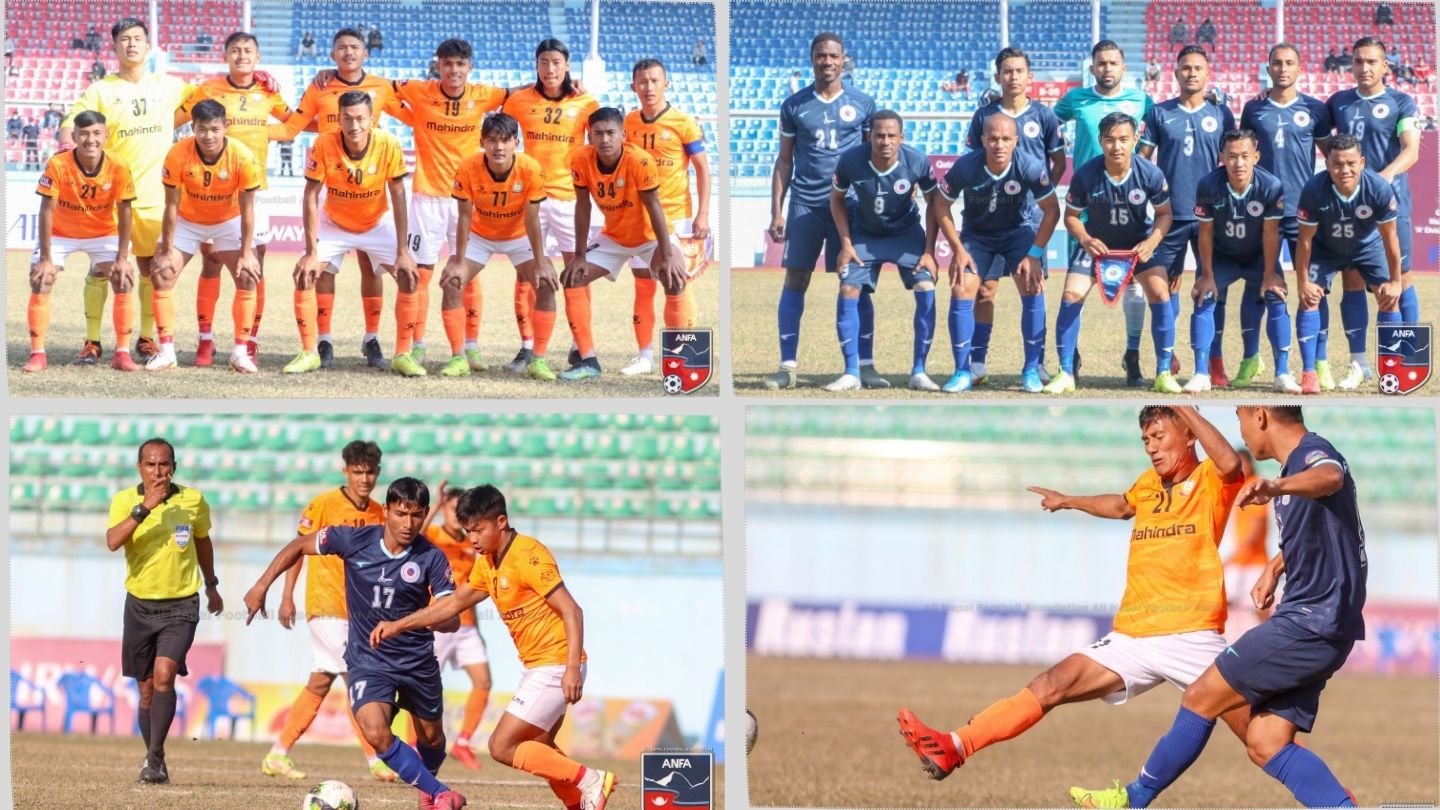
To understand Nepali football’s ecosystem, understanding the structure of leagues and competitions is essential. Football is not only a 90-minute game; it is an institutional mechanism that shapes player career development, club professionalism, and national pride. ANFA-operated competitions can be analyzed as follows.
Started in 1954 (B.S. 2011), the Martyrs Memorial “A” Division League is Nepal’s oldest and most prestigious professional league. It is not limited only to the Kathmandu Valley and is now attempting to adopt the “home and away” concept.
Competition format and level: Generally, 14 top clubs participate. Played in a round-robin format, this league measures Nepal’s actual football level.
International opportunity: The winner represents Nepal in AFC’s “AFC Challenge League” or “AFC Cup” with direct entry or qualification rights. For this, the club must have an “AFC club license.”
Financial aspect and prizes: ANFA signs agreements with a main sponsor and a broadcasting partner to run the league. The winner receives a large prize amount, and participating clubs receive preparation money.
B and C divisions play a major role in sustaining professional football in Nepal.
B-Division (The Mid-tier): Clubs relegated from A Division and promoted from C Division compete. The main objective is to return to A Division. Matches are highly competitive because both investment and reputation are at stake.
C-Division (Grassroots Professionalism): District and local clubs outside Kathmandu can enter after passing qualifiers. This is the first professional platform where new youth talents are identified.
Promotion and relegation: At the end of each season, ANFA strictly applies the rule of sending the bottom two teams down and promoting the top two teams upward. This system keeps competition alive.
Nepal is a strong nation in South Asian women’s football. Therefore, ANFA prioritizes the “National Women’s League.”
Dominance of departmental teams: Along with departmental teams such as APF, Nepal Police, and Tribhuvan Army, clubs supported by local municipalities also participate.
Model change: Previously organized as a short-duration tournament, efforts are now being made to move it into a two-legged league format, providing women players more match time and exposure.
District-level competitions outside Kathmandu are known as “Gold Cups” in Nepal. They protect the breadth of Nepali football and its mass-level attraction.
Major Gold Cups: Popular examples include Jhapa’s “Jhapa Gold Cup,” Sunsari’s “Buddha Subba,” Dharan’s “Aaha Rara,” and Biratnagar’s “Birat Gold Cup,” among others.
ANFA’s role: Even if clubs or district associations organize these competitions, technical and administrative sanctioning from ANFA is mandatory. ANFA may ban players who play in unsanctioned competitions.
Revenue sharing: These competitions generate significant income through ticket sales, and a rule requires a fixed percentage to be spent on district football development.
ANFA organizes U-14 and U-16 competitions between schools and clubs. Competitions such as “Lalit Smriti U-18” form the main basis for producing players for the national team. Age verification (Bone Density Test or age verification documents) is strictly enforced for participation.
Each ANFA competition is governed by “League Regulations.” When disputes arise, those rules are followed strictly.
Before the competition begins, each club must register a list of at least 18 to 30 players with ANFA’s registration section.
Citizenship and passport: For national competitions, citizenship or birth registration is mandatory. For foreign players, a labor permit and a certificate obtained through FIFA’s Transfer Matching System (TMS) are required.
Mandatory insurance: Under the principle of “No Insurance, No Match,” health and sports insurance for each player must be mandatory. In case of injury, provisions state that hospital treatment costs and compensation during recovery must be borne by the respective club or the insurance company.
Before a competition, ANFA’s team conducts a “ground inspection.”
Medical team: During a match, at least one ambulance and a trained doctor or physiotherapist must be near the pitch. Special concussion protocols must be followed according to FIFA standards.
Security arrangements: The presence of security bodies (Police/Stewards) is mandatory for crowd control and the safety of players and referees. If spectators misbehave or enter the stadium without authorization, organizers and clubs are fined.
There is a clear roadmap for filing complaints against cheating or unfair decisions during competition.
Written protest (Protest): If there is suspicion that the opposing team fielded an ineligible player or violated rules, an application must be submitted to the match commissioner within 60 minutes of the match ending, along with the prescribed protest fee.
Role of the Disciplinary Committee: Based on match commissioner and referee reports, the Disciplinary Committee conducts hearings. If evidence is found, the opposing team may be punished with a forfeit (3–0 defeat) and even points deduction.
Appeals (Appeals): If dissatisfied with the Disciplinary Committee’s decision, the case can be taken to the Appeals Committee within 72 hours. This committee’s decision is final and binding.
Common problems faced by stakeholders during competitions and their solutions:
Problem 1: Frequent fixture changes (Fixtures Change): Sometimes matches are rescheduled due to technical reasons or weather. Spectators should rely only on the notice board of the official website (the-anfa.com) and official social media handles.
Problem 2: Irregularities in ticketing: Black marketing can occur in big matches. Spectators should always buy tickets only from digital platforms or the stadium counter. Tickets should be purchased only after checking security features (Hollogram/QR Code).
Problem 3: Payment disputes between clubs: If players do not receive remuneration after the competition ends, they can file a complaint directly to the “Players Association” or the “ANFA Player Status Committee.” Clubs violating rules are banned in the next season.
This section contains key solutions readers commonly seek.
New players must be registered through the “FIFA Connect” system. Required documents include citizenship or birth registration, a passport-size photo, and a club consent letter.
Common problem: Age falsification or double registration. If found, the player is banned and the club is fined.
To play in the A-Division and professional competitions, a club must have a license. There are five criteria:
Sporting criteria: Academy and development plan.
Infrastructure criteria: Practice ground and office.
Personnel and administration: Qualified coach, secretary, and medical team.
Legal criteria: Statute and audit.
Financial criteria: Bank balance and debt-free status.
If you want to become a coach, you must participate in ANFA-run C, B, or A license coaching courses. For application, the form can be obtained from the “Downloads” section of the official website.
Under FIFA rules, involvement in any activity that influences match results is a crime. ANFA has arranged a confidential “Whistleblower” mechanism to provide such information.
ANFA has a strict policy against any form of physical, mental, or sexual abuse that may occur against minor players. In academies, having a designated supervisor for player safety is mandatory.
During play, a medical team and an ambulance must be mandatory.
Medical disclaimer: The medical information provided here is for informational purposes only. For the treatment of any sports-related injury, consult only an official sports physician or doctor. The details in ANFA’s profile will not replace treatment.
Registered professional players have specified funds related to “Injury Insurance.” Players need to be clear about this through agreements between their club and ANFA.
ANFA receives budget from both FIFA and the Government of Nepal. To maintain transparency, an “Audited Financial Report” is presented in the annual general assembly. For any procurement or contract process, ANFA publishes a public notice (RFP/Tender Notice) on its official website. Stakeholders have the right to demand financial discipline at any time.
ANFA has historical documents available.
Museum and archives: Results of past competitions and records of notable players.
Statistics: League standings and goal scorer statistics are updated in the “Stats” section of the website.
Citation style: When using ANFA data, it should be disclosed as: “Source: All Nepal Football Association, accessed on [Date].”
To avoid misleading information spread on social media, pay attention to the following.
ANFA does not publish any information from unauthorized places other than its Facebook verified blue tick page and website.
Be cautious of individuals who demand money in the name of free trials or selection. Most ANFA selections are free or institutionally determined.
Problem: Player registration rejected
What to do (immediate step): Check documents (whether citizenship is clear)
Where to complain: Administration Department, ANFA
Problem: Dispute in club licensing
What to do (immediate step): Read the points in the rejection letter
Where to complain: Club License Administration
Problem: Injustice related to discipline
What to do (immediate step): Prepare a written letter within 3 days
Where to complain: Appeals Committee
Problem: Not receiving the fixture schedule
What to do (immediate step): Check the official mobile app or website
Where to complain: Competition Department
Problem: Ticket fraud or black marketing
What to do (immediate step): Report to police or the ticketing partner
Where to complain: Management Section
Office hours: Sunday to Thursday (10:00 am to 5:00 pm), Friday (10:00 am to 3:00 pm)
Address: Satdobato, ANFA Complex, Lalitpur
Email: info@the-anfa.com
For media inquiries: media@the-anfa.com
There are many challenges to football development in Nepal, but if we move forward by understanding the institutional system, those challenges can be turned into opportunities. As a player, parent, or football supporter, our responsibility is to follow the rules and raise constructive criticism to bring the institution onto the right path.
The legal, financial, or medical information included in this content is for informational purposes only. It is not a substitute for advice from a qualified professional (Doctor, Lawyer, or Financial Auditor). For medical issues, consult a specialist doctor, and for legal advice, consult an advocate. The facts expressed in this content represent a system based on facts, not merely personal opinions in football management.

.jpg)