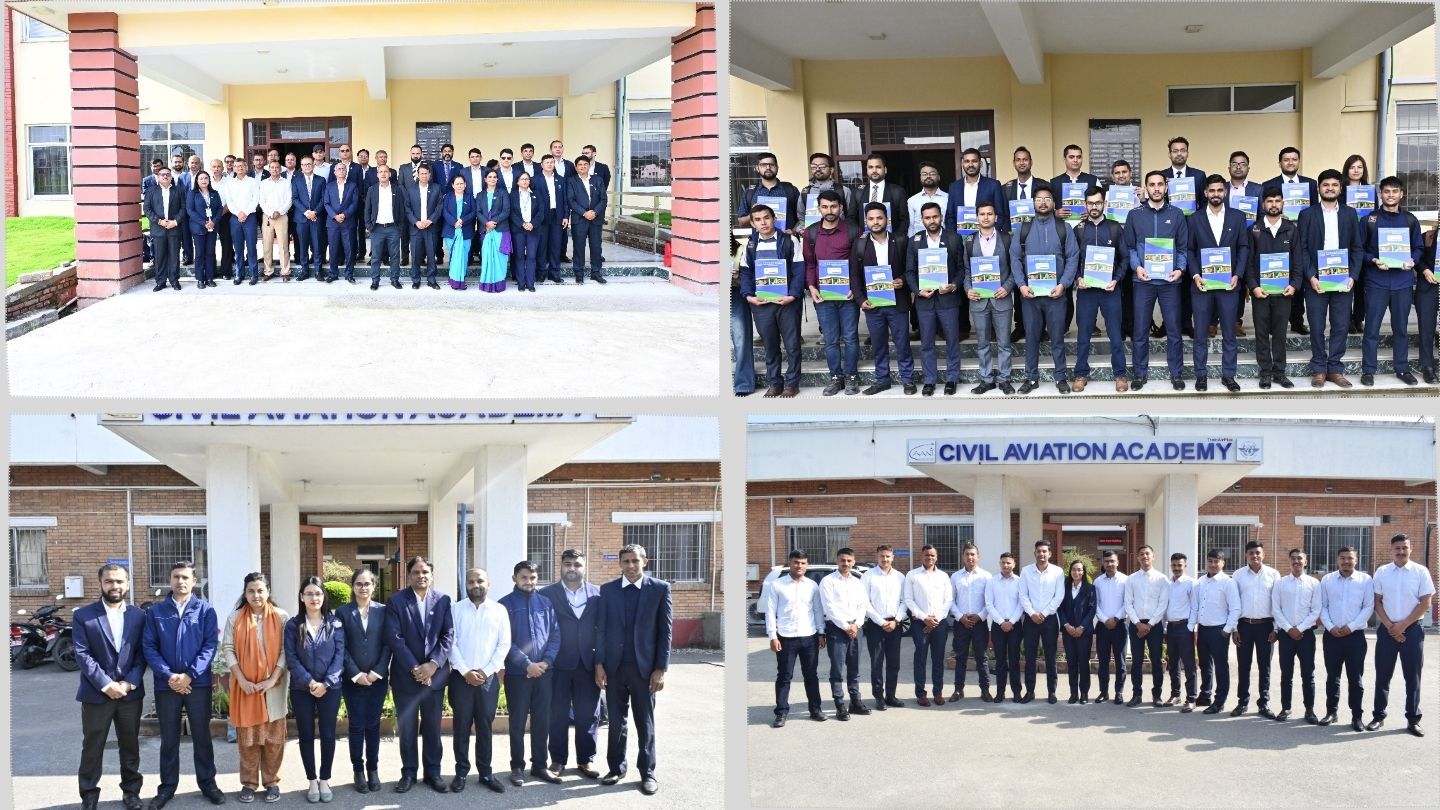
Civil Aviation Academy (CAA) is Nepal’s only official training institution established to produce and develop technically skilled aviation human resources. It began in 1972 as the Civil Aviation Training Centre (CATC) and currently operates as the Training Wing of the Civil Aviation Authority of Nepal (CAAN).
Located in Sanothimi, Bhaktapur, the Academy’s core role is to provide high-quality training in specialized areas required to strengthen aviation safety and regulation in Nepal. This includes Air Traffic Controllers (ATC), radio engineering technicians, airport rescue and firefighting (ARFF), and aviation security (AVSEC).
By closely following International Civil Aviation Organization (ICAO) standards and training methods, the Academy has played a foundational role in supporting Nepal’s recognition as a safe destination on the global aviation map.
This guide presents a detailed analysis of the Academy’s legal standing, course structure, admissions processes, and future outlook.

To understand the Academy properly, it is essential to know its legal basis and official standing.
Official Name and Identity
Nepali Name: Nagarik Uddayan Pratisthan (नागरिक उड्डयन प्रतिष्ठान)
English Name: Civil Aviation Academy (CAA)
Legacy Name: Civil Aviation Training Centre (CATC) (widely known by this name during and long after establishment)
Parent Institution and Linkage
The Academy is an important division under the Civil Aviation Authority of Nepal (CAAN).
Policy direction and management are handled by CAAN.
Technical and training quality oversight is carried out as per “Approved Training Organization” (ATO) standards through the Office of the Director General of Civil Aviation.
Legal Basis
The Academy has the legal mandate to develop aviation-sector human resources under the Civil Aviation Authority of Nepal Act, 2053 (1997) and related regulations.
Official Information Channels
Website: academy.caanepal.gov.np
Contact Location: Sanothimi, Bhaktapur (near Nepal Upakar Sangh)
Service Coverage: CAAN internal staff, private airline staff, and citizens with relevant educational qualifications
The Civil Aviation Academy is not only a training center. It is also a “think tank” that develops technical professionals responsible for keeping Nepal’s airspace safe.
Key Gaps It Addresses
Filling shortages of specialized aviation personnel needed for flight operations.
Providing foundational training for licensing as per ICAO Annex 1 requirements.
Updating personnel through refresher training in response to ongoing technical changes in aviation.
Who Benefits
Young students: Grade 12 (Plus Two) or equivalent graduates aiming for an aviation career.
Aviation professionals: Working ATCs or engineers seeking promotion or specialization.
Airlines and airport operators: Personnel requiring airport safety and firefighting training.
Clarification: What It Does Not Do
The Academy does not issue aviation licenses. It provides training and awards certificates to successful trainees. For licensing, candidates must complete separate examinations and processes through the regulatory division (CAAN PEL Office).
The Academy follows CAAN’s organizational framework to keep management accountable and transparent.
Leadership
The Academy is led by a senior executive head (Chief of Academy), typically at Deputy Director General or Director level.
Decision-Making
Course approvals are made based on ICAO standards and training manuals through decisions of a training council or director-level committee.
To maintain confidentiality and fairness in examinations, there may be representation or coordination with the Public Service Commission.
Integrity and Conduct
A monitoring and compliance function remains active to support transparency.
If there are complaints related to quota allocation or selection processes, there are channels to contact CAAN headquarters directly or use the Academy’s grievance box.
The Academy’s strongest asset is its international recognition.
ICAO TRAINAIR PLUS Membership
The Civil Aviation Academy is a Full Member of ICAO’s TRAINAIR PLUS program.
This membership indicates that the Academy’s training materials (Standardized Training Packages—STPs) meet international standards.
Approved Training Organization (ATO)
The Academy is recognized as an ATO by Nepal’s regulatory authority.
This means its facilities, laboratories, instructors, and learning methods align with ICAO annex requirements and Nepal’s regulatory PEL Manual.
The Academy’s learning environment is professional and technology-friendly.
Campus Location and Size
Located in Sanothimi, Bhaktapur, close to Kathmandu.
The campus extends over more than approximately 40 ropani.
Key Facilities
Simulator Lab: Advanced 3D simulators and 2D CG ATC systems for air traffic control training.
Radio Communication Lab: Practical laboratory for engineering trainees to test communication equipment and navigation aids.
Library: Specialized aviation documents (ICAO documents/manuals), journals, and technical books.
Inclusion and Security
Ramps are available for persons with disabilities.
The campus is monitored by CCTV, and identity cards are mandatory for security.
The Academy is divided into multiple divisions, each with specific objectives and training durations.
Division: ATS Faculty
Course: Air Traffic Control (ATC-001)
Duration: 10–12 months
Target Group: Open competitive / internal
Minimum Qualification: Bachelor’s degree in Science (Physics/Math)
Division: CNS/Engineering Faculty
Course: Radio Maintenance Course
Duration: 6–9 months
Target Group: Engineering technicians
Minimum Qualification: Diploma/Degree in Electronics/Telecom
Division: Fire Fighting (ARFF)
Course: Basic Firefighting Course
Duration: 3 months
Target Group: Airport staff
Minimum Qualification: Plus Two / PCL
Division: Aviation Security (AVSEC)
Course: AVSEC Basic/Refresher
Duration: 1–2 weeks
Target Group: Security guards/police/airport staff
Minimum Qualification: Security background
Delivery Mode
Most training is delivered in-person (classroom/field/lab). Some theory sessions may be conducted online, but practical components must be completed in the laboratory.
Admissions are highly competitive and are managed transparently. The process is grouped into three categories.
A) Through Government Vacancy Advertisements (CAAN New Intake)
CAAN announces vacancies in coordination with the Public Service Commission.
Candidates who succeed in written examinations and interviews are sent to the Academy for training.
B) Organizational Requests (Commercial Training)
Private airlines (e.g., Yeti, Buddha, Nepal Airlines Corporation, etc.) submit formal requests with fees to train their staff in aviation security or ground handling-related areas.
C) For Foreign Nationals
Nepal has also made some training available for staff from South Asian countries.
Documents Required for Application
Copy of citizenship certificate
Academic certificates (Plus Two/B.Sc./Bachelor); if education is from outside Nepal, equivalence is required
Character certificate
Health test report (especially for ATC: vision and hearing must be sound)
Strict evaluation is a key basis for the Academy’s academic quality.
Passing Requirement
In most courses, a minimum of 70% to 80% marks is required.
In some technical subjects, 100% attendance is mandatory.
Retake Policy
If a trainee fails a module, they may retake the exam after a certain period by paying the specified fee.
Certificate Verification
Employers may request verification by sending an official email to confirm whether a certificate is genuine.
The response is typically provided within 7 working days.
Nature of Fees
For candidates coming through Public Service Commission processes, training may be free, and a subsistence allowance may also be provided.
For private or open-market trainees, there is a fixed fee list (for example, basic ATO training may cost several hundred thousand rupees).
Payment Method
Application fees or course fees must be deposited into the official accounts of Rastriya Banijya Bank or other designated banks, and the voucher must be submitted.
Direct cash payment to any person is prohibited.
This section presents solutions to real issues commonly faced by applicants and trainees.
Problem 1: Errors in the online form or photo upload failure
Solution: This is often due to large image size (KB). Use resizing software. If the issue continues, email the Academy IT desk at [it.academy@caanepal.gov.np].
Problem 2: Name or citizenship spelling does not match certificates
Solution: A letter from the District Administration Office or the education council may be required. Obtain the necessary declaration or recommendation before applying to avoid being declared ineligible later.
Problem 3: Certificate delay even after training completion
Solution: Graduation or distribution is generally held within 30 days after results are published. In urgent cases, an application can be submitted to the Admin Department to obtain a temporary provisional letter.
Problem 4: Refund if training is cancelled after fee payment
Solution: As per Academy rules, if informed 7 days before training starts, the remaining amount may be refunded after deducting a 20%–30% service charge. After the course begins, fees are not refunded.
Details such as annual training output are recorded in annual progress reports.
Training Output
Over the past five years, the Academy has trained an average of about 300 to 500 trainees per year across different fields.
Gender Participation
In recent years, women’s participation in ATC has reportedly reached up to 40%, which is considered a positive development.
International Participation
Records indicate that aviation professionals from Bhutan and Bangladesh have also received training here in the past.
Aviation is a serious sector where discipline is a core requirement.
Absence Policy: If a trainee is absent for 3 consecutive days without prior approval, their name may be removed.
Technology Restrictions: Mobile phone use is strictly prohibited in ATC simulators and sensitive areas.
Media Policy: Posting technical visuals or documents from training on social media is treated as a breach of confidentiality.
Do not rely on intermediaries to avoid the risk of fraud. Always use official channels.
General Inquiry: +977-01-6631075
Admissions Section: Extension 105
Email: academy@caanepal.gov.np
Office Hours: Sunday to Thursday (10:00 AM–5:00 PM), Friday (10:00 AM–3:00 PM), except public holidays
Considering Nepal’s complex geography and the expansion of international airports (such as Bhairahawa and Pokhara), the relevance and importance of the Civil Aviation Academy continues to increase. Along with technological advancement, the Academy has also started including satellite-based navigation (GNSS) and higher-level automation courses.
If you are seeking growth in your career and are prepared for disciplined effort, this institution can be a strong option. A career in aviation is not only a job; it also carries significant national and international safety responsibility.
The information in this article is based on official documents. However, fee structures, advertisement dates, and course revisions may change, so applicants are requested to verify official updates directly from the Civil Aviation Academy or CAAN before admission. Any final decision on technical guidance, health standards, or legal matters remains with the official regulatory authority.
Sources (Citations)
Civil Aviation Authority of Nepal (CAAN) Official Portal (caanepal.gov.np)
Academy Information Brochure 2024
ICAO Training Standards (Annex 1 and Doc 9868)
Global Aviation Training (GAT) ICAO Catalog 2024


.jpg)