Gosaikunda Rural Municipality (गोसाईकुण्ड गाउँपालिका) was established in 2017 (2073 BS) as a local-level government of Nepal. The office of the Gosaikunda Gaunpalika is located in Syabrubesi, Rasuwa district of Nepal. Gosaikunda Rural Municipality is divided into six wards (Thuman, Timure, Briddhim, Langtang, Syaphru, and Dhunche).
With the strengthening of Nepal’s federal governance system, local governments have been established as the closest guardians of citizens. In this context, Gosaikunda Rural Municipality, located in Rasuwa District under Bagmati Province, is not only an administrative unit but also a unique confluence of Himalayan life, culture, and nature in Nepal.
In this detailed article, we present an in-depth analysis of Gosaikunda Rural Municipality’s institutional introduction, geographic location, demographic status, efforts toward good governance, and development challenges.
Gosaikunda Rural Municipality is a local government formed in accordance with Sub-clause (3) of Article 295 of the Constitution of Nepal 2072. During federal restructuring, this rural municipality was established by incorporating the former VDCs of Syafru, Dhunche, Bharkhu, Langtang, Timure, and Thuman.
Official Name: Gosaikunda Rural Municipality (Gosaikunda Gaupalika) / गोसाईकुण्ड गाउँपालिका
Type: Local government (Rural Municipality)
Province: Bagmati Province
District: Rasuwa
Legal Basis: Constitution of Nepal; Local Government Operation Act 2074
Established: 2073 Falgun 27 (as per the notice published in the Nepal Gazette)
Official Seal: Symbols reflecting local distinctiveness are used within Nepal’s national emblem
Website: www.gosaikundamun.gov.np
This rural municipality is exercising legislative, executive, and judicial powers within its jurisdiction, in accordance with the Constitution and laws.
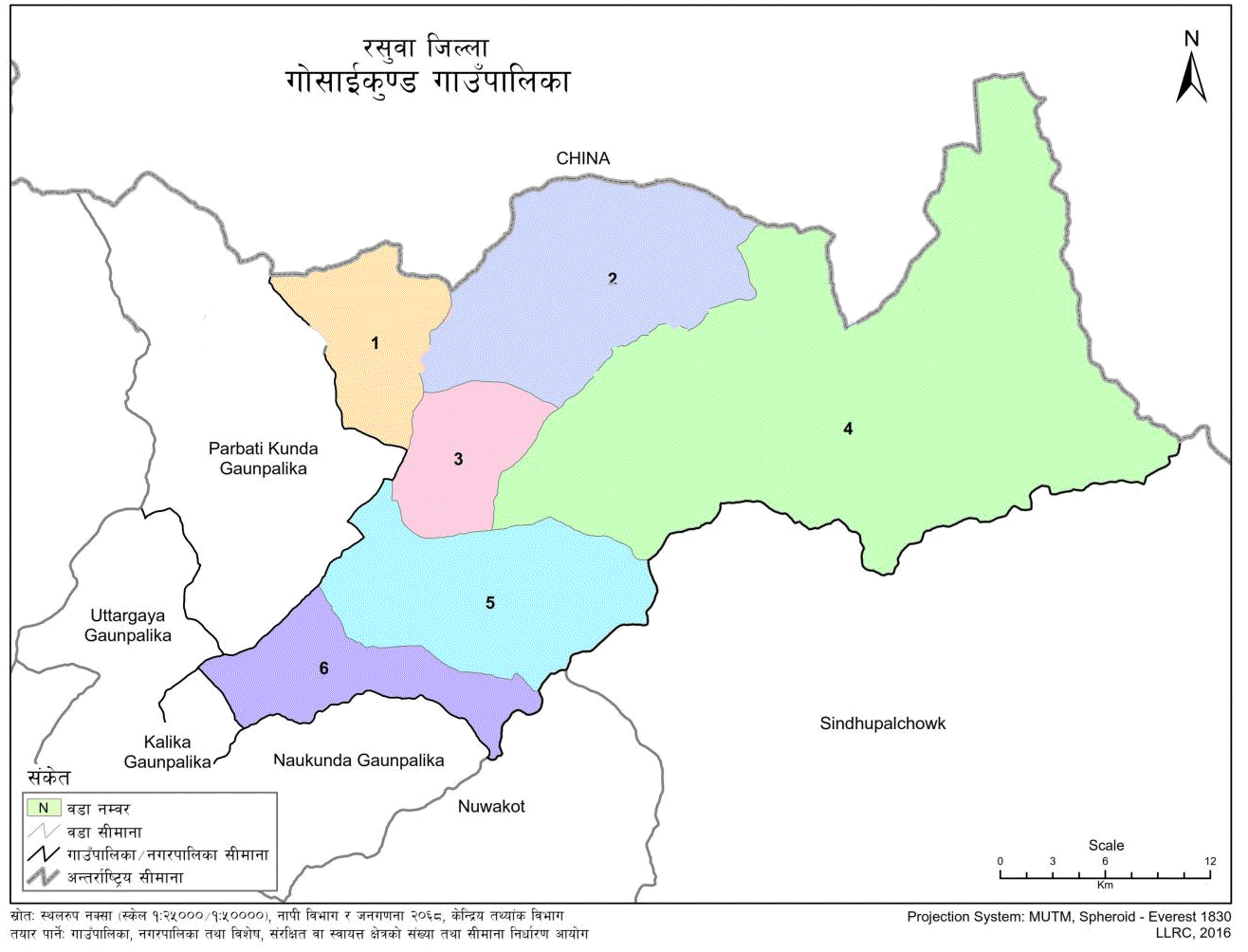
Gosaikunda Rural Municipality is geographically remote but naturally very rich. Its geographic characteristics have shaped its development model.
Location: Situated in the north-eastern part of Rasuwa District
East: Sindhupalchok District
West: Aamachhodingmo Rural Municipality
North: Tibet Autonomous Region of China
South: Kalika and Naukunda Rural Municipalities
Area: The total area of this rural municipality is 978.53 square kilometers. In terms of area, it is the largest rural municipality in the district.
Elevation and Climate: Elevation ranges from about 1,500 meters to 7,245 meters (Langtang Lirung peak) above sea level. Therefore, climates range from temperate to tundra (high Himalayan).
Administrative Division: This rural municipality is divided into 6 wards.
Ward No. 1: Thuman
Ward No. 2: Timure
Ward No. 3: Briddhim
Ward No. 4: Langtang
Ward No. 5: Syafru
Ward No. 6: Dhunche (Municipal Center)
Natural Resources: The famous Gosaikunda Lake, tributaries of the Trishuli River, and a large portion of Langtang National Park fall within this area.
According to the preliminary and final data of the National Census 2078, the demographic status here is as follows:
Total Population: Approximately 7,143 (with some variation compared to previous figures)
Population Density: Due to large geography and remoteness, population density is very low (about 7 people per square kilometer).
Major Ethnic Groups: The Tamang community is predominant. In addition, Sherpa, Gurung, Chhetri, and Brahmin communities also reside here.
Language: Tamang language is primarily spoken, while Nepali is used as the official and contact language for government work. In the high Himalayan areas, the influence of Bhote-Tamang culture is present.
Literacy: The overall literacy rate is estimated to be around 65% to 70%, with male literacy higher than female literacy. The rural municipality is currently running a campaign to become a “Fully Literate Rural Municipality.”
Gosaikunda Rural Municipality conducts its activities by following the principle of “participatory democracy.”
Rural Assembly: The legislative body that approves policies, rules, and the annual budget
Rural Executive: The executive body led by the Chairperson
Chairperson: Political leadership and overall commander of development
Vice-Chairperson: Coordinator of the Judicial Committee and responsible for plan monitoring
Chief Administrative Officer: Head of the administrative workforce, ensuring policy implementation and administrative good governance
Judicial Committee: A three-member committee operates under the coordination of the Vice-Chairperson to resolve local disputes using constitutional authority.
In line with the list of 22 exclusive and concurrent powers specified by the Local Government Operation Act 2074, the rural municipality has been providing the following services:
Vital Registration Services: Online registration of birth, death, marriage, divorce, and migration
Social Security: Distribution of social security allowances for senior citizens, single women, persons with disabilities, and children
Recommendation Services: Recommendations for citizenship, relationship verification, house-road verification, and various business-related recommendations
Revenue Collection: Management of integrated property tax, business tax, and rental tax
Disaster Management: Coordination of immediate relief and rescue during disasters such as snow avalanches, landslides, and fires
Education is the backbone of development. As a Himalayan area, the education sector here faces its own challenges and opportunities.
Number of Schools: There are a sufficient number of community schools at both basic and secondary levels.
Challenges: Due to geographic remoteness, students take time to reach schools, and in winter, extreme cold affects teaching and learning.
Recent Efforts:
Use of information technology in schools (ICT Lab)
Development and implementation of a local curriculum incorporating Tamang culture and the Himalayan environment
Scholarship programs for poor and hardworking students
Strengthening of Early Childhood Development (ECD) centers
With the slogan “Healthy Citizens, Prosperous Rural Municipality,” efforts are being made to deliver health services to people’s doorsteps.
Health Infrastructure: There is a district hospital in Dhunche, and health posts in each ward, with community health units active in some locations.
Maternal and Child Health: Birthing centers have been established for safe motherhood, and additional incentive allowances are provided for institutional delivery.
Immunization Program: Regular campaigns are conducted to ensure full immunization for children.
Social Inclusion: Targeted budget allocations are made for protecting the rights of persons with disabilities and for women’s empowerment.
The economy of Gosaikunda Rural Municipality mainly stands on three pillars: tourism, agriculture, and trade.
Tourism: This is the main source of income. Due to the Langtang trekking route and the Gosaikunda pilgrimage, hundreds of hotels and lodges are in operation here. This has not only provided local employment but has also supported foreign currency earnings.
Agriculture and Livestock: Potato, barley, buckwheat, and foxtail millet are major crops. Yak (chauri) rearing and sheep rearing are traditional occupations. Cheese production centers (such as the Chandanbari cheese factory) have helped in marketing local milk.
Trade: The Rasuwagadhi border point in Timure is the lifeline of trade with China. Imports and exports through this point have increased transport and commercial activity at the local level.
Building infrastructure in Himalayan geography is challenging and costly. Even so, the rural municipality is working in the following areas:
Roads: The Pasang Lhamu Highway connects this rural municipality with Kathmandu and the border with China. The rural municipality is expanding branch roads (agricultural roads) to connect wards with the center.
Drinking Water: Under the “One House, One Tap” campaign, access to safe drinking water is being expanded.
Electrification: The national transmission line has reached most areas, while in remote areas micro-hydropower and solar energy are used.
Communication: Although Nepal Telecom and Ncell networks have expanded, communication access in higher Himalayan areas still needs improvement. The rural municipality has prioritized free Wi-Fi zones and online services.
The name of this rural municipality itself is derived from the famous religious site “Gosaikunda,” reflecting its cultural significance.
Religious Sites: Gosaikunda Lake (where a large fair is held during Janai Purnima), Bhairavkunda, Saraswatikunda, and 108 kunds fall within this region. The Gosaikunda temple in Dhunche is also important.
Natural Attractions: Langtang Valley (considered one of the most beautiful valleys in the world), Kyanjin Gompa, and captivating mountain views.
Culture: Tamang culture, Mhendomaya songs, the Lhosar festival, and traditional monasteries have introduced this area’s identity to the world.
Tourism Promotion: The rural municipality is encouraging homestay programs by developing a “Tourism Master Plan.”
The direct impacts of climate change are beginning to appear in Himalayan regions.
Biodiversity: As this area falls within Langtang National Park, rare wildlife such as the red panda (habre), musk deer, and snow leopard are found here.
Climate Change: Increasing glacier melt and unseasonal rainfall have raised landslide risks. The damage caused in Langtang by the 2072 earthquake remains a tragic memory.
Disaster Preparedness: The rural municipality has established a disaster management fund and provides search and rescue training to local communities.
The rural municipality has set its goals through a periodic development plan.
Key Priorities: Road upgrading, investment in technical education, and sustainable tourism development
Major Projects: The Rasuwagadhi Hydropower Project and other small hydropower projects are under construction in this region.
International Support: In coordination with various non-governmental organizations, work is being carried out in drinking water and education.
The financial sources of Gosaikunda Rural Municipality are as follows:
Internal Sources: Tourism fees (claiming a portion of the park entry fee), business tax, and royalties from stone and gravel
External Sources: Equalization grants, conditional grants, special grants, and complementary grants received from the federal and provincial governments
Transparency: The rural municipality seeks to maintain financial transparency every year through public hearings and social audits.
Using modern technology to make service delivery faster and more efficient, the rural municipality has taken the following steps:
Mobile App: Access to information and notices through the rural municipality’s own mobile app
Online Revenue: Introduction of a system to pay taxes from home
Right to Information: Appointment of an information officer and quarterly publication of a bulletin
From the perspective of a senior administrator, the following challenges and opportunities can be seen in Gosaikunda Rural Municipality:
Geographic remoteness: High cost of transporting construction materials and delays in development works
Human resources: Frequent transfers of employees and shortage of skilled manpower due to remoteness
Migration: Youth migrating to Kathmandu or abroad in search of services and facilities
Disaster risk: Ongoing threats of earthquakes and landslides
Strong tourism potential: Possibility of developing Gosaikunda and Langtang into world-class tourist destinations
Utilization of the border point: Potential to develop Rasuwagadhi border point into an organized economic hub
Medicinal herbs: Commercial cultivation and processing of valuable herbs such as yarsagumba and panchaule
Hydropower: With abundant rivers and streams, the area can become a leader in energy production
The vision of Gosaikunda Rural Municipality is to build a “Beautiful, Prosperous, and Cultural Gosaikunda.”
Priorities: In the coming years, the rural municipality aims to focus on developing tourism infrastructure, quality health services, and technical education.
Sustainable Development Goals (SDG): Strong local-level efforts are being made toward ending hunger, ensuring gender equality, and climate action.
Gosaikunda Rural Municipality is a local level of Nepal where the blessings of nature and the fragrance of culture blend together. If the hard work of citizens, the vision of elected representatives, and the efficiency of staff align, this rural municipality can become a model rural municipality in Nepal.
Rather than viewing geographic remoteness only as a challenge, it is necessary to accept it as a Himalayan characteristic and develop through models of “eco-tourism” and a “mountain economy.” Creating an environment where children can receive quality education in their own place, and building a foundation where youth can find employment locally, is the key need of today.
This profile information expresses confidence that it provides clear and evidence-based information to anyone who wishes to understand Gosaikunda Rural Municipality closely. This is not only an introduction, but also a mirror of this rural municipality’s development.
Constitution of Nepal 2072
Local Government Operation Act 2074
National Census 2078 Report, Government of Nepal
Annual Policies and Programs of Gosaikunda Rural Municipality
Langtang National Park Profile
(Note: This profile is research-oriented and based on facts. It does not include any political bias or imaginary details.)

.jpg)