Nepal is a multilingual country. The thematic report of the National Census 2021 [2078 BS] shows that Nepal has 124 mother tongues and 117 second languages on record. This linguistic diversity directly affects public services, school learning, local-level communication, and civic participation—language can enable access in some places, and become a barrier to receiving or providing services in others.
The Constitution recognizes Nepali written in the Devanagari script as the language of government business at the federal level. It also allows provinces to determine one or more other national languages spoken by a majority within the province as the language(s) of provincial government business. As a constitutional body, the Language Commission (Bhasha Aayog) is mandated to develop the necessary standards for these matters and to make recommendations.
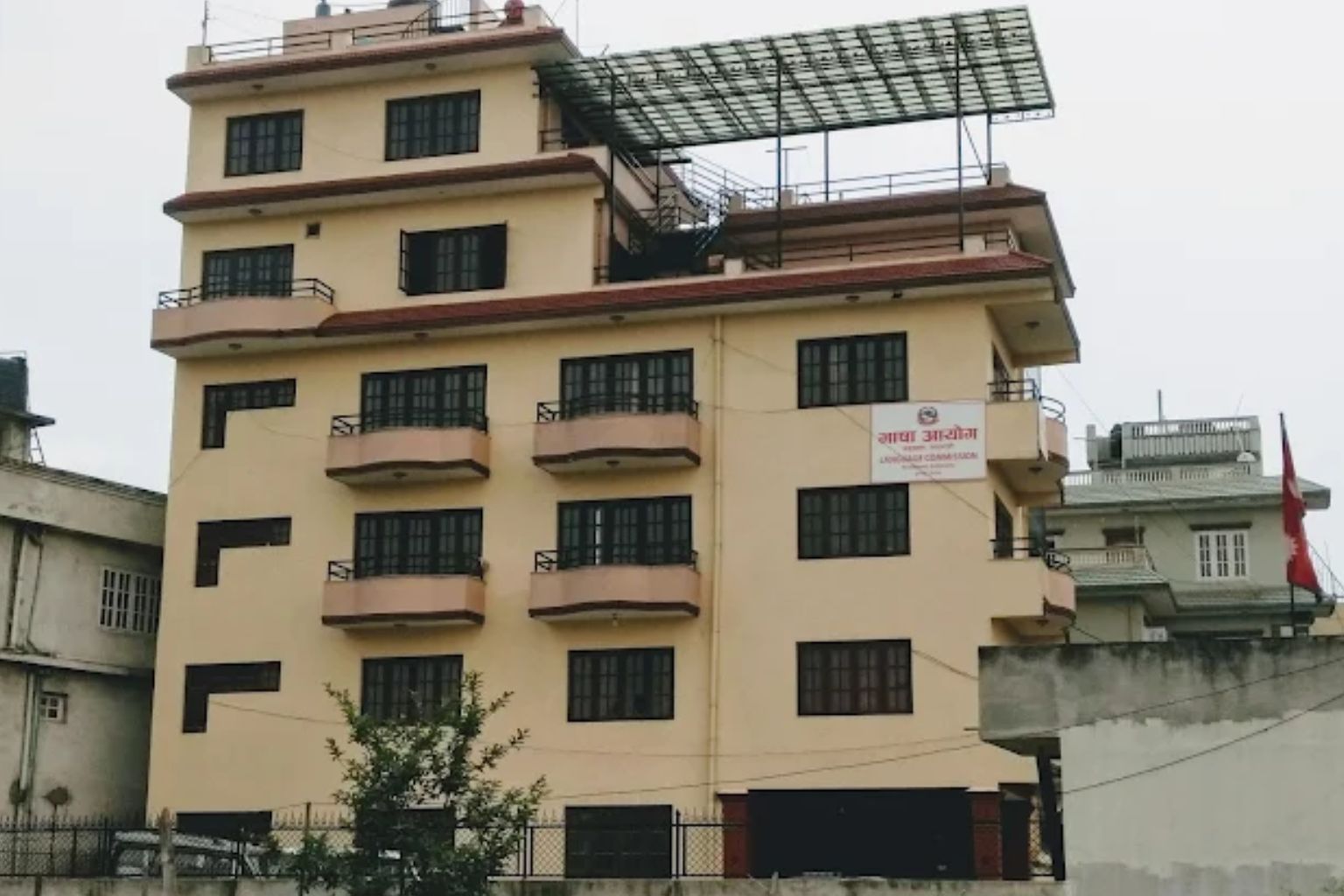
According to the Commission’s own self-published materials, the Language Commission was formed through a Cabinet decision dated 9 September 2016 [2073/05/23 BS; 23 Bhadau 2073]. The Commission works in line with constitutional responsibilities (standards for languages of government business, language preservation and development, feasibility of education in mother tongues, study–research–monitoring) and the additional tasks clarified by the Language Commission Act, 2017–2018 [2074 BS] (mother-tongue identification, recommendations/publications, making languages technology-friendly, a roster of language experts, and related work).
This profile article is focused on helping students, parents, teachers, schools/local governments, and policymakers understand the “Language Commission” as a practical institutional tool—covering the legal basis, key functions, provincial working languages, mother-tongue education, documentation of endangered languages, and implementation-oriented steps.
Students/youth: How to balance a mother tongue, Nepali, and a second language. What are your rights?
Parents: How to reduce learning challenges when the home language and school language differ.
Teachers/schools: Minimum technical and management steps for mother-tongue-based learning.
Local governments/provinces: Process, cost, risk, and minimum standards for starting multilingual services.
Policymakers/institutions: How to connect data, standardization, human resources, and monitoring when drafting language policy.
According to the National Census 2021 [2078 BS], 124 mother tongues and 117 second languages are recorded. The same thematic report also shows the distribution of language families—speakers of the Indo-European family are reported at about 83.1% and Sino-Tibetan at about 16.6%. It also includes Austro-Asiatic, Dravidian, sign language, and language isolates (such as Kusunda).
Some materials also mention that “Nepal has reached 131 languages.” This is usually based on additional languages identified by the Commission or studies and presented as “spoken languages.” However, for policy, budgeting, and service design, the official basis is usually the census data on mother tongues and second languages.
Therefore, when local governments or provinces make decisions, it is more important than the “number of languages” to connect practical facts about which languages service users actually use (in offices, schools, health institutions, and markets).
Service access: Whether forms, notices, complaints mechanisms, citizenship/registration, and health information are available in mother tongues/local languages can increase or reduce access.
School learning: In early grades, learning can be difficult when the home language differs from the school’s medium of instruction. A UNICEF study indicates the need to understand the relationship between language use/policy and learning experience in Nepali schools, and to use multilingual resources in a structured way in classrooms.
Policy targeting: Without understanding “which language is a majority where,” plans for languages of government business, translation, staffing, and material development can create resource imbalances.
The Constitution provides that:
Nepali written in Devanagari is the language of government business.
Provinces may make one or more other national languages spoken by a majority within the province the language(s) of provincial government business.
Other language-related matters are to be decided by the government based on the Language Commission’s recommendations.
The Commission’s own self-published documents state that the Language Commission was formally constituted through the Cabinet decision dated 9 September 2016 [2073/05/23 BS; 23 Bhadau 2073].
The Language Commission Act, 2017–2018 [2074 BS] organizes the Commission’s functions, procedures, and responsibilities (such as annual reports, mother-tongue identification, recommendations for preservation and development measures, publications, making languages technology-friendly, and a roster of language experts).
Chair/members: The Constitution provides for a chair and required members. On the Commission’s official website, Dr. Gopal Thakur is listed as Chair (Honourable Chair).
Secretariat/sections: Work is advanced by thematic division such as study–research, mother-tongue education, publication/standardization, and technology/digitization (this structure is reflected in the Commission’s publications and reports).
Expert collaboration: Reports mention collaboration with universities, linguistic institutions, community-based organizations, and experts to advance studies, recommendations, and documentation.
Based on the Constitution and the Act, the Commission’s main work includes:
Setting standards for languages of government business and making recommendations
Recommending measures for language preservation, promotion, and development
Measuring mother-tongue development levels and advising on feasibility/use in education
Study, research, and monitoring
Program design, publications, and technology enablement for mother tongues/scripts
Maintaining and managing a roster of language experts for national languages
On 6 September 2021 [2078 Bhadau 21, BS], details were made public that the Language Commission recommended various languages (other than Nepali) for provincial government business. The main list (as published in news reports) is as follows:
Koshi: Maithili, Limbu
Madhesh: Maithili, Bhojpuri, Bajjika
Bagmati: Tamang, Nepal Bhasa (Newar)
Gandaki: Magar, Gurung, Bhojpuri
Lumbini: Tharu, Awadhi
Karnali: Magar
Sudurpashchim: Doteli (Dotyali), Tharu
To put recommendations into practice, provinces/local governments must define laws and procedures, staffing arrangements, translation quality systems, and service priorities. Public news has reported preparations/implementation in Bagmati Province to use Tamang and Nepal Bhasa as languages of provincial government business.
A UNICEF study related to Nepal notes that, under the National Education Policy 2019–2020 [2076 BS], education up to the basic level can be provided in mother tongues as needed, and the school-level medium is policy-wise “trilingual.” The study also mentions that the Curriculum Development Centre has prepared learning materials in 26 languages.
In the report titled “Recommendations on Education in Mother Tongues, 2025–2026 [2082 BS],” the Commission states that over about nine years it completed studies in 24 local governments to identify mother-tongue levels and assess the feasibility of using mother tongues in education.
Mother tongue-based multilingual education (MTB-MLE): Strengthen concepts in the mother tongue in early grades, then gradually transition to Nepali (and English if needed).
Partial mother-tongue support: Even if teaching all subjects in the mother tongue is not possible, use the mother tongue systematically for classroom management, concept clarification, vocabulary lists, and home–school coordination.
Local curriculum/local materials: Link local knowledge, stories/songs, folklore, and community-based materials with learning content to make learning more relevant.
Language profile for Grades 1–3: A short survey on language(s) spoken at home.
Clear goals: Combine two goals in one plan—children understand concepts in the mother tongue, and build academic Nepali language competence.
Teacher support: Include assistants/community volunteers who know the local language in child-friendly roles.
Materials: Use available materials in 26 languages where applicable; otherwise develop small materials using pictures, bilingual word cards, and local stories.
Assessment: Simple tools to separate “understood the concept/did not understand” (picture-based questions, oral presentations).
Gradual transition: Increase reading/writing density in Nepali as grades rise, while keeping the mother tongue as a supportive bridge.
The census thematic report mentions a language like Kusunda as a “language isolate.” It records 23 mother-tongue speakers of Kusunda and also shows second-language use. For languages with such small speaker populations, it is difficult to protect the language without basic documentation—sounds, vocabulary, sentence patterns, and oral history—before expanding “classes/services.”
The Language Commission’s Ninth Annual Report notes that Nepal’s first language laboratory was established and that audio-visual documentation of various endangered languages has begun.
The Language Commission Act assigns the Commission responsibility to study and recommend ways to make mother tongues technology-friendly. The Ninth Annual Report also indicates work/recommendations toward inter-language translation methods and the development of digital/machine-based translation.
Minimum quality protocol for multilingual translation (3 rules)
Standard terminology: Keep terms consistent for citizenship, registration, tax, scholarships, health messages, and similar domains.
Two-stage review: A language expert plus a domain expert (education/health/administration).
Pilot testing: Improve content using service-user feedback before public rollout.
Linguistic profile: Identify 2–3 priority languages using the census plus school enrollment data plus service-counter experience.
Service prioritization: Select the 10 most crowded services.
Start with low-complexity materials: Notice boards, instructions, form-filling guides, help-desk scripts.
Translation quality framework: Standard terminology and two-stage review.
Staff orientation: Basic multilingual interaction for help-desk staff.
3–6 month pilot: Track complaints/suggestions.
Improvement cycle: Correct unclear terms/incorrect translations.
Formal procedure: Budget headings, update schedules, and records management.
According to the Commission’s citizen charter, services related to programs/recommendations can be requested through oral or written applications, many services do not charge fees, and responsible sections/staff are designated.
Seven points that can be included in an application
Subject (for example: multilingual notices/forms in a local government)
Office/local government/ward
Problem (in which service is language a barrier?)
Linguistic facts (which languages, estimated service users)
Proposal (which materials/services should be prioritized in which language?)
Potential resources (local language experts/teachers/community organizations)
Expected support (standards, terminology, training, or procedural clarity)
Policy–implementation gap: After recommendations, laws/procedures/human resources move slowly.
Standardization challenge: Inconsistent scripts/spelling/terminology weakens translation.
Teacher/material shortages: Even when materials exist, access, training, and regular use may be limited.
Data dynamics: Migration, multilingualism, and differences between “mother tongue vs actual use” complicate planning.
Implementation mechanism in provinces/local governments: Dedicated staff/section for language, annual plans, and clear responsibilities.
“As feasible as possible” model in education: If full-medium instruction is not possible, start with partial mother-tongue support.
Standard terminology and QA protocol: Treat translation as part of service quality.
Local material production: Bring small community-based materials into an official process.
Prioritize language documentation: Expand laboratory/documentation work for languages with very small speaker populations.
Monitoring and public reporting: Regular reviews of implementation status through annual reports/recommendations.
Q1: Does the Language Commission decide or recommend?
The Commission sets standards and makes recommendations. The Constitution provides that other language-related matters are decided by the government (based on the Commission’s recommendations).
Q2: Does mother-tongue education mean removing Nepali?
The policy objective is to start learning in a language children understand and increase academic competence in Nepali (and other needed languages). The UNICEF study also points to the need to use multilingual resources in a structured way.
Q3: What should be the first priority when starting multilingual services?
It is practical to start with low-risk materials such as notice boards, form-filling guides, and help-desk support.
If the Language Commission is understood not only as a symbol of “language preservation,” but as a constitutional mechanism needed for service access, learning quality, and inclusive implementation of federalism, its practical importance becomes clear. The reality shown by the National Census 2021 [2078 BS]—124 mother tongues and 117 second languages—makes multilingual management not an optional topic, but a required part of planned governance and education.
In this context, priorities should focus on three areas: (1) phased implementation of multilingual services at provincial/local levels, (2) practical models for mother-tongue-based learning that can begin with limited resources, and (3) documentation and data-structure building for languages with very small speaker populations. If the Commission’s recommendations and studies are linked to policy, budgeting, and service processes and carried into implementation, language rights shift from “paper” to “daily life.”



.jpg)