In line with the spirit of Nepal’s federal democratic republican governance system, Mangala Rural Municipality (Mangala Gaupalika) stands as a living embodiment of the constitutional commitment to bring “Singha Durbar’s authority to every village.”
This rural municipality came into existence based on the report of the Local Level Restructuring Commission formed under Article 295(2) of the Constitution of Nepal 2072 (B.S.), and the decision of the Government of Nepal dated 2073 Falgun 27 (B.S.). Formed by integrating the former VDCs of Babiyachaur, Kuhun, Baranja, Arman, and Pipalbot, this municipality is strategically and geographically located in the central part of Myagdi District.
Situated on the hilly terrain of Gandaki Province, this rural municipality spreads across an area of 89.07 square kilometers. Its topography is diverse, ranging from flat and fertile river basins along the Myagdi River to higher ridge and upland areas reaching nearly 3,000 meters above sea level.
Natural view-towers such as Jhankripani and Todke highlight its tourism potential, while the Myagdi River serves as a backbone for agriculture and irrigation in the area.
From an economic perspective, Mangala Rural Municipality is recognized as a “hub of orange cultivation” and an emerging center for commercial livestock farming. A significant part of its economy is based on the combined influence of remittance income from foreign employment and an agrarian economy.
Based on the latest data from the National Census 2078 (B.S.), the demographic structure reflects a dense settlement of the Magar community and strong social harmony among diverse ethnic groups.
With the long-term goal of “Happy and Prosperous Mangala,” this institution is practicing newer approaches in education, health, and infrastructure development within the scope of the Local Government Operation Act, 2074 (B.S.).
This institutional description is not merely a compilation of statistics; it is a research-based document that sketches a roadmap for sustainable development while addressing contemporary challenges such as geographical hardship and migration.
For policymakers, development partners, researchers, and students, this article will serve as an official and objective reference material to understand Mangala Rural Municipality in depth.
Mangala Rural Municipality is a self-governing and organized institution. Its legal basis and identity are as follows:
Official Name: Mangala Rural Municipality / Mangala Gaupalika (मंगला गाउँपालिका)
Type of Government: Local Government (Rural Municipal Executive)
Province: Gandaki Province
District: Myagdi
Legal Basis: Part 18 of the Constitution of Nepal 2072 (B.S.) and the Local Government Operation Act, 2074 (B.S.)
Year of Establishment: 2073 Falgun 27 (B.S.) (after state restructuring)
Official Seal: Nepal’s national emblem seal bearing the name and address reflecting Mangala Rural Municipality’s distinct identity
Head Office: Mangala Rural Municipality, Babiyachaur, Myagdi
Contact Details: Official website: www.mangalamun.gov.np, Email: info@mangalamun.gov.np
Mangala Rural Municipality holds the constitutional authority to formulate and implement its own policies, rules, and procedures. Through the Rural Municipal Assembly, it passes the annual budget and programs and implements a local development model.
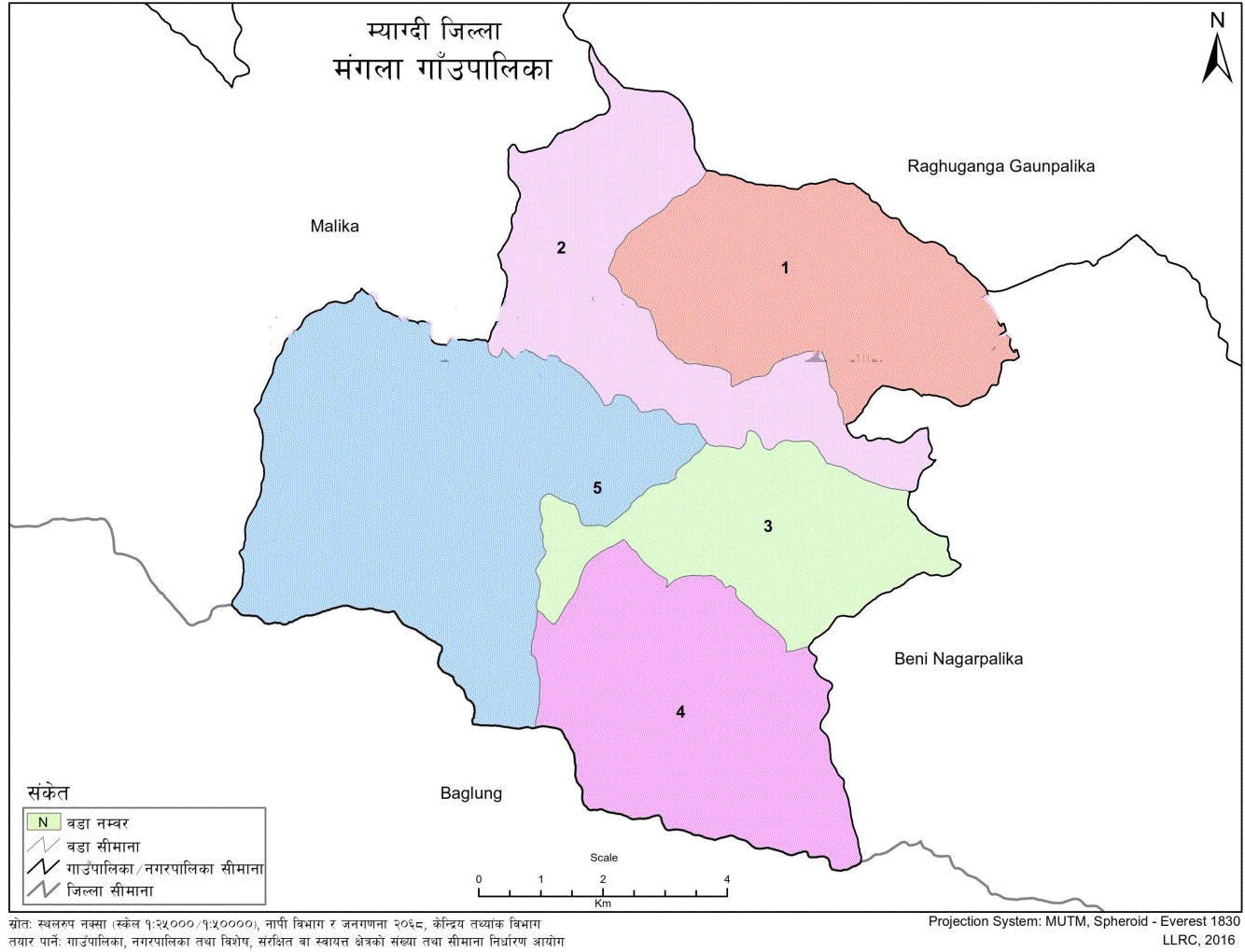
Located in the central part of Myagdi District, Mangala Rural Municipality is shaped by hilly terrain.
Total Area: 89.07 square kilometers
Geographic Location: The municipality lies to the west of Beni, the district headquarters of Myagdi. It borders Beni Municipality to the east, Malika Rural Municipality to the west, Dhaulagiri and Raghuganga Rural Municipalities to the north, and Baglung District to the south.
Altitude Range: Approximately 800 meters to 3,000 meters above sea level. Due to this altitude variation, climates range from subtropical to temperate.
Administrative Division: The municipality is divided into 5 wards:
Ward No. 1: Kuhun
Ward No. 2: Babiyachaur (Center)
Ward No. 3: Baranja (Lower Section)
Ward No. 4: Baranja (Upper Section)
Ward No. 5: Arman
Natural Resources: The Myagdi River and its tributaries (such as Archale Khola and Thulo Khola) flow through the area. Forests cover a large portion of land, offering various medicinal herbs and timber-based resources.
Planning, resource allocation, and the effectiveness of service delivery in any local level depend on its demographic structure. Mangala Rural Municipality’s demographic condition is not only a collection of statistics, but also a mirror of its socio-economic transformation.
Based on the final report of the National Census 2078 (B.S.) and the municipality’s profile (objective description), the demographic situation can be analyzed under the following sub-headings:
According to the National Census 2078 (B.S.), the total population of Mangala Rural Municipality is 16,502. Compared to the 2068 census, the population growth rate appears somewhat lower, mainly due to rapid migration and a declining birth rate.
This population is spread across 89.07 square kilometers, resulting in a population density of about 185 persons per square kilometer. However, due to geographical complexity, the distribution is not uniform.
Market-oriented areas such as Ward No. 2 (Babiyachaur) have higher density, while settlements in the upper regions of Wards No. 4 and 5 are scattered. This increases per-unit costs for infrastructure development (such as drinking water and electrification) and adds administrative challenges.
From a gender perspective, the number of women in Mangala is noticeably higher than men. Census data indicating a sex ratio around 90 suggests the condition of “missing males.”
The main reason is the out-migration of youth and men in the productive age group for foreign employment to Gulf countries, Japan, Korea, and Europe.
This demographic trend has created two significant social impacts:
Feminization of agriculture: Women’s role and workload have increased in farming, livestock rearing, and household decision-making.
Pressure of dependent population: With more children and senior citizens in the village and fewer active workers, the “demographic dividend” has not been utilized.
Mangala Rural Municipality is a “multi-ethnic and multi-cultural shared garden of flowers.” The ethnic structure shows the dominance of the Magar community (nearly 45–50 percent).
The Magar community’s distinct language, attire, and culture make the area rich in tourism and culture. In addition, there is a notable presence of Chhetri, Brahmin, Kami, Damai, Sarki, Newar, and Chhantyal communities.
This diversity has encouraged the local government to adopt a policy of “inclusive development.” There is an opportunity to modernize traditional skills of the Dalit community (ironwork, tailoring) and link the Magar cultural identity with homestay-based tourism.
Linguistically, most citizens use Nepali as a lingua franca. While the Magar community speaks its mother tongue (Magar Dhut), its use among the younger generation is declining.
To preserve it, the municipality has proposed including mother-tongue subjects in the local curriculum.
Religiously, Hindu followers are the majority. Worship, rituals, fairs, and festivals at well-known temples and shrines strengthen social unity.
Alongside this, there are Buddhist followers and smaller numbers of Kirat and Christian believers. A key feature is the high level of tolerance and harmony among religions and sects, which has made it easier to mobilize public participation in development efforts.
Mangala’s average literacy rate exceeding 75 percent is a positive aspect. In particular, literacy above 95 percent in the 15–24 age group ensures a more educated workforce in the future.
Women’s literacy has also improved significantly in the last decade.
However, “quality education” and “technical education” remain challenges. Due to the tendency of educated youth moving to cities for higher education and employment (brain drain), there is a shortage of intellectual human resources in the village.
To address this, the municipality needs to link education with skills and production.
A serious dimension of the demographic reality is migration. The number of people relocating from Mangala to Pokhara, Kathmandu, and the district headquarters Beni is increasing.
This out-migration driven by the search for better lifestyles and quality education has caused some settlements to become “empty.” As a result, cultivable land remains fallow and the use of natural resources declines.
On the other hand, centers like Babiyachaur face increasing pressure from unmanaged urbanization.
Mangala Rural Municipality is practicing a balanced exercise of the executive, legislative, and judicial functions.
Rural Municipal Assembly: The highest policy-making body of the municipality. It includes the Chairperson, Vice-Chairperson, Ward Chairpersons, and elected members.
Rural Municipal Executive: The body responsible for daily operations and implementation of decisions.
Key leadership:
Chairperson: Executive head of the municipality.
Vice-Chairperson: Coordinator of the Judicial Committee and head of the Monitoring Committee.
Chief Administrative Officer: A federal government-deputed official who leads administrative operations.
Judicial Committee: A three-member committee under the coordination of the Vice-Chairperson is active to resolve local-level disputes (such as boundary issues, wages and labor disputes, and domestic violence).
Subject-specific sections: Administrative, financial administration, education, health, agriculture, livestock service, infrastructure development, and social development sections provide specialized services.
With the goal of bringing government services to citizens’ doorsteps, Mangala provides the following services:
Vital registration services: Online registration of birth, death, marriage, divorce, and migration.
Social security: Distribution of social security allowances for senior citizens, single women, persons with disabilities, and Dalit children.
Recommendation services: More than 30 types of recommendations, including citizenship-related recommendations, relationship verification, land transfer, house registration, and others.
Revenue collection: Collection of integrated property tax, business tax, and rent tax.
Disaster management: Coordination of relief and rescue during accidents, landslides, or floods.
Public hearing: Practice of conducting public hearings at least twice a year for transparency and regular public audits.
Education is regarded as the “backbone of development.” The Constitution of Nepal 2072 (B.S.) established basic education as a fundamental right and assigned local levels full responsibility for managing education up to the secondary level.
Embracing this constitutional spirit, Mangala Rural Municipality has been running educational reform programs with the long-term vision of “Quality education, the foundation of a prosperous Mangala.”
Mangala Rural Municipality has a well-distributed network of educational institutions. Despite geographical challenges, primary-level access has been ensured in major settlements of each ward.
Community schools: More than 30 community schools operate in the municipality, with a notable number running secondary level (up to Grade 12). Mangala Secondary School in Babiyachaur is among the leading educational institutions in the area.
Institutional (private) schools: A limited number of private schools operate in urbanizing areas, providing competition and alternatives.
Student enrollment rate: While enrollment at the basic level has reached close to 100 percent, reducing dropout rates at the secondary level remains a major challenge.
Mangala Rural Municipality has developed and implemented a local curriculum to address local needs. The curriculum prioritizes:
Local geography and history: Students are informed about Mangala’s religious sites (such as Jhankripani and Todke), natural heritage, and historical events.
Cultural diversity: Preservation of the Magar language, arts, and culture along with the unique traditions of other communities.
Agriculture and medicinal herbs: Students are encouraged from an early age to identify local crops and medicinal herbs and understand their commercial importance.
Recognizing that traditional theoretical education alone cannot solve unemployment, Mangala has emphasized technical education.
Technical streams: Initiatives have begun in some secondary schools to teach technical subjects such as Plant Science and engineering-related areas.
Goal of self-employment: Adopting the concept of “Earn While You Learn,” the aim is to provide practical skills so that students can become capable of performing basic technical work after completing school-level education.
The municipality has given special attention to child development centers, regarded as the foundation of education.
In ECD centers operating in various localities, early learning, nutrition, and play are integrated. The municipality has been increasing investment to ensure child-friendly teaching methods and adequate learning materials.
Using the authority under the Local Government Operation Act, 2074 (B.S.), the municipality has issued the “Mangala Rural Municipality Education Act and Procedures.”
Teacher position alignment: Aligning teacher quotas with student numbers is complex, but efforts are being made to make it more scientific.
Capacity development: ICT training and modern teaching-method training are regularly organized to enhance teachers’ professional competence.
School Management Committee: The role of local guardians in overseeing and developing schools has been made more active and accountable.
From administrative and educational perspectives, Mangala’s education sector faces serious challenges:
Student migration: Due to families migrating to cities or abroad for higher education and employment, student numbers in rural schools are decreasing each year.
School merging: The process of merging low-enrollment schools is challenging due to political and geographical reasons, but it appears necessary for proper resource utilization.
Physical infrastructure: Although many school buildings were reconstructed after the 2072 earthquake, some remote schools still lack sufficient laboratories, libraries, and toilets.
Digital divide: Significant investment is still needed to ensure equal access for all students to online education and technology.
To ensure citizens’ right to health, Mangala has adopted a policy of “access to basic health services for all.”
Health institutions: Each ward has a Health Post. The process of constructing a basic hospital with 5 to 15 beds at the center is underway.
Immunization and nutrition: The municipality has been declared fully immunized. Nutrition programs (Golden Thousand Days) operate for children and pregnant women.
Maternal and child health: Birthing centers have been upgraded for safe delivery services. Programs such as “Postnatal meeting with the Chairperson” have played an effective role.
Social inclusion: Disability identity cards have been distributed and priority has been given for skill-based training. Targeted programs for Dalit and poor communities are in operation.
Mangala’s economy is mainly based on agriculture, livestock, and foreign employment.
Agriculture: Orange cultivation is a major identity of Mangala, particularly commercial orange farming in Kuhun and Baranja areas. Paddy, maize, millet, and wheat are major food crops.
Livestock: Cattle, buffalo, and goat rearing are traditional occupations. The municipality is moving toward self-reliance in milk and meat.
Foreign employment (remittance): Remittance from Gulf countries, Japan, and Europe is the main income source for many households, increasing market activity in central areas.
Cooperative movement: Cooperatives have expanded financial access for small farmers and local entrepreneurs.
Poverty reduction: Minimum employment is being provided to unemployed youth through the Prime Minister Employment Program and the provincial Chief Minister Self-Employment Program.
Roads and communication are the physical foundation of development.
Road network: The Beni–Darbang road section connects this municipality with the district headquarters and other local levels. Road tracks have reached all ward centers, though monsoon road blockages remain a persistent problem.
Drinking water: Safe drinking water access is expanding under the “One house, one tap” campaign.
Electrification: National grid electricity has reached almost all areas. In some remote settlements, micro-hydropower and solar energy are used.
Communication: Nepal Telecom and Ncell networks cover most of the area. Internet access has been extended to ward offices and schools.
Mangala Rural Municipality holds strong tourism potential.
Jhankripani: A major tourist destination of Mangala, offering scenic views of mountain ranges such as Dhaulagiri and Annapurna. Homestay development has increased domestic tourist numbers.
Todke: Located at the boundary of Mangala, Beni, and Raghuganga, it is famous for rhododendron landscapes and Himalayan viewing.
Cultural identity: Magar cultural dances such as Sorathi, Maruni, and Kaura are key attractions. Various fairs and festivals preserve local originality.
Religious sites: Local shrines and temples of deities form the base for religious tourism.
As a Himalayan and hilly district, environmental sensitivity is high.
Forest and biodiversity: Community forests are well managed. Trees such as pine, uttis, and daleghans are found in abundance.
Landslide risk: Due to topography and road construction, landslide risk is high in the monsoon season. Some areas of Babiyachaur and Baranja are considered sensitive.
Climate change: Untimely rainfall and drying water sources have affected agricultural production.
Mitigation measures: The municipality allocates budget for embankments, plantation, and disaster preparedness.
Mangala works through periodic and annual planning.
Pride projects: Municipality-level sports ground, construction of an administrative building, and upgrading of main roads.
Budget allocation: Education, health, and infrastructure are prioritized, with a fixed percentage allocated for targeted groups (women, children, Dalit).
Partnerships: Complementary and special grant projects are implemented with provincial and federal governments. Programs on sanitation and livelihood are run in coordination with non-governmental organizations (NGOs).
Financial transparency and accountability are key priorities of the municipality.
Sources of income: Fiscal equalization, conditional, complementary, and special grants from the federal government; provincial grants; and internal sources (taxes and fees).
Expenditure status: Efforts are made to balance development (capital) and administrative (recurrent) spending.
Audit: Final annual audits are conducted by the Office of the Auditor General. Mangala is moving toward reducing irregularities and maintaining financial discipline.
The use of technology has made service delivery faster and more efficient.
E-Governance: Online systems are applied for vital event registration and social security allowance distribution.
Mobile app: Through the “Mangala Rural Municipality” app, citizens can access information on notices, budgets, and plans.
Right to information: An information officer is appointed, and bulletins and reports are published quarterly.
Challenges:
Geographical hardship: High cost of delivering services and infrastructure to scattered settlements.
Migration: Youth power and well-off families migrating to Beni, Pokhara, or Kathmandu in search of quality education and better facilities.
Limited resources: Low internal revenue and heavy dependence on federal grants.
Unemployment: Youth forced into foreign employment due to lack of technical skills.
Opportunities:
Commercial agriculture: Strong potential for orange farming, livestock, and medicinal herb cultivation.
Tourism: Promotion of sites like Jhankripani and Todke can increase income generation.
Hydropower: Suitable geography for small and micro-hydropower projects.
Human capital: Skills and capital of returnee migrant youth can be invested in local development.
Mangala Rural Municipality’s long-term goal is “building a self-reliant and independent society.”
Priorities: In coming years, emphasis is placed on quality education, drinking water to every household, year-round road operation, and modernization of agriculture.
Sustainable Development Goals (SDGs): Global goals such as ending hunger, improving health, and gender equality have been mainstreamed into local plans.
The data and information presented in this article are based on the following reliable sources:
National Census 2078 (National Statistics Office).
Local Government Operation Act, 2074 (B.S.).
Annual policies, programs, and budgets of Mangala Rural Municipality (Fiscal Years 2079/80 and 2080/81).
Portal of the Ministry of Federal Affairs and General Administration (MoFAGA).
Official profile of Mangala Rural Municipality.
Mangala Rural Municipality is not merely an administrative unit; it is a foundational pillar of Myagdi’s prosperity.
With coordinated efforts among its leadership, administrative mechanism, and civil society, it can establish itself as a model rural municipality of Nepal.
For students, it is a center of study, and for policymakers, it is a practical ground for local development.
Moving forward, overcoming challenges and maximizing opportunities should be Mangala’s core path.

.jpg)