Rohini Rural Municipality (Gaupalika - राेहिणी गाउँपालिका, रूपन्देही) is located in the southeastern part of Rupandehi District. It was formed by merging the former Village Development Committees (VDCs) of Dhakdhai, Bagaha, Pajarhatta, Pokharbhindi, Chhipagadh, and Bodabar.
The municipality lies along the Bhairahawa–Dhakdhai section of the East-West Postal Highway and is situated at approximately 83.549742°E longitude and 27.512130°N latitude. The elevation is about 92.1 meters above sea level.
The total area of the municipality is 64.62 square kilometers. It shares borders with Nawalparasi District to the east, Siddharthanagar Municipality to the west, Omsatiya Rural Municipality to the north, and India to the south. The Rohini River flowing from the north adds to the region's natural, geographical, and cultural charm.
The municipality is home to 7,526 households with a total population of 43,327. Most residents are engaged in agriculture and livestock farming.
Situated about 30 kilometers from Butwal, the provincial capital of Lumbini Province, Rohini Rural Municipality was established in 2071 BS (2014 AD) through the merger of six former VDCs. Its administrative center is located at 27.510911°N latitude and 83.537414°E longitude, with an elevation of approximately 108 meters.
Rohini Rural Municipality is divided into 7 wards. As per the 2068 BS census, it had 5,654 households and a population of 37,175. Currently, it has grown to 6,462 households and a population of 45,592. The area lies in the flat Terai region, connected to the Chure hills. All ward offices are accessible by earthen motor roads.
The municipality holds significant potential for goat farming and other livestock activities. In agriculture, the main crops include paddy, maize, wheat, and mustard. About 90% of the land is suitable for various types of cultivation.
Nepal’s Constitution grants local levels the authority to implement federalism and local self-governance, including financial, administrative, and service delivery rights. Local governments have the legal power to formulate plans, mobilize internal resources, set taxes, and collect revenues.
If properly implemented, these provisions enhance the capacity of local governments to deliver services effectively. With the establishment of the federal democratic republic, rural municipalities like Rohini have evolved with expanded jurisdiction and responsibilities.
It is essential for rural municipalities to prepare detailed local profiles to clarify development directions and service delivery strategies. This helps reduce uncertainty and supports evidence-based decision-making.
The development, infrastructure management, and good governance of a rural municipality lie in the hands of elected representatives and civil servants. Political parties and social workers also play advisory roles. With the evolution of policy-making by elected bodies, preparing short-term and long-term plans has become essential.
In this context, Rohini Rural Municipality has developed a comprehensive Village Profile to guide structured development efforts. The profile provides detailed insights into the municipality's population, economy, infrastructure, education, environment, and other sectors.
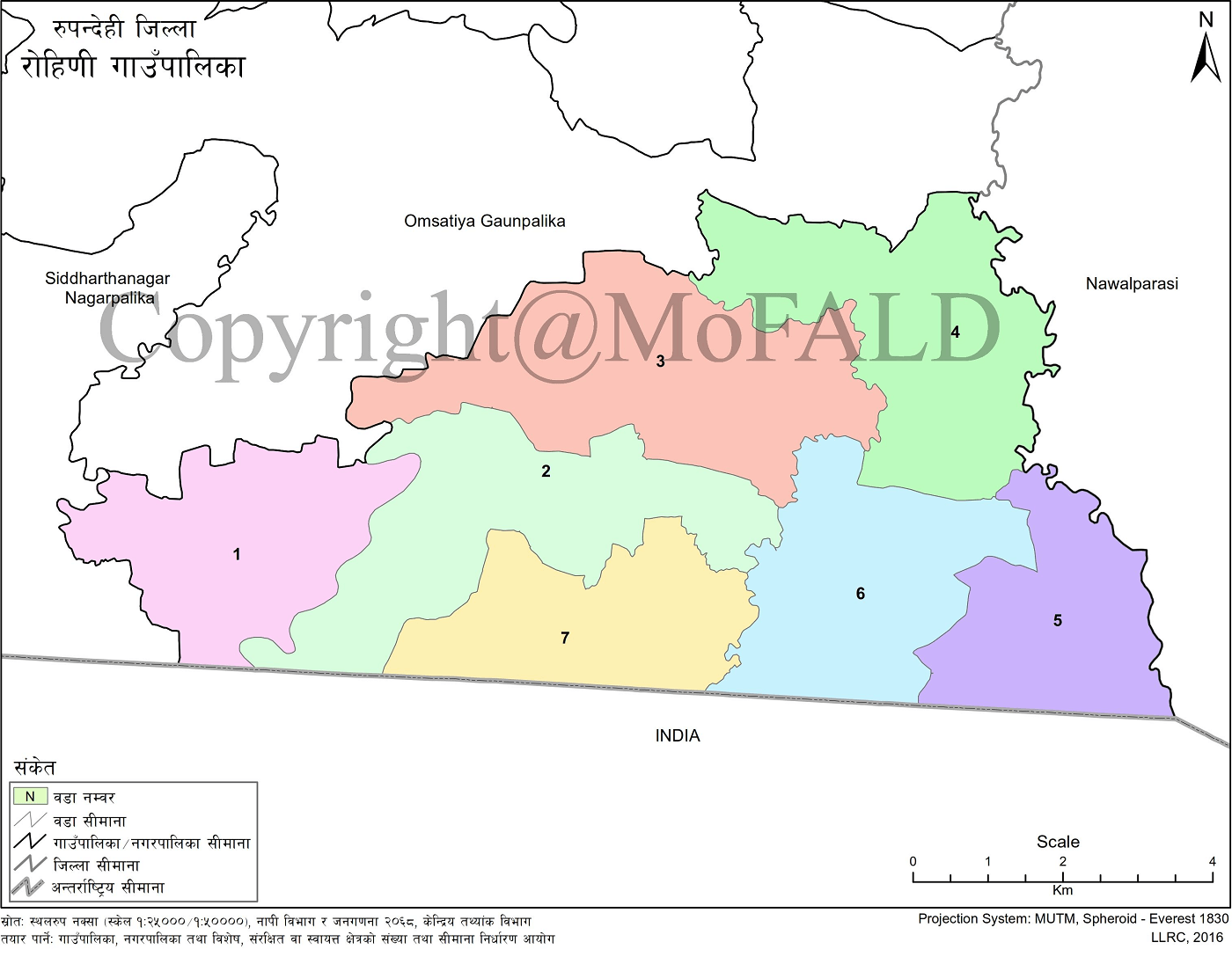
Latitude: From 27°28′10″ to 27°31′58″
Longitude: From 83°27′57″ to 83°37′00″
Boundaries:
East: Ramgram Municipality and Palhinandan Rural Municipality, Nawalparasi
West: Siddharthanagar Municipality, Rupandehi
North: Omsatiya Rural Municipality, Rupandehi
South: Nepal–India border
Elevation: Ranges from 76 meters to 126 meters above sea level
Due to confusion over service delivery and development planning, the municipality prioritizes the preparation of factual data to assess its current condition. The involvement of elected representatives, employees, political stakeholders, and social actors ensures accountability and governance.
By preparing this profile, Rohini Rural Municipality aims to establish a factual foundation for future planning, guiding decisions based on current economic, social, educational, environmental, and demographic realities.
According to a linguistic survey within the municipality, people speak 19 different languages. The majority (89.05%) speak Bhojpuri, followed by Awadhi and Nepali. The following is a summary of the main languages spoken by the population:
Bhojpuri – 89.05%
Awadhi – Second most spoken
Nepali – Third most spoken
The full breakdown of language distribution among the population is recorded in the municipality’s official data.
School Statistics in Rohini Rural Municipality
Unique Homes English Boarding School – Nursery - 10, Rohini, Rupandehi
Buddha Triveni Public English Boarding School – Nursery - 9, Rohini, Rupandehi
Siddartha Global E.B. School – Nursery - 8, Rohini, Rupandehi
Modern Generation Academy – Nursery - 4, Rohini, Rupandehi
Model Golden Future English School – Nursery - 8, Rohini, Rupandehi
Spangle English Boarding School – Nursery - 5-9, Rohini, Rupandehi
The Rising Star English School – Nursery - 5, Rohini, Rupandehi
Shree Ram Naresh Yadav Secondary School – National Examinations Board, 1-12, Dhakdhai, Rohini, Rupandehi
Pajarkatti Secondary School – Nursery - 11, Rohini, Rupandehi
Chhipagadh Secondary School – Nursery - 12, Rohini, Rupandehi
Piprahawa Secondary School – Nursery - 12, Rohini, Rupandehi
Pokharvindi Secondary School – Nursery - 10, Rohini, Rupandehi
Bagaha Secondary School – Nursery - 11, Rohini, Rupandehi
Bodwar Secondary School – Nursery - 10, Rohini, Rupandehi
Pashupati Basic School – Nursery - 10, Rohini, Rupandehi
Merit Public Boarding School – 1-10, Rohini, Rupandehi
Saraswati Basic School – Nursery - 5, Rohini, Rupandehi
Janachetana Basic School – Nursery - 8, Rohini, Rupandehi
Bhabisya Ujjwal Basic School – 2-8, Rohini, Rupandehi
Shree Ram Basic School – Nursery - 5, Rohini, Rupandehi
Nawa Jivan Basic School – Nursery - 8, Rohini, Rupandehi
Triveni Basic School – Nursery - 5, Rohini, Rupandehi
Jana Jagriti Basic School – Nursery - 5, Rohini, Rupandehi
Madarsa Gausiya Aahle Sunnat Nurul Olum Chainpur – Nursery - 10, Rohini, Rupandehi
Pre-school: 32
Basic Education: 36
Secondary Education: 13
Plus-2 (Higher Secondary): 5
Public Schools: 16
Private Schools: 7
Religious Schools: 13
Model Schools: 1
Total Schools: 36


.jpg)