Saptakoshi Municipality is a local government located in the northeastern part of Saptari District, Madhesh Province, Nepal. The municipality was formed by incorporating the former Fattepur, Odraha and Kamalpur Village Development Committees (VDCs). It consists of 11 wards.
According to the National Population and Housing Census 2078 (2021), conducted by the National Statistics Office, Saptakoshi Municipality had a total population of 23,510 and 5,218 households.
The municipality takes its name from the Saptakoshi River. Its geographical setting, associated with the Saptakoshi and Triyuga rivers, the Chure region and the Chandra Canal, contributes to its local identity.
Under the Constitution of Nepal and the Local Government Operation Act, 2074 (2017), the municipality is responsible for local administration, planning and budget management, basic services, infrastructure development and various public functions.
Official Name: Saptakoshi Municipality (सप्तकाेशी नगरपालिका)
Local Government Type: Municipality (Nagarpalika)
Province: Madhesh Province
District: Saptari
Municipal Executive Office: Tulsi Chowk, Saptari
Municipality Declaration: 2071 BS
Former VDCs: Fattepur, Odraha and Kamalpur
Total Wards: 11
Area: 60.31 square kilometres (according to the municipality's budget booklet for FY 2082/83)
Total Population: 23,510 (2021 Census)
Male Population: 11,398
Female Population: 12,112
Total Households: 5,218
Average Household Size: Approximately 4.51 persons
Official Website: https://saptakoshimun.gov.np/
The population and household figures are based on the National Population and Housing Census 2078 (2021), published by the National Statistics Office. The area figure is taken from the municipality's budget booklet for fiscal year 2082/83.
An earlier municipal introduction page records the area as 60.2 square kilometres. This indicates a minor difference between the published sources.
According to the municipality's official introduction, Saptakoshi Municipality was declared in 2071 BS by incorporating the former Fattepur, Odraha and Kamalpur Village Development Committees.
The municipality was named after the Saptakoshi River. Fattepur Bazaar, the Triyuga River and the Chandra Canal have particular significance in the local history of this area, which is connected to the river systems of eastern Nepal.
The municipality's former administrative structure is related to its present ward divisions. According to the published municipal budget booklet for fiscal year 2082/83:
Wards 1 to 5 cover areas of the former Fattepur VDC.
Wards 6 to 8 cover areas of the former Odraha VDC.
Wards 9 to 11 cover areas of the former Kamalpur VDC.
Under Nepal's federal governance system, Saptakoshi Municipality operates as a local government through its Municipal Assembly, Municipal Executive, Judicial Committee and ward offices.
Saptakoshi Municipality lies in an area connected to the northern Terai and Chure region of Saptari District. Its geography includes rivers, flat agricultural land, settlements and areas near the Chure hills.
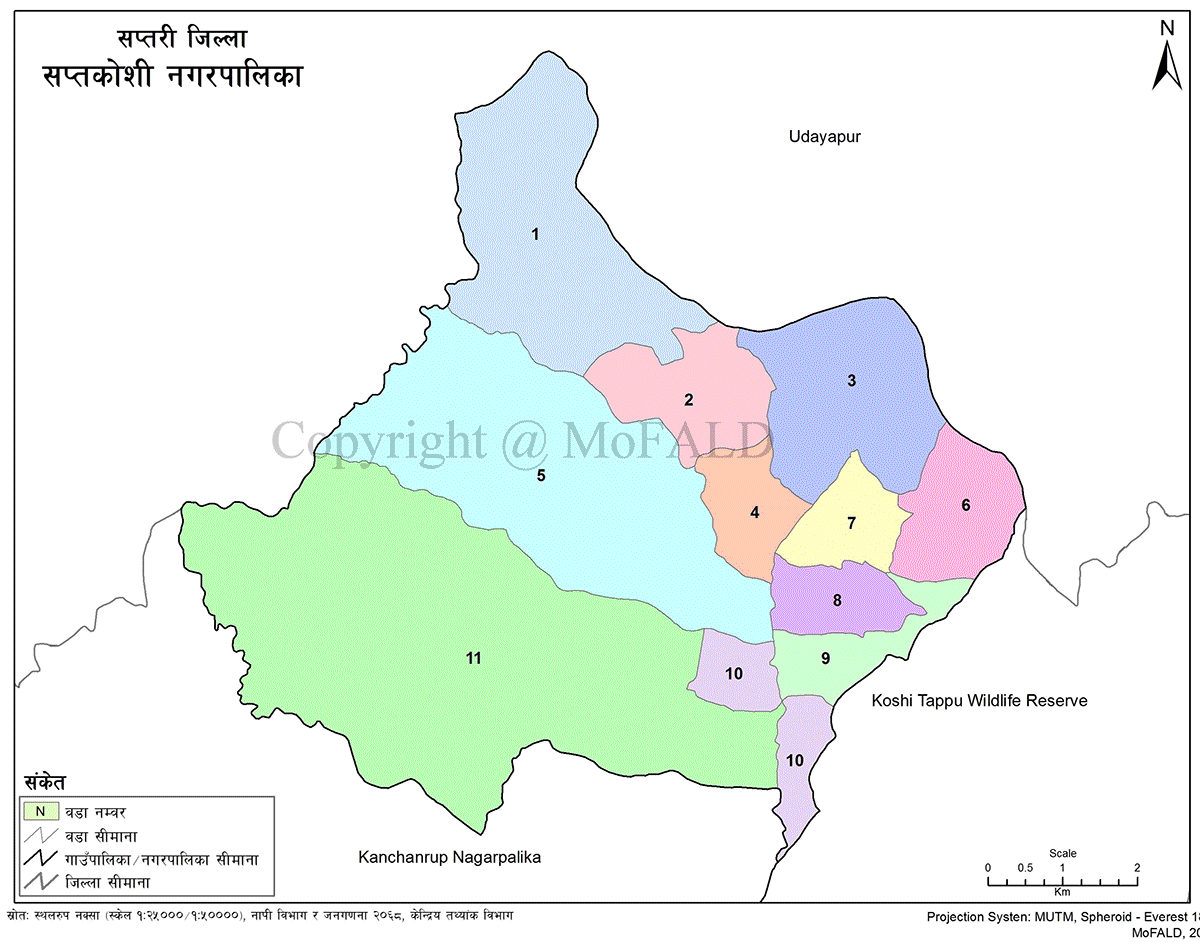
According to the municipality's official introduction and budget booklet, its geographical boundaries are:
East: Saptakoshi River and the Koshi Tappu Wildlife Reserve area
West: Chure hill region
North: Triyuga River and Belaka Municipality
South: Kanchanrup Municipality
Fattepur Bazaar is identified as a local commercial centre in the municipality's published information.
The Triyuga and Saptakoshi rivers are closely associated with the geographical identity of Saptakoshi Municipality. The municipality's official introduction mentions the Triyuga River near Fattepur Bazaar and the Chandra Canal irrigation system.
The Chandra Canal is among Nepal's older irrigation infrastructure systems. Its historical significance is connected to agricultural and water-resource development in the area.
The municipality's introduction also identifies Kamal Daha, the Chure region and natural and ecological sites associated with the Koshi Tappu Wildlife Reserve.
Because of these geographical features and water resources, river management, irrigation, environmental conservation and disaster risk reduction are relevant considerations in local development planning.
According to the National Population and Housing Census 2078 (2021), published by the National Statistics Office, Saptakoshi Municipality had a population of 23,510.
Of the total population, 11,398 were male and 12,112 were female. The census recorded 5,218 households in the municipality.
The main demographic indicators were:
Total Population: 23,510
Male Population: 11,398
Female Population: 12,112
Total Households: 5,218
Average Household Size: 4.51 persons
Sex Ratio: Approximately 94.11 males per 100 females
These figures refer to the 2021 census reference period. They should not be interpreted as the municipality's actual or updated population in 2026.
The municipality's budget booklet for fiscal year 2082/83 presents the following ward-wise population figures based on the 2021 Census.
|
Ward No. |
Former VDC Area |
Population |
|---|---|---|
|
1 |
Fattepur |
4,628 |
|
2 |
Fattepur |
2,734 |
|
3 |
Fattepur |
1,348 |
|
4 |
Fattepur |
2,418 |
|
5 |
Fattepur |
1,467 |
|
6 |
Odraha |
1,710 |
|
7 |
Odraha |
1,402 |
|
8 |
Odraha |
1,990 |
|
9 |
Kamalpur |
1,756 |
|
10 |
Kamalpur |
2,236 |
|
11 |
Kamalpur |
1,821 |
|
Total |
23,510 |
According to these figures, Ward No. 1 had the largest population, with 4,628 residents, while Ward No. 3 had the smallest population, with 1,348 residents.
Ward-wise population distribution can provide a useful basis for assessing access to local service centres, infrastructure requirements and priorities in development planning.
The governance system of Saptakoshi Municipality operates under the Constitution of Nepal, the Local Government Operation Act, 2074 (2017), and other applicable laws.
Its main institutional bodies include the Municipal Assembly, Municipal Executive, Judicial Committee, administrative divisions and ward offices.
The Municipal Assembly is the constitutional body responsible for performing the municipality's local legislative functions.
Under Article 223 of the Constitution of Nepal, the Municipal Assembly consists of the Mayor, Deputy Mayor, ward chairpersons, four elected members from each ward and the relevant members elected to the Municipal Executive in accordance with constitutional provisions.
Its principal responsibilities include enacting local laws, approving annual policies and programmes, adopting the municipal budget and making decisions concerning local revenue.
The Municipal Executive is the municipality's executive body.
Under Article 216 of the Constitution, the Municipal Executive consists of the Mayor as chairperson, the Deputy Mayor, ward chairpersons, five women members elected by the Municipal Assembly and three members elected from the Dalit or minority communities.
The Municipal Executive implements approved policies, plans and programmes. It also makes executive decisions concerning local administration and the delivery of public services.
The municipality's official website, reviewed in October 2026, listed the following elected representatives:
Mayor: Krishna Prasad Dhakal
Deputy Mayor: Rita Kumari Chaudhary
These names are based on the municipality's published institutional information. As details concerning officeholders may change over time, the latest information should be confirmed through the official website.
Article 217 of the Constitution of Nepal provides for a three-member Judicial Committee in the municipality, coordinated by the Deputy Mayor.
Section 47 of the Local Government Operation Act, 2074 (2017), defines the jurisdiction of the Judicial Committee.
The committee may adjudicate certain local disputes specified by law, while other designated disputes are addressed through attempts at mediation.
Disputes involving the use of property boundaries, irrigation canals or water sources, crop damage and certain wage-related matters may fall within the committee's jurisdiction, subject to applicable legal conditions.
The Judicial Committee does not have the authority to decide every type of dispute. The appropriate authority depends on the nature of the dispute and the applicable law.
The municipality's administrative functions are carried out under the leadership of the Chief Administrative Officer.
The administrative structure provides for functions relating to general administration, revenue, financial management, education, health, agriculture, infrastructure, social development and other sectoral responsibilities.
Saptakoshi Municipality has also published its Organization and Management Survey Report, 2081 BS.
The report covers matters relating to organizational structure, personnel management, workload and administrative improvements.
Schedules 8 and 9 of the Constitution of Nepal, together with the Local Government Operation Act, define the powers and responsibilities of local governments.
Saptakoshi Municipality's areas of responsibility include local planning and management, public services, education, health, agriculture, infrastructure, environmental management and social development.
Local governments have administrative and regulatory responsibilities relating to basic and secondary education.
These responsibilities include school management in accordance with applicable laws, educational planning, monitoring, local education programmes and assessment activities at the basic education level.
For updated information on the actual number of schools, their educational levels, teachers and students, readers should consult the municipal Education Section and official educational statistics.
Responsibilities relating to basic healthcare, sanitation, public health programmes and the management of local health institutions fall within the jurisdiction of local governments.
Depending on the municipality's service arrangements and available resources, activities relating to healthcare, immunization, nutrition, maternal and child health, and sanitation may be implemented or coordinated.
Information about specific services available at individual health facilities should be confirmed directly with the relevant health institution or the municipality's Health Section.
Saptakoshi Municipality's published policies and programmes include matters concerning agriculture, livestock development, irrigation and agricultural infrastructure.
Local government responsibilities include agricultural extension services, technical assistance to farmers, animal health programmes and the management of agricultural production-related initiatives.
The availability of these programmes, subsidies, application procedures and beneficiary selection requirements may vary according to the conditions of each approved programme.
The construction and management of local roads, public structures, drinking water and sanitation infrastructure, and municipal development projects are among the major responsibilities of local governments.
Given the municipality's geographical connection with the Triyuga and Saptakoshi rivers, river-related risks, environmental conservation and disaster preparedness are matters that require consideration in local development planning.
The municipality's annual policies and programmes may include proposed projects or budget allocations.
However, the inclusion of a project in the municipal budget does not necessarily mean that the project has been completed. Its implementation status can be established only through relevant official progress reports.
All 11 ward offices of Saptakoshi Municipality are important units for local administration and public service delivery.
Under Section 12 of the Local Government Operation Act, 2074 (2017), ward committees carry out designated responsibilities relating to planning, recordkeeping, recommendations, certification and other functions.
Depending on their requirements, residents may contact the relevant ward office for the following services.
Vital Event Registration: Registration of births, deaths, marriages, divorces and migration.
Recommendations and Certifications: Recommendations for citizenship-related purposes, relationship certification, residence verification and other recommendations permitted by law.
Land and Housing Matters: Boundary verification, house and road access recommendations, and other recommendations required for submission to relevant authorities.
Local Revenue: Services relating to applicable local taxes and revenue in accordance with the law.
Social Security and Records: Local coordination of social security programmes and maintenance of beneficiary records.
Ward Development Planning: Identification of local needs, recommendation of development projects and coordination during implementation.
The authority to issue documents such as citizenship certificates and passports rests with the relevant administrative authorities.
A recommendation issued by a ward office should not be understood as the issuance of those documents.
Required documents, fees, procedures and processing times may differ according to the type of service.
Before submitting an application, residents should consult the municipality's updated Citizen Charter, notices issued by the relevant ward office or the applicable legal provisions.
In particular, fees relating to revenue, registration and recommendation services may be affected by the municipality's Finance Act or other applicable legal provisions.
Saptakoshi Municipality approves its annual policies, programmes and budget through the Municipal Assembly.
The municipality's published budget booklet for fiscal year 2082/83 includes its geographical and administrative profile, local policies, sectoral programmes, budget allocations and decisions of the Municipal Assembly.
The official municipal website provides access to materials relating to policies and programmes, budgets, Finance Acts, Appropriation Acts and other publications.
When reviewing municipal budgets, it is important to distinguish between approved budgets, revised budgets, actual expenditure and the physical progress of development projects.
The allocation of a particular amount in a fiscal year does not, by itself, establish that the money has been spent or that the corresponding work has been completed.
The municipality's official website provides the following institutional contact information:
Office: Saptakoshi Municipality, Office of the Municipal Executive
Address: Tulsi Chowk, Saptari, Madhesh Province, Nepal
Office Phone: 031-550019
Official Email: saptakoshimun@gmail.com
Additional Institutional Email: saptakoshi.mun079@gmail.com
Official Website: https://saptakoshimun.gov.np/
Before visiting the municipal office, residents can check the availability of services, office hours and required documents with the relevant section or ward office.
Saptakoshi Municipality is a local government in the northeastern part of Saptari District, divided into 11 wards.
Formed by incorporating the former Fattepur, Odraha and Kamalpur areas, the municipality's identity is connected to the Saptakoshi and Triyuga rivers, the Chandra Canal, local agriculture and its settlement patterns.
According to the National Population and Housing Census 2078 (2021), the municipality had a population of 23,510 and 5,218 households.
The municipality performs responsibilities relating to local governance, public services, development planning, revenue and administration under the Constitution and applicable laws.
For residents seeking official information about service procedures, budgets, project progress and institutional details, the principal sources are the municipal office, ward offices and published government records.
Saptakoshi Municipality is located in Saptari District, Madhesh Province, Nepal. It lies in the northeastern part of the district.
Saptakoshi Municipality has 11 wards. Its administrative divisions are numbered from Ward No. 1 to Ward No. 11.
According to the National Population and Housing Census 2078 (2021), Saptakoshi Municipality had a total population of 23,510, comprising 11,398 males and 12,112 females.
The National Population and Housing Census 2078 (2021) recorded 5,218 households in Saptakoshi Municipality.
Saptakoshi Municipality was formed by incorporating the former Fattepur, Odraha and Kamalpur Village Development Committees.
According to the municipality's official website and published budget booklet, the Office of the Municipal Executive is located at Tulsi Chowk, Saptari.
Residents can contact their respective ward offices for birth registration, marriage registration, migration registration and local recommendation services.
They should consult the updated Citizen Charter for information about the required documents and procedures.