



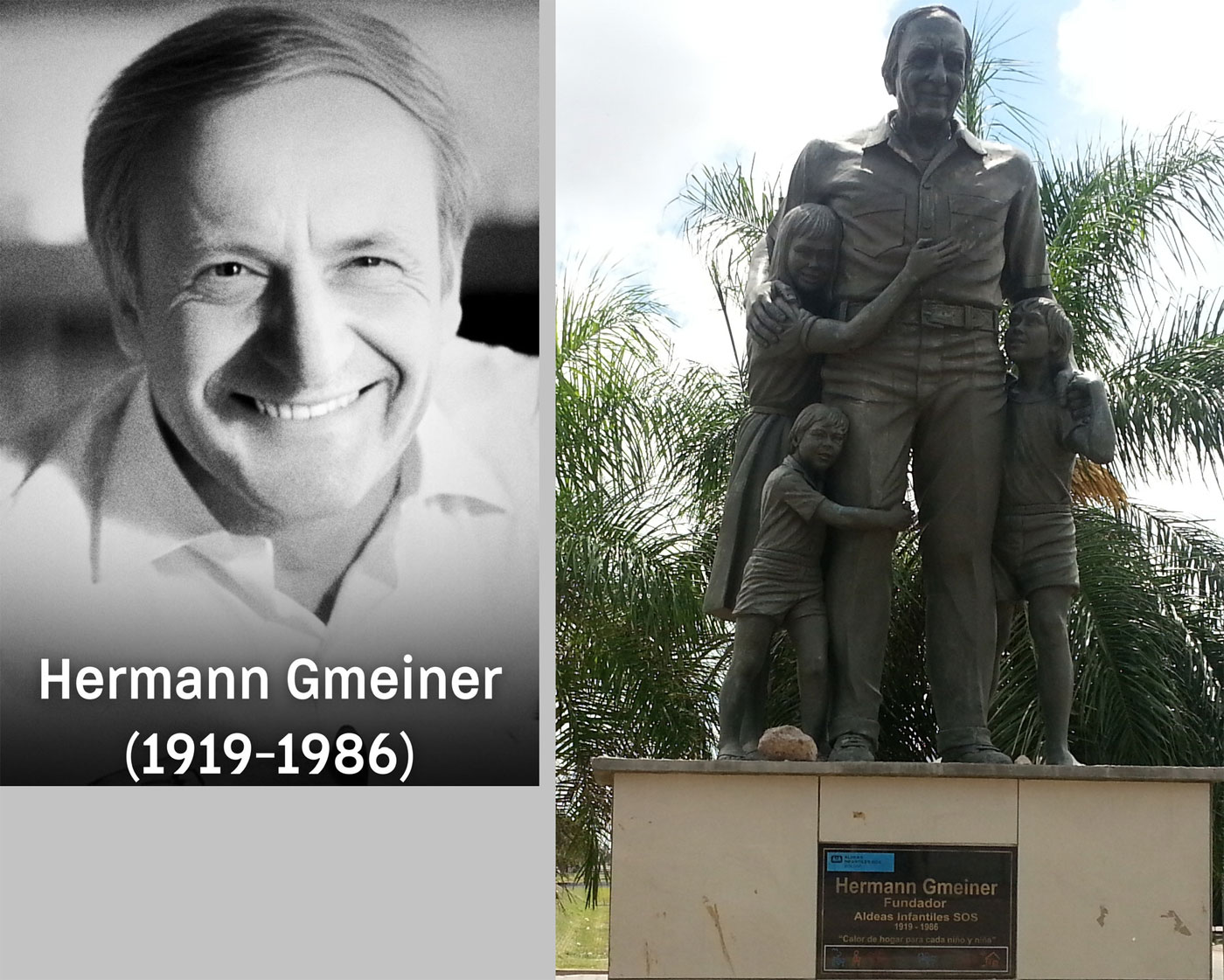
Humanity’s Extraordinary Figure: Hermann Gmeiner and the SOS Children’s Villages Movement
June 23 holds a special place in the history of humanity. Hermann Gmeiner, born on June 23, 1919, in Alberschwende, Austria, gave up personal comfort and devoted his life to children who were helpless, abandoned, orphaned, and at risk. The seed of humanity he planted has now spread to more than 135 countries. Marking his birth anniversary is not only about remembering a great person; it is also about honoring a vision, a movement, and deep love for children.
Hermann Gmeiner was the seventh of eight children. After losing his mother at a young age, he came to understand the value of family love and protection very closely. His sister, Elsa Gmeiner, took responsibility for the family and raised her younger siblings. That experience left a deep impression on him and helped him realize how essential a family is in a child’s life.
After the Second World War, thousands of children across Europe were left orphaned. Many had lost their homes, families, and hopes for the future. Although society was trying to provide shelter for them, most efforts were limited to institutional care. Hermann Gmeiner saw things differently. He believed children needed not just buildings, but families; not just management, but love; and not charity alone, but belonging.
Beginning and Principles of SOS Children’s Villages
In 1949, the first SOS Children’s Village was established in Imst, Austria. Because of limited financial resources, many believed the plan would not succeed. But Hermann Gmeiner’s determination, tireless work, and faith in humanity made it possible.
The idea he developed was simple but transformative: every child should have a mother, a home, a family with brothers and sisters, and a supportive community. These four basic pillars of SOS Children’s Villages have given direction to the lives of millions of children.
What began in a small village in Imst grew into a global movement within a few decades. Hermann Gmeiner traveled to different countries and introduced a new approach to child protection. With his inspiration and leadership, the movement that started in Europe expanded to Asia, Africa, Latin America, and other parts of the world.
Today, SOS Children’s Villages Nepal works not only in childcare but also in education, youth development, family strengthening, child protection, emergency relief, and community development.
SOS Children’s Villages in Nepal
For Nepal, Hermann Gmeiner is not only an international figure. His name is directly connected with the lives of thousands of Nepali children. In the late 1960s, when new possibilities were being explored in Nepal’s child welfare sector, Hermann Gmeiner visited Nepal and studied the possibility of establishing a children’s village.
After that, the first SOS Children’s Village was established in Sanothimi, Bhaktapur, and it was formally inaugurated in 1973. It opened a new door of hope, security, and opportunity for thousands of children.
Today, children’s villages are operating in different parts of Nepal, along with Hermann Gmeiner schools, youth villages, training centers, day-care and health centers, emergency relief, and family and community upliftment programs. Children raised through these programs have gone on to become doctors, engineers, teachers, entrepreneurs, administrators, and successful citizens in many fields.
This writer also had the privilege of serving in an important role at SOS Nepal from 1982 to 2014. It was not merely a job; it was a school of humanity. Seeing the life journeys of hundreds of children up close, and watching them grow into self-reliant, capable, and responsible citizens, clearly shows how far-sighted Hermann Gmeiner’s dream was.
Relevance and Contribution
Children today face many new challenges, including war, natural disasters, poverty, foreign migration, family breakdown, and social inequality. In this context, Hermann Gmeiner’s message has become even more relevant.
He taught that every child is not only someone who needs protection, but also a source of possibility. When children receive love and care, security, and opportunity, they can change not only their own lives but also the society around them.
Hermann Gmeiner passed away in 1986, but his ideas, values, and contribution continue to live on. Millions of children, young people, families, and communities around the world are still benefiting from his vision.
Greatness is not measured by how much wealth a person earns, but by how many lives they fill with hope. In this sense, Hermann Gmeiner remains one of the extraordinary figures in the history of humanity.
On his birth anniversary, the truest tribute to him is to commit, from our own places, to building a society where every child receives love, respect, security, and opportunity. His words, “The children of the whole world are our own children,” have truly come to life today.



Comments 0
No comments yet. Be the first to start the conversation.