



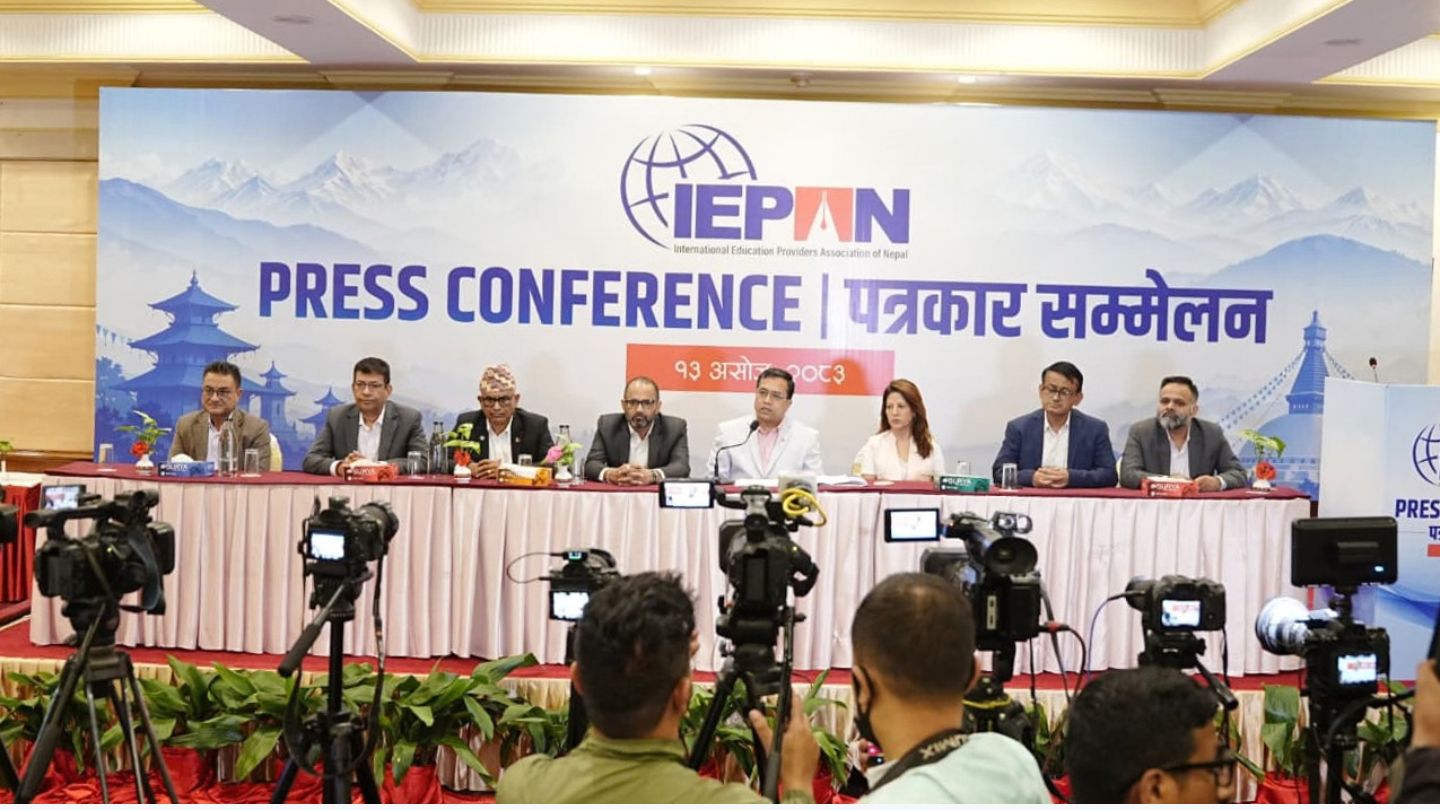
The International Education Providers Association of Nepal (IEPAN) has stressed that public debate over academic programs operated in Nepal through affiliation with foreign universities should be based on facts, law and evidence.
IEPAN said questions about the legal status of institutions and the quality of education should be assessed on the basis of existing legal provisions, the accreditation status of the foreign university, international recognition of the degree and acceptance of graduates in the employment market.
The issue concerns a growing segment of foreign-affiliated university study options in Nepal.
At a press conference held on Tuesday, IEPAN President Laxman KC said claims that programs operating with approval from the Ministry of Education could be closed at any time without a legal basis were completely incorrect.
He said the Foreign Educational Program (Operation and Regulation) Regulations, 2083, issued under Section 19 of the Education Act, 2028, provide a clear legal basis for the operation and regulation of such programs.
More Than 37,000 Students in 58 Institutions, Rs. 25 Billion Investment
According to IEPAN, 58 educational institutions in Nepal are currently running academic programs affiliated with 35 foreign universities from seven countries, with 37,208 students enrolled in these institutions.
IEPAN claimed that approximately Rs. 25 billion has been invested in the sector, which directly employs around 5,000 people and provides indirect employment to another 15,000.
The association also presented figures claiming that the sector contributes approximately Rs. 500 million annually in direct government revenue and more than Rs. 1 billion in indirect revenue, while generating economic activity worth around Rs. 15 billion to Rs. 20 billion.
KC said studying for a foreign degree in Nepal can cost up to around 15 times less than the total cost of studying abroad, while also allowing students to remain with their families.
IEPAN estimated that these programs help prevent a potential annual foreign-currency outflow of around Rs. 50 billion to Rs. 60 billion.
The association, however, clarified that it would not be reasonable to assume that every student who goes abroad for study would otherwise have enrolled in a college in Nepal.
Foreign-Affiliated Colleges Described as ‘Trendsetters’ in IT and New Technologies
KC claimed that foreign-affiliated colleges have played a major role in producing information technology professionals in Nepal and have acted as “trendsetters” in introducing new academic areas.
Citing a study by the Institute for Integrated Development Studies (IIDS), he said Nepal exported approximately USD 515 million, or around Rs. 68 billion, worth of IT services in 2022.
He also referred to an estimate that the sector could approach USD 1 billion, or roughly Rs. 145 billion, by 2025.
According to IEPAN, colleges operating through affiliation with foreign universities were among the institutions that introduced teaching in areas such as big data analysis, artificial intelligence (AI), cybersecurity, network security, hotel and hospitality management, interior design and animation in Nepal.
Concern Over Students Going Abroad and Foreign-Currency Outflow
Pointing to the growing number of students leaving Nepal for higher education, IEPAN said there is a need to provide quality education with international standards within the country.
According to figures presented by KC, 112,593 students obtained No Objection Certificates (NOCs) in fiscal year 2080/81, while Rs. 124.95 billion was sent abroad for education purposes.
In fiscal year 2081/82, 123,589 students received NOCs, while education-related foreign-currency outflow reached Rs. 138.48 billion, according to the figures he presented.
IEPAN said Nepal needs to strengthen domestic opportunities for employment and entrepreneurship if it is to address the continuing migration of young people.
Quality, Monitoring and Regulation
Speaking about educational quality, KC said branch campuses of foreign universities and affiliated colleges operate under different models, but both should be assessed on the basis of their curriculum, teaching staff, infrastructure and student learning outcomes.
He said the Ministry of Education has been conducting on-site monitoring of colleges through teams that include subject experts.
According to KC, the new regulations require affiliated institutions to begin the Quality Assurance and Accreditation (QAA) process within three years. Readers seeking background on the process can also refer to Collegenp's UGC QAA Certificate Guide Nepal.
He also said fees payable to foreign universities are transferred through the banking system only with approval from the Ministry.
IEPAN called for regulatory authorities to investigate any institution where there is evidence of irregularity.
KC further stated that short-duration training programs should not be compared with full academic degrees.
Overall Contribution of Private Educational Institutions
Citing the Nepal Education Institution Survey, 2081 of the National Statistics Office, IEPAN also referred to the broader contribution of non-government educational institutions.
According to survey figures for fiscal year 2080/81, non-government institutions had:
-
466,805 students enrolled in higher education;
-
approximately Rs. 160 billion in total value added; and
-
311,516 people engaged in the sector.
IEPAN clarified that these figures do not represent only the 58 foreign-affiliated institutions. They cover the wider group of educational institutions outside government ownership.
Goal of Developing Nepal as an ‘Education Hub’
IEPAN said it aims to see Nepal develop into an “education hub” and a study destination for international students in the future.
The association urged the government to establish clear arrangements for visas and other services required by foreign students. Related information for prospective international students is also available in Collegenp's guide on why study in Nepal for international students.
IEPAN also called on the Ministry to:
-
publish an updated list of approved institutions and academic programs;
-
clearly define the standards used for quality assessment; and
-
strengthen the mechanism for addressing student complaints.




Comments 0
No comments yet. Be the first to start the conversation.