



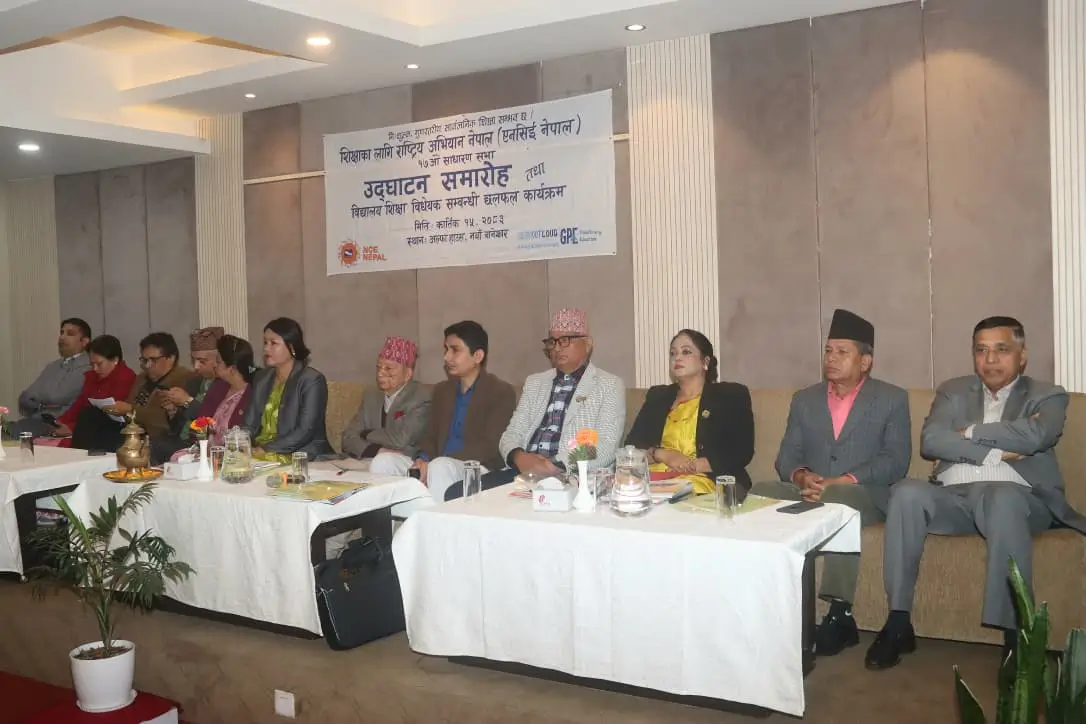
Stakeholders held extensive discussions on the proposed School Education Bill during the 17th Annual General Meeting of the National Campaign for Education (NCE) Nepal.
Members of Parliament, policymakers, education experts, and rights activists emphasized that the bill should guarantee the constitutional right to free and quality education.
During the discussions, speakers highlighted the need to make public education a responsibility of the state, clearly divide educational authority among federal, provincial, and local governments, and allocate adequate funding to the education sector.
Views of the Commission and Ministry
Inaugurating the program, Top Bahadur Magar, Chairperson of the National Human Rights Commission, said that although education had improved compared to the past, the progress remained insufficient.
He stressed the need to make education child-friendly, inclusive, and safe, with adequate basic infrastructure. He also urged policymakers to incorporate the suggestions received during the discussions.
Shiva Kumar Sapkota, Joint Secretary at the Ministry of Education and Sports, said the bill would be introduced by incorporating the spirit of Nepal's Constitution and suggestions received from stakeholders.
Recommendations From Education Experts
Former Education Secretary Balananda Paudel suggested that the bill should further clarify the responsibilities of different levels of government.
He explained that education policy falls under the responsibility of the federal government, while the operation and management of school education are the responsibilities of local governments.
Educationist Prof. Dr. Bidya Nath Koirala said the bill should contain explicit provisions enabling every local government to implement the constitutional requirements for compulsory and free education.
Another educationist, Prof. Dr. Bal Chandra Luitel, called for reassessing educational resources based on an analysis of demographic conditions.
Views Expressed by Members of Parliament
Members of Parliament from different political parties presented their views on various aspects of the proposed bill during the discussion.
- Kusum Maharjan (Member of Parliament, Rastriya Swatantra Party): Stated that improving education is everyone's responsibility and expressed a commitment to facilitating the work required from the government and Parliament. Maharjan also called for extensive dialogue on the issues that should be included in the bill.
- Dr. Pramila Kumari Gachhadar (Member of Parliament, Nepali Congress): Called for allocating at least 20 percent of the total budget to education and addressing the concerns raised by stakeholders.
- Guru Prasad Baral (Member of Parliament, CPN-UML): Stated that if the government introduced the bill appropriately, efforts would be made to strengthen its focus on implementation.
- Sajida Khatun Siddiqui (Member of Parliament, CPN-UML): Demanded that no external party should dominate the bill-drafting process and that child labor should be clearly defined in the legislation.
- Hariprabha Khadgi (Bagmati Provincial Assembly Member): Called for resolving confusion over the distribution of authority among the three levels of government and preventing the bureaucracy from dominating policymaking.
Stakeholders' Demands and Recognition of Outstanding District Network
Sundar Pant, President of the Nepal Teachers' Federation, urged stakeholders to move beyond the perception that teachers alone are responsible for the lack of improvement in schools.
He also demanded that the School Education Bill respect teachers' trade union rights.
Giridhari Subedi, spokesperson for the National Federation of the Disabled Nepal, emphasized the need to implement the right of students with disabilities to access education without barriers.
Labaraj Oli, President of NCE Nepal, said the campaign, which has networks in 46 districts and 550 members, would submit recommendations on the bill to the government after incorporating suggestions from all stakeholders.
During the program, the Rupandehi District Committee was honored as NCE Nepal's outstanding district network.

Comments 0
No comments yet. Be the first to start the conversation.