



Special Education in Nepal: Korean Project and Jobs
Kathmandu, Magh 16, 2082 (BS).
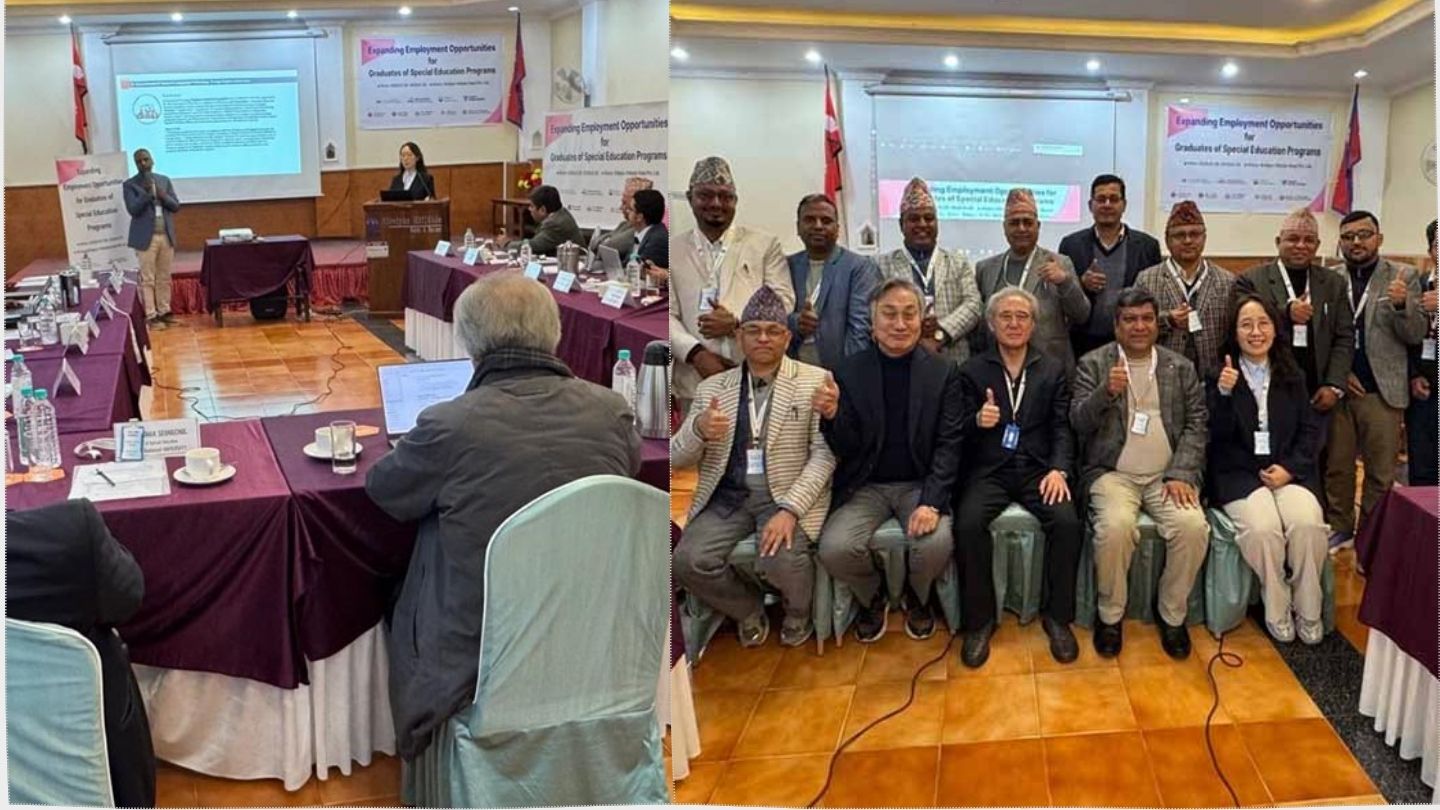
Stakeholders have commended South Korea’s contribution to Nepal’s “Special Education Campaign,” which is being implemented to support the education and learning of persons with disabilities.
Speakers at a program held in Kathmandu on Thursday stressed that the workforce produced through special education should have expanded employment opportunities. They also emphasized that special education should be made an integral part of the country’s mainstream education system.
The program is being run with the specific objective of producing competent teachers who can teach children with different abilities and disabilities.
Historic Start and International Partnership
In Nepal, Tribhuvan University launched the special education program for the first time in 2015. At present, the subject has also expanded to other universities.
Since the program’s establishment, the “Leading University Project for International Cooperation” (LUPIC), run under South Korea’s Changwon National University, has been providing important technical and academic support.
Prof. Dr. Ved Raj Acharya, Dean of the Faculty of Education at Tribhuvan University, said the role of Korean academic institutions has been pivotal in laying the foundation for special education in Nepal and in systematizing it.
Academic Advancement and Opportunities
In the initial phase, only undergraduate-level teaching began with support from the LUPIC project. According to Dean Acharya, its scope has now expanded.
He said studies are currently being conducted up to the master’s, MPhil, and doctoral (PhD) levels.
He said, “With the start of teaching in education related to special needs, the LUPIC project has provided facilities such as scholarships for outstanding students and opportunities to pursue a PhD in Korea. This cooperation needs to be continued in the future as well.”
He also shared that the workforce produced through this program has been finding employment in the market with relative ease, and that the interest of new students has been encouraging.
Incentives and Student Interest
At the program, Associate Professor Raju Acharya, Head of the Department of Special Education at Mid-West University, said the LUPIC project has provided strong support to students through financial incentives and career development.
He said, “In the special needs education program, the student who becomes the best each semester is provided, through LUPIC, with an amount equivalent to 50 percent as a scholarship. This is attracting students to enroll in this subject and to study diligently.”
He further suggested that, to make special education more effective, every school should ensure a sanctioned post for at least one Inclusive Teacher, and that the government should facilitate this.
Mahesh Prasad Niraula, a director at Purbanchal University, also pointed out the need to expand special needs education across a wider scope.
Korean Experience and Commitment
At the program, Prof. Dr. Jang Deiyong, Director of the LUPIC project, said progress in Nepal’s special needs education sector has been satisfactory.
Noting that it is a positive development that the produced workforce is being readily absorbed into employment, he said, “We will provide as much support as possible to make this program effective. This project is also an important medium for further strengthening the relationship between Nepal and Korea.”
On the occasion, Prof. Khwak Seunchul of the Department of Special Education at Kongju National University shared the Korean experience. According to him, after the Korean government formulated strict laws and policies related to special education, interest in the sector increased sharply.
He also said the Korean government gives high priority to the education and care of students with disabilities.
Similarly, Prof. Park Sanghee of Daegu Cyber University provided technical information about the educational materials, physical infrastructure, and systems being used in Korea for teaching and learning of children with disabilities.
Kim Yungyong, Manager of the LUPIC project, highlighted the support being provided by the project to universities and schools, and its future plans.


Comments 0
No comments yet. Be the first to start the conversation.