



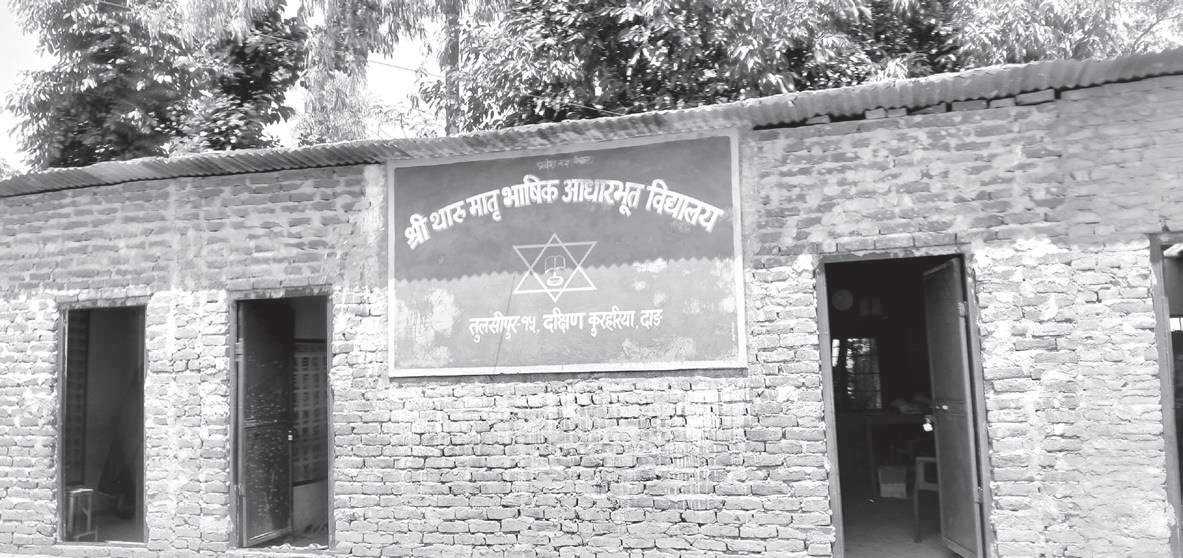
Dang: For the first time in the district, a school offering instruction in the Tharu mother tongue has come into operation. A basic school located at South Kurhariya, Ward No. 15 of Tulsipur Sub-Metropolitan City, has started teaching from nursery class to Grade 4 in the Tharu language.
According to the school’s Head Teacher Kiran Chaudhary, out of 71 students studying at the school, 67 are from the Tharu community. He informed that teaching in the Tharu language has been introduced at the school with the objective of providing education to local children in their mother tongue.
Local leader Rohit Chaudhary had been taking initiatives for a long time to operate the school in the Tharu language. Three years ago, he had registered an application at Tulsipur Sub-Metropolitan City seeking permission to operate the school, and since then had continuously raised his voice on language rights through various programs, discussions, and policy debates.
The 47th executive meeting of Tulsipur Sub-Metropolitan City granted permission to operate a Tharu-language school in South Kurhariya. Mayor Tikaram Khadka said permission was granted to operate the school to preserve the Tharu language, culture, and identity, as the area is linked to the historical legacy of Tharu King Dangi Sharan.
According to Mayor Khadka, the school has been permitted to operate under the concept of a guthi [trust]. He also said that volunteer teachers would be arranged on behalf of the municipality. He stated that the municipality believes learning achievement will be effective when education is provided in the mother tongue.
At present, eight male and female teachers and one office assistant are working at the school. According to Head Teacher Chaudhary, all nine staff members are from the Tharu community.
Rohit Chaudhary, the campaigner for operating the Tharu mother-tongue school, said that since around 400 households of the Chaudhary community live around the school, providing education in the mother tongue would be even more effective. He said children’s interest and confidence in learning also increase when they receive education connected with their own language, culture, and identity.
The initiative also reflects the wider importance of cultural diversity in Nepal and the role of school education in supporting local language and identity.


Comments 0
No comments yet. Be the first to start the conversation.