




B.A.LL.B (Law) Entrance: How to Pass Nepal Law Campus Exam?
Hello. I am your facilitator and a senior mentor who has spent more than two decades in this field. Today, I am not going to give you ordinary “tips and tricks.” I am giving you a roadmap that will help you open the first door to your dream of becoming a lawyer, a judge, or a legal expert—Nepal Law Campus.
Many of you may think, “Studying law means memorizing sections.” But the reality is different. Law is a confluence of logic, language, and society. When we talk about Tribhuvan University (TU)’s B.A.LL.B. (Bachelor of Arts Bachelor of Laws), this five-year course is not just a degree; it is a journey that changes how you think.
Nepal Law Campus (NLC), which we may also affectionately call “Nepal’s Harvard” (because of its historical and academic significance), has become extremely difficult to get into. Every year, around 5,000 to 7,000 students apply, but the seat count is only 105 (at Nepal Law Campus). I am not sharing this frightening statistic to scare you, but to help you understand the reality.
Your competition is not with your friend. It is with your own strategy. Let us begin the “operation” of this entrance exam.
Table of Content
- B.A.LL.B (Law) Entrance: How to Pass Nepal Law Campus Exam?
- Where Do Students Miss Out?
- Exam Structure: The Map of the Battlefield
- Objective (MCQs) — The 30-Marks Game Changer
- Written Exam (Subjective: Long & Short) — 50 Marks
- Expert Writing Format
- Creative Writing — 20 Marks
- 6-Month and 3-Month Preparation Plan
- Books and Resources
- What Not to Do (Common Mistakes to Avoid)
- Conclusion
Where Do Students Miss Out?
I have seen thousands of talented students fail. They did not fail because they lacked knowledge. They failed because they lacked direction. The main problems are:
-
Superficial understanding of the syllabus: Many memorize common market guidebooks, but they do not develop the “Analytic Skill” required by TU.
-
Writing skill: Everyone can get similar results in objective (MCQs). But in subjective exams, 50% of students fall behind because they do not know the proper format for writing answers.
-
Time management: In a 3-hour exam, students panic at the end because they cannot manage MCQs, long answers, short answers, and creative writing within the time limit.
-
Language confusion: Many lose 20 marks because they do not realize that creative writing must be in English, or because their English is weak.
This article will uproot all four of these problems from the root.
Exam Structure: The Map of the Battlefield
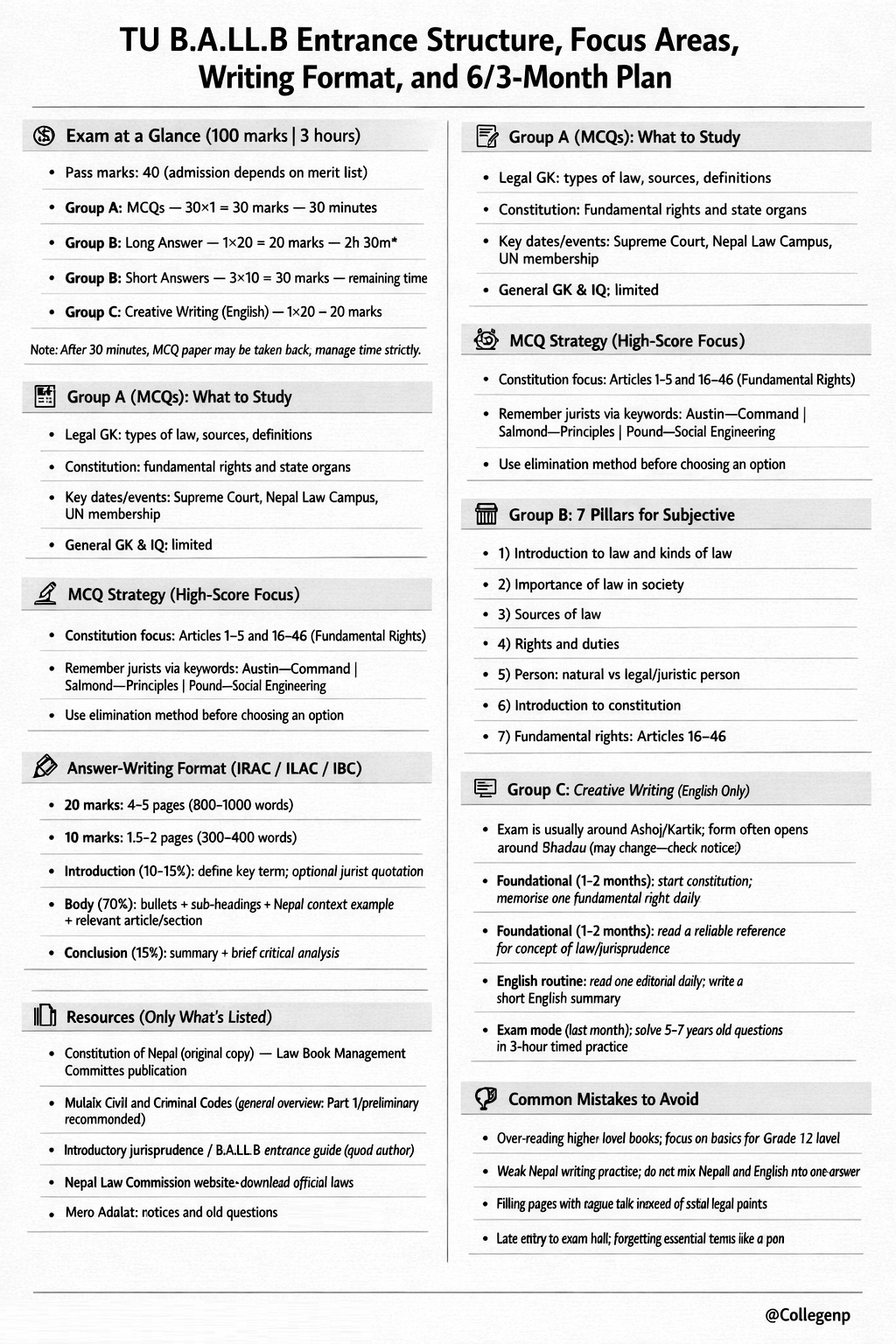
You must understand the structure of the battle you are fighting. According to the new syllabus prescribed by Tribhuvan University’s Faculty of Law, the entrance exam is of 100 full marks, and the pass marks are 40.
But remember: scoring 40 does not get you admission; you must get your name on the merit list.
Exam Format (Modality)
Group A
-
Nature of questions: Objective Questions (MCQs)
-
No. × Marks: 30 × 1
-
Total marks: 30 marks
-
Time: 30 minutes
-
Remarks: General Knowledge, IQ, and Legal Knowledge
Group B
-
Nature of questions: Subjective (Long Answer)
-
No. × Marks: 1 × 20
-
Total marks: 20 marks
-
Time: 2 hours 30 minutes*
-
Remarks: Tests deep understanding of law
-
Nature of questions: Subjective (Short Answers)
-
No. × Marks: 3 × 10
-
Total marks: 30 marks
-
Time: (Remaining time)
-
Remarks: Must solve 3 questions
Group C
-
Nature of questions: Creative Writing (English)
-
No. × Marks: 1 × 20
-
Total marks: 20 marks
-
Time: (In the same sitting)
-
Remarks: Independent writing (English language only)
Total
-
Full marks: 100 marks
-
Total time: 3 hours
Note: After 30 minutes of MCQs, the question paper is taken back, or even if it is provided together, you must manage time carefully.
Now I will break down each section in detail (Detailed Dissection).
Objective (MCQs) — The 30-Marks Game Changer
Many students treat this as a game of luck, which is wrong. These 30 marks are your “bonus.” The students who score 28–30 are the ones who reach the top positions in the merit list.
Syllabus for MCQs
Questions in this section come from the following areas:
-
Legal General Knowledge (Legal GK): Types of law, sources, definitions.
-
Constitutional history and system: Nepal’s current constitution, fundamental rights, organs of the state.
-
Important dates and events: Establishment of the Supreme Court, establishment of Nepal Law Campus, Nepal’s membership in the United Nations, etc.
-
General knowledge (General GK & IQ): In limited quantity.
Expert Strategy
Treat the Constitution like a sacred text: You must memorize key parts of the Constitution of Nepal 2072—Articles 1 to 5 (Preliminary), Articles 16 to 46 (Fundamental Rights), and provisions related to Directive Principles of the State, President, Prime Minister, and Judiciary.
Example: “Which article contains the Right to Equality?” (Answer: Article 18)
Do not get confused in definitions: Remember how different jurists define law.
-
Austin: “Law is the command of sovereign” (Law is the command of the sovereign).
-
Salmond: “Body of principles recognized and applied by the state...”
-
Roscoe Pound: “Social Engineering”.
(Remember this using the “keyword method.” As soon as you see “Command,” recall “Austin.”)
Elimination method: First remove the options that are clearly incorrect among the four choices. This helps you reach the correct answer.
Sample practice questions (fact-based)
-
When was the “Muluki Ain” issued? (B.S. 1910)
-
“Everyone is equal in the eyes of law”—which principle is this? (Rule of Law)
-
What was the old name of Nepal Law Campus? (Law Institute or Law College—established in 1954)
Written Exam (Subjective: Long & Short) — 50 Marks
This is the section that separates a “student” from an “expert student.” Out of 50 marks, you should aim for at least 30–35.
The 7 Pillars of the Syllabus
Tribhuvan University has prescribed seven topics. I have decoded them here in detail. Use these notes as the base of your preparation.
1) Introduction to Law and Kinds of Law
Problem: Students only write, “Law is a rule.”
Solution (Expert Definition): Law is a collection of rules enforced by the state that regulates human behaviour and makes a person liable to punishment if violated.
Types:
-
Substantive Law (substantive law): Creates rights and duties (example: Muluki Criminal Code).
-
Procedural Law (procedural law): Explains the process of obtaining justice (example: service of summons, process of taking evidence).
-
Civil vs Criminal: Matters between individuals (land, partition) are civil, while matters between the state and an individual (murder, theft) are criminal.
2) Importance and Role of Law in Society
Here, you should explain law as law and order, justice, and a tool of social change.
Example: How the law made to end the Chhaupadi practice became a force for social transformation.
3) Sources of Law (Most Important)
-
Custom: Long-practised accepted social traditions.
-
Legislation: Law made by the parliament (the supreme source).
-
Precedent: Principles established by the Supreme Court while interpreting cases (binding on lower courts).
4) Rights and Duties
Rights and duties are two sides of the same coin. When you demand rights, you must have fulfilled duties.
-
Hohfeldian Analysis (mention only if possible): If A has a right, then B has a duty.
5) Person (Legal and Natural)
-
Natural Person: A human being of flesh and bones (you and me). Legal status exists from birth to death.
-
Legal/Juristic Person: An institution recognized by law as a person (example: company, university). They can file cases and can be sued.
6) General Introduction to Constitution
The constitution is the fundamental law. If other laws conflict with the constitution, they become void to the extent of conflict (Article 1 of the Constitution of Nepal).
7) Fundamental Rights in the Constitution of Nepal
You must broadly remember Articles 16 (Right to Live with Dignity) to 46 (Right to Constitutional Remedy).
Expert Writing Format
Many students ask: “How much should I write in the subjective exam?”
-
Long Question (20 marks): 4 to 5 pages (800–1000 words)
-
Short Question (10 marks): 1.5 to 2 pages (300–400 words)
But writing more is not enough. It must be organized and coherent. I recommend using the ILAC model or a simple IBC (Introduction, Body, Conclusion) model.
Structure for 10-mark or 20-mark answers
Introduction (10–15%)
Define the key term of the question. Starting with a quotation from a jurist improves the presentation.
Example: For the question “What is precedent?”—in general terms, precedent is the rule created by courts while deciding cases, also called “judge-made law.”
Body Content (70%)
-
Write in bullet points.
-
Classify and use sub-headings: types, features, importance.
-
Add a practical example linked to Nepal.
-
Example: You may mention the case of Annapurna Rana vs Kathmandu District Court (private side) (if you know it), otherwise provide a general example.
-
-
Mention relevant legal provisions.
-
Example: While writing about the right related to justice, Article 20 must be included.
-
Conclusion (15%)
Summarize the main points and add your own critical analysis.
Example: “Therefore, although precedent is a major source of law, its application must balance the principles of justice and the needs of society.”
Creative Writing — 20 Marks
Many students slip here. Do not take this section lightly as “General English.” The purpose is not only to test grammar, but to assess your ideas, logic, argument, and horizon of thinking.
Language: This section is strictly in English (English Language Test). You cannot write in Nepali.
Word limit: Generally 300 to 500 words.
Possible topics
This section includes legal, social, or contemporary socio-legal/political issues, such as:
-
Do you think Federalism is suitable for Nepal? Challenges and Opportunities.
-
Role of Youth in combating Corruption.
-
Social Media: A boon or a bane for democracy?
-
Gender Equality and laws in Nepal.
How to write
Divide a 300-word essay into three paragraphs:
Paragraph 1: The Hook & Thesis (Introduction)
Start with a strong line, introduce the topic, and clearly state your stance.
Example: “Federalism was introduced in Nepal as a mechanism to decentralize power and ensure inclusive development. However, after nearly a decade of practice, debates regarding its economic viability and administrative complexity have surfaced...”
Paragraph 2: The Arguments (Analysis)
Discuss both pros and cons. Add facts or examples.
Expert Tip: Do not write emotionally. Write logically or legally. Stay neutral on politics, religion, or controversial issues. Do not insult anyone or advocate for any party.
Paragraph 3: The Way Forward (Conclusion)
Be solution-oriented. Do not only describe the problem.
Example: “To conclude, while federalism poses financial challenges, its role in empowering local governance cannot be undermined. Strict fiscal discipline and administrative efficiency are the keys to its success.”
6-Month and 3-Month Preparation Plan
The entrance exam date is generally seen around Ashoj/Kartik (Bhadra/Ashwin), and the form usually opens around Bhadau (sometimes it can change; you must check notices). Here is a time-based plan:
First 1–2 months (Foundational Phase)
-
Constitution: Buy the constitution and start reading. Memorize one fundamental right per day.
-
Syllabus study: Read an authentic reference book to understand the basics of “Concept of Law” or “Jurisprudence.”
-
English: Build the habit of reading one editorial per day and writing its summary in English.
Last 1 month (Exam Mode)
-
Old question solutions: Collect questions from the last 5–7 years and solve them within the exact time limit (3 hours). Market guides like “Sapana Pradhan” or “Mero Adalat” may be supportive, but do not depend on them completely.
-
Mock test: Create questions yourself or practice with friends. This is essential to increase handwriting speed.
Books and Resources
What you read determines your results. Do not rely only on cheap market notes.
1) Essential books
-
Constitution of Nepal (original copy): Published by the Law Book Management Committee.
-
Muluki Civil and Criminal Codes (General Overview): No need to go too deep, but reading “Part 1” (Preliminary) helps.
-
Introductory Jurisprudence: B.A.LL.B entrance exam guide (by a good author).
2) Websites and apps
-
Nepal Law Commission (www.lawcommission.gov.np): To download official laws.
-
Mero Adalat: For exam notices and old questions.
What Not to Do (Common Mistakes to Avoid)
In my 20 years of experience, students get trapped in these five mistakes:
-
Over-Reading: Do not waste time reading LL.M or much higher-level books. You are a Grade 12 pass student, so clear your basics.
-
Ignoring Nepali Typing/Writing: Many “boarding school” students have weak Nepali writing. Writing legal answers (Section B) in Nepali can score more because legal terminology is naturally strong in Nepali. If you write in English, your vocabulary selection must be excellent. Do not mix both languages into a messy blend.
-
Hallucination Words (fabricated talk): Instead of filling three pages with lines like “Law means giving justice to everyone,” it is 1,000 times better to write five solid legal points.
-
Late Entry: Do not make mistakes like reaching the exam hall at the last minute or forgetting to carry a pen.

Conclusion
In the end, Nepal Law Campus entrance is not just an exam; it is a test of discipline and consistency. Knowing the “Sources of Law” alone will not make you pass—you need the skill to write it properly within 2 hours and 30 minutes.
Start opening the constitution from today. Connect legal issues in the news with the syllabus. Do not nurture imaginary anxiety. With the right preparation, the right materials, and the right guidance, one name inside that quota of 105 can be yours.
(This article is fully based on research. Since the official syllabus and admission process of Tribhuvan University’s Faculty of Law can change over time, readers are requested to always check the campus notice board or website for official updates.)







Comments 0
No comments yet. Be the first to start the conversation.