




B.A.LL.B vs LL.B: Which Legal Education Path Is Right in Nepal?
Until about two decades ago, studying “Law” in Nepal was often seen as an “alternative” option—chosen after failing to secure admission in other subjects, or pursued mainly for promotion-related purposes. Today, that context has changed.
After the Constitution of Nepal 2072, rising legal awareness in society, expansion of the corporate sector, and an active judiciary have made legal education one of the most attractive and prestigious career paths among young students in Nepal.
Many students and parents now face a practical dilemma:
“Should I study law directly after Grade 12 (B.A.LL.B), or complete a bachelor’s degree first and then study law (LL.B)?”
This article addresses that dilemma using a practical, fact-based approach.
Table of Content
- B.A.LL.B vs LL.B: Which Legal Education Path Is Right in Nepal?
- Basic Introduction: What Are B.A.LL.B and LL.B?
- Admission Eligibility and Criteria
- Curriculum Breakdown: What Will You Study?
- Institutions and Universities in Practice
- Careers and Opportunities: Is B.A.LL.B Better or LL.B?
- Who Should Choose Which?
- Cost and Financial Reality
- Conclusion
- Frequently Asked Questions (FAQs)
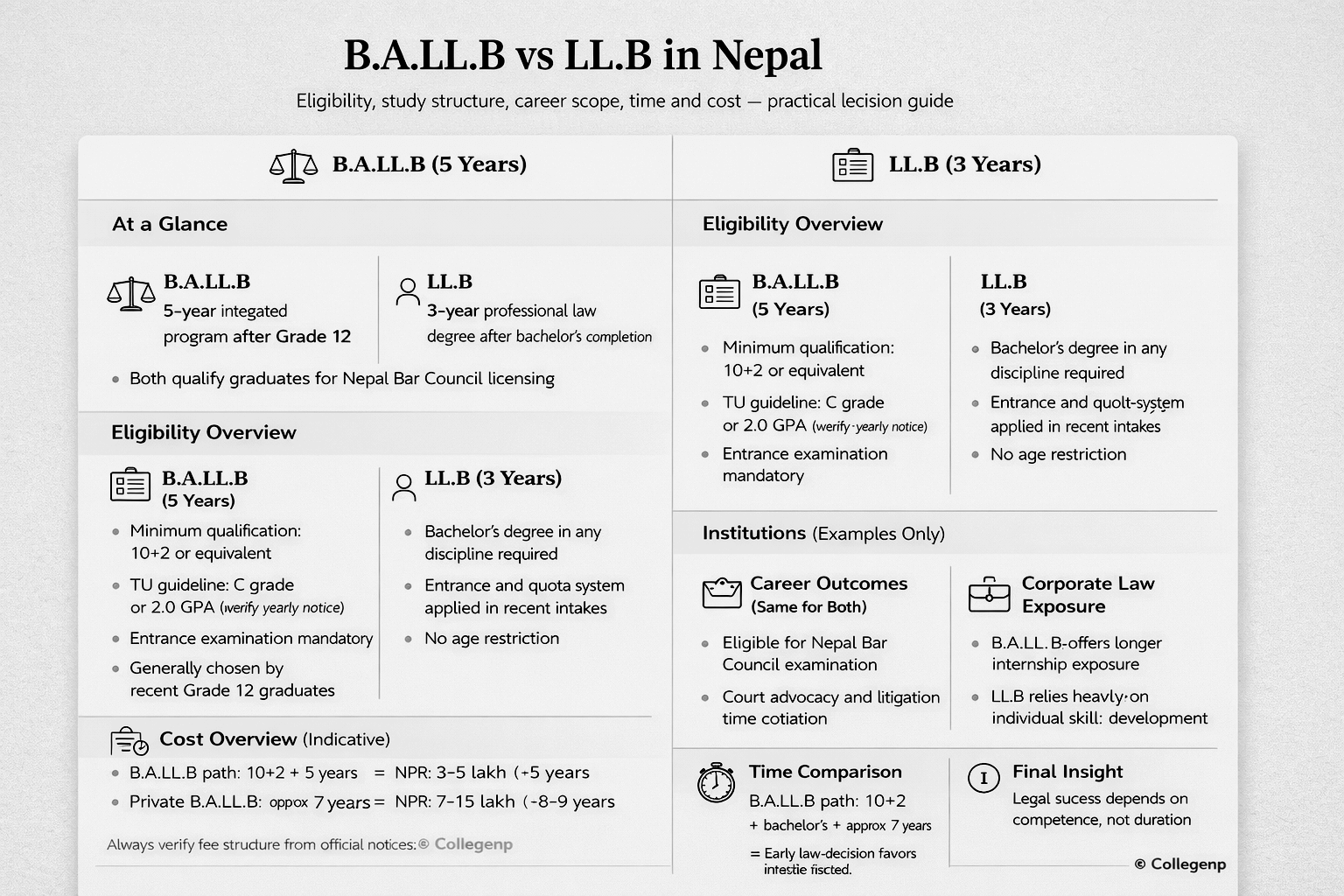
Basic Introduction: What Are B.A.LL.B and LL.B?
Nepali universities generally provide legal education through two main streams. The final destination is the same—a “law graduate”—but the routes are different.
B.A.LL.B (Bachelor of Arts Bachelor of Laws) – Five-Year Program
This is an integrated course designed for students who decide, immediately after completing Grade 12 (High School), that law will be their core career path.
Structure: Arts subjects such as Sociology, Political Science, Economics, or International Relations are taught alongside core law subjects.
Goal: To help students understand the relationship between society and law, and to develop a capable advocate or legal professional within five years.
LL.B (Bachelor of Laws) – Three-Year Program
This is the traditional route for individuals who have already completed a 3-year or 4-year bachelor’s degree in any field (Science, Management, Education, Humanities, etc.) from a recognized university.
Structure: There are no arts or background subjects. From the first day, the focus is on core law subjects.
Goal: To provide legal education to more mature learners who already have a prior academic foundation, preparing them for advocacy or judicial/legal careers.
Admission Eligibility and Criteria
Major universities in Nepal (Tribhuvan University, Purbanchal University, Kathmandu University, Mid-Western University, and others) set specific admission criteria.
Eligibility for B.A.LL.B (Five Years)
-
Minimum academic qualification: 10+2 or equivalent (NEB/HSEB) passed
-
Required GPA/grade: In the case of TU, minimum “C” grade or 2.0 GPA (this can change year to year; official notice must be checked)
-
Entrance exam: Mandatory; highly competitive. Written exam is required, and some colleges also conduct interviews
-
Age limit: No fixed limit, but typically recent Grade 12 graduates apply
Eligibility for LL.B (Three Years)
-
Minimum academic qualification: Bachelor’s degree in any subject from a recognized university
-
Required GPA/grade: Proof of bachelor’s completion (eligible even with Pass Division)
-
Entrance exam: In TU, in recent years, an entrance exam has been applied (for the quota system)
-
Age limit: No age limit. Applicants may range from recent graduates to retired employees
Expert Insight: Even if you completed +2 in Science or Management, you can study B.A.LL.B. The answer to “I studied Commerce—can I study law?” is yes, you can.
Curriculum Breakdown: What Will You Study?
This section answers the practical question: “What will I actually face inside the classroom?”
B.A.LL.B Curriculum (Social Sciences + Law)
This curriculum is interdisciplinary.
Early years (Years 1–2)
Alongside foundational legal principles, students study subjects such as Political Science, Sociology, Economics, and International Relations. This helps students understand society and reinforces the idea that “law exists for society.”
Later years (Years 3–5)
Students study core legal subjects in depth, such as the Civil Code, Criminal Law, Constitutional Law, Company Law, and Procedural Law. Moot Court (mock court) and internship are mandatory components.
LL.B Curriculum (Core Law)
This three-year course is intensive.
First year
Subjects include Jurisprudence, Constitutional Law, Family Law, and legal principles. The focus moves directly into case law and analysis of legal provisions.
Second and third years
Subjects commonly include Criminal Law, Property Law, Evidence Law, Procedural Law, and Tax/Banking Law. Practical components (Clinical Law) are included, but due to the shorter timeframe compared to a five-year program, academic pressure may be higher.
Institutions and Universities in Practice
Below is objective, fact-based information on some key institutions providing legal education in Nepal. This is not a ranking; it is a list of available options.
Nepal Law Campus (Bhrikutimandap, Kathmandu)
-
TU constituent campus
-
Offers both B.A.LL.B and LL.B
-
Key points: Nepal’s oldest and historic law campus. The 3-year LL.B has a very large student intake, and politics and academics often run in parallel. The B.A.LL.B usually has a limited quota (around 70), so it tends to be more structured.
Kathmandu School of Law (KSL, Bhaktapur)
-
Affiliated with Purbanchal University (PU)
-
Offers only the 5-year B.A.LL.B
-
Key points: Operates with a residential concept. The teaching approach is research-based. There is no 3-year LL.B here.
National Law College (Sanepa)
-
Affiliated with Tribhuvan University (TU)
-
Offers B.A.LL.B
-
Key points: Follows TU curriculum under private management.
Kathmandu University (School of Law, Dhulikhel)
-
Has introduced newer integrated programs such as BBMS-LL.B (Management and Law Integrated)
-
Key points: Quality and international image are considered strong.
Chakravarti Hubby Education Academy
-
Listed as an available option under PU.
Other universities
-
Lumbini Buddhist University, Mid-Western University, and Far-Western University have also started legal education programs.
Problem: Many students think only in terms of “government college is cheap, private is expensive.”
Solution: Yes, fees are lower in government (constituent) campuses, but competition is extremely high. If you do not appear on the merit list, you should understand the fees and academic environment of alternative colleges in advance.
Careers and Opportunities: Is B.A.LL.B Better or LL.B?
This is where a common myth needs to be addressed. You may hear claims like “five-year graduates are smarter than three-year graduates” or “three-year graduates are more experienced.” The reality is more practical.
Advocate License (Bar Council)
Both degrees are eligible for the Nepal Bar Council examination. After obtaining the license, you become an Advocate. In court, judges do not ask whether you studied a 3-year or 5-year program; they evaluate your arguments, evidence, and legal interpretation.
Public Service Commission (Judicial Service)
For judicial service roles (government attorney, officer, or judge), both degrees are treated as equivalent. With a 3-year LL.B, you can still become Chief Justice; with a 5-year B.A.LL.B, you can as well.
Corporate sector (Corporate Lawyer)
Here, 5-year B.A.LL.B graduates may have a slight edge in some cases, because five years often includes continuous project work, presentations, and internships, which can strengthen soft skills and English proficiency. This may not always apply; it depends on individual effort.
Time factor
-
B.A.LL.B: 10+2 (2 years) + 5 years = 7 years (after SLC/SEE)
-
LL.B route: 10+2 (2 years) + bachelor’s (3/4 years) + LL.B (3 years) = 8/9 years (after SLC/SEE)
If you want to study law from an early stage, B.A.LL.B can save about 1 to 2 years.
Who Should Choose Which?
Based on many years of experience, these are clear recommendations.
Situation 1: Recent Grade 12 graduate (Fresh +2 passout)
Recommendation: Choose B.A.LL.B.
Reason: You have time to learn, and your legal foundation becomes stronger. Studying another subject for three years and then studying law again for three years can cost you time.
Situation 2: Bachelor’s degree holder
Recommendation: Choose LL.B (3 years).
Reason: Starting B.A.LL.B again and going back five years is not a practical decision. Work hard for three years and become a legal professional. Your earlier degree gives maturity, which is a major asset in legal practice. For example, if you have completed MBS or BBA, you may become more capable as a corporate lawyer than a fresher B.A.LL.B graduate because you already understand business.
Situation 3: Working professional or homemaker
Recommendation: LL.B (3 years) is more practical.
Reason: In Nepal Law Campus and many other campuses, the 3-year LL.B is often operated in morning or evening shifts (attendance and class rules may vary by college). A 5-year program is usually full-time (day college), making it harder to balance with work.
Cost and Financial Reality
No serious analysis is complete without discussing costs.
-
Government college (B.A.LL.B): NPR 300,000 to 500,000 (for the full 5 years) (estimated; may vary by quota and time)
-
Private college (B.A.LL.B): NPR 700,000 to 1,500,000 (KU and affiliated colleges tend to be higher)
-
Government college (LL.B): Very low cost. Annual fees may be around NPR 20,000 to 25,000 (or even less), so many consider it pocket-friendly.
Caution: In the 3-year route, many enroll because fees are low but do not attend classes regularly. In the legal profession, a certificate alone does not work without knowledge. Understand that investment is not only money—it is also time.
Conclusion
As an editor and senior in this field, the core point is this: B.A.LL.B and LL.B are tools, not the final goal.
In Nepal today, there are thousands of licensed advocates, but there is still a shortage of capable legal professionals. Whether you study a five-year program or a three-year program, you can reach the top if you have:
-
Reading habit (continuous study)
-
Analytical skill
-
Patience
-
Integrity
Students should understand this comparison: B.A.LL.B is a “modern highway,” while LL.B is a “traditional royal road.” Both roads lead to the same destination—the court.
Make your decision by considering your current academic status, financial condition, and available time. Do not follow market rumors; prioritize your own interest.
Frequently Asked Questions (FAQs)
Can I go abroad for a Master’s in Law (LL.M) after B.A.LL.B?
Yes. Degrees from TU, PU, and KU are recognized internationally. If you achieve a good GPA, you can apply for LL.M programs at universities worldwide.
Is law difficult for a student who studied Science?
No. In fact, many examples show that science students often understand complex legal provisions quickly because their logical reasoning tends to be strong.
Which college is the best?
There is no single “best” college; there is a college that is “suitable for you.” If you want environment, research, and guidance, choose colleges with regular classes (such as KSL, NLC, and the B.A.LL.B program at Nepal Law Campus). If you plan to study on your own and only sit for exams, you may look into more open-structured 3-year options.
(Author’s note: This content is fully based on research, facts, and Nepal’s prevailing legal education structure. Before making any decision, you are requested to check the relevant university’s official website or contact the Dean’s office.)
Also Read: List of Law Colleges in Nepal





Comments 0
No comments yet. Be the first to start the conversation.