




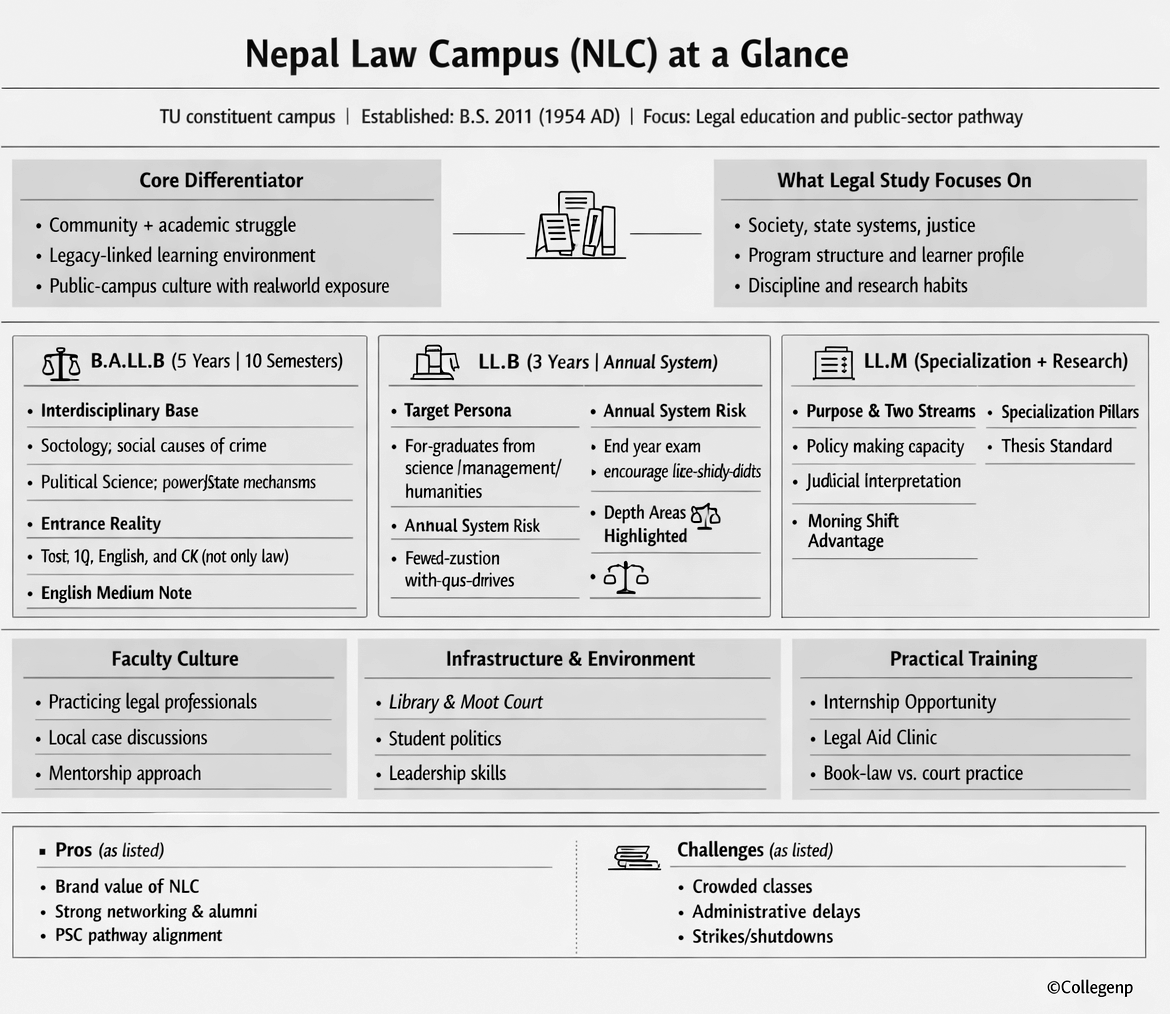
Nepal Law Campus (NLC), informally known as “Law College,” is not only a brick-and-cement building. Established in B.S. 2011 (1954 AD), it is Nepal’s oldest constituent campus of Tribhuvan University (TU).
This text explains why NLC is viewed as distinct, how its major programs differ in intent and structure, what its faculty culture looks like, and what students should realistically expect from its environment and systems.
Table of Content
- Why It Is Different From Others
- Programs: Beyond the Syllabus
- Faculty: From Book Pages to the Classroom
- Infrastructure and Environment
- Internship and Clinical Education
- Why NLC: The Verdict
- Conclusion

Why It Is Different From Others
In private colleges, you may be treated as a “customer,” but at NLC you will find “struggle” and “community.” Its walls carry the history of Nepal’s Chief Justices, Attorneys General, and senior advocates.
Studying here is presented as becoming part of that “legacy.”
Programs: Beyond the Syllabus
Being a law student is not only memorizing “sections” and “sub-sections.” It is about understanding the structure of society, the machinery of the state, and the spirit of justice.
NLC aims to provide this “holistic” knowledge through its three main programs. Although these programs may look similar from the outside, the text argues their “DNA” is different.
Based on many years of experience, the source analyzes these programs so readers can identify a suitable path for their future.
B.A.LL.B (Bachelor of Arts Bachelor of Laws)
This five-year program is not only a combination of two degrees. It is described as a foundation for “social engineering.”
TU introduced this course to produce legal professionals who can understand society, beyond traditional advocacy.
Interdisciplinary Approach
In B.A.LL.B, you do not study only law.
-
Sociology helps you understand the social causes of crime.
-
Political Science helps you understand power-sharing and state mechanisms.
-
Economics helps you understand corporate law and market dynamics.
When debating a “constitutional issue,” constitutional provisions alone may not be enough; knowledge from the B.A. component can help explain the political background.
The Harsh Reality of the Entrance Examination
For 105 seats (including open, inclusive, and foreign quotas), thousands of students compete every year. It is described as Nepal’s “Iron Gate.”
The exam does not test only legal knowledge. It tests IQ, English language command, and general knowledge (GK). The text claims this proves NLC admits only “creamy layer” students, and selection itself becomes a “badge of honor.”
Pressure and Refinement Under the Semester System
This is a 10-semester course. There is no flexibility to study only at the year-end and pass, as in an annual system.
Continuous assessment includes assignments, presentations, and mid-term examinations. The text argues this trains students to meet deadlines and handle pressure, which is necessary for professional life.
Necessity of English Medium
Many students ask, “Why English?” The source gives a simple answer: globalization.
Corporate law firms, international treaties and agreements, and work involving multinational companies largely use English. NLC’s B.A.LL.B is presented as preparation for a “global market.”
However, classroom discussions take place in both Nepali and English, maintaining linguistic balance.
LL.B (Bachelor of Laws)
Many mistakenly view the three-year LL.B as an “alternative” or “lower level” than B.A.LL.B. The source argues that, in reality, it forms the backbone of Nepal’s judiciary and civil service.
This course targets those who have already completed a bachelor’s degree in science, management, or humanities and now want a legal career. Students typically have the maturity that comes around age 21–22.
A cited advantage is classroom diversity: engineers, journalists, teachers, police officers, and others. This is said to raise the level of “peer learning.”
The Trap of the Annual System
There is no semester system here; exams take place at the end of the year.
A serious problem described is that many students enroll but do not attend college, and later try to pass by reading “guide books.” The text states that anyone aiming to become a successful lawyer must convert this “freedom” into discipline.
The syllabus is described as very extensive. Procedural Law and the Law of Evidence are taught in depth and are presented as the “Bible” for advocacy.
Strategic Advantage of the Morning Shift
Classes run from 6:30 AM to 10:30 AM, leaving the rest of the day free.
The source describes a real-world use of this time: capable students work in the afternoons at senior advocates’ offices, courts, or NGOs. By the end of three years, they are said to gain not only a degree but also three years of “practical experience,” an opportunity the text says B.A.LL.B students rarely get.
Financial Aspect
The source states that completing a full law degree for about NPR 30,000–35,000 is rare globally. It describes this as a state subsidy, and frames correct utilization as a student responsibility.
LL.M (Master of Laws)
Postgraduate study is not only for “getting a job.” It is presented as building capacity for “policy making” and “judicial interpretation.”
Two Streams
At NLC, LL.M is described in two formats:
-
Regular (Morning): A two-year program with limited seats and high competition, described as fully research-oriented.
-
Evening (Self-financed): A three-year program targeted to professionals such as lawyers, judges, and government employees.
Pillars of Specialization
The text states you do not study “general law” here; you must choose a specialization, such as:
-
Criminal Law: For those interested in criminal investigation and prosecution.
-
Constitutional Law: For those interested in constitutional interpretation and state governance.
-
Commercial Law: For corporate and banking sectors.
-
International Law: For diplomacy and international relations.
Importance of the Thesis
The thesis is not treated as a formality. The source states there is a strict viva-voce and a plagiarism check.
It also states an expectation that research produced here should be of a level suitable for reference when the Supreme Court establishes precedents or when Parliament drafts laws.
Faculty: From Book Pages to the Classroom
The text argues that an institution’s stature is determined not by buildings but by the minds teaching there. It describes NLC’s biggest asset as its faculty.
Encounter With Living History
Imagine studying constitutional law with a professor who served as an expert advisor to the constitution drafting committee of B.S. 2072. Or studying the Muluki Criminal Code with a professor who drafted that law.
The described impact is that such faculty do not teach only theory from books; they explain legislative intent and the politics embedded within lawmaking. The source claims this is not knowledge you find through Google or guide books.
Confluence of Judiciary and Academia
Many professors are not only full-time academics. They are also senior advocates, former judges, or government attorneys.
The text contrasts this with many private colleges: instead of examples from decades-old British cases, NLC faculty are described as using very recent Supreme Court decisions or their own courtroom experiences, giving students a direct sense of the “court room.”
Reality Check on Mentorship
A bitter truth is also stated: because it is a government college, teachers do not follow students and say, “Study,” as in private colleges.
The text emphasizes the need for proactive students. Senior professors are described as reservoirs of knowledge, but students must take initiative: asking questions after class, meeting in offices, and assisting in research.
Those who do so are presented as the ones who gain the real benefits.
A Golden Gate for Networking
A professor teaching you today may be a judge tomorrow, or a bar association chairperson.
The source frames building strong relationships with professors as securing your place in the legal field. It also claims that recommendations can play a major role in obtaining scholarships at international universities or internships at large law firms.
The text concludes that NLC’s curriculum and faculty are not a “ready-made package,” but a mine. Extracting gold or returning with only soil depends on a student’s effort, persistence, and habit of research.
If you want to make law not only a “profession” but a “passion,” the text says the campus benches and dust are waiting to welcome you.
Infrastructure and Environment
If you expect “five-star hotel” facilities, you may be disappointed. However, the text argues the environment itself can shape a hardened lawyer.
Library
It is described as Nepal’s richest legal library, with thousands of old judgments, gazettes, and rare legal books. The text also says online database facilities are being added.
Moot Court
Practicing in the moot court hall is described as similar to arguing in a real court.
The text states NLC students have represented Nepal in international moot court competitions such as “Henry Dunant” and “Jessup.”
Political Consciousness
Student politics is active here. The text advises not viewing this only negatively.
It argues that tomorrow’s national leaders emerge from practice in the Free Student Union (FSU), and that it teaches leadership development, oratory skills, and negotiation.
Internship and Clinical Education
The source states, based on 20 years of experience: “Law is one thing in books, and another in court.”
It asks what NLC is doing to bridge this gap.
Collaboration With Kathmandu Metropolitan City
The text states NLC recently signed an agreement with Kathmandu Metropolitan City, under which students can do paid internships in the metropolis’ legal department. It presents this as an example of practical learning.
Legal Aid Clinic
Under a clinical course, students practice providing legal assistance to poor and helpless people by going to communities or through the campus clinic. The text says this helps students become not only lawyers but also “social activists.”
Why NLC: The Verdict
The text presents both benefits (pros) and challenges (cons) and suggests understanding them in balance.
What You Get
-
Brand Value: The text claims writing “Nepal Law Campus” on a biodata has a distinct effect in an employer’s view.
-
Networking: A benchmate could become a future minister or judge.
-
Alumni Network: It describes NLC’s alumni network as Nepal’s strongest.
-
Public Service Commission: If your goal is to become a government attorney or judge, the text argues NLC’s study culture appears designed for that, and claims most toppers are produced here.
-
Affordable: It states that getting quality education so cheaply is rare globally.
Challenges to Overcome
-
Crowds: Large class sizes may make it hard to concentrate.
-
Administrative delays: As a government system, there can be delays in results publication or administrative processes.
-
Strikes and shutdowns: As a center of student politics, studies can sometimes be disrupted.
Expert Advice
If you want “the college to teach me everything,” the text suggests a private college may fit. If you have the drive to search, struggle, and become a grounded lawyer through your own effort, the text says Nepal Law Campus is for you.
Studying here is not only memorizing books; it is closely observing the interrelationship between society, politics, and justice. The text concludes that the real essence of advocacy is hidden in the campus dust.
Conclusion
Based on many years of experience, the source states that a successful lawyer is not the one who memorizes many legal provisions, but the one who can provide practical solutions to problems.
It concludes that Nepal Law Campus provides the foundation for building that practical and resilient lawyer.







Comments 0
No comments yet. Be the first to start the conversation.