



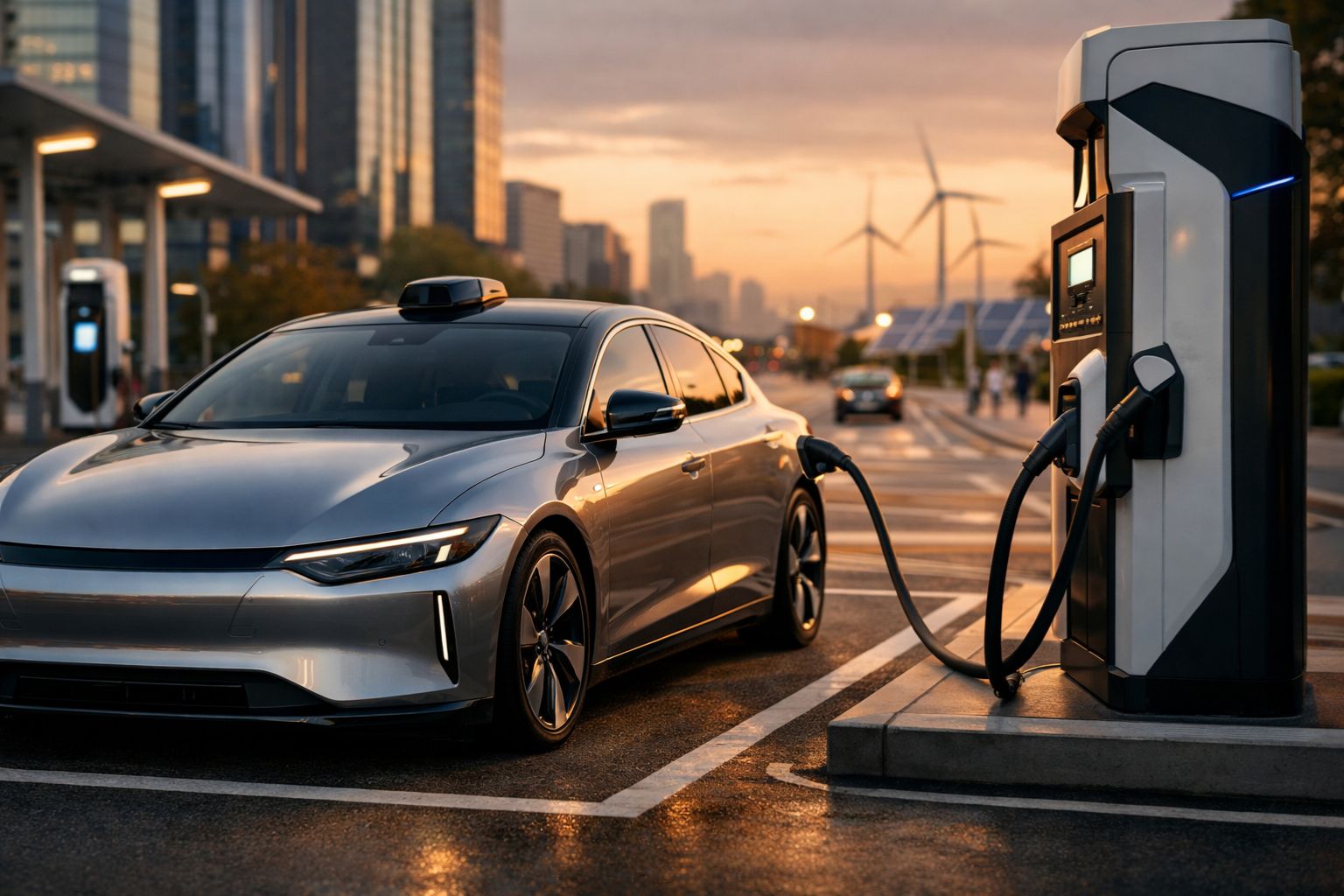
The Future of Transportation: Electric Vehicles and Autonomy
Electric vehicles (EVs) are moving from niche to normal in many markets, while driver-assistance and automated-driving features keep expanding. These shifts are connected: modern EVs are built around software, sensors, high-voltage power electronics, and frequent updates—many of the same building blocks that advanced driver-assistance systems (ADAS) and higher automation rely on.
Still, “EV” and “self-driving” are not the same story. EVs are a powertrain change. Autonomy is a safety- and responsibility-change. EV adoption depends on charging access, battery supply chains, and grid capacity. Autonomy depends on reliable perception, strong safety cases, clear rules, and trustworthy monitoring after vehicles are sold.
This article explains where EVs and autonomy stand, why they intersect, and what to look for next—without hype.
Table of Content
- The Future of Transportation: Electric Vehicles and Autonomy
- Why EVs and autonomy are rising together
- Electric vehicles: what matters most
- Autonomy: what “self-driving” means in practice
- Where EVs and autonomy reinforce each other
- Infrastructure and policy signals to watch
- A practical evaluation checklist
- What the next decade likely looks like
- FAQs
- Reference
Why EVs and autonomy are rising together
Three forces pull these trends in the same direction:
Software-defined vehicles
Cars now ship with powerful computers, connectivity, and regular software updates. EVs accelerated this shift because battery management, charging, thermal control, and motor control are software-heavy. Automated-driving features also live in software, so the “updateable car” model supports both.
Sensors and electrification fit well
Cameras, radar, and compute draw power and create heat. EV architectures are already designed around high-voltage systems and centralized thermal management, which can make integration cleaner than in older designs.
Fleet economics reward both
Ride-hail, delivery, campus shuttles, and trucking fleets care about operating cost, uptime, and standardization. EVs can cut fuel and maintenance spend in the right duty cycles, while automation promises labor savings and fewer crashes—if it works safely and consistently.
Electric vehicles: what matters most
Batteries and range are engineering tradeoffs, not magic
An EV’s real-world usefulness comes from a bundle of choices:
-
Battery capacity and chemistry
-
Vehicle efficiency (weight, aerodynamics, tires)
-
Thermal management (heat pump or resistive heating)
-
Charging curve (how fast it can add energy as the battery fills)
The key point: “range” on a spec sheet does not fully predict trip convenience. Charging speed and station reliability often matter more than the last 50 km of rated range.
Charging: access and reliability decide adoption
Most EV charging still happens at home when home charging exists. Public charging matters for apartment dwellers, long trips, taxis, delivery routes, and rural travel.
Recent data from the International Energy Agency (IEA) shows rapid growth in public charging deployment, including large additions in 2024 and a global public-charger stock measured in the millions.
What to watch next:
-
More fast chargers on highways and in dense neighborhoods
-
Better uptime standards and simpler payment
-
Smarter load management so charging does not overload local feeders
Grid impact: the issue is timing, not only total electricity
EVs raise total electricity demand, yet the bigger challenge often comes from simultaneous peak charging. Smart charging can shift demand to off-peak hours, and managed fleets can schedule charging around depot capacity.
A useful mental model:
-
One EV is not a grid problem.
-
Many EVs charging fast in the same place at the same time can be.
Emissions: EV benefits depend on electricity mix and full lifecycle
EVs have no tailpipe emissions, which helps urban air quality. Climate impact depends on the electricity used for charging and the emissions from manufacturing, especially battery production.
The IPCC’s Sixth Assessment Report (AR6) discusses lifecycle emissions for transport options and shows that EV climate benefits grow when electricity is low-carbon.
The practical takeaway: the cleanest EV is the one charged on a cleaner grid, driven efficiently, and kept on the road long enough to spread manufacturing emissions across many kilometers.
Autonomy: what “self-driving” means in practice
Driver assistance vs automated driving
Many vehicles sold now include Level 2 driver-assistance features (lane centering plus adaptive cruise, for example). Level 2 still requires the human driver to supervise at all times.
In the United States, NHTSA’s Standing General Order (SGO) collects crash reports involving automated driving systems (ADS) and Level 2 advanced driver-assistance systems, underscoring that Level 2 systems remain part of the safety conversation, not a solved problem.
Why autonomy is hard: the world is messy
Driving demands:
-
Seeing and tracking road users
-
Predicting behavior
-
Handling rare edge cases
-
Following local rules and social norms
-
Working in bad weather, glare, occlusion, construction, and mixed traffic
A common misconception is that most driving is “easy” and only a few cases are “hard.” Real roads mix both constantly.
Safety motivation is real, but responsibility stays complex
Road safety remains a global crisis. The World Health Organization reports about 1.19 million road traffic deaths each year worldwide.
Autonomy is often pitched as a way to reduce crashes, especially those tied to attention, judgment, and fatigue. NHTSA’s NMVCCS “critical reason” analysis assigned the critical reason to the driver in 94% of the investigated crashes—while also warning this is not the same as legal fault or a single “cause.”
That nuance matters. “Automation reduces human error” is a reasonable goal, yet any deployed system must show it reduces risk across the full set of conditions where it operates.
The role of Operational Design Domain (ODD)
Most serious autonomy work is “ODD-first.” An ODD spells out the exact conditions where the system can drive:
-
Road type (motorway, city streets, geofenced zones)
-
Weather limits
-
Speed range
-
Map coverage
-
Behavior expectations for other road users
A system that is safe inside its ODD can still be unsafe outside it.
Regulation is moving from ideas to type approval
Regulators are building frameworks for automated driving.
In Great Britain, the Vehicle Certification Agency (VCA) describes Automated Lane Keeping Systems (ALKS) and notes these vehicles are approved to UNECE Regulation R157.
UK government material also points to UN Regulation No. 157 as an established type approval regulation for ALKS.
This matters because type approval forces clear definitions: what the system does, what it does not do, how handover works, and what data is stored for incident review.
Where EVs and autonomy reinforce each other
Energy and compute tradeoffs
Automated-driving hardware uses power: sensors, computers, and cooling. In an EV, that energy comes from the same battery used for propulsion. Range impact depends on hardware design, driving conditions, and duty cycle.
Expect:
-
More efficient onboard compute
-
Better sensor fusion so systems rely on complementary sensors, not brute force
-
More attention to power budgeting and thermal design
Software updates: a shared advantage and a shared risk
EVs rely on software updates for charging behavior, battery management, and new features. Automated-driving systems rely on updates for perception improvements, bug fixes, and safety patches.
That creates a paired risk: updates can change vehicle behavior after sale. Any serious deployment needs strong processes to validate, document, and monitor changes in the field.
A related point is cybersecurity. ISO/SAE 21434 sets engineering requirements for vehicle cybersecurity risk management across the lifecycle.
Fleet services: the near-term home for higher automation
Fully autonomous private cars remain hard because they must handle massive variability. Fleets can limit variability:
-
Known routes
-
Central maintenance
-
Professional monitoring
-
Controlled rollouts
-
Faster feedback cycles
That is why many autonomy efforts focus on ride-hail zones, campuses, ports, and freight corridors first.
Infrastructure and policy signals to watch
Charging rules are becoming more specific
In the EU, the Alternative Fuels Infrastructure Regulation (AFIR) sets mandatory targets and requirements tied to public charging power, interoperability, and user information, and it has applied since April 13, 2024.
Even outside Europe, similar themes keep appearing:
-
Minimum coverage targets
-
Uptime expectations
-
Payment transparency
-
Better signage and wayfinding
Battery sustainability and traceability
Battery supply chains raise questions about mining impacts, labor, and recycling. Policymakers are pushing for clearer traceability and end-of-life systems.
The EU’s batteries regulation aims to cover the battery lifecycle from production to recycling, with sustainability and safety requirements.
Battery passports—digital records that track materials and battery attributes—are already being piloted by automakers ahead of EU requirements expected later in the decade.
Safety engineering standards are maturing
Safety for automation is not one standard; it’s a stack:
-
Functional safety for electrical/electronic failures (ISO 26262)
-
Safety of the intended functionality (SOTIF, ISO 21448) for performance limits without a “fault”
-
Cybersecurity engineering (ISO/SAE 21434)
-
Guidance aimed at ADS safety cases and post-deployment monitoring is also expanding in ISO work.
The direction is clear: regulators want structured processes, measurable safety arguments, and monitoring after deployment—not only marketing claims.
A practical evaluation checklist
If you are choosing an EV
-
Home charging: Can you charge where you live, with safe wiring and consistent access?
-
Public charging: Are reliable fast chargers on your common routes?
-
Cold and heat: How does range change in your climate, and does the model manage battery temperature well?
-
Charging speed: Look at charging curves, not only peak kW claims.
-
Service and warranty: Battery warranty terms, local service availability, and parts supply
If you are using driver-assistance features
-
Know the level: Level 2 means you supervise continuously.
-
Know the limits: Where does it struggle (heavy rain, sun glare, faded lane lines, construction)?
-
Hands and eyes: Follow the system’s monitoring requirements, and treat alerts as real
-
Updates: Read update notes, and assume behavior can change after an update
-
Data and privacy: Learn what is recorded during a crash or near-crash
If you work in a city, school, or transit agency
-
Charging plan: Depot power limits, load management, and maintenance staffing
-
Route fit: Match EV range and charging windows to duty cycles
-
Safety case: Demand clarity on ODD, disengagement handling, and incident response
-
Cyber posture: Require lifecycle cybersecurity processes and patch timelines
-
Procurement language: Write measurable uptime, reporting, and update-validation requirements
What the next decade likely looks like
EV adoption will keep growing where charging access is solved and vehicle prices keep moving toward mainstream budgets. The IEA reports global electric car sales above 17 million in 2024, with electric cars taking more than one-fifth of new sales worldwide.
Autonomy will expand in narrower steps:
-
Better Level 2 and Level 2+ systems, paired with stronger monitoring
-
More low-speed and motorway-limited automated features under clearer rules
-
More autonomy in fleets and fixed routes before broad consumer “anywhere” autonomy
The most important shift is not a single breakthrough. It’s the slow conversion of cars into regulated, monitored software platforms—with safety arguments that can be inspected, updated, and challenged in the real world.
FAQs
Are EVs always cleaner than gasoline cars?
EV climate impact depends on electricity generation and full lifecycle emissions. On cleaner grids, EVs deliver larger climate benefits; on dirtier grids, benefits shrink.
Do public chargers exist in large enough numbers?
Public charging is growing fast, with millions of public charging points worldwide and major yearly additions reported by the IEA. Local reliability and coverage still vary a lot by region and by operator.
Is a “self-driving” feature the same as Level 2 driver assistance?
No. Many marketed “autopilot-like” features are Level 2 and still require constant supervision. Regulators track crashes involving Level 2 systems, reinforcing that these systems remain part of the safety burden.
What is ALKS?
ALKS is a regulated automated feature designed to control both steering and speed for extended periods on motorway-type roads, with type approval tied to UNECE Regulation R157 in Great Britain guidance.
Why do people cite “94% of crashes are due to human error”?
NHTSA’s NMVCCS assigned the “critical reason” to the driver in 94% of investigated crashes, while stating that this is not the same as assigning cause or legal fault.
What standards shape safety and security for automated vehicles?
Key standards include ISO 26262 (functional safety), ISO 21448 (SOTIF), and ISO/SAE 21434 (cybersecurity), with newer ISO work addressing ADS safety guidance.
Reference
-
International Energy Agency (IEA), Global EV Outlook 2025: EV sales and market trends
-
International Energy Agency (IEA), Global EV Outlook 2025: public charging growth and totals
-
IPCC AR6 WGIII (Transport): lifecycle emissions framing for EVs
-
World Health Organization, Global Status Report on Road Safety: global road deaths
-
NHTSA Crash•Stats (DOT HS 812 506): NMVCCS “critical reason” findings and interpretation limits
-
NHTSA Standing General Order: crash reporting for ADS and Level 2 systems
-
European Commission, AFIR overview page: targets, interoperability, applicability date
-
UK Vehicle Certification Agency: ALKS description and R157 reference
-
UK government safety principles page: UN Regulation No. 157 context
-
ISO standard pages: ISO 26262, ISO/SAE 21434, ISO 21448, ISO/TS 5083
-
EU batteries regulation background (Council + Commission environment pages)
-
Reuters report on early battery passport rollout and EU timeline






Comments 0
No comments yet. Be the first to start the conversation.