




Table of Content
- The Future of Human-Computer Interaction: The Changing Relationship Between Technology and Humans
- What Is Human-Computer Interaction?
- Technological Development: From Command Line to Natural Interface
- Key Future Technologies
- Opportunities and Benefits
- Challenges and Concerns
- Decision-Making Guidance for Readers
- Global Perspective
- Conclusion
The Future of Human-Computer Interaction: The Changing Relationship Between Technology and Humans
With the rapid development of technology, the relationship between humans and computers is undergoing a major transformation. We have moved from a time when large machines had to be controlled only through special codes and keyboards to an era of voice, physical gestures, and even human thought.
Understanding the future of human-computer interaction (HCI) is essential because it is redefining our lifestyle, work methods, education, health care, and entertainment.
This article presents the future of human-computer interaction, its major technologies, its opportunities and challenges in human life, and the global perspective in a simple but factual way. This information will be useful for students, technology enthusiasts, parents, and anyone who wants to understand the technology of the future.
What Is Human-Computer Interaction?
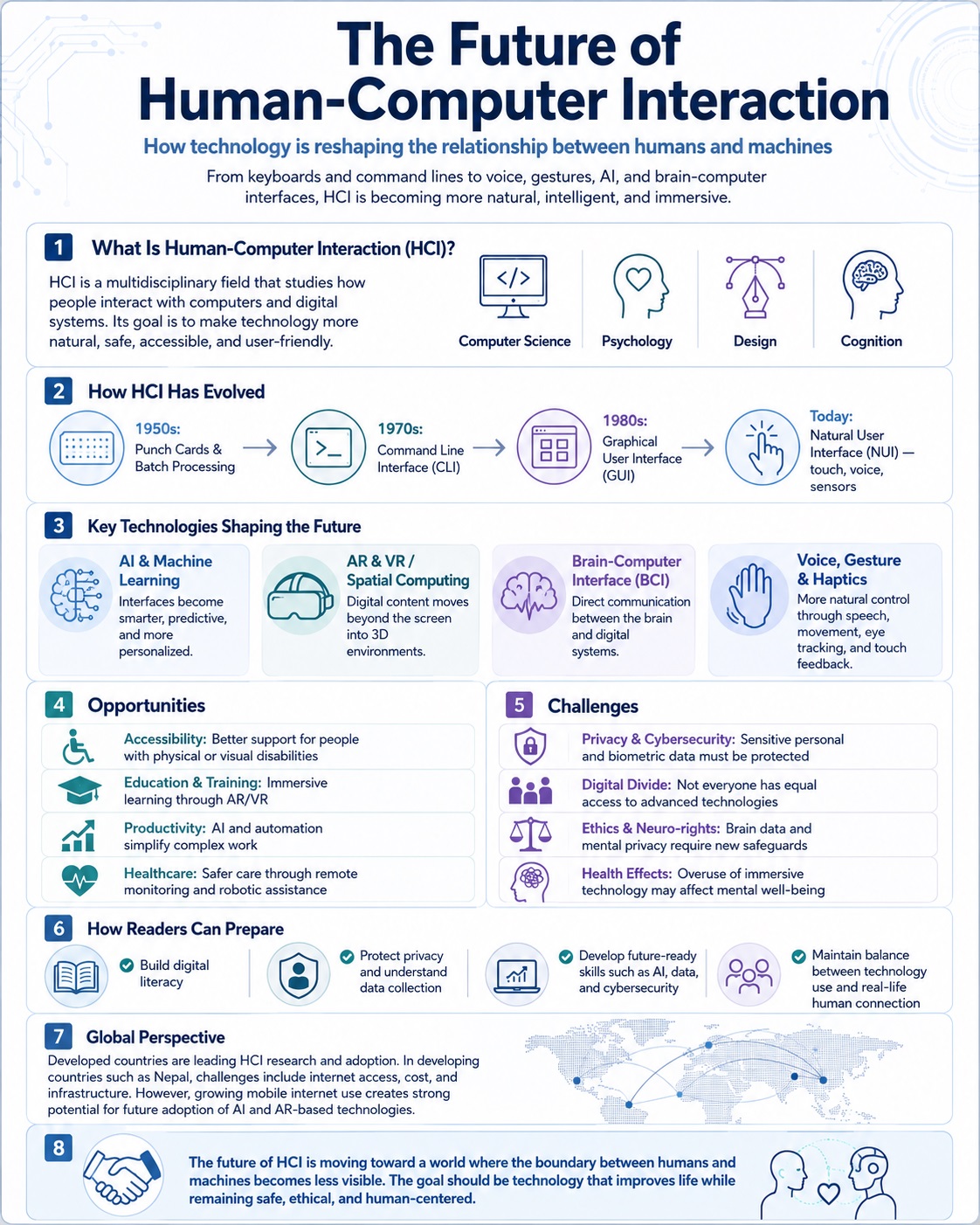
Human-computer interaction (HCI) is a multidisciplinary field of study that analyzes the relationship, design, and use of human and computer technology. It includes subjects such as computer science, psychology, cognitive science, and design.
Its main objective is to make technology easier, safer, and more natural for humans, so that people do not have to learn the language of machines; instead, machines can understand human language and behavior.
Technological Development: From Command Line to Natural Interface
To understand the future, it is necessary to look at the past. The development of HCI can mainly be divided into four stages:
-
Early Stage: Punch Cards and Batch Processing: In the 1950s, computers were huge, and punch cards were used to give them instructions. This process was very slow and complex.
-
Command Line Interface: Around the 1970s, with the arrival of screens and keyboards, users began operating computers by typing special commands, or codes. However, technical knowledge was essential for this.
-
Graphical User Interface: In the 1980s, the use of a mouse and visible icons on the screen began. This brought computers within the reach of ordinary people through “point and click.”
-
Natural User Interface: Today, we are in the era of touchscreens, voice recognition, and sensor technology. From swiping on smartphones to voice control on smart TVs, these are examples of NUI.
Key Future Technologies
The future of human-computer interaction will not be limited to screens. It will connect our physical and virtual worlds. The major technologies shaping the future are as follows:
1. Artificial Intelligence and Machine Learning
Artificial intelligence (AI) and machine learning are making interfaces intelligent and predictive. Previously, we had to give computers clear instructions for every task, but now AI can learn our habits, needs, and behavior and make decisions on its own.
For example, virtual assistants such as Apple’s Siri, Amazon’s Alexa, and Google Assistant do not only work by listening to our voice; they also understand the context of our questions and provide appropriate answers.
In the future, AI will provide services by understanding the user’s intent in advance. This is known as predictive computing. It will make technology more personalized.
2. Augmented Reality and Virtual Reality
Augmented reality (AR) and virtual reality (VR) are taking computing beyond two-dimensional screens and into three-dimensional environments. In technical terms, this is called spatial computing.
AR adds digital information to our real world, such as showing navigation while walking with smart glasses. VR, on the other hand, takes the user completely into a new digital world.
Devices such as Apple Vision Pro and Meta Quest have already made significant progress in this direction. In the future of HCI, people will not simply look at computer screens; they will work while being surrounded by digital information.
3. Brain-Computer Interface
Brain-computer interface (BCI) is one of the most exciting and potentially revolutionary technologies in HCI. It establishes direct contact between the human brain and a computer.
Companies such as Neuralink are developing chips and sensors that can convert human thoughts into digital signals.
The main benefit of this technology is that people with physical disabilities or paralysis may be able to operate computers, robotic arms, or wheelchairs simply by thinking. Although this technology is currently in the research and early testing stage, it has the potential to completely change communication between humans and machines in the future.
4. Voice, Gesture, and Haptic Technology
The need for physical touch to control future devices will gradually decrease. Technologies that allow tasks to be performed through facial expressions, eye tracking, and hand gestures are developing rapidly.
In addition, haptic technology is making it possible to experience digital environments through touch. For example, haptic gloves are being developed so that when a person touches an object in a virtual world, they can also feel its pressure, weight, or temperature in the real world.
Opportunities and Benefits
The future of human-computer interaction will bring countless opportunities:
-
Increased Accessibility: People with physical or visual disabilities will be able to use technology through voice and brainwaves.
-
Revolution in Education and Training: Students will be able to experience historical events directly through AR and VR, or medical students will be able to practice virtual surgery.
-
Increased Productivity: AI and automation will make complex tasks easier, allowing people to spend more time on creative work.
-
Improved Health Care: Remote monitoring and robotic surgery will make health care safer and more global.
Challenges and Concerns
The more advanced technology becomes, the more new challenges it creates. These challenges need to be addressed in time.
Privacy and Cybersecurity
When our devices collect sensitive data such as our voice, face, heartbeat, and even brainwaves, the consequences can be very serious if that data is hacked or misused.
Strong security systems will be essential to protect personal data and prevent cyberattacks. Basic knowledge of cybersecurity will also become increasingly important.
Digital Literacy and Accessibility
Not everyone may have access to these expensive technologies. This creates a risk of widening the digital divide between those who know how to use technology and those who do not.
Ethics and Neuro-Rights
With the development of brain-computer interfaces, concerns are growing that human thoughts and brain data could also be stolen. This has created the need for new legal concepts and ethical standards such as neuro-rights to protect mental privacy.
Health and Psychological Effects
Psychologists have expressed concern that spending too much time in virtual reality may distance people from the real world, lead to technology addiction, and negatively affect mental health.
Decision-Making Guidance for Readers
How should readers prepare themselves in this rapidly changing technological era?
-
Increase Digital Literacy: Instead of fearing new technologies, learn how they can be used safely in work and daily life.
-
Pay Attention to Privacy: When using smart devices, understand what kind of data they collect and keep privacy settings secure.
-
Develop New Skills: Students and young people should develop skills in future-oriented fields such as AI, data science, and cybersecurity.
-
Maintain Balance: Maintaining a balance between technology use and real-life human relationships is extremely important for mental health.
Global Perspective
From a global perspective, developed countries such as the United States, European countries, and China are far ahead in the research and use of new HCI technologies. However, in developing countries such as Nepal, reliable internet access, expensive devices, and a lack of technology-friendly infrastructure remain major challenges.
Even so, the growing use of mobile phones and mobile internet in Nepal keeps alive the possibility of adopting new technologies quickly in the future.
Just as developing countries moved directly into the mobile phone era by bypassing the landline telephone era, they may also be able to adopt affordable and accessible AR or AI technologies more easily in the future.
Conclusion
The future of human-computer interaction is moving toward removing the boundary between humans and machines. Technology is no longer only an external tool in our lives; it is becoming an integral part of our thinking and behavior.
It will expand our abilities and help solve complex problems. However, strong legal systems, cybersecurity, ethical standards, and global cooperation will be necessary to ensure its safe and fair use.
The development of technology should serve human benefit and convenience.






Comments 0
No comments yet. Be the first to start the conversation.