



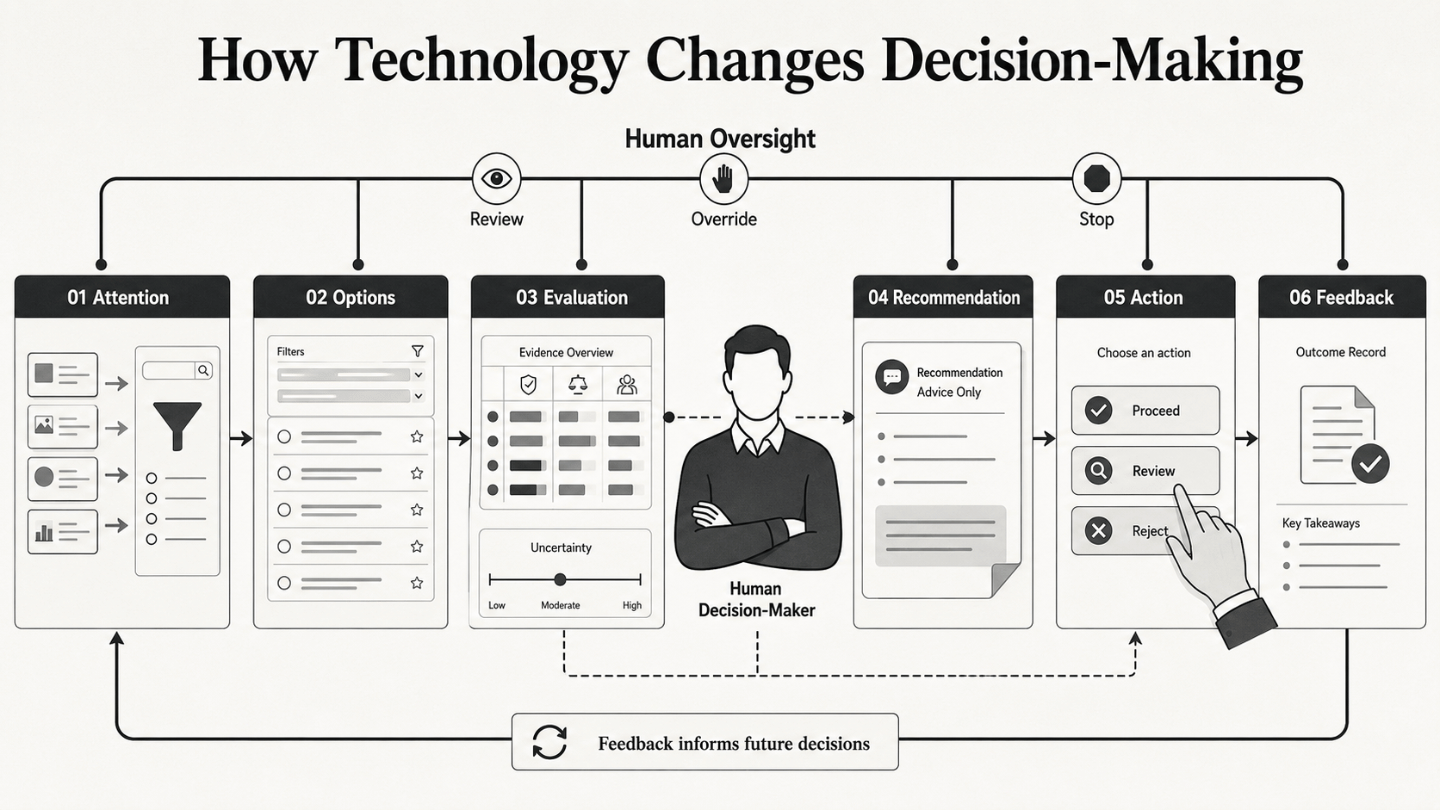
Technology influences decisions before a person actively selects an option. Search systems determine what receives attention. Rankings and defaults shape which alternatives appear. Forecasting tools summarize possible outcomes, while automated systems may recommend or carry out an action.
These functions can improve access, speed, and consistency, but they do not guarantee accurate, fair, or well-reasoned decisions. Their effect depends on the available information, system design, user knowledge, objective being pursued, and consequences of error.
Understanding the impact of technology on decision making therefore requires more than comparing human and machine performance. The more useful question is where technology enters the decision process and how much judgment or authority is delegated at each stage.
Answer Summary: Technology changes decisions by filtering information, structuring options, processing evidence, issuing recommendations, automating actions, and learning from outcomes. It can reduce routine effort and reveal patterns people may miss. It can also remove context, reinforce bias, encourage misplaced trust, and obscure responsibility. Responsible use depends on independent checks, retained human judgment, and oversight suited to the stakes and reversibility of each decision.
Table of Content
- How Technology Influences the Decision Process
- Key Terms for Technology-Assisted Decisions
- Six Ways Technology Changes Decision-Making
- Where Technology Helps Most
- Human, Automated, and Collaborative Decisions
- Examples Across Different Settings
- Matching Oversight to Risk and Reversibility
- Five Questions to Ask Before Following a Recommendation
- How Individuals Can Preserve Judgment
- How Organizations Can Strengthen Oversight
- Better Tools Still Require Better Judgment
Key Takeaways:
-
Technology influences attention, options, evaluation, action, and feedback.
-
Faster or more consistent decisions are not necessarily more accurate.
-
Cognitive offloading can reduce mental demand but may alter what people remember or practice.
-
Automation bias occurs when people rely too heavily on automated advice.
-
Rankings, defaults, prompts, and interface friction can steer choices.
-
Higher-stakes and less reversible decisions require stronger human control.
-
Meaningful oversight requires authority, information, competence, and time to intervene.
How Technology Influences the Decision Process
Technology reshapes the environment in which decisions are made, not only the final act of choosing. A person may remain formally responsible even when a digital system determines which facts, options, comparisons, and warnings are visible.
Darioshi and Lahav propose a behavioral-economics model of technology-assisted decision-making that focuses on information access and exposure to behavioral biases. An Institute for Security and Technology report separately examines user-experience design, gamification, and search systems as influences on reasoning and judgment. These sources support a mechanism-based explanation, but they do not establish that every digital interface affects every user in the same way.
The Six-Stage Decision Stack
A decision can be viewed as six connected stages:
-
Attention and input: What information reaches the person?
-
Option selection: Which alternatives are displayed, ranked, or excluded?
-
Evaluation: How is evidence summarized, visualized, or forecast?
-
Recommendation: Does a system suggest or rank an option?
-
Action: Does a person decide, or does the system act with limited intervention?
-
Feedback: How do outcomes shape later recommendations?
A weakness at an early stage can affect everything that follows. Incomplete information may produce a narrow set of options, while the resulting choice may become new data that reinforces the same pattern.
Key Terms for Technology-Assisted Decisions
Several related terms describe different levels of technological influence. Distinguishing them helps clarify who holds authority and where responsibility remains.
| Term | Meaning | Why it matters |
|---|---|---|
| Decision support | Technology supplies information, analysis, predictions, or recommendations while a person or institution retains a decision role. | The output assists judgment but does not remove human responsibility. |
| Automated decision | A system produces a decision or action with limited or no real-time human intervention. Degrees of automation vary. | Strong safeguards are needed when consequences are serious or difficult to reverse. |
| Choice architecture | Defaults, rankings, prompts, menus, and interface elements that structure a choice. | Design can influence behavior without issuing an explicit recommendation. |
| Automation bias | Overreliance on automated advice, including accepting an incorrect recommendation or overlooking missing information. | Apparent technical authority may discourage independent checking. |
| Cognitive offloading | Using an external action or tool to reduce internal memory or processing demands. | It can free mental capacity but changes how work and knowledge are distributed. |
| Human oversight | Human authority, responsibility, competence, and ability to question, override, repair, or stop a system. | A nominal reviewer is insufficient without the information and power to act. |
Six Ways Technology Changes Decision-Making
Technology affects decisions through six closely connected mechanisms. Each can improve the process under suitable conditions, but each can also introduce new limitations.
1. It Changes What Information Reaches Us
Technology can expand access to information while controlling what receives attention. Search rankings, feeds, alerts, recommendations, and personalized interfaces place selected facts before deliberate comparison begins.
Search, Ranking, and Personalization
Search tools can organize large collections, compare documents, translate text, and retrieve relevant material quickly. Yet relevance is not completeness. A highly ranked result may be useful without representing every credible view or every fact that matters.
Personalization can reduce irrelevant material, but it may also narrow exposure by favoring content similar to earlier behavior. The process may use clicks, browsing activity, location, or other data that users do not fully see.
Readers evaluating online claims can apply the source-checking methods in Collegenp’s guide to digital literacy for checking technology claims and scams.
More Access Versus Information Overload
More information supports judgment only when it is relevant, reliable, and understandable. Under information overload, people may accept the first plausible answer, follow a familiar source, or rely on a summary without checking what it excludes.
A stronger information check asks:
Which missing fact could materially change this decision?
This shifts attention from collecting more material to finding evidence that affects the choice.
2. It Changes Which Options We Consider
Technology influences choices through defaults, filters, menus, rankings, and the effort required to find alternatives. These features can reduce confusion, but they can also narrow the choice set before users compare it.
Defaults, Filters, and Interface Design
A default remains selected unless the user changes it. Filters reduce a large set of options according to chosen criteria. Rankings place some alternatives above others, while prompts and warnings direct attention at selected moments.
These features are forms of choice architecture. They do not necessarily remove freedom of choice, but they influence which action appears easiest, most normal, or most visible.
Users need a reasonable way to inspect the criteria, adjust settings, and reach meaningful alternatives. Organizations should also consider whether the interface serves the user’s objective or primarily advances another goal.
Convenience, Digital Nudges, and Hidden Persuasion
A digital nudge uses presentation, timing, defaults, or friction to steer behavior without formally removing choice. Some nudges support a clear user need, such as warning that required information is missing. Others may favor engagement, sales, data collection, or another organizational objective that differs from the user’s interests.
Privacy matters because personalization and nudging often depend on behavioral information. Useful questions include:
-
What data produced this recommendation?
-
Was the user informed about how the data would be used?
-
Can personalization be adjusted or disabled?
-
Can the user reach alternatives without unreasonable difficulty?
The issue is not that every nudge is harmful. The relevant question is whether the influence is understandable, proportionate, and compatible with the user’s interests.
3. It Changes How Evidence Is Processed
Digital tools can calculate, visualize, compare, simulate, and forecast beyond unaided human processing. Their value is strongest when the task is defined, the data are suitable, and decision-makers understand the output’s limits.
Dashboards, Forecasting, and Simulation
Dashboards show selected trends, forecasting systems estimate outcomes, and simulations test scenarios. These functions may reveal anomalies or compare options consistently. Collegenp’s article on how big data affects business and education decisions provides related background.
Every summary still reflects choices about what to measure and display. A dashboard presents selected indicators, while a forecast depends on earlier observations, definitions, assumptions, and modeling decisions.
The National Institute of Standards and Technology explains in its guidance on AI risk and human–AI interaction that converting complex human and social observations into measurable quantities may remove necessary context. It also emphasizes the need to define human roles and responsibilities clearly because results depend on the task, system, users, and surrounding conditions.
Speed and Consistency Are Not Accuracy
Technology can affect several qualities of a decision. Improvement in one does not establish improvement in another.
| Dimension | Possible benefit | Main limitation |
|---|---|---|
| Speed | Processes information quickly | A fast output can still be wrong or incomplete. |
| Consistency | Applies the same rule repeatedly | The same mistake can be repeated across many cases. |
| Accuracy | Detects patterns in suitable data | Performance can fall when the data or setting changes. |
| Fairness | May reduce some individual variation | Data, labels, rules, and access may reproduce unequal patterns. |
| Accountability | Creates logs and repeatable procedures | Responsibility may become unclear across people and systems. |
A system that saves time has not shown that it improves fairness. A consistent recommendation has not shown that it fits unusual cases.
Decision-makers should identify which outcome they are trying to improve and how that outcome will be measured.
4. It Moves Cognitive Work Outside the Mind
Cognitive offloading means using an external action or tool to reduce internal information-processing demands. Calendars, calculators, search tools, navigation services, note systems, and artificial intelligence (AI) assistants can all perform this function.
Risko and Gilbert’s review of cognitive offloading describes how physical actions and external tools can change a task’s information-processing requirements. Their analysis also emphasizes metacognitive judgment: users must decide when an external aid is appropriate and how much reliance it deserves.
When Offloading Frees Attention
Offloading can reduce routine memory demands and allow attention to be directed elsewhere. A student might use a calendar to track deadlines rather than repeatedly rehearsing dates. A professional might use software to calculate several scenarios while concentrating on assumptions and consequences.
In a 2025 perspective, Andy Clark argues that effective use of generative AI requires similar metacognitive skills: deciding what to delegate, how much to rely on a system, and how to assess its suggestions. This is a conceptual argument rather than an experimental finding about all users.
When Offloading Reduces Skill Practice
Offloading does not automatically weaken thinking. Its effect depends on what is delegated, how often the tool is used, and whether the underlying skill is still practiced.
A calculator may remove repetitive arithmetic without preventing mathematical reasoning. By contrast, accepting an explanation without evaluating it may reduce opportunities to practice interpretation or source checking.
The practical issue is skill allocation:
-
Which routine work can be delegated safely?
-
Which knowledge is needed to detect an error?
-
Which skills must remain available when the tool is unavailable?
-
Can the user explain or defend the result independently?
5. It Introduces Automated Advice and Automation Bias
Automated advice presents an output that may appear systematic, consistent, or evidence-based. Users may place too much trust in it, reject it without adequate reason, or rely on it inconsistently.
Why People Over-Trust or Under-Trust Systems
Parasuraman and Manzey’s 2010 paper integrates research on complacency, attention, task demands, and automation bias. It is a foundational review rather than a systematic review in the modern evidence-synthesis sense.
Automation bias can include:
-
accepting an incorrect automated recommendation;
-
failing to search for contradictory evidence;
-
overlooking information the system did not consider;
-
assuming automation has checked every relevant factor.
Under-trust also matters. A person may reject useful assistance because of a previous failure, poor explanation, or general distrust.
Responsible use therefore requires calibrated trust: reliance that reflects the tool’s demonstrated performance in the relevant setting.
What a Clinical Study Found
Kücking and colleagues studied automation bias in a clinical diagnostic task involving 210 participants. They measured bias through agreement with incorrect AI-enabled recommendations.
The study found less false agreement among participants with stronger diagnostic performance, certified wound-care training, or physician status. Higher perceived benefit was associated with more false agreement.
These findings apply to the wound-assessment task studied and should not be treated as universal effects across every profession or type of AI system. Factors such as trust, self-confidence, and task difficulty are discussed in the wider automation-bias literature, but they should not be presented as findings established by this single study.
Why Human–AI Teams Do Not Automatically Perform Better
Combining a person with an AI system does not guarantee a better result. Lai and colleagues’ survey of more than 100 empirical human–AI decision-making studies highlights substantial variation in tasks, interfaces, user roles, evaluation methods, and outcomes. The survey was released as a preprint and should be treated accordingly.
A peer-reviewed 2025 PNAS article by Ben-Michael and colleagues evaluated AI recommendations in one United States pretrial decision setting. In the studied randomized trial, the recommendations did not improve the classification accuracy of judges’ cash-bail decisions.
The result concerns a specific instrument, outcome definition, legal setting, and evaluation framework. It does not establish that AI advice is ineffective in all legal decisions.
A separate 2025 Scientific Reports experiment involved 703 participants in an online card game. Corvelo Benz and Gomez Rodriguez found a positive association between the usefulness of AI assistance and alignment between the system’s confidence and the participant’s confidence.
That experiment supports a task-specific point about confidence alignment, not a broad conclusion about all human preferences or decision environments. Together, these studies show why human–AI performance must be assessed in the actual task rather than assumed from the presence of both human and machine input.
6. It Creates Feedback Loops
Feedback loops arise when human behavior supplies data and system outputs influence later behavior. They can refine recommendations, but they can also reinforce errors, restricted choices, or biased patterns.
Human Data Shapes Systems, and Systems Shape Humans
A recommendation system may learn from clicks, ratings, purchases, approvals, or earlier decisions. Those records may reflect limited access, social pressure, interface design, previous recommendations, or missing alternatives rather than settled preferences.
When the records guide later choices, past conditions can become embedded in future outputs. The system may then influence the behavior it later interprets as evidence.
What Feedback-Loop Experiments Showed
A Nature Human Behaviour study of human–AI feedback loops by Moshe Glickman and Tali Sharot was published online in December 2024 and appeared in the journal’s 2025 volume. It reported experiments involving 1,401 participants.
In specific perceptual, emotional, and social judgment tasks, interaction with biased AI could increase human bias over time. The research also found that interaction with accurate AI could improve accuracy in parts of the study.
These findings demonstrate a possible feedback mechanism under the studied conditions. They do not establish that every AI interaction produces the same effect.
Feedback loops make continuing evaluation important. A system should not be judged only at launch because data, users, incentives, and operating conditions can change.
Where Technology Helps Most
Technology often provides more value in repeatable, well-defined, information-rich tasks where errors can be detected and corrected. Human judgment carries greater weight when a decision involves ambiguity, values, unusual circumstances, rights, welfare, or consequences that are difficult to reverse.
This is a practical heuristic, not a universal rule.
Repeatable, Defined, and Reversible Tasks
Greater technological assistance is easier to assess when:
-
inputs are reasonably consistent;
-
success criteria are defined;
-
errors can be detected;
-
exceptions can be referred to a person;
-
outcomes can be corrected without serious harm.
Examples may include sorting documents, checking forms for missing fields, calculating scenarios, scheduling, or identifying patterns for later review.
Even in these tasks, users need a way to recognize when the system is operating outside its expected conditions.
Ambiguous, Value-Laden, and High-Stakes Decisions
Human authority becomes more important when people may reasonably disagree about goals or trade-offs, when context is difficult to represent, or when an error affects rights, safety, education, employment, health, finance, or access to public services.
Medical, legal, financial, hiring, admissions, and public-service examples in this article illustrate decision mechanisms only. They do not replace qualified professional advice, official requirements, or jurisdiction-specific review.
Human, Automated, and Collaborative Decisions
The suitable approach depends on the task, available evidence, and cost of error. No approach is superior across every setting.
| Approach | Suitable conditions | Required safeguards |
|---|---|---|
| Human-led | Novel, ambiguous, context-heavy, or value-sensitive decisions | Relevant expertise, bias checks, documentation, peer review, and an appeal route |
| Automated | Repetitive, bounded, testable, and reversible tasks | Suitable data, monitoring, exception handling, logs, and stop controls |
| Human–AI collaborative | Tasks combining computational scale with contextual judgment | Clear roles, visible uncertainty, independent review, override authority, and outcome tracking |
Collaboration is meaningful only when the person has enough information, time, competence, and authority to disagree.
NIST’s framework, the OECD AI Principles, and UNESCO’s Recommendation on the Ethics of Artificial Intelligence emphasize human agency, transparency, accountability, risk management, or oversight. These documents are governance frameworks and recommendations. They do not prove that a nominal reviewer will prevent every error, and they do not replace applicable local law.
Examples Across Different Settings
The same mechanisms appear in personal choices and institutional decisions. The consequence of error determines the level of checking and control required.
| Setting | How technology influences the decision | Appropriate check |
|---|---|---|
| Everyday online choice | Rankings, reviews, defaults, and recommendations shape what appears first. | Compare alternatives and check whether the ranking goal matches the user’s need. |
| Education or learning | Search, note tools, and AI assistants organize material or suggest actions. | Verify sources and retain the ability to explain the material independently. |
| Workplace or business | Dashboards, forecasts, and scoring tools frame performance or resource choices. | Inspect definitions, missing context, incentives, and who can challenge the output. |
| Healthcare, hiring, or public services | Decision-support systems may prioritize cases, flag risks, or recommend action. | Require qualified review, documented reasons, an appeal route, and local legal or policy checks. |
These are simplified illustrations, not documented case studies. Real decisions depend on the institution, system, data, jurisdiction, and people involved.
Readers examining education-specific effects can also review the impact of technology on student learning.
Matching Oversight to Risk and Reversibility
Oversight should become stronger as consequences rise and correction becomes harder. Stakes concern the potential harm or benefit attached to a decision. Reversibility concerns whether an error can be repaired promptly and fairly.
| Decision profile | Oversight level | Practical controls |
|---|---|---|
| Low stakes and easy to reverse | Light review | Clear settings, user choice, correction options, and basic error reporting |
| Moderate stakes or partly reversible | Structured review | Source checks, uncertainty disclosure, approval rules, logs, and periodic review |
| High stakes or hard to reverse | Strong human control | Qualified authority, independent checks, documented reasons, appeal, monitoring, and power to stop the system |
This matrix is a practical decision framework rather than a legal standard.
An explanation alone does not ensure meaningful oversight. Explanations may be incomplete or interpreted differently by different users. Effective control also requires testing, authority, contestability, monitoring, and review of outcomes.
NIST specifically recommends defining human roles and responsibilities and collecting information about overrides and disagreements where appropriate.
Five Questions to Ask Before Following a Recommendation
Before accepting a technological recommendation, ask:
-
What information is missing?
Check whether the system has access to the context that could materially alter the decision. -
What is the system trying to achieve?
A tool may optimize engagement, speed, cost, risk prediction, or another measurable goal that does not fully match the user’s priorities. -
How uncertain is the output?
Treat a prediction as an estimate. Look for limitations, confidence information, and conditions under which performance may change. -
Can the decision be challenged or reversed?
Stronger review is needed when an error is difficult to correct or affects rights, safety, education, employment, or access to services. -
Who is accountable?
Identify who checks the data, approves the action, handles appeals, records errors, and can stop the system.
These questions reinforce the evaluation methods discussed in Collegenp’s guide to developing critical thinking skills.
How Individuals Can Preserve Judgment
Individuals can use digital tools while retaining control over values, interpretation, and consequential choices. The aim is to prevent convenience from becoming unexamined dependence.
Pause Before Accepting Rankings or Defaults
Treat the first result, recommended option, and preselected setting as starting points. Check whether alternatives are available and whether the ranking criteria fit the decision.
Compare Sources and Seek Disconfirming Evidence
Look for evidence that could show the preferred option is wrong. Compare original sources where possible, especially for consequential claims.
A decision process becomes stronger when it tests a conclusion rather than collecting only evidence that supports it.
Use Tools to Generate Options, Not Define Values
AI can summarize information, propose alternatives, or test scenarios. It cannot independently determine what a person should value.
Any apparent priorities come from objectives, instructions, rules, training data, interface design, or user input.
Collegenp’s guide to using artificial intelligence in daily life provides related task-level examples.
Keep Important Skills in Practice
Continue practicing source evaluation, estimation, independent explanation, interpretation, and error detection. These abilities help users recognize missing context or an unsuitable result.
Useful self-checks include:
-
Can I explain why the recommendation makes sense?
-
Could I identify a major factual error?
-
Do I understand the assumptions?
-
What would I do if the tool were unavailable?
-
Which part of the decision still requires personal or professional judgment?
How Organizations Can Strengthen Oversight
Meaningful oversight requires defined authority, suitable competence, enough time, access to relevant information, and a procedure for responding to errors. Assigning a person to approve an output is insufficient when that person cannot question or change it.
Define Decision Rights and Escalation
Organizations should state:
-
which decisions a system may support;
-
which recommendations require human approval;
-
which actions may be automated;
-
who can override or stop the system;
-
where unusual cases should be escalated.
Test Across Groups and Contexts
Performance should be assessed where the tool will operate. Results from one population, institution, language, workflow, or time period may not transfer to another.
Evaluation should examine:
-
data quality;
-
relevant outcome measures;
-
error patterns;
-
unusual cases;
-
changing conditions;
-
groups that may be affected differently.
Record Overrides, Errors, Appeals, and Outcomes
Records should show when people accepted, rejected, or changed a recommendation; what errors occurred; whether an appeal was made; and whether outcomes matched the stated purpose.
These records can help identify whether users are relying uncritically on the system, rejecting useful advice, or encountering recurring problems.
Review Systems When Conditions Change
Data, user behavior, rules, objectives, and operating conditions change. Monitoring should continue after a system enters use.
The OECD AI Principles were updated in May 2024 and address human rights, transparency, robustness, safety, and accountability. UNESCO’s 2021 recommendation provides a broader ethical framework involving human dignity, oversight, privacy, fairness, auditability, and accountability.
Both provide international guidance rather than jurisdiction-specific legal requirements.
Better Tools Still Require Better Judgment
Technology changes decision-making by reshaping attention, options, analysis, recommendations, action, and feedback. Its value lies in extending human capacity where tasks, evidence, limits, and responsibilities are clearly defined.
The same tools can narrow attention, hide assumptions, reinforce past patterns, or encourage misplaced confidence. Responsible use requires clear goals, reliable information, calibrated trust, retained skills, meaningful oversight, and accountability for outcomes.
The central question is not whether technology should participate in human choices. It is how much influence and authority a particular system should receive in a particular context.







Comments 0
No comments yet. Be the first to start the conversation.