



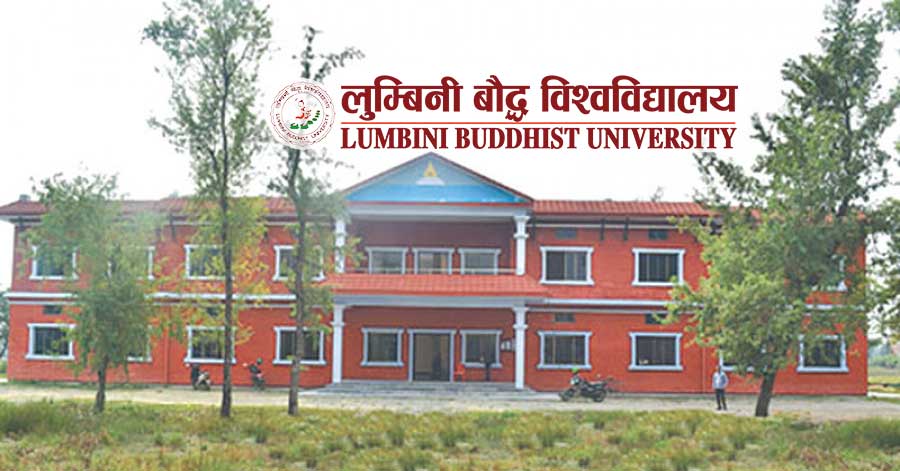
Lumbini Buddhist University (LBU), known in Nepali as लुम्बिनी बौद्ध विश्वविद्यालय, is an autonomous university based in the Lumbini area of Rupandehi, Nepal. Its statutory purpose centers on higher education, teaching, study, and research in Buddhist philosophy, literature, education, and culture.
Buddhist studies forms the university’s core academic identity. Its academic scope also extends to law, tourism and hospitality, business and artificial intelligence, languages, archaeology, international relations, development studies, engineering-related fields, and Sowa Rigpa. The university operates through academic faculties, schools, campuses, and institutions connected through affiliation or collaboration.
| Field | Detail |
|---|---|
| Official English name | Lumbini Buddhist University (LBU) |
| Nepali name | लुम्बिनी बौद्ध विश्वविद्यालय |
| Institution type | Autonomous university |
| Statutory basis | Lumbini Buddhist University Act, 2063 (Act No. 16) |
| Central location | Lumbini area, Rupandehi District, Nepal |
| General Administration | Parsa, Lumbini Sanskritik Municipality, Rupandehi, Lumbini Province, Nepal |
| Main academic areas | Buddhist Studies; Humanities & Social Sciences; Development Studies & Applied Sciences |
Lumbini Buddhist University developed around the idea of establishing a university in Lumbini with Buddhist education, scholarship, culture, and research at the center of its academic work.
Its legal mandate gives particular importance to Buddhist philosophy, literature, education, and culture. This foundation continues to define the university, although its academic structure is not limited to programs carrying a Buddhist Studies title.
LBU brings Buddhist disciplines together with professional, interdisciplinary, language, social-science, development, and applied fields. Students may encounter academic work concerned directly with Buddhist texts, traditions, philosophy, meditation, Himalayan studies, traditional art, peace, and development, alongside subjects such as law, hospitality, tourism, archaeology, international relations, business, language education, development studies, engineering management, disaster risk, forestry, and Sowa Rigpa.
This combination gives the university an academic character rooted in Buddhist scholarship while allowing study across several related and professional disciplines.
The idea behind Lumbini Buddhist University is connected with the World Buddhist Summit held in Lumbini from 30 November to 2 December 1998.
The summit considered the establishment of an international Buddhist university in Lumbini, the birthplace of Gautam Buddha, with an academic focus on Buddhist philosophy, literature, culture, and related subjects.
The Lumbini Declaration issued at the conclusion of the summit called for action toward establishing such a university. A seven-member preparatory committee was subsequently formed by the Lumbini Development Trust.
The committee included:
Prof. Dr. Tulasi Ram Vaidya as Convener
Ven. Sudarshan Mahasthavir
Ven. Ngawang Hoser Lama
Rev. Pt. Badri Ratna Bajracharya
Prof. Mohan Prasad Lohani
Prof. Tri Ratna Manandhar
Mr. Min Bahadur Shakya
Discussion on the proposed university continued through several meetings and preparatory stages.
On 3 Kartik 2061 B.S., a meeting chaired by the then Minister of Culture, Tourism and Civil Aviation, Hon. Deep Kumar Upadhyaya, formed the “Proposed Lumbini International Buddhist University Main Preparatory Committee 2061.”
Hon. Bharat Shah, then a Member of Parliament, served as Convener. Prof. Dr. Naresh Man Bajracharya, an expert in the field and then Head of the Central Department of Buddhist Studies at Tribhuvan University, served as Member-Secretary.
LBU dates its formal establishment to 14 Marga 2061 B.S., when the university was established through an ordinance. The establishment was declared on 16 Marga 2061 B.S. during the second World Buddhist Summit held in Lumbini.
A meeting of the Main Preparatory Committee on 23 Marga 2061 B.S. later made several institutional decisions, including renaming the committee as the “Lumbini Buddhist University Main Preparatory Committee 2061.”
The establishment chronology is not identical across official records. The Nepal Law Commission’s text of the Lumbini Buddhist University Act, 2063 preserves actions taken under a Lumbini Buddhist University Ordinance, 2062, while University Grants Commission records use 2062 B.S. (2005 A.D.) as the establishment year.
For that reason, the university’s history is better represented through its recorded B.S. chronology and statutory development rather than by assigning one unqualified A.D. establishment year.
Lumbini Buddhist University operates under the Lumbini Buddhist University Act, 2063.
The Lumbini Buddhist University Act, 2063 provides the statutory foundation for the university.
The Act defines LBU as an autonomous corporate body and places its central office in the Lumbini area of Rupandehi District. It is recorded as Act No. 16.
The Act identifies the university’s academic purpose in relation to higher-level teaching, study, and research in:
Buddhist philosophy
Buddhist literature
Education
Culture
This legal framework distinguishes LBU from a college operating under affiliation with another university. LBU is itself a university with its own statutory framework, governance system, academic bodies, campuses, and institutional relationships.
The university also identifies itself as an autonomous public institution of higher learning.
LBU connects its educational purpose with Buddhist principles and the broader ideas of peace, harmony, social responsibility, and human development.
Its mission centers on creating a community in which Buddhist principles inform education and everyday conduct. Intellectual development is considered alongside values such as wisdom, non-violence, empathy, maitri, compassion, and responsibility toward society.
The university’s educational direction does not isolate Buddhist learning from other forms of higher education. Its policies connect Buddhist culture, arts, philosophy, education, meditation, and ethical principles with a wider academic environment.
Professional and non-professional fields are also included within this structure.
The university’s academic direction therefore has two connected dimensions. One is the study and development of Buddhist knowledge itself. The other is the inclusion of Buddhist thought, culture, ethics, and related perspectives within interdisciplinary and professional education.
Research is another part of this institutional purpose. Buddhist religion, philosophy, culture, literature, art, archaeology, medical traditions, and related fields appear within the university’s research interests.
LBU organizes its academic work through three broad areas:
Buddhist Studies
Humanities & Social Sciences
Development Studies & Applied Sciences
The term “Faculty” is used for Buddhist Studies and Humanities & Social Sciences in parts of the university structure. Development Studies & Applied Sciences also appears as a School.
Together, these academic areas cover doctoral, postgraduate, undergraduate, certificate, professional, and interdisciplinary study.
Buddhist Studies forms the university’s principal discipline-specific academic area.
The academic portfolio spans different levels of study and several Buddhist traditions, languages, philosophical approaches, and applied areas.
Programs associated with Buddhist Studies include:
Ph.D. in Buddhist Studies
Master’s Degree by Dissertation
Master of Arts in Buddhism and Nepal Studies
Master of Arts in Translation and Interpreting
Theravada Buddhism
Pali Buddhist Studies
Mahayana Buddhism
Buddhist Studies
Applied Buddhism
Buddhism and Peace Studies
Buddhism and Sustainable Development
Buddhism and Himalayan Studies
Bhot Buddhist Studies
Bachelor’s-level study in Bhot Buddhist Studies
Traditional Buddhist art programs
Buddhist meditation programs
The range shows that Buddhist education at LBU is not restricted to a single tradition or method of study.
Some areas focus on Buddhist texts, languages, philosophy, doctrine, or historical traditions. Others connect Buddhist studies with peace, development, translation, Himalayan traditions, meditation, and traditional art.
Theravada, Mahayana, Pali, Bhot, Himalayan, meditation, and artistic traditions appear within the broader academic setting.
This structure allows Buddhist Studies to function as a multidisciplinary field rather than as one narrowly defined course of study.
The Humanities and Social Sciences area expands the university’s academic work into social-science, legal, professional, language, tourism, hospitality, business, international-relations, and archaeological fields.
Programs associated with this area include:
Bachelor of Arts Bachelor of Law (BA LL.B.)
Bachelor in Hospitality and Tourism Management
Bachelor in Travel and Tourism Management
Bachelor of Business Administration–Artificial Intelligence
Bachelor in Teaching Chinese to Speakers of Other Languages
Master in International Relations, Peace and Diplomacy
Master of Arts in Archaeology and Buddhist Archaeological Sites
MBA in Hospitality Management
Several of these programs connect naturally with the wider academic character of the university.
The Master of Arts in Archaeology and Buddhist Archaeological Sites links archaeological study with Buddhist heritage. International Relations, Peace and Diplomacy has a thematic relationship with the university’s wider interest in peace and international engagement.
Tourism and hospitality introduce professional fields relevant to travel, hospitality management, and tourism studies. The BA LL.B. provides a legal education pathway, while business and Chinese-language teaching add further academic directions.
The faculty therefore combines traditional humanities and social-science concerns with professional and interdisciplinary study.
Development Studies & Applied Sciences covers another group of interdisciplinary and applied programs.
Programs associated with this area include:
Master in Development Studies
Master of Science in Agro-Forestry
Master of Science in Construction Engineering and Management
Master in Science in Disaster Risk Engineering and Management
Bachelor of Sowa Rigpa Medicine & Surgery
These fields bring development, forestry, engineering-related management, disaster risk, and Sowa Rigpa into the university’s academic framework.
Their presence reflects an institutional structure that extends beyond Buddhist Studies while retaining Buddhist education as a distinct academic foundation.
Development studies provides a social and development-oriented area of study. Agro-forestry adds an environmental and land-related field. Construction Engineering and Management and Disaster Risk Engineering and Management introduce applied technical and managerial study.
Sowa Rigpa adds another field connected with traditional systems of knowledge and medicine.
The academic character of LBU can be understood through several broad subject groups.
| Academic direction | Examples |
|---|---|
| Buddhist scholarship | Buddhist Studies, Theravada Buddhism, Mahayana Buddhism, Pali Buddhist Studies, Bhot Buddhist Studies |
| Culture and heritage | Archaeology, Buddhist archaeological sites, traditional Buddhist art, Himalayan studies |
| Peace and society | Peace Studies, International Relations, Development Studies, Social Work |
| Professional fields | Law, hospitality, tourism, business |
| Language and translation | Translation and Interpreting, Chinese-language teaching, Bhot-related study |
| Applied fields | Agro-Forestry, construction management, disaster risk, Sowa Rigpa |
This breadth does not change the university’s statutory Buddhist foundation. Instead, it places Buddhist scholarship within a wider institutional setting that includes social, professional, cultural, language, development, and applied disciplines.
LBU operates through campuses, academic units, and institutions connected with the university through different institutional arrangements.
Names associated with this network include:
Central Campus
City Campus Butwal
School of Development Studies & Applied Sciences
Aksheswar Traditional Buddhist Art College
Lotus Buddhist Academic College
Boudha Multiple Campus
Lumbini College of Buddhism and Himalayan Studies
Sowa Rigpa International College
Tulsipur Metro College
Sulakshyan Kriti Bihar
Theravada Buddhist Academy
Sugata Buddhist College
Lumbini International Academy of Science & Technology
The institutional relationship is not expressed through one uniform category for every name in this group. Some form part of the university’s campus or academic structure, while others are connected through affiliation or collaboration.
This distinction matters because LBU is not organized as a single-campus institution with every academic activity taking place at one location.
Different programs and academic activities may be associated with different campuses or connected institutions within the university system.
Research is built into LBU’s statutory and academic purpose.
Its research direction includes work related to:
Buddhist religion
Buddhist philosophy
Buddhist culture
Buddhist literature
Buddhist art
Archaeology
Buddhist medical practices
Related interdisciplinary areas
The university’s policy direction encourages research into Buddha’s teachings and Buddhist education from multiple perspectives, including practical and interdisciplinary approaches.
Research activity also connects Buddhist subjects with culture, archaeology, art, medicine, society, and other academic fields.
The Lumbini Research Center forms part of this institutional research setting. Its academic direction includes research in Buddhist philosophy, culture, literature, and related fields together with cooperation involving national and international academic partners.
Publication is one component of LBU’s research environment.
Prajñā is a scholarly journal associated with the Faculty of Buddhist Studies.
Navārambhaḥ is associated with Central Campus.
These publications provide academic spaces connected with research, scholarly writing, and institutional academic activity.
Their presence also reflects the role of publication within the university’s broader research structure rather than limiting academic work to classroom teaching.
International engagement is consistent with the university’s original conception in Lumbini and the transnational nature of Buddhist scholarship.
The university’s cooperation policy includes academic interaction with national and international universities and institutions.
Such cooperation can involve the exchange of:
Academic knowledge
Faculty
Students
Research interests
Institutional experience
LBU’s academic fields also have international dimensions of their own.
Buddhist traditions such as Theravada and Mahayana cross national boundaries, while Pali, Bhot, Himalayan studies, translation, peace studies, international relations, tourism, archaeology, and Buddhist heritage naturally involve regional or international academic contexts.
This international orientation should be understood as part of the university’s academic and institutional character rather than as evidence of comparative ranking or institutional superiority.
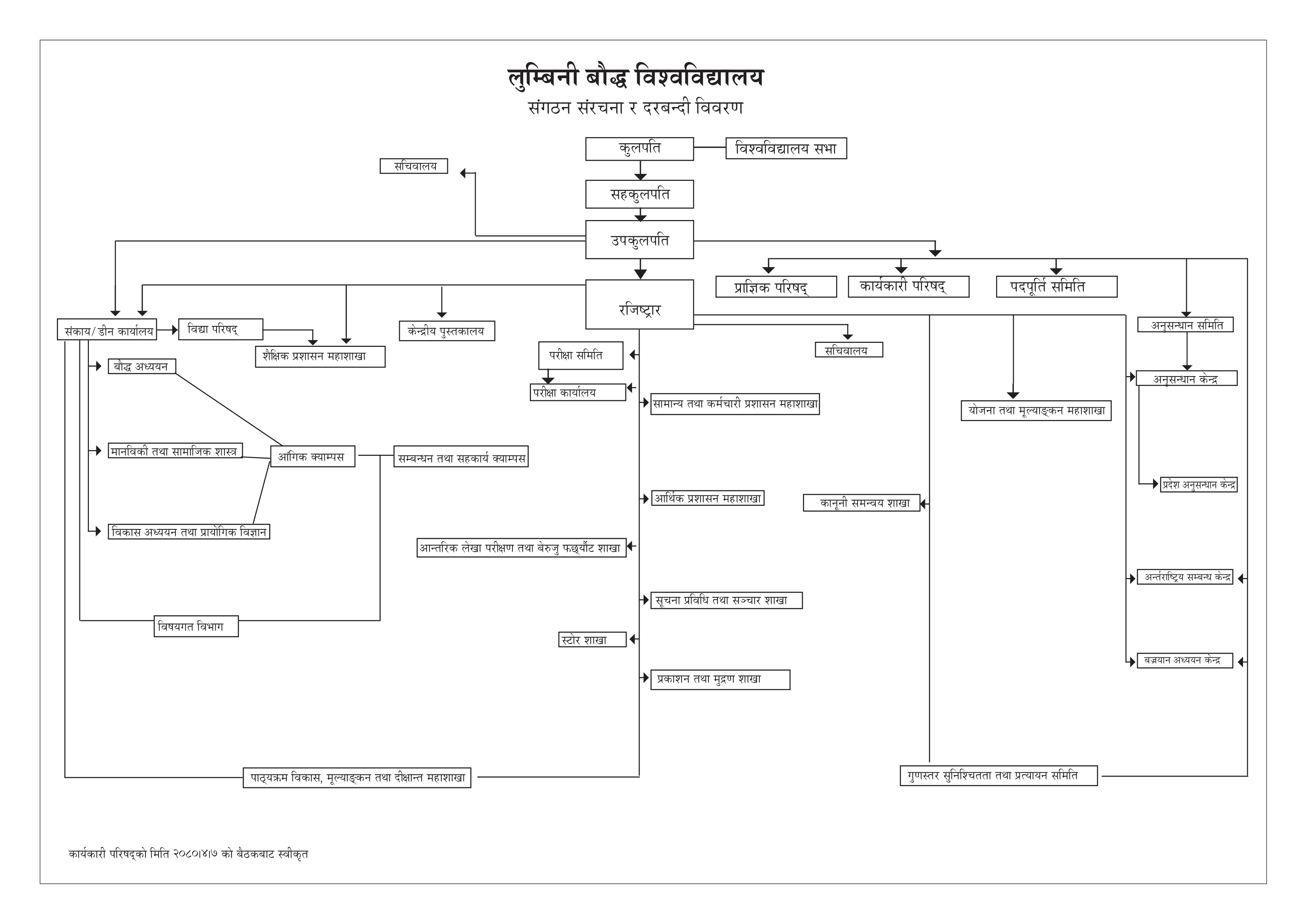
LBU operates through a formal university governance and administrative structure.
Its organizational framework includes:
Chancellor
Pro-Chancellor
Vice-Chancellor
Registrar
University Assembly
Academic Council
Executive Council
Recruitment Committee
Examination Committee
Examination Office
Faculties and Dean’s Offices
Academic Administration Division
Central Library
Planning and Evaluation Division
Research Committee
Curriculum Development, Evaluation and Convocation Division
General and Personnel Administration Division
Financial Administration Division
Internal Audit and Arrears Settlement Section
Information Technology and Communication Section
Legal Coordination Section
Publication and Printing Section
The academic structure further includes subject-specific departments, campuses, academic committees, and units associated with Buddhist Studies, Humanities and Social Sciences, and Development Studies and Applied Sciences.
The University Assembly forms part of LBU’s highest institutional governance structure.
The Academic Council deals with academic matters connected with curriculum, teaching, examinations, and related academic policy.
The Executive Council carries out decisions within the university’s governance framework.
These bodies place academic policy, administration, examination, institutional management, and university decision-making within a defined organizational structure.
The arrangement also separates different responsibilities rather than placing every academic and administrative function under one office.
Examination and academic administration form dedicated parts of LBU’s institutional structure.
The university’s examination framework covers matters connected with:
Examination organization
Assessment
Grading
Evaluation
Academic administration
The Dean’s Office and Examination Office form part of this structure.
The Curriculum Development, Evaluation and Convocation Division provides an additional institutional link between curriculum work, academic evaluation, and convocation.
This structure places examination and academic management within formal university bodies rather than treating them as separate administrative activities without institutional oversight.
LBU’s institutional policies address academic standards, teaching methods, educational resources, quality assurance, campus relations, and academic management.
Quality assurance and accreditation processes appear within the university’s policy framework in relation to academic programs and institutional relationships.
Dean-level academic management and academic departments are assigned roles in managing programs and developing the human resources and infrastructure required for academic work.
Educational technology and teaching materials also form part of the university’s policy approach.
The purpose of these provisions is administrative and academic regulation. They should not be interpreted as claims that every program, campus, or institution holds a particular external accreditation unless such status is separately established.
LBU’s institutional policy allows academic relationships with other institutions while maintaining particular attention to Buddhist education.
Its policy on affiliation gives priority to institutions active in Buddhist religion and philosophy within that area of the university’s work.
Cooperation with national and international institutions also forms part of its academic direction.
The university distinguishes between affiliation and broader forms of collaboration. This helps explain why its wider institutional network can contain campuses and organizations connected with LBU through different relationships rather than through one single category.
LBU’s research policy gives particular attention to Buddhist religion, philosophy, culture, literature, art, archaeology, education, and related fields.
It also allows research activity to connect with:
Local bodies
Government institutions
Private-sector organizations
Academic partners
National and international organizations
Students in different disciplines are encouraged within the institutional policy framework to engage with research topics connected with Buddhism and related cultural, historical, artistic, archaeological, and medical traditions.
The university also considers subject-specific research centers within its broader research organization.
This creates a research model in which Buddhist Studies remains central but can interact with other disciplines.
The university’s administrative policies address accountability, transparency, financial discipline, institutional responsibility, and ethical conduct.
Its organizational approach includes:
Defined administrative responsibilities
Financial administration
Internal audit
External audit
Institutional evaluation
Decision-making through established university bodies
The University Assembly, Academic Council, and Executive Council form part of this governance environment.
These provisions establish an administrative framework for institutional accountability and academic management.
LBU’s academic and administrative structure includes several resources connected with student study and university services.
These include:
Examination and result services
Library services
Student portal
Scholarship-related information
Academic program information
Institutional notices
University academic services
The Central Library also appears as a formal part of the organizational structure.
Student resources serve different academic purposes. Library services support study and research, examination services relate to academic assessment, and the student portal provides an institutional online point for enrolled students.
Scholarship provisions and schemes may have their own conditions and should not be interpreted as a universal financial entitlement for all students.
The Central Library forms part of LBU’s academic organization.
Within a university whose fields include Buddhist literature, philosophy, culture, archaeology, languages, law, social sciences, development studies, and applied subjects, library services form an important element of the academic structure.
The library sits alongside research, curriculum, examination, academic administration, and publication functions within the university organization.
Its institutional placement connects library services with both teaching and research rather than treating them solely as a general campus facility.
The expansion of LBU into professional and applied fields does not remove Buddhist Studies from the center of its academic identity.
Buddhist philosophy, literature, culture, education, language, meditation, peace, development, archaeology, traditional art, and Himalayan studies remain closely connected with the institution’s original purpose.
Some newer academic areas also have direct links to this foundation.
Archaeology and Buddhist archaeological sites relate to heritage. International Relations, Peace and Diplomacy connects with peace-oriented study. Tourism can interact with cultural and heritage contexts. Sowa Rigpa introduces a traditional medical system within the university’s wider applied academic structure.
Other programs, such as law, business, engineering management, or agro-forestry, broaden the institutional portfolio in directions that are less directly tied to Buddhist Studies.
The result is a university whose historical and legal identity remains Buddhist while its academic activity spans a wider range of disciplines.
Lumbini is integral to the origin and identity of the university.
The first World Buddhist Summit that contributed to the university proposal was held in Lumbini, and the later statutory framework places the university’s central office in the Lumbini area of Rupandehi.
This connection is institutional rather than merely geographic.
Lumbini’s importance in Buddhist history provided the setting for the original proposal to establish a university devoted to Buddhist philosophy, literature, culture, and related fields.
The university’s academic work in Buddhist Studies, archaeology, heritage, art, language, peace, and culture continues to reflect parts of that founding context.
The university’s statutory central location is the Lumbini area of Rupandehi District.
Its General Administration is located at Parsa, Lumbini Sanskritik Municipality, Rupandehi, Lumbini Province, Nepal.
| Location field | Detail |
|---|---|
| Central location | Lumbini area, Rupandehi District |
| General Administration | Parsa, Lumbini Sanskritik Municipality, Rupandehi, Lumbini Province, Nepal |
| Province | Lumbini Province |
| Country | Nepal |
The statutory central location and the General Administration address describe related but different location information within the university structure.
Lumbini Buddhist University can be understood through four closely connected features.
The first is its Buddhist academic foundation. Buddhist philosophy, literature, education, culture, languages, traditions, meditation, art, peace, and related subjects remain central to the university’s purpose.
The second is its interdisciplinary expansion. The university also has academic work in humanities, social sciences, law, tourism, hospitality, business, archaeology, international relations, development, forestry, engineering-related management, disaster risk, language teaching, and Sowa Rigpa.
The third is its multi-unit institutional structure. Academic activities are associated with campuses, faculties, schools, and institutions connected through different arrangements.
The fourth is its research orientation. Research, publication, academic cooperation, and scholarly activity form part of the university’s institutional structure alongside teaching.
Together, these elements define LBU as an autonomous university with a Buddhist foundation and a broader multidisciplinary academic portfolio.
The university operates under the Lumbini Buddhist University Act, 2063, Act No. 16.
Meta Title: Lumbini Buddhist University: Programs, History & Profile
Meta Description: Learn about Lumbini Buddhist University in Nepal, including its history, legal foundation, academic areas, programs, campuses, research and university structure.
Slug: lumbini-bouddha-university
Primary Keyword: Lumbini Buddhist University
Secondary Keywords: Lumbini Buddhist University Nepal, LBU Nepal, Lumbini Buddhist University programs, LBU Buddhist Studies, Lumbini Buddhist University history, LBU academic structure
Google NLP Notes:
Key Entities: Lumbini Buddhist University, LBU, Lumbini, Rupandehi, Lumbini Sanskritik Municipality, Buddhist Studies, Humanities & Social Sciences, Development Studies & Applied Sciences
Search Intent: Informational and institutional research
Content Category: University Profile
Sentiment: Informational
Lumbini Buddhist University is an autonomous university based in the Lumbini area of Rupandehi, Nepal. Its statutory academic purpose centers on higher education, teaching, study, and research in Buddhist philosophy, literature, education, and culture.
The Nepali name is लुम्बिनी बौद्ध विश्वविद्यालय.
LBU dates its formal establishment to 14 Marga 2061 B.S. through an ordinance. The recorded establishment chronology is not identical across all official records, while the university’s statutory framework is established under the Lumbini Buddhist University Act, 2063.
The university’s statutory central location is in the Lumbini area of Rupandehi District, Nepal. Its General Administration is located at Parsa, Lumbini Sanskritik Municipality, Rupandehi, Lumbini Province.
Yes. The Lumbini Buddhist University Act, 2063 defines LBU as an autonomous corporate body.
LBU identifies itself as an autonomous public institution of higher learning.
Its academic structure includes Buddhist Studies, Humanities & Social Sciences, and Development Studies & Applied Sciences.
No. Buddhist Studies forms its core academic field, but the university also has programs connected with law, hospitality, tourism, business, languages, international relations, archaeology, development studies, forestry, engineering-related management, disaster risk, and Sowa Rigpa.
Academic areas include Buddhist Studies, Theravada Buddhism, Mahayana Buddhism, Pali Buddhist Studies, Bhot Buddhist Studies, Applied Buddhism, Buddhism and Peace Studies, Buddhism and Sustainable Development, Buddhism and Himalayan Studies, meditation, and traditional Buddhist art.
Its academic portfolio includes Bachelor of Arts Bachelor of Law, tourism and hospitality programs, Bachelor of Business Administration–Artificial Intelligence, and MBA in Hospitality Management.
Development Studies & Applied Sciences includes study connected with agro-forestry, construction engineering and management, disaster risk engineering and management, development studies, and Sowa Rigpa.
Yes. Research forms part of its statutory and academic purpose. Its research interests include Buddhist philosophy, religion, culture, literature, art, archaeology, medical traditions, and related interdisciplinary areas.
Prajñā is associated with the Faculty of Buddhist Studies, while Navārambhaḥ is associated with Central Campus.
Yes. The Central Library forms part of the university’s organizational structure.
The university’s organizational structure includes the University Assembly, Academic Council, Executive Council, Examination Committee, faculties and dean-level offices, research bodies, and administrative divisions.
