




Soft skills are personal, social, and self-management abilities that help students communicate clearly, work with others, manage time, respond to feedback, and solve problems. They are different from hard skills, such as mathematics, writing, coding, accounting, or using software, because soft skills describe how a student learns, behaves, and works with people.
For students, these skills matter in class discussions, group projects, exams, presentations, clubs, scholarship applications, internships, interviews, and early career preparation. A student may understand a subject well but still struggle to explain an idea, meet a deadline, listen during group work, or revise after teacher feedback. This guide explains eight soft skills students can practice in everyday academic situations.
The U.S. Department of Labor identifies oral and written communication, teamwork and collaboration, and critical thinking or problem-solving as work-readiness skills. OECD also reports that students with stronger social and emotional skills tend to have stronger educational outcomes and healthier lives.
Answer Summary:
Soft skills for students are practical habits that support communication, teamwork, time management, adaptability, presentation, problem-solving, active listening, and willingness to learn. Students build these skills through class participation, group work, feedback, reflection, clubs, volunteering, internships, and real responsibilities. The goal is not to list soft skills as claims, but to show them through clear evidence.
Table of Content
- What Are Soft Skills for Students?
- Why Soft Skills Matter for Students
- Soft Skills vs Hard Skills
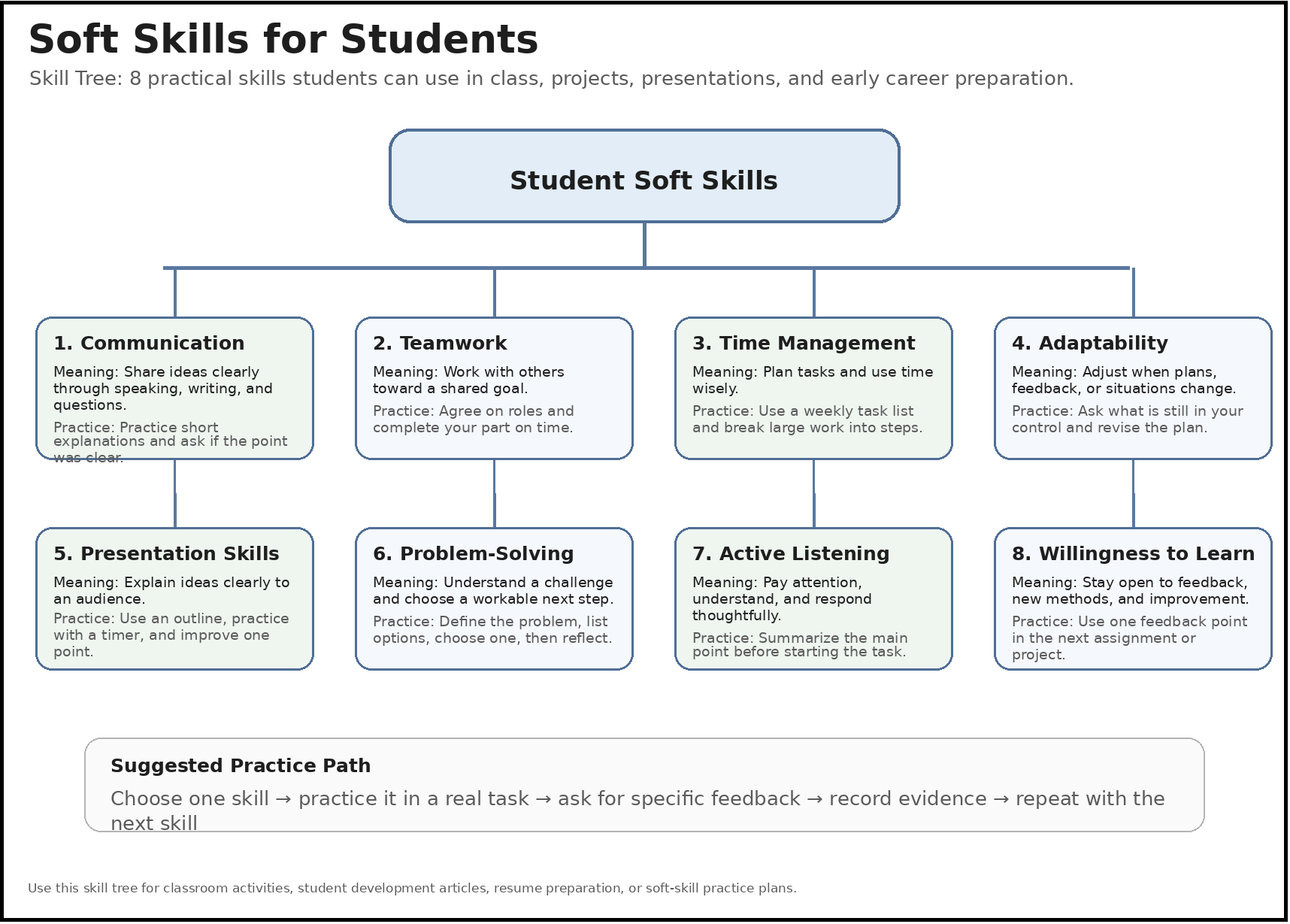
- Quick List of 8 Soft Skills for Students
- 8 Practical Soft Skills for Students
- How Students Can Improve Soft Skills
- How to Show Soft Skills on a Resume or Interview
- Certificates, Degrees, and Soft Skills
- Conclusion
Key Takeaways:
-
Soft skills describe how students communicate, listen, plan, adapt, and work with others.
-
Hard skills show subject or technical ability; soft skills help students apply that ability well.
-
The eight focus skills are communication, teamwork, time management, adaptability, presentation, problem-solving, active listening, and willingness to learn.
-
Students improve soft skills through practice, feedback, and reflection.
-
Resume claims are stronger when supported by project, club, presentation, or volunteer evidence.
-
Soft skills support academic and career readiness, but they do not replace subject knowledge.
-
Students should practice one skill at a time for better consistency.
What Are Soft Skills for Students?
Soft skills for students are non-technical abilities that shape how they learn, interact, and manage responsibilities. They include communication, teamwork, time management, adaptability, presentation skills, problem-solving, active listening, and willingness to learn.
These skills are not fixed personality traits. A quiet student can become a clearer speaker. A disorganized student can learn to plan assignments. A student who struggles in group work can learn to share tasks, listen, and follow through.
CASEL describes social and emotional learning through five core areas: self-awareness, self-management, social awareness, relationship skills, and responsible decision-making. OECD’s Survey on Social and Emotional Skills studies these abilities among 10- and 15-year-old students and examines how they relate to academic success, employability, active citizenship, health, and well-being.
Why Soft Skills Matter for Students
Soft skills matter because students learn with teachers, classmates, mentors, and future employers. They help students manage academic work, participate in group tasks, respond to feedback, and prepare for future opportunities.
Good grades and technical knowledge are valuable, but students often need more than subject knowledge. They need to explain what they know, ask for help, manage deadlines, take responsibility, and work with people who may think differently.
OECD reports that higher levels of many social and emotional skills are linked with stronger academic achievement in mathematics, reading, and arts, along with lower rates of tardiness and skipping school. This does not mean soft skills alone create academic results. Students still need subject knowledge, study time, teacher support, resources, and fair learning conditions.
Soft skills also support students when they apply for internships, scholarships, student leadership roles, volunteer work, part-time jobs, and entry-level positions. The National Association of Colleges and Employers defines career readiness through eight competencies: career and self-development, communication, critical thinking, equity and inclusion, leadership, professionalism, teamwork, and technology.
Soft Skills vs Hard Skills
Soft skills describe how students work. Hard skills describe what students can do in a subject or technical area.
For example, solving an equation, writing an essay, coding a webpage, preparing a lab report, or using spreadsheet software are hard skills. Explaining the answer clearly, working with a partner, managing the deadline, listening to instructions, and revising after feedback are soft skills.
The World Bank describes skills development as a combination of foundational skills, higher-order cognitive skills, socio-emotional skills, technical skills, entrepreneurial skills, and digital skills. This wider view is useful for students because academic knowledge and personal work habits often need to work together.
Soft skills do not replace hard skills. A student applying for an engineering program still needs mathematics and science preparation. A student applying for a design role still needs design work. A student applying for a coding internship still needs coding ability. Soft skills help students use their knowledge better, but they are not a substitute for learning the subject.
Quick List of 8 Soft Skills for Students
The research brief for this article defines the topic as eight student-relevant skills: communication, teamwork, time management, adaptability, presentation, problem-solving, active listening, and willingness to learn. It also recommends a practical student-first guide with examples, practice tips, resume use, and FAQs rather than a broad career-only article.
| Soft Skill | What It Means | Student Example | Practice Method |
|---|---|---|---|
| Communication | Sharing ideas clearly through speaking and writing | Explaining a project idea to classmates | Practice short explanations and ask if the point was clear |
| Teamwork | Working with others toward a shared goal | Dividing tasks in a group assignment | Agree on roles and complete your part on time |
| Time management | Planning tasks and using time wisely | Studying across a week before an exam | Use a weekly task list |
| Adaptability | Adjusting when plans or feedback change | Revising a project after teacher comments | Ask what can be improved next |
| Presentation skills | Explaining ideas to an audience | Giving a class presentation | Practice with a timer |
| Problem-solving | Finding a practical way to handle a challenge | Fixing an error in project data | Define the problem before choosing a solution |
| Active listening | Paying attention and responding thoughtfully | Repeating key instructions before starting work | Summarize the main point in your own words |
| Willingness to learn | Staying open to feedback and improvement | Revising an essay after feedback | Use one suggestion in the next attempt |
8 Practical Soft Skills for Students
The eight skills below are useful because students can practice them in school, college, and early career settings. Each skill includes a meaning, a student example, a practice method, and a realistic limit.
1. Communication
Communication is the ability to share ideas clearly, respectfully, and in the right format. Students use communication when speaking in class, writing assignments, asking questions, emailing teachers, explaining project ideas, and answering interview questions.
Good communication does not mean talking more than everyone else. It means making the message easy to understand. A student with good communication skills chooses the main point, gives enough context, and checks whether the listener understands.
Example: During a group project, a student says, “I can research the background today. Can you prepare the slides? Let’s compare notes tomorrow.” This message is clear because it names the task, the person, and the timeline.
How to practice: Before speaking, decide the main point. Use simple words. After explaining, ask whether the point was clear. For writing, reread the message before sending it and remove unclear wording.
Limit: Communication does not mean every discussion will go smoothly. Students still need patience, listening, and respect when opinions differ.
2. Teamwork
Teamwork is the ability to work with others toward a shared result. Students use teamwork in group assignments, science projects, lab work, clubs, sports, debates, competitions, and community activities.
Good teamwork does not mean one student does all the work. It means sharing tasks, respecting roles, listening to ideas, and completing assigned work on time.
Example: In a four-member assignment, one student gathers sources, one prepares slides, one writes speaking notes, and one checks formatting. The group reviews the final work before submission.
How to practice: Agree on roles before starting. Set a shared deadline before the official deadline. Invite input from quieter members. Write down tasks so the group does not rely on memory.
Limit: Teamwork does not mean avoiding disagreement. A strong team can discuss problems calmly and change the plan when needed.
3. Time Management
Time management is the ability to plan tasks and use time wisely. Students need it for homework, exam preparation, projects, club responsibilities, family duties, and rest.
Time management is not about staying busy all day. It is about deciding what needs attention first and giving enough time to meaningful work.
Example: Instead of studying an entire chapter the night before an exam, a student studies two sections each day, reviews notes at the end of the week, and asks the teacher about unclear topics.
How to practice: Keep a weekly task list. Break large assignments into smaller parts. Set a personal deadline before the official deadline. Study difficult subjects when attention is stronger.
Limit: Time management cannot remove every unexpected problem. Students still need flexibility when plans change.
4. Adaptability
Adaptability is the ability to adjust when plans, feedback, tools, or situations change. Students use adaptability when project instructions change, a group member is absent, a topic becomes harder than expected, or teacher feedback requires revision.
Adaptability does not mean accepting poor planning or unfair treatment. It means responding constructively when change is part of learning.
Example: A teacher asks a group to revise a presentation because the evidence is weak. An adaptable student helps update the outline, finds stronger sources, and adjusts the speaking order.
How to practice: When a plan changes, ask what is still in your control. Try a different study method if one method is not working. Treat feedback as information for revision.
Limit: Adaptability does not mean staying silent when instructions are unclear. Asking for clarification is part of adapting well.
5. Presentation Skills
Presentation skills help students explain ideas to an audience. These skills include organizing content, speaking clearly, using visuals, managing time, and answering questions.
Many students feel nervous before presentations. That can happen even with preparation. The goal is not perfect delivery; the goal is a clear message.
Example: A student presenting a science project starts with the problem, explains the method, shows the result, and ends with what the group learned.
How to practice: Use a simple outline: opening, main points, evidence, closing. Practice with a timer. Use slides as support, not as a full script. Record one practice version and choose one area to improve.
Limit: Presentation practice may not remove all nervousness. Students can still present clearly while feeling nervous.
6. Problem-Solving
Problem-solving is the ability to understand a challenge, compare options, and choose a workable next step. Students use problem-solving when homework is confusing, project data is wrong, group work is delayed, or exam preparation is not going well.
Good problem-solving starts with defining the real issue. If students rush to an answer, they may solve the wrong problem.
Example: A group project is behind schedule. A problem-solving student lists unfinished tasks, identifies the most urgent part, divides remaining work, and sets a check-in time.
How to practice: Write the problem in one sentence. List two or three possible solutions. Choose the option that fits the time, resources, and rules. Afterward, reflect on what should change next time.
Limit: Problem-solving does not mean students should handle every problem alone. Some problems need help from a teacher, counselor, parent, mentor, or supervisor.
7. Active Listening
Active listening means paying attention, understanding the message, and responding thoughtfully. It is different from staying quiet while waiting to speak.
Students use active listening in class, group discussions, presentations, interviews, and feedback conversations. It helps reduce mistakes and shows respect. Coursera describes active listening as absorbing what someone shares and reflecting back through questions and body language that the message was heard.
Example: A teacher explains an assignment. An active listener notes the deadline, asks one clarifying question, and repeats the main requirement in their own words.
How to practice: Put away distractions during instructions. Look at the speaker when appropriate. Ask a clarifying question when needed. Summarize the key point before starting the task.
Limit: Active listening does not mean agreeing with everything. Students can listen carefully and still ask questions or offer another view.
8. Willingness to Learn
Willingness to learn is the habit of staying open to feedback, new methods, and improvement. Students need it when they face new subjects, unfamiliar tools, difficult chapters, and mistakes.
A student who is willing to learn does not pretend to know everything. They ask questions, try again, and use feedback in the next attempt.
Example: After receiving feedback on an essay, a student rewrites the introduction, checks the argument, and asks how to make the next draft stronger.
How to practice: Ask one specific question when confused. Use feedback in the next assignment. Try one new study method for a difficult topic. Keep a short reflection note after projects or tests.
Limit: Willingness to learn should not mean accepting unlimited workload. Students also need rest, planning, and realistic priorities.
How Students Can Improve Soft Skills
Students improve soft skills by practicing them in real situations. The most useful practice comes from classroom tasks, group work, presentations, clubs, volunteering, internships, and reflection.
The National Careers Service suggests developing communication skills through activities such as joining a sports team or creative arts club, volunteering, and practicing calls. Coursera also describes soft skills as attributes and behaviors that shape how a person approaches tasks and other people.
Use Everyday School and College Tasks
Daily academic tasks give students enough chances to practice. A student can practice communication by asking a clear question. They can practice active listening by summarizing instructions. They can practice teamwork by completing a group role on time.
Useful practice situations include:
-
Class discussions
-
Group assignments
-
Lab work
-
Presentations
-
Student clubs
-
Sports teams
-
Debate or quiz competitions
-
Peer study groups
-
Volunteering
-
Internship tasks
Practice One Skill at a Time
Students often improve better when they focus on one skill for a short period. Trying to improve every skill at once can become confusing.
A simple four-week plan can look like this:
-
Week 1: Use a weekly task list for time management.
-
Week 2: Ask one clear question in class to practice communication.
-
Week 3: Summarize instructions before starting work to practice active listening.
-
Week 4: Explain one topic to a friend to practice presentation skills.
This approach makes the skill visible. Students can see what they practiced and what changed.
Ask for Specific Feedback
Feedback works better when the question is specific. Instead of asking, “Was my presentation good?” a student can ask, “Was my opening clear?” or “Did I speak too fast?”
Specific feedback helps students revise their behavior. Teachers, classmates, mentors, club leaders, and internship supervisors can give useful feedback when the question is clear.
Keep a Soft-Skill Evidence Log
A soft-skill evidence log is a short record of real examples. Students can use it later for resumes, scholarship forms, interviews, and personal reflection.
The log can include:
-
Project title
-
Student role
-
Skill used
-
Challenge faced
-
Action taken
-
Result or lesson
-
Feedback received
For example, a student may write: “Science exhibition project: coordinated a four-member group, divided tasks, corrected presentation slides after teacher feedback, and presented the final model.”
 How to Show Soft Skills on a Resume or Interview
Students should show soft skills with evidence. A plain claim such as “good communication skills” is weaker than a specific example from a project, club, presentation, volunteer role, or internship.
NACE’s career readiness framework includes competencies such as communication, critical thinking, professionalism, teamwork, leadership, technology, and career and self-development. These competencies are easier to show when students describe what they did and where they used the skill.
Weak vs Strong Resume Examples
Weak: Good teamwork skills.
Stronger: Worked with a four-member group to research, prepare, and present a science exhibition model.
Weak: Good time management.
Stronger: Planned weekly study tasks while completing club responsibilities and submitting assignments on time.
Weak: Strong communication skills.
Stronger: Presented a class project, answered teacher questions, and revised slides after peer feedback.
Interview Answer Method
Students can answer soft-skill questions using a simple structure:
-
Situation: What was happening?
-
Task: What responsibility did you have?
-
Action: What did you do?
-
Result or lesson: What changed, or what did you learn?
Example answer:
“In a group presentation, our slides were incomplete two days before submission. I listed the missing parts, divided the remaining work, and set a short review meeting. We finished the presentation on time, and I learned that assigning roles early helps the group avoid last-minute confusion.”
Resume Evidence Table
| Soft Skill | Evidence Students Can Mention |
|---|---|
| Communication | Presented a class project and answered questions |
| Teamwork | Completed a defined role in a group assignment |
| Time management | Planned exam revision while meeting assignment deadlines |
| Adaptability | Revised a project after teacher feedback |
| Presentation skills | Delivered a seminar, debate, project report, or speech |
| Problem-solving | Found an error in project data and helped correct it |
| Active listening | Clarified instructions before submitting work |
| Willingness to learn | Used feedback to improve the next draft or presentation |
Certificates, Degrees, and Soft Skills
Soft skills can be practiced without a certificate, but structured courses may help some students. Certificates and degrees serve different purposes, so students should judge them by learning value, practice quality, and recognition.
Certificate vs Degree
A certificate is usually a shorter program focused on a specific topic or skill area. A soft-skill certificate may cover communication, leadership, teamwork, public speaking, workplace readiness, or interview preparation.
A degree is a longer academic qualification with broader curriculum, formal assessment, and institutional requirements. Degrees may include soft-skill development through seminars, assignments, presentations, labs, internships, and group projects, but soft skills are rarely the only focus.
For soft skills, a certificate may support learning, but behavior matters more than the certificate name. A student who completes a communication course still needs to show communication through writing, presentations, interviews, or project work.
Quality Signals to Check
Students should evaluate soft-skill courses carefully. Useful quality signals include:
-
Clear learning outcomes
-
Credible instructor or provider background
-
Practice-based assignments
-
Feedback or assessment
-
Real speaking, writing, teamwork, or reflection tasks
-
Evidence students can use in a portfolio or resume
-
Clear time commitment
-
Transparent completion requirements
A short course with practice and feedback may be more useful than a longer course that only provides videos.
Pros, Cons, and Limits
Certificates can be flexible and focused. They may help students practice public speaking, communication, teamwork, or interview skills.
Their limits include recognition, depth, assessment quality, and cost. Some certificates may not be widely recognized. Some may not transfer into school or college credit. Students should check whether the course includes real practice before paying.
Degrees usually provide broader learning and stronger formal recognition in many fields. Their limit is that they take more time and may not focus directly on one soft skill. Students should build soft skills through both formal learning and everyday practice.
Conclusion
Soft skills for students are practical habits that support learning, group work, presentations, deadlines, feedback, and early career preparation. Communication, teamwork, time management, adaptability, presentation skills, problem-solving, active listening, and willingness to learn are useful because students can practice them in ordinary academic situations.
Students do not need to master every skill at once. A sensible next step is to choose one skill, practice it in a real situation, ask for specific feedback, and record evidence. Over time, these habits can support stronger class participation, clearer project work, and more credible resumes or interviews.




Comments 0
No comments yet. Be the first to start the conversation.