



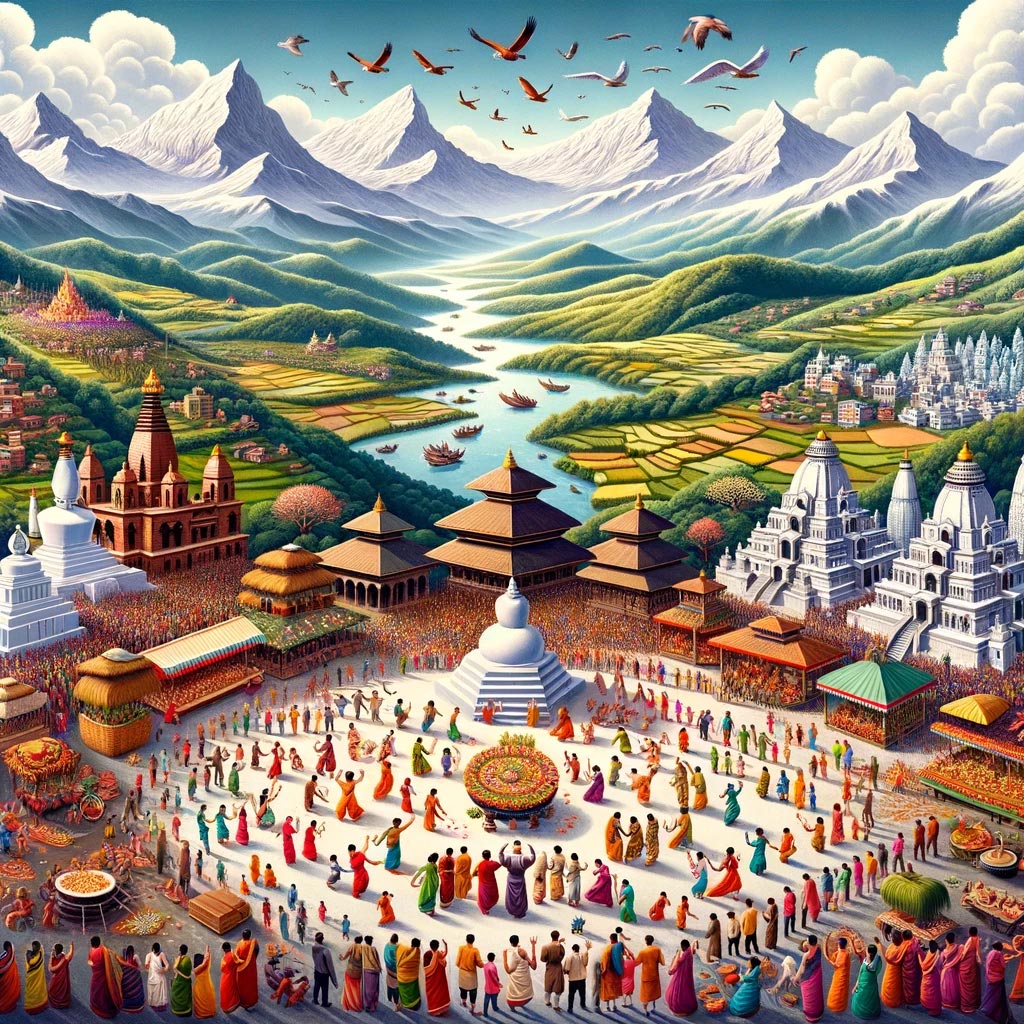
Dashain, Tihar, and Chhath are three important festivals in Nepal, each with distinct religious meanings, family traditions, and cultural practices. Dashain emphasizes the worship of Goddess Durga and the exchange of blessings, Tihar honors deities, animals, and sibling relationships, while Chhath centers on devotion to the Sun and prayers for family well-being.
These festivals bring religious observances into everyday family life through shared meals, household preparations, prayers, visits to relatives, and community gatherings. They also provide opportunities for younger generations to learn traditions from parents, grandparents, and other relatives.
Although the festivals share themes of devotion, gratitude, and family connection, their customs are not identical across Nepal. Religious beliefs, ethnic identities, regional traditions, and individual family practices influence how each celebration is observed.
Table of Content
- Understanding Dashain, Tihar, and Chhath
- Dashain: Family Blessings, Worship, and Reunions
- Tihar: Lights, Animal Worship, and Sibling Relationships
- Chhath: Sun Worship and Family Well-Being
- Regional and Community Differences in Festival Traditions
- How Families Preserve Traditions Across Generations
- How Festival Celebrations Are Changing
- Understanding and Respecting Festival Customs
- Conclusion
Understanding Dashain, Tihar, and Chhath
All three festivals occur during Nepal's autumn festival season, but each has its own religious background and ceremonial practices.
| Festival | Religious and Cultural Focus | Main Family Traditions |
|---|---|---|
| Dashain | Worship of Goddess Durga, blessings, and the symbolic victory of good over evil | Ghatasthapana, jamara, tika, family reunions, and feasts |
| Tihar | Worship of Laxmi and Yama, respect for animals, and sibling relationships | Animal worship, Laxmi Puja, Deusi–Bhailo, Mha Puja, and Bhai Tika |
| Chhath | Worship of the Sun, gratitude, purity, and family well-being | Preparation of offerings, traditional observances, sunset and sunrise prayers, and sharing prasad |
Dashain is traditionally observed over fifteen days, Tihar spans five days, and Chhath is commonly described as a four-day observance.
Their dates change annually because they follow traditional lunar calendars. The exact timing should be checked against the relevant Nepali calendar when planning celebrations or travel.

Dashain: Family Blessings, Worship, and Reunions
Dashain, also called Bada Dashain or Vijaya Dashami, is among Nepal's most widely observed Hindu festivals. Its religious significance is associated particularly with Goddess Durga's victory over the demon Mahishasura, symbolizing the triumph of divine power over destructive forces.
The festival is also associated with seasonal harvest traditions and extended family gatherings. For many households, its defining experience is visiting respected elders, receiving blessings, and spending time with relatives who may live in different places.
According to the Nepal Tourism Board's explanation of Dashain, worship, gifts, blessings, family visits, and ceremonial observances are central to the festival.
Ghatasthapana and the Growing of Jamara
Dashain begins with Ghatasthapana, the ceremonial establishment of a sacred vessel and the beginning of worship associated with Goddess Durga.
Families who observe this tradition prepare a designated prayer space and sow grains, particularly barley, to grow jamara. The young shoots are kept for use during the festival's principal blessing rituals.
Jamara represents auspiciousness and prosperity in the religious tradition. Its preparation also gives household members an opportunity to participate in a ceremony that connects the beginning of Dashain with its main day.
Practices vary: some families prepare the ritual at home, while others obtain jamara from temples or established ceremonial spaces.
Phulpati, Maha Ashtami, and Maha Nawami
The days preceding Vijaya Dashami include important forms of worship, particularly Phulpati, Maha Ashtami, and Maha Nawami.
Families may visit temples, conduct household prayers, prepare religious offerings, and gather for meals. Some traditions include animal offerings, while other households follow different devotional practices.
These observances are not uniform. The ceremonies performed, the deities honored, and the degree of participation depend on family traditions and religious affiliations.
For families that observe these days together, preparations often involve several generations, with experienced members explaining the order and meaning of the rituals.
Vijaya Dashami: Receiving Tika, Jamara, and Blessings
Vijaya Dashami, the tenth day, is the central family occasion of Dashain.
In many households, elders place tika on the foreheads of younger relatives and offer jamara alongside spoken blessings. Red tika is commonly prepared using rice, yogurt, and vermilion, although the color and preparation vary among communities.
Blessings traditionally express wishes for health, longevity, well-being, and prosperity. The exchange also recognizes family relationships and respect between generations.
Relatives may travel between households to receive tika from parents, grandparents, and other respected elders. In many families, these visits continue beyond Vijaya Dashami until Kojagrat Purnima, the full-moon day that concludes Dashain.
The ceremony has particular significance for families separated by work, education, or migration. Even when members cannot gather, exchanging greetings or blessings can help maintain family connections.
Food, Clothing, and Family Activities During Dashain
Shared meals are an important part of Dashain, but there is no single menu followed by every Nepali household.
Depending on family traditions and dietary preferences, meals may include rice, lentils, vegetables, meat dishes, pickles, and festive preparations such as sel roti.
New clothes, gifts, kite flying, and traditional bamboo swings known as ping are associated with celebrations in many places.
These activities have different meanings for different generations. Children may remember the festival through play and family visits, while adults may associate it more closely with worship, household responsibilities, and reunions.
Tihar: Lights, Animal Worship, and Sibling Relationships
Tihar, also known as Yamapanchak, is a five-day Hindu festival associated with the worship of Yama, the deity of death, and Laxmi, the goddess of wealth and prosperity.
Its ceremonies recognize relationships between human beings, animals, divine beings, and family members. Oil lamps, flowers, decorative patterns, traditional songs, and family gatherings are common features.
The Nepal Tourism Board's account of Tihar describes the religious observances associated with each day and the importance of Laxmi Puja and Bhai Tika.
Kaag Tihar and Kukur Tihar
The first day, Kaag Tihar, is dedicated to crows, traditionally regarded as messengers associated with Yama.
Households participating in this observance place food for crows as a religious offering.
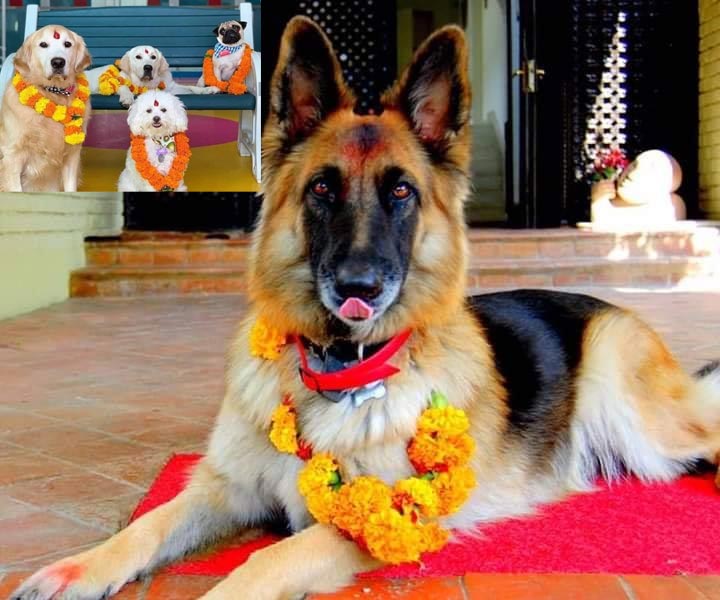
The second day, Kukur Tihar, honors dogs for their association with loyalty, protection, and their role in Hindu religious traditions.
Families may offer suitable food, place flower garlands on dogs, and apply tika as a gesture of respect. The practice includes both household pets and, in some communities, community dogs.
Animal welfare is an important practical consideration. Food, decorations, and handling should be appropriate to the animal, without causing distress or forcing participation.
Gai Tihar and Laxmi Puja
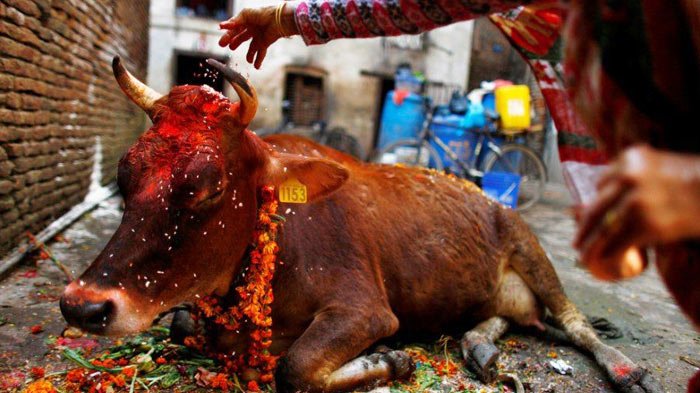
The third day commonly includes Gai Tihar, dedicated to the cow, and Laxmi Puja, performed to honor the goddess of wealth and prosperity.
Households prepare by cleaning living spaces, arranging worship materials, and decorating entrances with lamps, flowers, or colorful patterns.
Marigold garlands and oil lamps are particularly associated with Tihar, although electric lighting is also used.
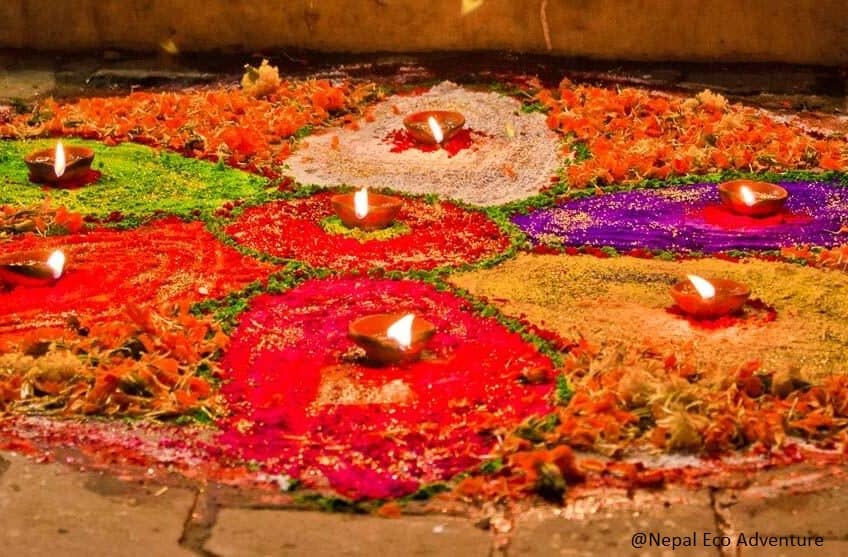
During Laxmi Puja, families offer prayers and symbolically welcome the goddess into their homes. The ceremony reflects religious beliefs about auspiciousness, household well-being, and prosperity.
For family members, decorating the home and preparing the worship space can be shared activities rather than responsibilities assigned to one person.
Govardhan Puja, Goru Tihar, and Mha Puja
The fourth day includes different observances according to community tradition.
Goru Tihar honors oxen, while Govardhan Puja is associated with Hindu worship traditions concerning Lord Krishna and Govardhan.
Among Newar communities, Mha Puja is a particularly important observance associated with the ritual honoring of the self.
Mha Puja includes ceremonial arrangements and family worship connected with well-being, personal dignity, and spiritual renewal. It is also closely associated with the beginning of Nepal Sambat, the calendar era celebrated by Newar communities.
These ceremonies show why Tihar cannot be understood solely as a festival of household lights. Its meanings extend to agricultural relationships, religious identity, and community-specific practices.
Bhai Tika: Blessings Between Siblings
Bhai Tika, observed on the fifth day, celebrates the relationship between brothers and sisters.
In a common form of the ceremony, sisters apply multicolored tika to their brothers' foreheads, offer garlands and other ceremonial items, and pray for their well-being and longevity.
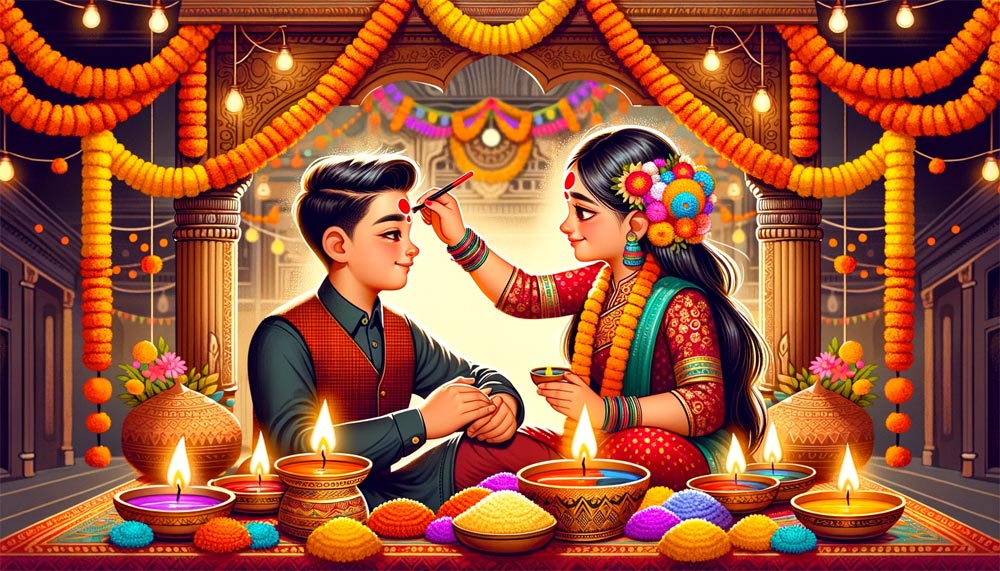
Brothers express appreciation through gifts or other gestures of affection and respect. Some communities observe variations that emphasize reciprocal blessings.
Bhai Tika is not simply an exchange of gifts. Its significance lies in recognizing family relationships and reaffirming responsibilities of care and mutual support.
Families may adapt the occasion when siblings live abroad, cannot travel, or follow different household traditions.
Deusi–Bhailo and Community Participation
Deusi–Bhailo is a distinctive musical tradition associated with Tihar.
Groups visit homes, perform songs and dances, and offer good wishes. Household members may respond with food, money, or other appropriate gifts.
The activity brings neighbors and community members together and provides opportunities for younger participants to learn traditional songs and performance customs.
Although performances and musical styles may change, the underlying practice remains a form of communal participation.
Tihar foods commonly include sel roti, sweets, fruits, and other dishes prepared according to family preferences.
Chhath: Sun Worship and Family Well-Being
Chhath is a Hindu religious festival dedicated to the Sun, with devotional traditions also associated with Chhathi Maiya.
The festival holds particular cultural importance in Nepal's Madhesh region, including communities connected with Maithili and Bhojpuri traditions.
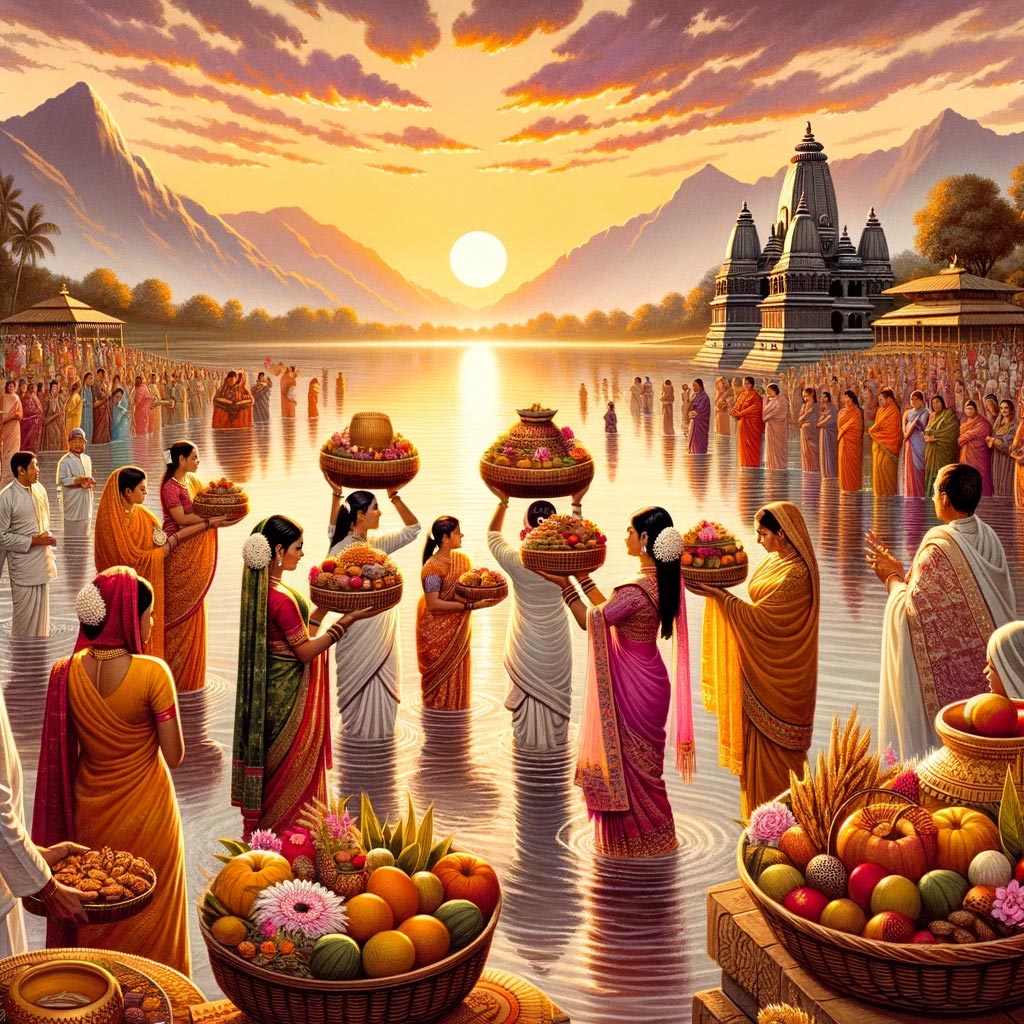
Its observances emphasize purity, gratitude, discipline, and prayers for family well-being. The Sun is honored as a life-sustaining force, and devotees perform religious offerings at sunset and sunrise.
Chhath is especially associated with Janakpur and other parts of the southern plains, but it is also observed in Kathmandu and elsewhere in Nepal.
The Four Main Days of Chhath
Chhath is commonly observed through four stages, although particular practices may differ among families.
| Day and Observance | Main Religious Activity | Family Significance |
|---|---|---|
| Nahay Khay | Ritual purification and preparation | Establishing the ceremonial setting |
| Kharna | Worship and traditional fasting observances | Preparing and sharing ritual offerings |
| Sandhya Arghya | Offerings to the setting Sun | Collective prayers and family participation |
| Usha Arghya | Offerings to the rising Sun | Completion of worship and distribution of prasad |
Certain adult devotees observe demanding fasting traditions, including periods without water. These are religious observances rather than general health practices, and they are not suitable for everyone.
Participation in Chhath also includes many activities that do not involve fasting, such as preparing offerings, helping relatives, maintaining ceremonial spaces, and joining community prayers.
Sunset and Sunrise Offerings
The sunset and sunrise ceremonies are the most recognizable public observances of Chhath.
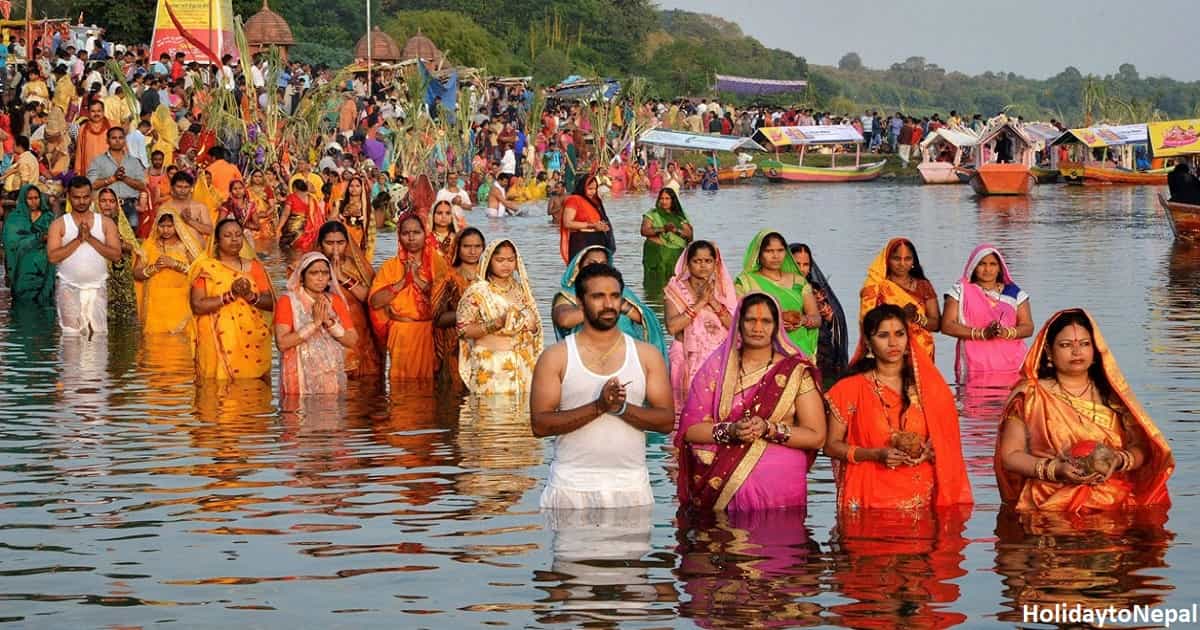
Families gather at rivers, ponds, or designated water bodies. Devotees offer arghya, a ceremonial offering of water, to the setting Sun and return for prayers to the rising Sun.
These ceremonies express gratitude and hopes for well-being.
The contrast between sunset and sunrise gives Chhath a distinctive ritual sequence. Both moments are honored rather than treating sunrise as the sole sacred occasion.
Public observances often involve collective preparation and cooperation among participating families, particularly when many devotees share the same ceremonial location.
Thekuwa, Fruits, and Traditional Offerings
Food preparation is an important family responsibility during Chhath.
Thekuwa, a traditional sweet made from wheat flour and ingredients such as jaggery or sugar, is widely associated with the festival.
Other offerings may include bananas, coconuts, sugarcane, and seasonal fruits. Items are arranged according to family customs, often in traditional trays or baskets.
The distribution of prasad, or blessed offerings, following the final prayers allows relatives and other participants to share in the completion of the festival.
Family Responsibilities During Chhath
Chhath often requires substantial household coordination.
Family members may prepare food, arrange offerings, organize transport, care for younger relatives, and assist participants at worship locations.
Women hold central ritual roles in many Chhath traditions, although participation is not limited to women. Men and other family members also contribute to the ceremonies and preparations.
These shared responsibilities help explain why Chhath is both a devotional observance and an important occasion for family cooperation.
Regional and Community Differences in Festival Traditions
Nepal's cultural diversity means that Dashain, Tihar, and Chhath are not celebrated in one identical way.
Religious affiliation, language, ethnic background, local history, and family traditions all affect participation.
Dashain Among Different Communities
Dashain is observed across many parts of Nepal, but not every ethnic or religious community celebrates it.
Some Newar communities observe Mohani, which shares a calendrical and religious relationship with Dashain while incorporating distinctive rituals, family feasts, and forms of worship.
Among Rai communities, practices differ between families and locations. Some households use white tika, while others do not traditionally observe Dashain.
These distinctions matter because a familiar festival name does not necessarily imply identical ceremonies or meanings.
They also show why describing Dashain as universally celebrated by all Nepalis would be inaccurate.
Tihar and Newar Traditions in Kathmandu Valley
Tihar includes observances shared by different communities alongside practices with specific cultural identities.
For many Newar families, the festival period is associated with Swanti, including Mha Puja and Kija Puja, a sibling-honoring ceremony.
The celebration of Nepal Sambat adds another important cultural dimension.
Elsewhere, household decorations, worship practices, Deusi–Bhailo performances, and family gatherings may differ according to local customs.
The differences should be understood as legitimate traditions rather than variations measured against one supposedly standard form.
Chhath in Madhesh and Urban Nepal
Chhath has strong historical and cultural associations with Nepal's southern plains.
In Janakpur, public ceremonies at ponds form an important part of the celebration, with offerings and devotional gatherings involving participating families.
Chhath is also observed in Kathmandu, where worshippers gather at locations such as ponds and riverbanks.
These celebrations demonstrate how religious traditions continue outside the communities and geographic areas most closely associated with their historical practice.
For readers interested in the wider context, Nepal's culture and traditions include many other celebrations shaped by different religious and ethnic communities.
Festival customs should be understood in their specific family and community contexts. A ritual familiar in one household may be performed differently, or not observed at all, in another.
How Families Preserve Traditions Across Generations
Family participation is one of the important ways festival knowledge is passed from one generation to another.
Young people may learn the significance of tika, jamara, worship materials, songs, and food traditions by observing older relatives.
However, participation alone does not guarantee understanding. Explaining the meaning of a ceremony often makes it more useful for younger family members than asking them to repeat actions without context.
Families can support cultural continuity through practical approaches:
-
Explain the religious and cultural meaning of rituals in language younger members understand.
-
Share household responsibilities rather than assigning all preparations to one person.
-
Teach traditional foods, songs, and customs through participation.
-
Respect differences in religious belief, personal choice, and community practice.
-
Preserve family knowledge through conversations, photographs, and written records when appropriate.
-
Encourage younger relatives to ask questions about traditions and their meanings.
These approaches allow cultural learning to remain meaningful without assuming that every family member has the same interests or religious beliefs.
How Festival Celebrations Are Changing
Festival traditions can change as families move, household arrangements evolve, and different forms of communication become available.
Relatives who once lived near each other may now be separated by employment, education, or migration. This can affect how often they gather and how ceremonies are organized.
Video calls and digital greetings provide ways for distant relatives to participate socially, although they do not reproduce every part of an in-person ritual.
Changes in housing and urban environments can also influence preparations. Apartment living may require adjustments to household worship arrangements, while public Chhath gatherings depend on access to appropriate communal spaces.
Electric decorations, recorded music, and digital photographs may accompany older practices.
Such changes do not necessarily mean that traditions have disappeared. Their significance depends on which customs families retain, why they retain them, and how they understand their meaning.
At the same time, practical considerations such as household costs, travel requirements, animal welfare, cleanliness, and public safety may influence decisions about celebrations.
The goal need not be to reproduce every practice exactly as it was performed in a previous generation. Families may instead distinguish essential religious customs from arrangements that can reasonably change.
Understanding and Respecting Festival Customs
For someone unfamiliar with Nepal's festivals, respectful participation begins with recognizing that religious ceremonies and social celebrations may have different expectations.
A guest invited to a family gathering should not assume that every part of the occasion is open to unrestricted participation.
Several considerations are useful:
-
Ask the host about appropriate conduct before joining a household ceremony.
-
Respect prayer spaces, offerings, and objects with religious significance.
-
Request permission before photographing people or private rituals.
-
Do not assume that every Nepali family observes the same festival traditions.
-
Treat dietary restrictions and religious practices respectfully.
-
Avoid pressuring anyone to participate in unfamiliar or physically demanding observances.
These principles apply whether someone is attending a Dashain family gathering, visiting a home during Tihar, or observing Chhath prayers in a public setting.
Conclusion
Dashain, Tihar, and Chhath reflect different aspects of Nepal's religious and family traditions.
Dashain centers on Goddess Durga, ceremonial blessings, and family reunions. Tihar combines worship of deities and animals with household celebrations and sibling relationships. Chhath emphasizes devotion to the Sun through traditional offerings and collective prayers.
Their cultural importance extends beyond the ceremonies themselves. Families preserve knowledge through shared responsibilities, conversations, food traditions, and participation across generations.
Understanding these festivals also requires recognizing Nepal's diversity. Their meaning is most accurately appreciated by respecting the differences between communities, households, and individual practices rather than treating any single celebration as representative of every Nepali family.







Comments 0
No comments yet. Be the first to start the conversation.