



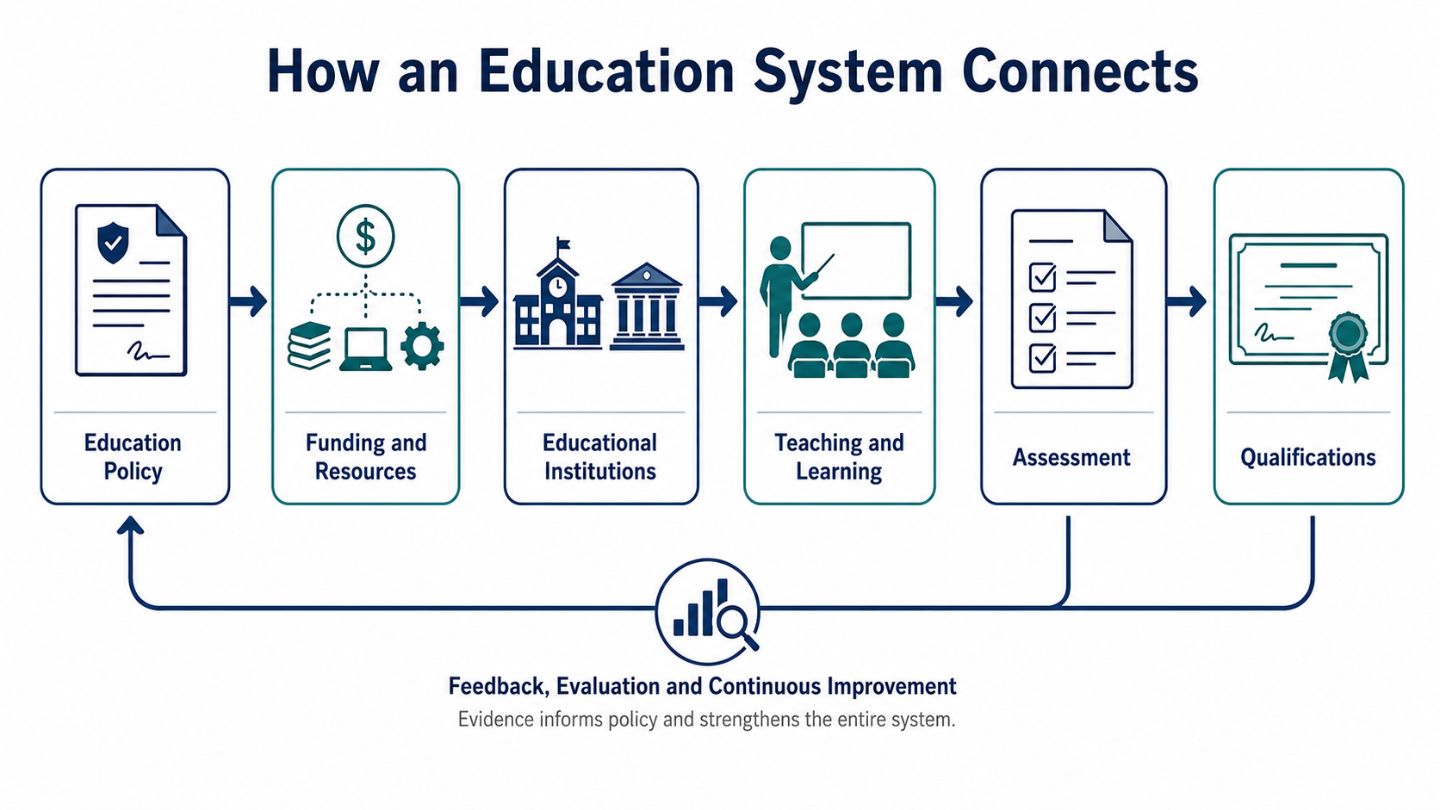
An education system is the network of institutions, rules, people, funding arrangements, curricula, teaching practices, assessments, and qualifications through which a society organizes learning.
According to UNESCO’s definition of an education system, the term covers formal and non-formal education and learning opportunities available to children, young people, and adults in a country or society, whether provided or financed by state or non-state actors.
Schools and universities are central to this network, but they are not the whole system. Education also involves ministries, local authorities, teachers, examination bodies, vocational institutions, quality-assurance agencies, employers, families, and other organizations.
Countries use different school-entry ages, grade names, compulsory-education periods, examination systems, funding models, and qualification titles. This article explains the functions education systems commonly perform without presenting any one national structure as universal.
Answer Summary: Education systems turn public education goals into organized learning. Authorities establish policies, responsibilities, standards, and funding arrangements. Institutions and teachers deliver programmes, assessments measure learning, and qualifications record achievement. Entry and progression rules determine how learners move between stages and pathways. These functions are common across many systems, but their names, legal requirements, and administrative structures vary by country.
Table of Content
- What Is an Education System?
- How Does an Education System Work?
- What Are the Common Levels of Education?
- Who Makes Education Decisions?
- How Do Learners Enter and Progress?
- How Do Curriculum and Teaching Work?
- How Do Assessment, Examinations, and Qualifications Work?
- How Is Education Funded?
- How Do Academic and Vocational Pathways Differ?
- How Are Quality and Accountability Managed?
- What Is Common Globally, and What Varies by Country?
- Why Do Education Systems Differ?
- How Can You Understand an Unfamiliar Education System?
- Final Perspective
Key Takeaways:
-
Education systems include more than schools and universities.
-
Governance, funding, curriculum, teaching, assessment, and data are interconnected.
-
Decision-making may be divided among central, local, and institutional authorities.
-
Education levels can be compared internationally, but national terminology still differs.
-
Academic and vocational pathways serve different purposes and may both lead to further learning.
-
A credential title alone does not establish its level or international recognition.
-
Official authorities should guide admission, accreditation, licensing, and equivalence decisions.
What Is an Education System?
An education system is an organized framework for planning, financing, providing, assessing, and recognizing learning.
It generally includes:
-
education laws and policies;
-
government and administrative authorities;
-
schools, colleges, universities, and training institutions;
-
teachers and other education personnel;
-
curricula and learning standards;
-
teaching and learning resources;
-
assessment and examination arrangements;
-
qualifications and recognition procedures;
-
funding and resource-allocation mechanisms;
-
quality assurance and accountability;
-
education data, evaluation, and policy review.
These parts operate together. A change in one area can require adjustments elsewhere. Introducing a new curriculum, for example, may also require revised textbooks, teacher preparation, assessment methods, budgets, and reporting arrangements. This example illustrates how system components can interact; it is not a universal reform sequence.
Education System Versus School System
A school system is generally one part of a wider education system.
A school system usually concerns organized primary and secondary education, including schools, teachers, curricula, administration, and school-level assessments.
The wider education system may also include:
-
early childhood education;
-
technical and vocational education and training;
-
higher education;
-
apprenticeships and work-based learning;
-
professional education;
-
adult learning;
-
literacy programmes;
-
non-formal education;
-
examination and qualification bodies;
-
accreditation and quality-assurance arrangements.
The distinction matters because organized learning can begin before primary school and continue throughout adulthood.
Formal, Non-Formal, and Informal Learning
Formal, non-formal, and informal learning describe different ways in which learning is organized.
Formal education is institutionalized and planned through recognized education organizations. It normally follows an organized programme and may lead to a recognized qualification.
Non-formal education is also organized and intentional, but it operates as an addition, alternative, or complement to formal education. It can include literacy programmes, workplace training, community education, and structured short courses. It does not necessarily lead to a formally recognized qualification.
Informal learning is less institutionalized. It may occur through work, family life, community participation, reading, observation, personal projects, or self-directed activity.
Some education systems provide mechanisms for recognizing prior or non-traditional learning. Their availability and legal effect must be checked within the relevant national system.
How Does an Education System Work?
An education system connects public goals and legal responsibilities with institutions, teaching, assessment, qualifications, and learner progression.
Two models help explain this relationship: the system process and the learner journey.
The System Process
A simplified system process is:
Public goals and rights → laws and policy → funding and resources → institutions and programmes → curriculum and teaching → assessment → qualifications → evaluation and reform
Each stage addresses a different question:
-
Public goals and rights: What learning opportunities should society provide?
-
Laws and policy: Which authorities and institutions are responsible?
-
Funding and resources: How will staff, facilities, programmes, and support services be financed?
-
Institutions and programmes: Where and through which arrangements will learning take place?
-
Curriculum and teaching: What should learners study, and how will learning be supported?
-
Assessment: How will progress and achievement be evaluated?
-
Qualifications: How will completed learning be documented?
-
Evaluation and reform: How will evidence inform later policy and practice?
This is an explanatory model, not an official structure used identically in every country. In practice, several stages operate simultaneously and influence one another.
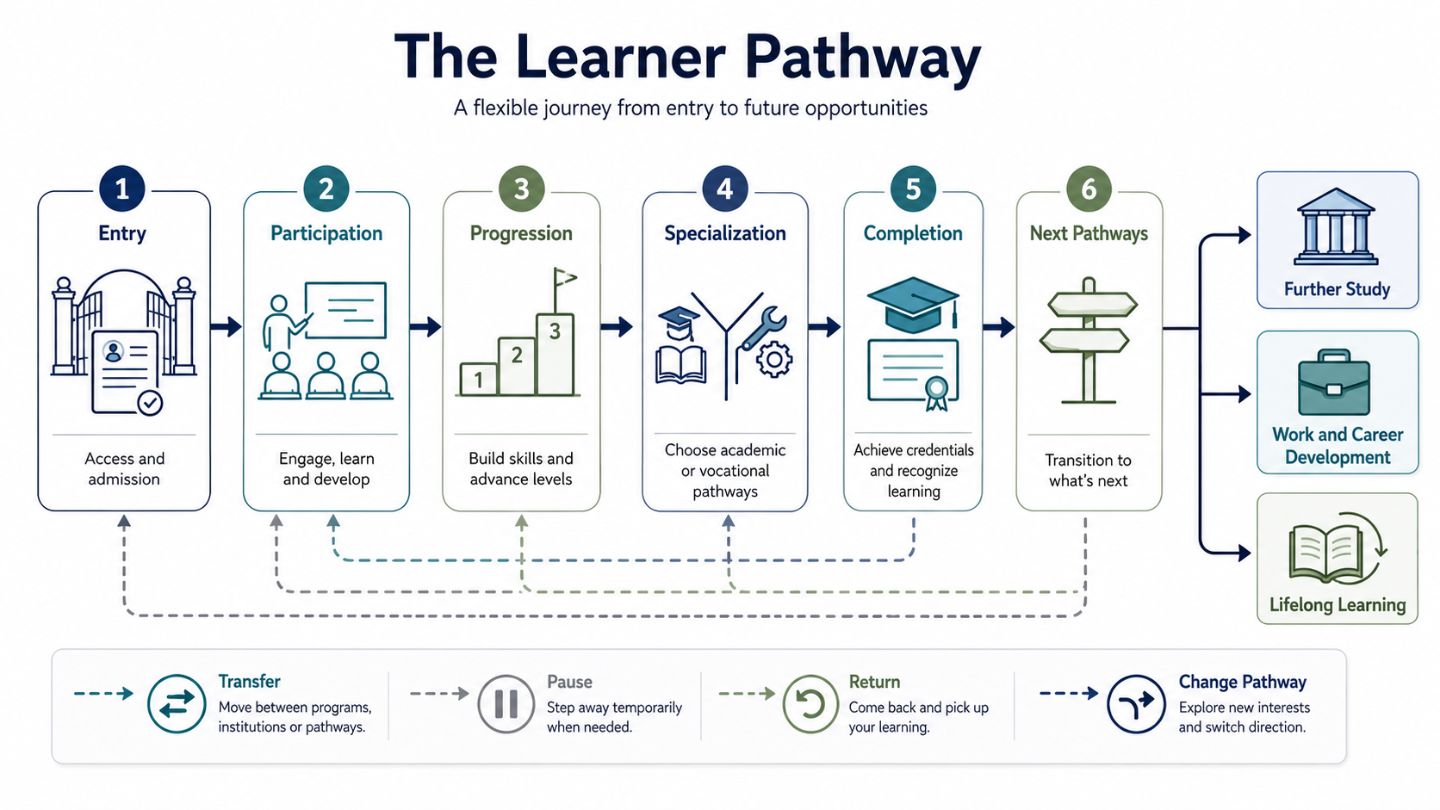
The Learner Journey
A learner’s journey can be represented as:
Entry → participation → progression → specialization → completion → further education, work, or lifelong learning
A learner may:
-
enter through an age-based or qualification-based rule;
-
participate in compulsory or optional education;
-
advance through grades, levels, or competencies;
-
select academic, technical, or vocational subjects;
-
transfer between institutions or pathways;
-
complete a programme and receive a qualification;
-
continue to higher education, training, work, or adult learning.
The journey is not always linear. People may repeat a stage, pause their studies, change programmes, return as adults, or combine education with employment.
What Are the Common Levels of Education?
Education levels are broad categories used to organize programmes by their learning content, complexity, and position within a national system.
The UNESCO Institute for Statistics maintains the International Standard Classification of Education (ISCED). It provides a common framework for categorizing education programmes and qualifications so that national systems can be compared internationally.
| General level | Main purpose | What readers should verify |
|---|---|---|
| Early childhood education | Supports early development and preparation for later learning | Entry arrangements, provider type, programme purpose, and compulsory status |
| Primary education | Develops foundational knowledge and skills | Starting age, duration, curriculum, and completion requirements |
| Lower secondary education | Extends general learning across a wider range of subjects | Its position within compulsory education and progression rules |
| Upper secondary education | Offers advanced general, academic, technical, or vocational study | Subject pathways, examinations, and access to later education |
| Post-secondary non-tertiary education | Provides learning beyond secondary level that is not classified as tertiary | Qualification level, recognition, and progression rights |
| Short-cycle tertiary education | Provides advanced occupational or academic education | Credit transfer, programme status, and access to later degrees |
| Bachelor’s or equivalent level | Provides an initial degree-level higher-education qualification | Admission, institutional status, programme requirements, and recognition |
| Master’s or equivalent level | Provides advanced education following an earlier qualification | Entry requirements and academic or professional orientation |
| Doctoral or equivalent level | Focuses mainly on advanced research or professional scholarship | Research, supervision, examination, and award requirements |
| Adult and continuing education | Supports literacy, reskilling, professional development, or personal learning | Whether it is formal, non-formal, credit-bearing, or qualification-based |
These categories should not be assigned universal ages or grade numbers. National programmes must be interpreted within their own structures.
At the factual review date of July 16, 2026, the UNESCO Institute for Statistics continued to present ISCED 2011 as the framework for classifying education levels.
Early Childhood Education
Early childhood education supports development and learning before primary education.
It may be provided through schools, childcare centres, community programmes, public institutions, private organizations, or mixed arrangements. Its governance, purpose, duration, and relationship with compulsory schooling vary by country.
Primary Education
Primary education generally concentrates on foundational learning.
Its curriculum commonly includes literacy, numeracy, communication, and introductory subject knowledge. The starting age, duration, language of instruction, curriculum, and promotion rules are determined within each system.
Lower and Upper Secondary Education
Secondary education builds on primary education and normally introduces broader or more advanced study.
Some systems divide it into lower and upper secondary stages. Upper secondary education may offer academic, general, technical, or vocational pathways.
A qualification completed at this stage may provide access to employment, vocational programmes, post-secondary education, or higher education. The actual progression rights depend on the qualification and receiving institution.
Post-Secondary and Tertiary Education
Post-secondary education includes programmes entered after secondary education. Not every post-secondary programme is classified as tertiary education.
Tertiary education may include short-cycle programmes, bachelor’s degrees, master’s degrees, doctorates, and other advanced qualifications.
Institution names cannot be interpreted consistently across countries. A term such as “college” may refer to different institutional or educational levels, so the programme’s formal level and awarding authority matter more than the name alone.
Adult Education and Lifelong Learning
Adult education supports people who return to learning for literacy, professional development, occupational change, community participation, or personal goals.
Lifelong learning includes learning across different ages, settings, and stages of life. It may involve formal study, professional development, non-formal programmes, or self-directed learning. Collegenp’s article on why lifelong learning matters provides related practical discussion.
Who Makes Education Decisions?
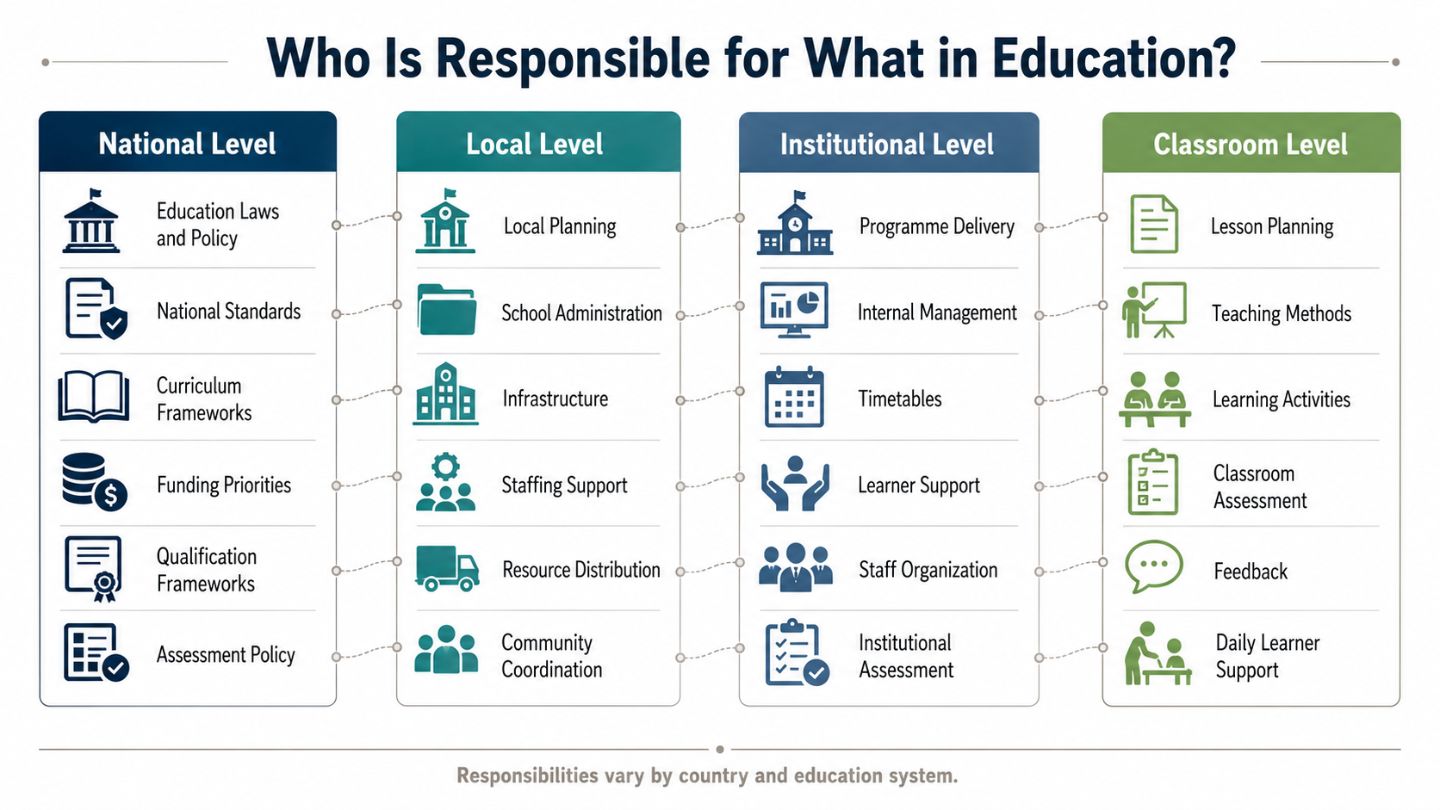
Education decisions may be distributed among national authorities, regional or local bodies, schools, universities, examination organizations, quality-assurance agencies, teachers, and other participants.
The division of responsibility differs between countries and can also vary by decision type. A system may be centralized in curriculum standards while allowing schools greater control over staffing, resources, or teaching methods.
Centralized and Decentralized Arrangements
A centralized arrangement places substantial decision-making authority at the national or central level.
A decentralized arrangement gives more authority to regional governments, local bodies, institutions, or schools.
Most national systems combine both approaches. OECD guidance on school autonomy describes school-level decision-making as a balance between responding to local needs and following priorities and standards established at higher levels of the education system.
Decentralization may be intended to improve responsiveness, efficiency, or local control, but these are policy aims rather than guaranteed outcomes.
Main Actors and Their Possible Responsibilities
| Actor | Responsibilities it may hold |
|---|---|
| National government or education ministry | Laws, national policy, standards, planning, budgets, qualification frameworks, and system priorities |
| Regional or local authority | Local planning, administration, infrastructure, staffing, resource distribution, or support services |
| School, college, or university | Programme delivery, internal management, teaching organization, learner support, and institutional assessment |
| Examination or qualification body | External examinations, certification, standards, or qualification administration |
| Quality-assurance or accreditation authority | Review of systems, institutions, or programmes within its legal mandate |
| Teachers and academic staff | Instruction, learner support, classroom assessment, and professional decisions |
| Learners and families | Participation, educational choices, feedback, representation, and support |
| Employers and professional bodies | Workplace learning, occupational standards, professional requirements, or licensing input |
These are possible responsibilities rather than a universal allocation of authority.
Public and Non-State Institutions
State and non-state actors can both provide or finance education.
Labels such as public, private, community, charitable, or faith-based are governed by national law. They do not by themselves establish a programme’s quality, cost, recognition, or educational level.
How Do Learners Enter and Progress?
Learner progression is shaped by entry, participation, promotion, transfer, specialization, completion, and admission rules.
Entry and Compulsory Education
Entry may depend on:
-
age;
-
earlier education;
-
residence;
-
language requirements;
-
entrance examinations;
-
academic results;
-
programme prerequisites;
-
available places;
-
recognition of previous learning.
Compulsory education means that the law requires a defined group to participate in education. The relevant ages, stages, exemptions, and enforcement arrangements are jurisdiction-specific.
Promotion and Completion
A learner may progress through:
-
completion of a grade or programme;
-
classroom assessment;
-
examinations;
-
attendance requirements;
-
demonstrated competencies;
-
institutional decisions;
-
a combination of requirements.
When requirements are not initially met, systems may use repetition, reassessment, conditional progression, learning support, or competency-based advancement.
Selection and Specialization
Students may later choose subjects or enter academic, technical, vocational, artistic, or occupational routes.
The consequences of specialization differ. Some systems allow movement between routes, while others require bridging courses, additional examinations, or recognition of earlier learning.
Transfer and Re-entry
A learner changing institutions or countries may be asked to provide:
-
transcripts;
-
qualification records;
-
subject descriptions;
-
placement-test results;
-
language evidence;
-
a credential evaluation;
-
evidence of prior learning.
Requirements should be confirmed with the receiving institution or responsible authority.
How Do Curriculum and Teaching Work?
A curriculum organizes intended learning. It may define subjects, content, competencies, learning outcomes, assessment expectations, or recommended learning time.
Learning Standards and Curriculum
Learning standards state what learners are expected to know or be able to do. A curriculum turns these expectations into an organized programme.
Curriculum development may involve:
-
ministries and curriculum agencies;
-
subject specialists;
-
teachers;
-
universities;
-
examination bodies;
-
professional organizations;
-
employers;
-
communities.
The participating groups and their authority vary between systems.
Learning Materials and Teaching Methods
Textbooks, laboratories, digital resources, libraries, discussions, projects, practical work, and workplace experiences are tools for delivering a curriculum. They are not the curriculum itself.
Teaching choices may depend on:
-
subject requirements;
-
learner needs;
-
class size;
-
language;
-
available facilities;
-
teacher preparation;
-
institutional policy;
-
assessment requirements.
Teacher Preparation and Development
Teachers translate curriculum expectations into classroom learning.
Education systems may establish requirements for initial teacher education, supervised practice, recruitment, registration, licensing, induction, continuing development, and evaluation.
These requirements are country-specific and should be confirmed through the relevant authority.
School and Teacher Autonomy
School autonomy concerns the decision-making authority given to schools over areas such as staffing, resources, curriculum implementation, assessment, and administration.
Teacher autonomy concerns professional classroom decisions, including lesson organization, methods, activities, and some assessments.
Neither type of autonomy normally operates outside the laws, standards, funding conditions, and accountability arrangements of the wider system.
How Do Assessment, Examinations, and Qualifications Work?
Assessment gathers evidence about what learners know, understand, or can do.
It can guide teaching, record achievement, support progression, contribute to certification, or help evaluate the wider education system.
Classroom Assessment
Teachers may assess learning through:
-
observation;
-
discussions;
-
assignments;
-
practical tasks;
-
projects;
-
portfolios;
-
presentations;
-
quizzes and tests.
Assessment during instruction can identify learning needs and help teachers adjust support. End-of-period assessment evaluates learning after a defined stage.
School Examinations
Schools and institutions may organize internal examinations under their own or approved rules.
An internal examination may contribute to grades, promotion, placement, completion, or eligibility for an external assessment. Its effect depends on the system and should not be assumed to equal that of a national or externally awarded qualification.
National or External Examinations
National or external examinations are administered or regulated beyond the individual school.
Depending on the system, they may be used for:
-
certification;
-
admission;
-
selection;
-
progression;
-
system monitoring;
-
institutional accountability.
Some systems place substantial weight on external examinations. Others combine them with school-based assessment, practical work, portfolios, or continuous assessment.
Certificates, Diplomas, and Degrees
Credential titles do not have identical meanings across countries.
| Credential title | Possible use | Main caution |
|---|---|---|
| Certificate | May document secondary, vocational, professional, short-course, or higher-education completion | The title alone does not prove its level or recognition |
| Diploma | May describe vocational, post-secondary, professional, or higher-education study | Its meaning differs significantly between systems |
| Degree | Usually describes a higher-education award such as a bachelor’s, master’s, or doctorate | Recognition depends on the awarding system and applicable rules |
| Professional licence or credential | May permit or support practice in a regulated occupation | Academic graduation and professional authorization can be separate |
| Course-completion document | Records attendance or completion | It may not represent academic credit or a recognized qualification |
A qualification should be examined through:
-
the awarding authority;
-
its level in the home system;
-
entry requirements;
-
programme workload;
-
curriculum and learning outcomes;
-
assessment requirements;
-
the institution’s status;
-
programme approval or accreditation where applicable;
-
progression rights;
-
professional or licensing consequences.
Recognition Across Countries
A foreign credential is not automatically equivalent to a local credential with a similar title.
UNESCO’s Global Convention on the Recognition of Qualifications concerning Higher Education establishes principles for fair, transparent, and non-discriminatory recognition. Recognition still takes place within the laws and procedures of the relevant country or authority, and substantial differences between qualifications may affect the outcome.
Recognition decisions can be made for different purposes by different bodies. A university may assess a qualification for admission, while an employer, professional regulator, or government authority may make a separate decision for employment, licensing, immigration, or another purpose.
Learners should obtain the relevant official decision before relying on a qualification for:
-
admission;
-
credit transfer;
-
employment;
-
professional licensing;
-
immigration;
-
further study.
How Is Education Funded?
Education systems can be financed through public, household, private, employer, community, donor, and international sources.
Possible funding sources include:
-
national taxation and government budgets;
-
regional or local government budgets;
-
tuition and institutional fees;
-
household expenditure;
-
scholarships and grants;
-
private or non-profit providers;
-
employers;
-
community organizations;
-
international development partners.
The funding mix varies by country, education level, and institution type.
How Resources Reach Institutions
A simplified public-finance sequence is:
Revenue collection → public budget → education allocation → regional or institutional distribution → spending on staff, facilities, programmes, and learner support
Allocation may take account of:
-
enrolment;
-
programme type;
-
staff requirements;
-
learner needs;
-
geography;
-
infrastructure;
-
policy priorities;
-
accountability conditions.
These are possible factors rather than one standard formula.
The World Bank and UNESCO’s Education Finance Watch 2024 frames education-finance challenges around the adequacy, efficiency, and equity of spending. It also emphasizes that higher spending alone does not ensure better outcomes when resources are poorly allocated or used.
How Do Academic and Vocational Pathways Differ?
Academic and vocational pathways differ mainly in their intended learning outcomes, curricula, teaching methods, and relationship with further study or work.
Neither pathway is universally more suitable. Their value depends on the learner’s goals, programme quality, recognition, progression options, and occupational requirements.
| Comparison area | Academic or general pathway | Vocational or technical pathway |
|---|---|---|
| Main emphasis | Broad subject knowledge, theory, analysis, and preparation for further study | Occupational knowledge, practical competence, and work-related learning |
| Common methods | Reading, lectures, discussion, essays, laboratories, research, and examinations | Workshops, laboratories, simulations, workplace learning, and practical assessment |
| Possible next steps | Further academic study, professional education, or employment | Employment, apprenticeship, professional certification, advanced vocational study, or tertiary education |
| Questions to examine | Subject depth, assessment standards, recognition, and progression rights | Occupational relevance, facilities, practical assessment, recognition, and licensing relevance |
| Possible limitation | May not provide occupation-specific preparation | May be specialized and may require bridging study for some academic routes |
| Transferability | Depends on subjects, credits, level, and receiving institution | Depends on programme design, recognition, credits, and progression agreements |
These are general distinctions. Actual programmes can combine academic, practical, technical, and workplace learning.
Academic or General Education
Academic education commonly emphasizes broad subject knowledge, conceptual understanding, analysis, and preparation for later study.
It may also include projects, laboratories, practical activities, research, communication, and career-related learning.
Completion does not guarantee entry into a particular institution or occupation. Admission and professional requirements must be checked separately.
Technical and Vocational Education and Training
Technical and vocational education and training, or TVET, covers education, training, and skills development related to occupational fields, production, services, and livelihoods.
TVET can operate at secondary, post-secondary, and tertiary levels. It may include classroom instruction, workshops, simulations, supervised workplace learning, continuing training, and professional development.
TVET should not be assumed to occupy one fixed educational level. Its qualifications, assessment methods, and progression options differ across national systems. Collegenp’s discussion of the role of vocational education in economic development provides related background reading.
Apprenticeships and Work-Based Learning
Apprenticeships combine organized learning with supervised workplace experience.
Their legal status, duration, assessment, qualification outcome, payment arrangements, and relationship with employment vary by jurisdiction.
Before entering an apprenticeship, a learner should verify:
-
the responsible training or regulatory body;
-
the qualification awarded;
-
the employer’s and provider’s roles;
-
supervision arrangements;
-
assessment requirements;
-
employment or payment conditions;
-
progression and licensing outcomes.
Non-Formal, Online, and Adult Learning
Short courses, online programmes, workplace training, and community education can support knowledge and skill development outside a standard degree route.
Learners should distinguish among:
-
attendance certificates;
-
assessed course certificates;
-
credit-bearing modules;
-
recognized qualifications;
-
professional certifications;
-
portfolios or other informal evidence.
A short course can have practical learning value without carrying formal academic credit. Its usefulness should be judged against its intended purpose rather than assumed from the credential title.
How Are Quality and Accountability Managed?
Quality assurance examines whether education systems, institutions, or programmes meet applicable standards.
Depending on the jurisdiction and education level, quality controls may include:
-
curriculum standards;
-
teacher-qualification rules;
-
inspections;
-
institutional self-evaluation;
-
programme approval;
-
accreditation;
-
internal and external examinations;
-
learning assessments;
-
participation and completion data;
-
financial oversight;
-
complaints procedures;
-
safeguarding requirements;
-
public reporting.
Institutional Status and Programme Accreditation
Institutional recognition, programme approval, and accreditation do not operate identically in every country.
Depending on the system:
-
an institution may require legal recognition or authorization;
-
a programme may require separate approval or accreditation;
-
professional programmes may require recognition from a sector regulator;
-
quality assurance may apply to the system, institution, programme, or a combination of these.
Before enrolling, learners should check:
-
whether the institution is legally recognized;
-
whether the programme requires separate approval;
-
which authority grants that status;
-
what qualification the learner will receive;
-
whether the qualification supports the intended next step;
-
whether professional licensing is separately required.
Assessment Data and System Feedback
System-level assessment can help authorities examine learning outcomes and how they are distributed among learner groups.
This evidence may inform policy, curriculum, teaching, resource allocation, and institutional support. Assessment results should not, however, be treated as a complete measure of education quality.
Depending on the purpose of an evaluation, other relevant factors can include access, equity, learner welfare, resources, governance, teaching conditions, and legal compliance.
What Is Common Globally, and What Varies by Country?
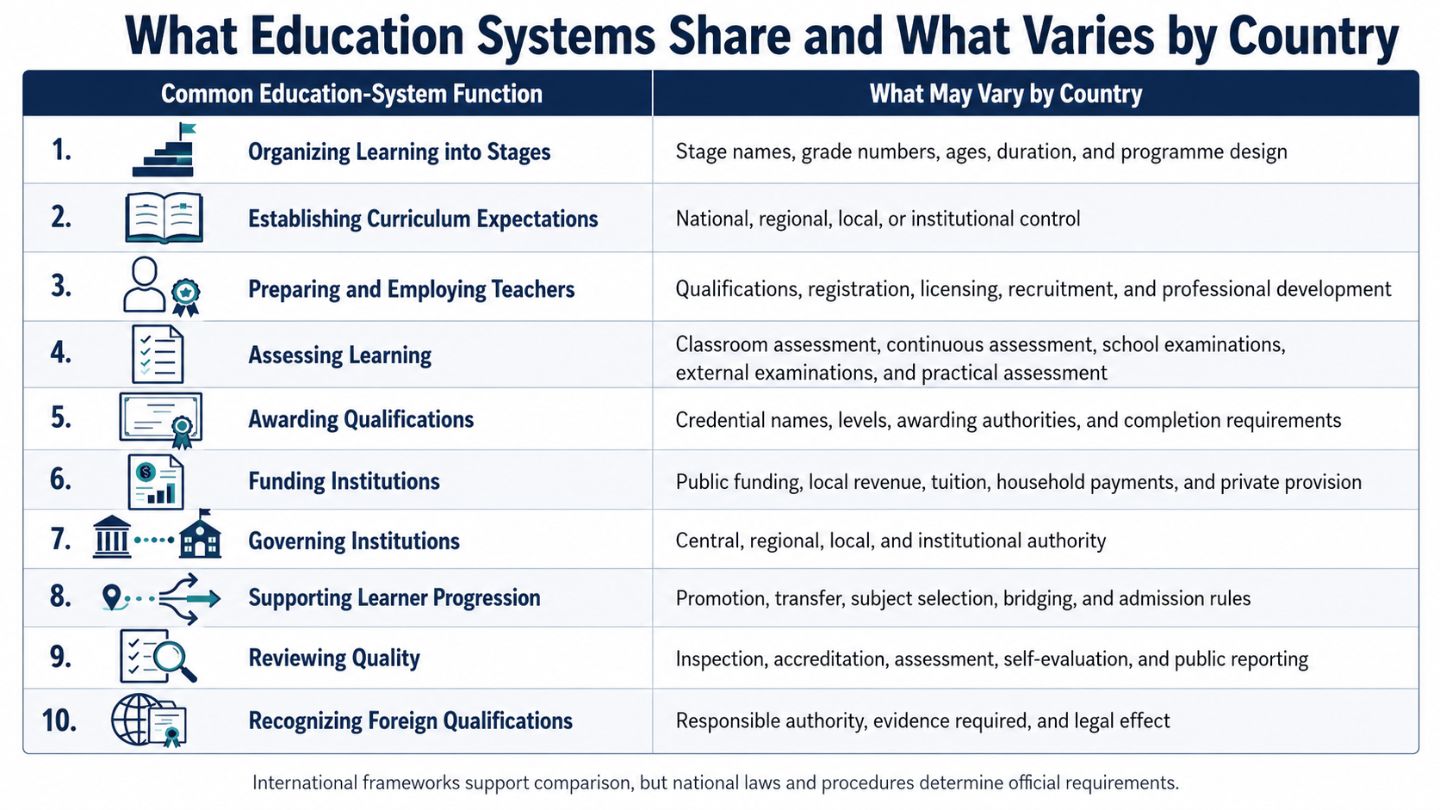
Education systems share broad functions, but national rules and terminology differ.
| Common function | What may vary |
|---|---|
| Organizing learning into stages | Stage names, grade numbers, ages, duration, and programme design |
| Establishing curriculum expectations | National, regional, local, or institutional control |
| Preparing and employing teachers | Qualifications, registration, licensing, recruitment, and development |
| Assessing learning | Classroom assessment, continuous assessment, school examinations, external examinations, and practical assessment |
| Awarding qualifications | Credential names, levels, awarding authorities, and completion requirements |
| Funding institutions | Public funding, local revenue, tuition, household payments, and private provision |
| Governing institutions | Central, regional, local, and institutional authority |
| Supporting progression | Promotion, transfer, subject selection, bridging, and admission rules |
| Reviewing quality | Inspection, accreditation, assessment, self-evaluation, and public reporting |
| Recognizing foreign qualifications | Responsible authority, evidence required, and legal effect |
International frameworks support comparison, but they do not replace national law, policy, or qualification-recognition decisions.
Why Do Education Systems Differ?
Education systems develop within different legal, political, historical, economic, linguistic, cultural, and geographic conditions.
Factors that can shape a system include:
-
constitutional arrangements;
-
government structure;
-
national and local languages;
-
population distribution;
-
public resources;
-
historical institutions;
-
labour-market needs;
-
relationships between state and non-state providers;
-
compulsory-education laws;
-
examination traditions;
-
qualification frameworks;
-
policy priorities.
These differences affect terminology as well as structure. Similar programme names may describe different levels, while comparable programmes may have different names.
International classifications help organize comparisons, but they do not establish automatic legal equivalence between individual qualifications.
How Can You Understand an Unfamiliar Education System?
A reliable comparison begins with official information and applies the same questions to each system.
National Education System Checklist
-
What education levels exist?
-
What are their official names?
-
What entry ages or prior qualifications apply?
-
Which stages are compulsory?
-
Which authority controls the curriculum?
-
Who funds and operates institutions?
-
How are learners assessed and promoted?
-
Which internal or external examinations are used?
-
What qualifications are awarded?
-
Which academic and vocational pathways are available?
-
Can learners transfer between pathways?
-
Who recognizes or authorizes institutions?
-
Does the programme require separate approval or accreditation?
-
How are foreign qualifications evaluated?
-
What progression rights does each qualification provide?
-
Are separate professional licences required?
How to Compare Two Qualifications
Do not compare qualifications only by name or duration.
Examine:
-
level in the home education system;
-
entry requirements;
-
curriculum;
-
learning outcomes;
-
workload;
-
assessment methods;
-
practical requirements;
-
awarding authority;
-
institutional status;
-
programme approval or accreditation;
-
credit-transfer arrangements;
-
eligibility for further study;
-
professional or licensing consequences.
Final equivalence, admission, transfer, and licensing decisions should come from the authority responsible for that purpose.
Final Perspective
Education systems connect public goals, governance, resources, institutions, teaching, assessment, qualifications, and learner pathways.
Their broad functions are widely recognizable, but national structures are not interchangeable. School-entry ages, grade names, curricula, examinations, funding arrangements, qualification titles, and recognition procedures must be understood within their own jurisdiction.
Students and families should therefore separate general education terminology from official requirements. Before making an admission, transfer, qualification-recognition, or professional decision, they should verify the institution, programme, qualification level, progression rights, and responsible authority.







Comments 0
No comments yet. Be the first to start the conversation.