



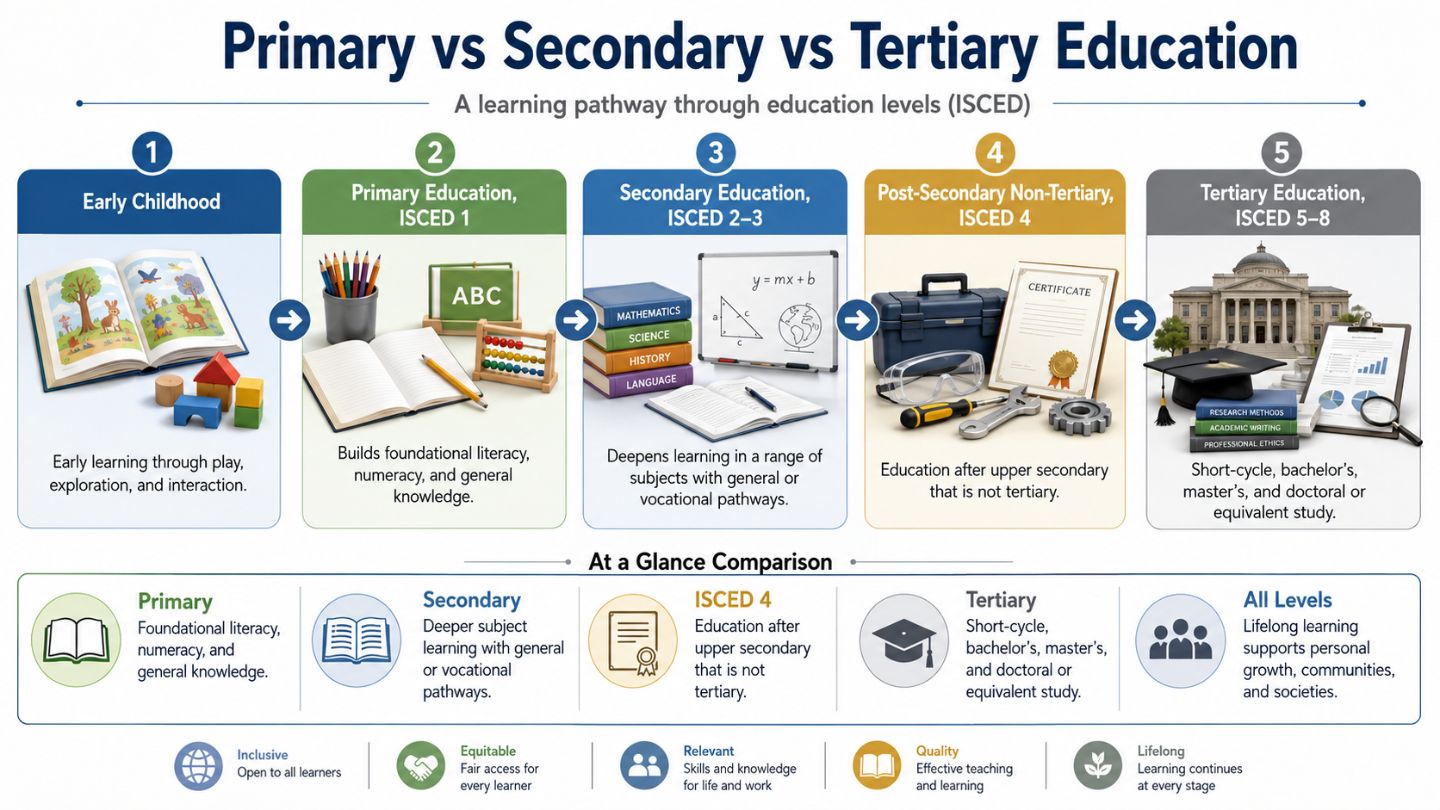
Primary education builds foundational skills in reading, writing, mathematics, and general knowledge. Secondary education follows primary school and introduces more subject-focused learning through lower and upper stages. Tertiary education covers advanced academic, professional, technical, and vocational study after secondary education.
Under the International Standard Classification of Education (ISCED) 2011:
-
Primary education is ISCED 1.
-
Lower secondary education is ISCED 2.
-
Upper secondary education is ISCED 3.
-
Post-secondary non-tertiary education is ISCED 4.
-
Tertiary education covers ISCED 5–8.
These stages describe a learning sequence, not a ranking of importance or quality. National education systems use different school names, grades, starting ages, programme lengths, and qualification titles. A term such as “college,” “high school,” “certificate,” or “diploma” therefore does not always indicate the same education level in every country.
The article concerns education levels. It does not cover the use of primary, secondary, and tertiary to classify research sources, economic sectors, healthcare services, or other subjects.
Answer Summary: Primary education provides foundational learning at ISCED 1. Secondary education includes lower secondary at ISCED 2 and upper secondary at ISCED 3. ISCED 4 is post-secondary non-tertiary education. Tertiary education begins at ISCED 5 and includes short-cycle, bachelor’s, master’s, and doctoral or equivalent programmes. Exact ages, grades, institution names, and progression rules vary by country.
Table of Content
- Education Levels at a Glance
- What Is Primary Education?
- What Is Secondary Education?
- What Is Post-Secondary Non-Tertiary Education?
- What Is Tertiary Education?
- Main Differences Between the Education Levels
- Is Vocational Education Always Tertiary?
- Why Education Names, Ages, and Grades Vary by Country
- How to Classify an Unfamiliar Programme
- How the Education Pathway Connects
- What to Remember About the Three Education Levels
Key Takeaways:
-
Primary education is ISCED 1.
-
Secondary education covers ISCED 2 and 3.
-
ISCED 4 is post-secondary but not tertiary.
-
Tertiary education covers ISCED 5–8.
-
Vocational programmes can exist at several levels.
-
Institution and qualification names do not determine level by themselves.
-
Official country-specific sources are needed for exact grades, ages, admission rules, and qualification recognition.
Education Levels at a Glance
The main difference between primary, secondary, and tertiary education is the progression from foundational learning to subject-focused study and then to advanced specialisation.
The UNESCO Institute for Statistics maintains ISCED as an international framework for comparing education programmes and qualifications. It allows countries to map different national structures into a shared set of levels without requiring identical grades, school names, or programme lengths.
| Education level | ISCED level | Main purpose | Usual position in the pathway | Common outcome or next route |
|---|---|---|---|---|
| Primary education | 1 | Build foundational literacy, numeracy, and introductory knowledge | After early childhood or pre-primary education | Lower secondary education |
| Lower secondary education | 2 | Complete basic education through more subject-oriented study | After primary education | Upper secondary education or another recognised pathway |
| Upper secondary education | 3 | Provide more specialised general or vocational study | After lower secondary education | Employment, ISCED 4, tertiary entry, or another pathway |
| Post-secondary non-tertiary education | 4 | Broaden upper-secondary learning or improve occupational and tertiary-entry options | After upper secondary education | Employment, tertiary entry, or both |
| Short-cycle tertiary education | 5 | Provide practical, professional, or occupation-specific tertiary learning | Usually after upper secondary or another accepted route | Employment or further tertiary study |
| Bachelor’s or equivalent | 6 | Develop intermediate academic or professional knowledge | Tertiary education | First degree or equivalent qualification |
| Master’s or equivalent | 7 | Develop advanced or specialised knowledge | Usually after earlier tertiary study or through an equivalent long-cycle programme | Advanced qualification or further study |
| Doctoral or equivalent | 8 | Develop advanced research knowledge and original research | Advanced tertiary education | Doctoral or equivalent qualification |
This table provides an international comparison rather than a universal grade chart. Countries may organise the stages differently while mapping their programmes to the same ISCED levels.
What Is Primary Education?
Primary education is ISCED level 1. It is normally the first main stage of formal education after early childhood or pre-primary provision.
Purpose and Learning Focus
Primary education develops basic reading, writing, mathematics, and introductory knowledge across a broad range of subjects.
The curriculum gives learners the foundation required for later education. It is generally broader and less specialised than secondary education because students are still developing essential knowledge, communication abilities, and learning habits.
“Primary education” and “elementary education” often refer to similar stages, but their exact coverage differs across countries. “Basic education” should also be used carefully because some systems include both primary and lower secondary education within that term.
Readers interested in the wider access, resource, and implementation issues surrounding this stage can consult Collegenp’s discussion of primary education in developing nations. That article provides related context rather than defining the international ISCED level.
Typical Entry and Duration
The OECD describes entry between approximately ages five and seven and a six-year duration as common international patterns for primary education. These figures are reference points, not universal rules.
A country may:
-
Begin primary education earlier or later
-
Use a shorter or longer primary cycle
-
Organise the stage under different grade names
-
Apply different compulsory-schooling requirements
-
Use different assessment or transition procedures
Exact starting ages, grade structures, and progression rules should be checked through the relevant national education authority.
What Is Secondary Education?
Secondary education follows primary education and consists of two stages: lower secondary education at ISCED 2 and upper secondary education at ISCED 3.
Lower Secondary Education at ISCED 2
Lower secondary education usually completes the main provision of basic education. Teaching becomes more subject-oriented, and learners are more likely to study with specialist teachers.
This stage may be called:
-
Lower secondary school
-
Middle school
-
Junior secondary school
-
Junior high school
-
Part of basic education
These terms are not globally interchangeable. Their grade coverage and duration depend on the national system.
Lower secondary programmes may contain general or vocational elements, although formal differences between pathways are usually more pronounced at upper secondary level.
Upper Secondary Education at ISCED 3
Upper secondary education provides greater specialisation than lower secondary education. Programmes may have a general, vocational, technical, or combined orientation.
General programmes often support preparation for tertiary study while providing a recognised secondary qualification. Vocational programmes may combine general subjects with occupational knowledge, practical learning, work-based training, or preparation for employment.
These orientations serve different purposes. One should not be described as universally better than another.
Qualification names may include:
-
Secondary school certificate
-
School-leaving certificate
-
Diploma
-
Baccalaureate-type qualification
-
Vocational qualification
-
Another nationally recognised award
The qualification title does not establish its international level or equivalence by itself.
Students considering occupation-focused routes can also read about vocational skills for students. The classification of a vocational programme must still be checked separately because vocational education can occur at several ISCED levels.
What Secondary Education Can Lead To
Depending on the programme and national system, secondary education may lead to:
-
Upper secondary study after lower secondary education
-
Employment
-
Apprenticeship or work-based learning
-
Vocational or technical training
-
Post-secondary non-tertiary education
-
Tertiary education
-
Another recognised national pathway
An upper-secondary qualification does not guarantee entry to every tertiary programme. Institutions may consider subjects studied, grades, examinations, language requirements, portfolios, professional conditions, or other admission criteria.
What Is Post-Secondary Non-Tertiary Education?
Post-secondary non-tertiary education is ISCED level 4. It follows upper secondary education but does not meet the ISCED classification criteria for tertiary education.
This distinction means that “post-secondary education” and “tertiary education” are not exact synonyms.
ISCED 4 programmes may:
-
Broaden knowledge gained at upper secondary level
-
Strengthen occupational preparation
-
Prepare learners for tertiary admission
-
Improve employment options
-
Combine vocational and general learning
The OECD describes these programmes as generally broadening rather than substantially deepening the knowledge and competencies gained at upper secondary level.
Programme names can include foundation, bridging, further education, technical training, or vocational education. None of these labels automatically establishes ISCED 4 status. Classification depends on the programme’s official position within its national education system.
The boundary can be summarised as follows:
-
ISCED 4: post-secondary non-tertiary
-
ISCED 5: short-cycle tertiary
-
ISCED 6: bachelor’s or equivalent
-
ISCED 7: master’s or equivalent
-
ISCED 8: doctoral or equivalent
What Is Tertiary Education?
Tertiary education covers ISCED levels 5–8. It includes advanced academic, professional, technical, and occupation-focused programmes.
Tertiary study is not limited to universities or conventional degree programmes.
Short-Cycle Tertiary Education at ISCED 5
Short-cycle tertiary programmes are often practical and occupation-specific. They may prepare learners for employment, progression to another tertiary programme, or both.
Possible awards include certificates, diplomas, associate-type qualifications, and other national credentials.
A qualification called a certificate or diploma is not automatically tertiary. Similar titles are used at several education levels. Relevant classification factors include:
-
Entry requirements
-
Curriculum level
-
Learning outcomes
-
Assessment requirements
-
Awarding authority
-
Official national classification
Bachelor’s or Equivalent Education at ISCED 6
Bachelor’s or equivalent programmes provide intermediate academic or professional knowledge, skills, and competencies. They commonly lead to a first degree or equivalent qualification.
The OECD identifies three to four years of full-time study as a typical pattern, but duration varies by country, discipline, and programme structure. Duration alone does not determine the ISCED level.
Master’s or Equivalent Education at ISCED 7
Master’s or equivalent programmes provide more advanced or specialised academic or professional learning than bachelor’s-level programmes.
Some are entered after a bachelor’s qualification. ISCED 7 can also include certain long first-degree programmes whose content and complexity are equivalent to master’s-level education.
Programmes may include coursework, professional practice, research, or a combination of these elements.
Doctoral or Equivalent Education at ISCED 8
Doctoral or equivalent programmes lead to advanced research qualifications. They involve advanced study and original research and may exist in academic or professional fields.
Requirements, assessment structures, and qualification titles differ among countries and disciplines.
Which Institutions Provide Tertiary Education?
Tertiary programmes may be delivered by:
-
Universities
-
Colleges
-
Polytechnics
-
Technical institutes
-
Professional schools
-
Specialist academies
-
Vocational institutions
-
Other recognised providers
An institution may offer programmes at several levels. A college, for example, might provide upper secondary courses, ISCED 4 programmes, short-cycle tertiary study, and degree programmes.
The World Bank sometimes uses “tertiary education” broadly in policy discussions about formal post-secondary provision. This article follows the more precise ISCED boundary: level 4 is non-tertiary, while tertiary education begins at level 5.
For a broader discussion of what advanced education is intended to achieve, see Collegenp’s article on the purpose of higher education.
Main Differences Between the Education Levels
The levels differ in educational purpose, curriculum depth, entry position, specialisation, teaching structure, and resulting qualifications.
Primary vs Secondary Education
Primary education establishes foundational knowledge and learning abilities. Secondary education builds on that foundation through deeper and more subject-oriented study.
At primary level, the curriculum is broad and introductory. At secondary level, subjects become more distinct, teaching may involve more specialists, and learners may begin general or vocational pathways.
Primary education normally leads to lower secondary education. Secondary education may lead to employment, further training, ISCED 4 study, or tertiary education.
Secondary vs Tertiary Education
Secondary education consists of ISCED 2 and 3. Tertiary education begins at ISCED 5.
Upper secondary education may be specialised, but it remains part of school-level education. Tertiary programmes provide more advanced academic, professional, technical, or occupational learning.
ISCED 4 sits between these stages. It is post-secondary in sequence but non-tertiary in classification.
Qualification Titles and Recognition
Qualification titles do not establish level or equivalence by themselves.
A certificate or diploma may belong to secondary, post-secondary non-tertiary, or tertiary education. Two qualifications with the same title may differ in:
-
Entry requirements
-
Curriculum depth
-
Learning outcomes
-
Assessment standards
-
Awarding authority
-
Official education level
Classification and recognition are separate matters. An ISCED level supports international comparison, but it does not guarantee that another institution, employer, professional body, or country will accept the qualification as equivalent.
International applicants should verify:
-
The qualification’s official level
-
The status of the awarding institution
-
Admission requirements at the receiving institution
-
Credential-assessment procedures
-
Professional recognition or licensing conditions
Readers comparing different forms of tertiary provision may find the overview of college education options useful. Programme recognition and equivalence must still be confirmed through the relevant official authority.
Is Vocational Education Always Tertiary?
Vocational education can exist at several ISCED levels. The word “vocational” describes a programme’s orientation toward occupational or practical learning; it does not establish its level.
Vocational programmes may be classified as:
-
Lower secondary education at ISCED 2
-
Upper secondary education at ISCED 3
-
Post-secondary non-tertiary education at ISCED 4
-
Short-cycle tertiary education at ISCED 5
Some higher-level tertiary programmes may also have a strong professional or occupational focus.
A vocational programme should therefore be classified using its entry requirements, curriculum, qualification, progression route, and official national status.
Why Education Names, Ages, and Grades Vary by Country
ISCED makes national education systems comparable without requiring them to use identical structures.
Countries retain their own:
-
School names
-
Grade numbers
-
Starting ages
-
Programme lengths
-
Curriculum arrangements
-
Compulsory-schooling rules
-
Institution types
-
Qualification titles
Elementary, Middle School, and High School
Elementary school often corresponds broadly to primary education.
Middle school, junior high school, and lower secondary school commonly relate to ISCED 2.
High school often includes upper secondary education, although it may cover lower secondary grades in some systems.
These are broad associations rather than universal classifications. The school name should be checked against the official national structure.
Collegenp’s overview of the education system in Nepal provides one country-specific example. Its terminology and structure should not be applied automatically to other countries.
Is College Always Tertiary?
No. “College” is an institution label rather than a universal education level.
A college may provide:
-
Upper secondary education
-
Further education
-
ISCED 4 programmes
-
Short-cycle tertiary programmes
-
Bachelor’s or other degree programmes
-
Programmes at several levels
The specific programme matters more than the provider’s name.
Higher Education vs Tertiary Education
“Higher education” and “tertiary education” often overlap, especially when discussing universities and degrees.
Their formal scope may differ under national laws, institutional practice, or statistical systems. In this article, tertiary education follows the ISCED definition of levels 5–8.
“Post-secondary education” is broader because it may include ISCED 4 as well as tertiary education.
How to Classify an Unfamiliar Programme
The most reliable method is to examine the programme rather than its name.
Use the following questions:
-
What is required for entry?
Check whether admission normally follows primary, lower secondary, upper secondary, ISCED 4, or earlier tertiary study. -
What level of learning does the programme provide?
Determine whether the content is foundational, subject-oriented, post-secondary preparatory, or advanced tertiary study. -
What qualification is awarded?
Identify the official award rather than relying on an informal course title. -
What can learners normally do next?
Check whether the programme leads to another school stage, employment, tertiary admission, professional preparation, or advanced study. -
How is the programme officially classified?
Consult the national education authority, qualifications framework, recognised institution, or official ISCED mapping.
A programme’s education level should not be inferred only from its duration, provider name, occupational focus, or the fact that it occurs after high school.
Students moving into tertiary education can use Collegenp’s guide to choosing the right course for higher education as a separate decision-support resource. Course selection does not replace verification of programme level, recognition, or admission eligibility.
International recognition requires a separate assessment. UNESCO’s Global Convention on the Recognition of Qualifications concerning Higher Education provides a framework for fair qualification assessment, but it does not make every qualification automatically equivalent across countries.
How the Education Pathway Connects
A simplified ISCED pathway is:
Early childhood education (ISCED 0) → Primary education (ISCED 1) → Lower secondary education (ISCED 2) → Upper secondary education (ISCED 3) → Post-secondary non-tertiary education (ISCED 4) and/or tertiary education (ISCED 5–8)
This is a classification model, not a rule that every learner follows one continuous academic path.
Learners may:
-
Enter vocational education during secondary school
-
Complete ISCED 4 before entering tertiary education
-
Move directly from upper secondary to an eligible tertiary programme
-
Enter employment or an apprenticeship
-
Return to education later
-
Use an alternative admission route
-
Move between general and vocational pathways
Available transitions depend on national regulations, programme requirements, and institutional policies.
What to Remember About the Three Education Levels
Primary, secondary, and tertiary education are connected stages with different purposes.
Primary education develops foundational learning at ISCED 1. Secondary education continues through lower secondary at ISCED 2 and upper secondary at ISCED 3. ISCED 4 is post-secondary non-tertiary education. Tertiary education begins at ISCED 5 and continues through bachelor’s, master’s, and doctoral or equivalent levels.
The central practical rule is to classify the programme, not just the institution or qualification name. Entry requirements, curriculum depth, resulting qualification, progression route, and official national classification provide a more reliable picture.
For decisions involving admission, international recognition, employment, or professional eligibility, readers should consult the receiving institution or relevant official authority.






Comments 0
No comments yet. Be the first to start the conversation.