



Emotional intelligence in students is the learned ability to notice, name, understand, express, and regulate emotions in ways that help learning and relationships. UNESCO places these skills within social and emotional learning, and CASEL frames that work across self-awareness, self-management, social awareness, relationship skills, and responsible decision-making. Yale’s RULER model uses the same logic in a form that schools can teach and practice.
This topic matters because emotional intelligence is tied to outcomes that schools face every day: participation, conflict, belonging, engagement, and academic performance. A meta-analysis summarized by PubMed found a positive association between emotional intelligence and academic performance across 42,529 students. CASEL’s research page reports broad positive outcomes when schools promote social and emotional learning, and CDC links school connectedness with stronger academic and health outcomes.
The strongest guidance does not treat emotional intelligence as a stand-alone lesson or a short activity list. UNESCO’s system guide, CASEL’s school-family-community approach, and RULER’s whole-school model all point to the same pattern: students grow these skills through repeated routines, adult modeling, family alignment, and classrooms where they feel safe and known.
Summary
Schools build emotional intelligence in students by teaching emotion vocabulary, pause-and-respond habits, empathy, and repair after conflict inside daily classroom routines. The work is strongest when teachers model calm responses, families share common language, and schools protect belonging through connected and supportive climates. These efforts are linked with engagement, relationships, and academic performance, though they do not replace counseling or other student supports.
Table of Content
- What is emotional intelligence in students?
- Why does emotional intelligence matter at school?
- What conditions help emotional intelligence grow?
- How do teachers build emotional intelligence in daily lessons?
- How should emotional intelligence work change by age?
- How can schools assess growth without over-testing?
- What outcomes are realistic, and what are the limits?
- Conclusion
- FAQs
Key Takeaways
-
Emotional intelligence is a learnable set of emotion and relationship skills, not a fixed trait.
-
Schools teach it best through daily routines and adult modeling.
-
School connectedness and belonging shape whether students can use these skills.
-
Bullying and weak student-teacher relationships are linked with lower social and emotional skills.
-
Younger students need concrete routines; older students need reflection, feedback, and transfer across settings.
-
Growth is best tracked through language, behavior, reflection, and relationships across time.
-
Emotional intelligence helps school life, but it does not replace mental health care or broader student services.
What is emotional intelligence in students?
Emotional intelligence in students is the capacity to recognize emotions, understand their causes, label them with accurate language, express them in context, and regulate responses so learning and relationships stay on track. Yale describes these as the five RULER skills: recognizing, understanding, labeling, expressing, and regulating emotions. CASEL covers similar ground through its five social and emotional competence areas.
Emotional intelligence and SEL are linked but not identical
Emotional intelligence is one part of the wider work of social and emotional learning. UNESCO defines SEL as the process of gaining competencies to manage emotions, care for others, build relationships, make responsible decisions, and handle challenging situations. In school terms, emotional intelligence is the skill set, and SEL is the educational frame that gives students repeated chances to learn and use those skills across classrooms, schools, families, and communities.
Which skills matter most at school?
The most useful school-facing skills are self-awareness during stress, self-management during frustration, social awareness during peer interactions, relationship skills during group work, and responsible decision-making during conflict. CASEL’s framework places these skills inside real settings rather than in isolation, which fits how students learn them in practice.
Why does emotional intelligence matter at school?
Emotional intelligence matters at school because it shapes how students learn, relate to others, and recover from stress. Research from APA, CASEL, OECD, and CDC links these skills and the conditions around them with academic performance, engagement, belonging, and healthier relationships.
Learning, grades, and engagement
Emotional intelligence is linked with learning and engagement, not only with behavior. The APA meta-analysis reported a positive overall association between emotional intelligence and academic performance. CASEL reports that SEL is associated with positive student outcomes, and the 2023 systematic review by Santos and colleagues found that social and emotional competencies are positively associated with student engagement across youth populations.
Relationships, bullying, and belonging
Relationships are a major part of emotional intelligence at school because students learn these skills inside social environments. OECD reports that students exposed to bullying tend to show lower levels of almost all social and emotional skills, while better student-teacher relationships are linked with stronger skill levels. CDC defines school connectedness as the belief that adults and peers in school care about students and their learning, and CDC materials link connectedness with higher grades, better attendance, and graduation.
Age and gender patterns
Age and gender patterns matter because social and emotional skills do not look the same across adolescence. OECD reports that, at age 15, girls tend to report lower emotional regulation skills such as stress resistance and emotional control, while boys tend to report lower empathy, achievement motivation, and responsibility. OECD also reports that some of these gaps are smaller at age 10 and wider at age 15. Schools should read these patterns as planning guidance, not as labels for individual students.
What conditions help emotional intelligence grow?
Emotional intelligence grows best when students practice it often in settings where adults are steady, language for feelings is common, and belonging is protected. UNESCO, CASEL, CDC, and Yale all point away from one-off lessons and toward repeated use across classroom, school, family, and community settings.
Repeated practice in safe routines
Students build emotional intelligence through repetition in ordinary school moments such as feedback, group work, exams, transitions, and disagreements. CASEL’s framework treats these skills as part of everyday learning across settings, and UNESCO’s policy guide argues for integrating SEL into education systems rather than leaving it to occasional activities.
Teacher modeling and adult emotional skill
Teacher behavior shapes emotional learning because students watch how adults respond to stress, error, conflict, and apology. The 2023 teacher emotional competence study found that training was linked with less emotion dismissing and better classroom climate. RULER also treats adult learning as part of school climate rather than as a separate track from student learning.
Family-school-community alignment
Family and community alignment helps students hear the same core messages across settings. CASEL states that SEL is reinforced and sustained when districts, families, and community partners align and work together. UNICEF Nepal describes a case in which children and caregivers were equipped with social-emotional learning skills to improve communication and well-being.
How do teachers build emotional intelligence in daily lessons?
Teachers build emotional intelligence through short, repeatable routines woven into normal class life. These routines work best when they give students language for feelings, time to pause before reacting, and guided reflection after conflict or stress. RULER provides one well-known set of tools for this work.
Emotion check-ins and better feeling words
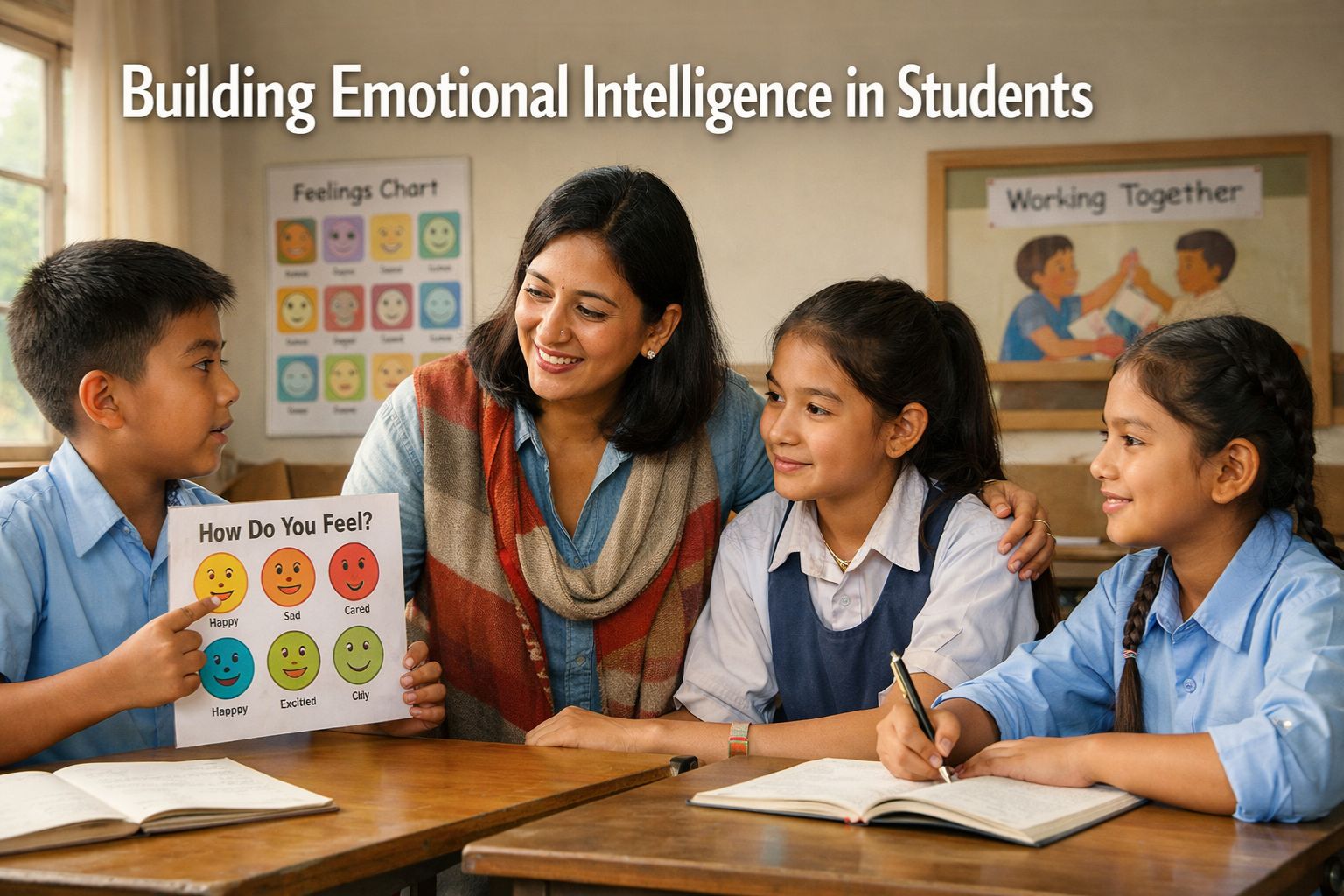
Emotion check-ins build self-awareness because students need language before they can regulate. Yale describes the Mood Meter as a tool that builds self- and social awareness and develops a more precise emotion vocabulary. A teacher can use a two-minute opener in which students name a feeling, identify a likely trigger, and choose one strategy for getting ready to learn.
Pause-and-respond routines
Pause-and-respond routines teach students how to create space between feeling and action. Yale describes the Meta-Moment as a process for responding to emotional situations in ways that align with one’s best self and healthy relationships. In school use, this can sit before exams, presentations, peer disagreements, or feedback conversations.
Guided reflection after conflict
Conflict reflection builds empathy and repair because it asks students to think about impact, not only rule-breaking. Yale describes the Blueprint as a guide for reflecting on conflict, restoring relationships, and strengthening empathy and conflict resolution. This makes peer disputes, group-project tension, and exclusion incidents usable learning moments.
Stories, role-play, and discussion
Stories and discussion help students work with emotions in concrete ways. The University of Maryland’s Emotion Coaching project trains elementary teachers to use picture books and storytime to teach emotion regulation. For older students, role-play and case discussion can move the same work into group chats, performance anxiety, disagreement, and feedback.
Shared norms and belonging
Shared norms strengthen emotional intelligence because students need a clear picture of how they want the classroom to feel and act. RULER’s Charter is designed to create agreed norms for how people want to feel and what they will do to help create those feelings. CDC’s connectedness guidance makes the same point at school level: belonging is a condition for learning and well-being.
How should emotional intelligence work change by age?
Emotional intelligence teaching should change by age because students differ in language, independence, peer pressure, reflection, and the emotional demands they face. CASEL’s framework and the OECD age findings both support age-sensitive design.
Early years and primary school
In early years and primary school, emotional intelligence teaching should be concrete, visible, and routine-based. Picture books, feeling charts, teacher think-alouds, short check-ins, and partner talk fit this stage well. The University of Maryland’s emotion coaching work highlights picture books and storytime as useful routes for teaching emotion regulation to elementary students.
Lower and upper secondary
In secondary school, emotional intelligence teaching should shift toward reflection, peer interaction, feedback, identity, and online communication. OECD data show wider age-15 differences in several social and emotional skills, which suggests a stronger need for explicit work on regulation, empathy, trust, and responsibility during adolescence. Advisory check-ins, conflict reflection sheets, and structured peer dialogue fit this stage well.
College and university students
In college and university settings, emotional intelligence work should focus on self-direction, collaboration, feedback, and coping with independence. The APA meta-analysis links emotional intelligence with academic performance, and the 2024 BMC Psychology study found positive links with well-being and academic achievement through self-efficacy, motivation, and resilience. Reflection after group work, seminar norms for disagreement, and pause routines before presentations suit this stage.
How can schools assess growth without over-testing?
Schools can assess emotional intelligence growth without turning it into one score. The stronger approach is to watch language, behavior, reflection, peer interaction, and help-seeking across time and across settings.
Watch language, behavior, and reflection
Good signs of growth include more precise feeling words, more thoughtful responses under stress, clearer reflection after conflict, and stronger participation in group work. The engagement review by Santos and colleagues supports tracking these patterns because social and emotional competencies are positively associated with engagement.
Use evidence from more than one setting
Emotional intelligence is context-dependent, so one class or one survey rarely tells the whole story. CASEL’s framework places these skills across classroom, school, family, and community settings. A fuller picture comes from teacher notes, student reflection, family communication, attendance patterns, and climate feedback.
What outcomes are realistic, and what are the limits?
Schools can expect gains in emotion language, classroom climate, peer interaction, and engagement when emotional intelligence work is taught consistently and supported by school climate. They should not treat it as a stand-alone answer to all discipline, mental health, or achievement problems.
What schools can expect
RULER’s evidence page reports that observers rated RULER classrooms as having more emotional support after one and two years and better classroom organization after two years. CASEL’s research page reports broad positive outcomes for SEL, and the teacher emotional competence study adds evidence that adult training can improve classroom climate.
What emotional intelligence cannot do alone
Emotional intelligence teaching does not replace counseling, mental health care, special education planning, or school policy. It works best as one part of a wider student-support system that includes trusted adults, safe climates, referral pathways, and family partnership. This article is for educational information only and does not replace clinical or individualized student support.
Conclusion
Schools and families build emotional intelligence in students through repeated practice, shared language, steady adult modeling, and climates where belonging is protected. The evidence points away from isolated activities and toward routines that let students notice feelings, manage responses, understand others, and repair harm after conflict. A sound starting point is small: one check-in routine, one pause strategy, one reflection tool, and one shared norm for how the classroom should feel.
FAQs
Can emotional intelligence be taught in school?
Yes. Emotional intelligence can be taught in school when students get repeated chances to recognize, label, express, and regulate emotions through classroom routines, adult modeling, and guided reflection. UNESCO, CASEL, and Yale all describe these skills as teachable within education.
What is the difference between emotional intelligence and SEL?
Emotional intelligence is the skill set used to understand and manage emotions. SEL is the wider educational process that teaches these skills alongside empathy, relationships, and responsible decision-making across classrooms, schools, families, and communities.
What are useful classroom activities for emotional intelligence?
Useful classroom activities include emotion check-ins, richer feeling-word practice, pause-and-respond routines, conflict reflection, story-based discussion, and shared classroom norms about how students want to feel and act together. Yale’s RULER tools and the University of Maryland’s emotion coaching work both fit this pattern.
How long does it take students to build emotional intelligence?
Students build emotional intelligence over months and years through repeated use, not through one lesson. RULER’s school evidence reports classroom changes across one- and two-year periods, which fits the wider view that these skills grow through sustained practice.
When should a school seek added support for a student’s emotional needs?
A school should seek added support when a student shows persistent distress, major behavior change, or needs that go beyond classroom guidance. Emotional intelligence teaching is educational support, not a replacement for counseling, clinical care, or formal student-support pathways.





Comments 0
No comments yet. Be the first to start the conversation.