




Why reading feels harder than it used to
If you’re a student, you read every day—messages, captions, notices, short posts. The struggle starts when you try to sit with a chapter, an essay, or a full book long enough to understand it.
Large surveys and time-use research suggest a wider pattern: fewer people set aside time for reading for enjoyment. A University College London news release summarising research using the American Time Use Survey reported that the share of Americans who read for pleasure on an average day fell from about 28% (2004) to about 16% (2023).
Among young people, reading enjoyment can be low too. The National Literacy Trust’s 2024 report found 34.6% of 8–18-year-olds said they enjoyed reading in their free time.
A reading habit is still buildable. It works best when you treat it like a routine you design, not a mood you wait for.
What a reading habit means in student life
A reading habit means you read on most days without a long internal debate. You start with less mental effort, then reading becomes part of your normal schedule.
Reading habits matter for school as well. OECD’s PISA in Focus brief reported that, on average, students who read daily for enjoyment scored about the equivalent of one-and-a-half years of schooling higher than students who did not. That does not mean novels magically raise grades. It points to a link between regular reading and skills school rewards: comprehension, vocabulary growth, and sustained attention.
The habit loop in plain words
A habit has three parts:
-
Cue: a trigger (time, place, event)
-
Action: the reading you do
-
Reward: a small payoff that makes repeating easier
You do not need a big reward. A simple check mark in a notebook can work.
The “minimum dose” rule
Students often fail at reading plans when the goal is too big. Your minimum dose is the smallest reading session you can repeat even on your busiest week. This protects consistency, which protects the habit.
Research on habit formation supports patience and repetition. In a 2010 study on everyday habit formation, the average time to reach near-automaticity was reported as 66 days, with wide variation across people and behaviours.
Start small and protect consistency
A reading routine grows from a small daily action that stays stable.
The 10-minute daily rule
Pick a daily minimum like:
-
10 minutes, or
-
2–5 pages, or
-
one short section of an article
Ten minutes is short enough to start on most days, long enough to create momentum.
The 2-minute start trick
Some days, starting feels heavy. Lower the starting cost:
-
Open the book.
-
Read for 2 minutes.
-
Stop if you want.
This protects the routine even when energy is low. Many students continue once they begin, yet you do not need to rely on that.
Build a reading system that fits your schedule
Motivation changes. A system stays.
Choose a time anchor
Tie reading to an existing daily event:
-
after breakfast
-
after returning home
-
after dinner
-
before bed
Write the rule in one line: “After dinner, I read for 10 minutes.”
Choose a place anchor
Pick one main reading spot. A consistent place reduces the effort of getting started.
Examples:
-
a specific chair at home
-
a library seat
-
a desk corner with a lamp
-
a quiet classroom bench before class
Add phone friction
You do not need dramatic rules. You need small barriers that protect attention:
-
keep the phone across the room for your reading window
-
silence notifications during your reading minimum
-
keep the phone face down and out of reach
-
use a simple timer, then keep the phone away until it ends
The goal is to make reading the easiest next action.
Pick reading material you can finish

A habit collapses when every reading session feels like punishment. Start with finishable material, then scale up.
Use a “reading ladder”
Move from easy to harder over time:
-
Step 1: short stories, short essays, readable non-fiction
-
Step 2: books with short chapters, biographies, beginner-level classics
-
Step 3: denser non-fiction, research-heavy writing, academic chapters
Finishing a book builds trust: “I complete what I start.”
Use audio as a bridge when print feels hard
Audio can help some students begin when print feels frustrating. The National Literacy Trust reported that 37.5% of children and young people said listening to audio sparked their interest in reading books, and those who enjoyed listening were more likely to enjoy reading in their free time.
A practical method:
-
listen to a chapter during commute or chores
-
read a few pages of the same chapter later
-
write a short recap in your own words
This keeps you connected to text without forcing long print sessions on day one.
Paper or screen: choose what supports deep reading
Digital reading is useful, especially for quick access. For longer and denser text, paper can help comprehension for many readers. A 2018 meta-analysis comparing paper-based and screen-based reading reported an overall comprehension advantage for paper across included studies. (
A student-friendly approach:
-
use paper for dense chapters, exam units, long essays
-
use screens for short readings, quick reference, searching terms
-
if you read on a screen, use full-screen mode and remove extra tabs
This is not a rule about “good” or “bad” formats. It is a choice about focus and understanding.
Read actively so you remember more
A common student complaint: “I read, then I forget.” Passive reading feels smooth, yet it often fades fast. Active reading adds small steps that make memory stronger.
A simple 4-step method for textbooks and exam chapters
-
Preview: skim headings, subheadings, summaries, diagrams
-
Question: turn headings into questions
Example: “What are the causes of inflation?” -
Read: read to answer your questions
-
Recall: close the book and answer from memory
This turns reading into learning.
The 3-sentence recall
After a short chunk (a page or a subsection), write:
-
Sentence 1: the main idea
-
Sentence 2: one key detail or example
-
Sentence 3: why it matters for the chapter or exam
Three sentences keep your notes short, clear, and useful.
Make reading support exam preparation

Reading helps exams most when you combine it with two simple learning habits: spacing and retrieval.
Space your review across days
Spacing means spreading learning across multiple sessions instead of one long session. A 2006 review and quantitative synthesis of distributed practice summarised evidence from many experiments and reported a strong spacing effect across a large set of assessments.
A student schedule can look like:
-
Day 1: read + 3-sentence recall
-
Day 3: short self-quiz from your notes
-
Day 7: quick recap + another quiz
This keeps the content alive without long study blocks.
Use retrieval practice
Retrieval practice means pulling information from memory, not rereading. In “Test-Enhanced Learning,” Roediger and Karpicke reported that taking memory tests can improve later retention, a phenomenon often called the testing effect.
Simple retrieval options:
-
close the book and write what you remember in five lines
-
answer end-of-chapter questions without looking first
-
teach the idea to a friend in two minutes
-
make five questions from a chapter, answer them the next day
Fix common reading problems students face
Reading problems are normal. The goal is to match the fix to the problem.
“I get distracted”
Try shorter checkpoints:
-
read one page, pause for 10 seconds, continue
-
keep a pen beside you to underline key lines
-
keep a small “distraction list” on paper (write the thought, return to reading)
Distraction often comes from unclear goals. Before each session, set one purpose:
-
“I need the definition and one example.”
-
“I need the steps in this process.”
“I forget fast”
Forgetting after reading often means recall was missing. Add one recall step:
-
3-sentence recall after each chunk
-
five-question quiz after each chapter
-
one-page summary after each topic
Do not aim for perfect notes. Aim for notes you can review in five minutes.
“I read slowly”
Slow reading is normal with new or technical content. Speed rises with familiarity and focus.
Try:
-
preview first, so your brain has a map
-
read for meaning, not for perfect recall on the first pass
-
mark confusing lines, move forward, return later
-
use a finger or pen tip to guide your eyes on long paragraphs
For exam chapters, accuracy matters more than speed.
“I feel sleepy”
Sleepiness often comes from timing and posture:
-
read sitting up, not lying down
-
shift heavy reading to morning or early evening
-
use shorter sessions (10–15 minutes), then take a short break
-
keep the room well-lit
If night reading is your only option, pick lighter reading for that slot and keep exam chapters for earlier sessions.
Track progress without turning reading into pressure
Tracking works best when it stays simple.
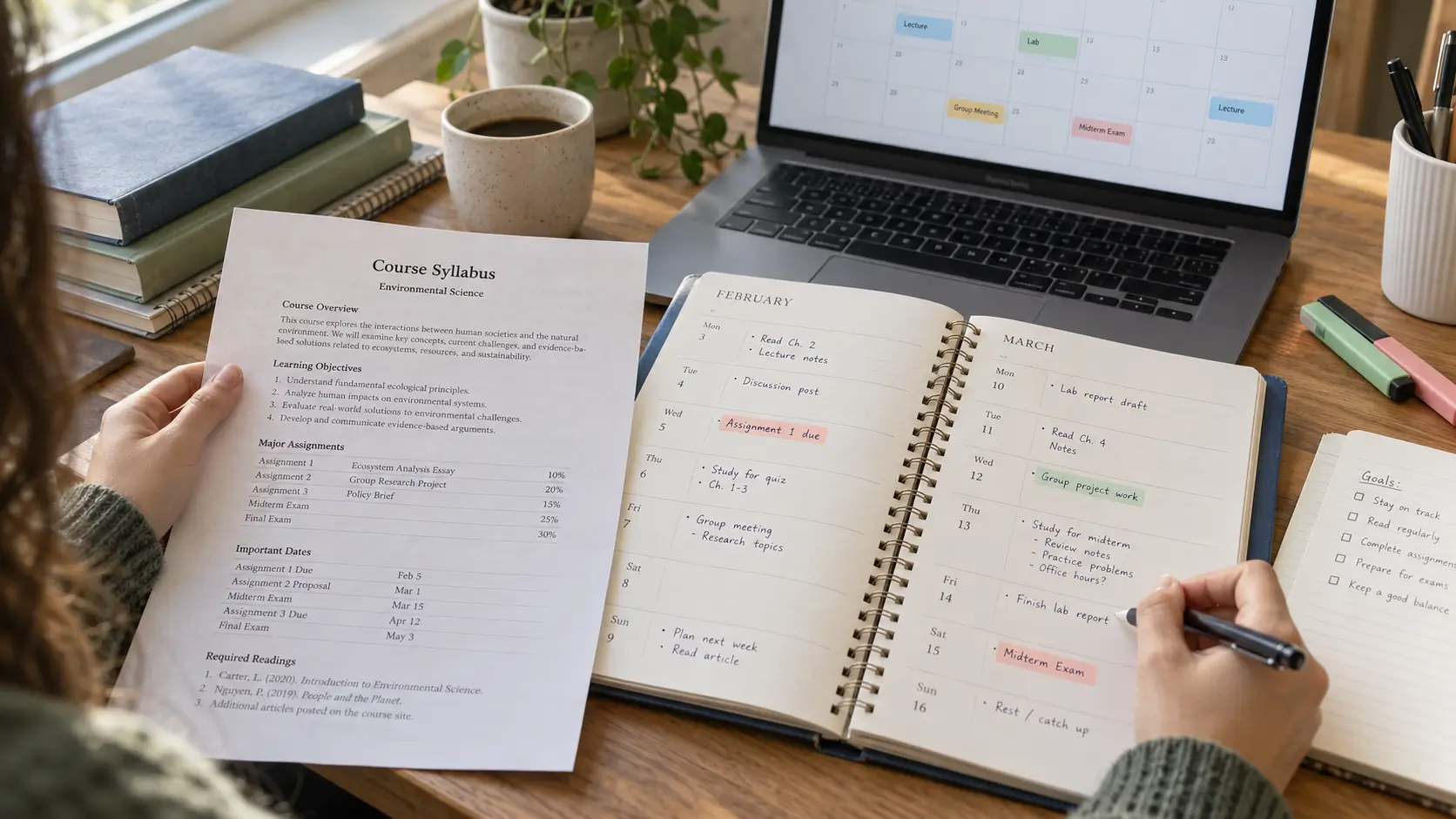
A simple reading log
Use one notebook page per month:
-
Date
-
Minutes read
-
What you read (one line)
-
One takeaway (one line)
This makes progress visible without turning reading into a performance.
Weekly reset
Once a week, ask:
-
What did I finish?
-
What time anchor worked best?
-
What blocked reading?
-
What will I read next week?
Then adjust one small part: time anchor, place, material choice, or phone friction.
A realistic 30-day reading routine for students
This plan builds consistency first, then builds volume and learning gains.
Week 1: Make starting easy
-
Daily minimum: 10 minutes
-
Use finishable material from the reading ladder
-
Use the 2-minute start trick on hard days
-
Log minutes read
Week 2: Add active reading for study material
-
Keep the daily minimum
-
Use the 4-step method for one study session on 3–4 days
-
Add 3-sentence recall for study chunks
Week 3: Add spacing and self-quizzing
-
Keep the daily minimum
-
Revisit last week’s notes on two separate days
-
Add one short self-quiz for each chapter
Week 4: Raise stamina without breaking the habit
-
Keep the daily minimum on busy days
-
Raise reading time to 15–20 minutes on 3 days
-
Finish one small book or one full unit of a textbook
If you miss a day, restart the next day with the minimum dose. Do not “repay” the missed time with a long session. Consistency matters more.

Conclusion
A student reading habit is built through small daily reading, a clear time anchor, a consistent place, and material you can finish. Add phone friction to protect attention. Use active reading and short recall so the reading turns into memory. Keep the minimum dose steady for a month, then raise time slowly. Research on habit formation suggests the timeline varies across people, so patience matters more than intensity.
FAQs
1) How long should I read each day as a student?
Start with 10 minutes daily. Keep that minimum dose steady for 30 days, then raise time on a few days each week.
2) What should I read first to build a reading habit?
Start with finishable material: short stories, short non-fiction, books with short chapters, or readable articles. Use a reading ladder and move up after you finish.
3) How can I focus on reading when my phone distracts me?
Add friction: keep the phone across the room, silence notifications, and use a timer. Pair this with a clear goal for each session.
4) How can I remember what I read for exams?
Use recall and self-quizzing. Close the book and answer questions from memory. Research on test-enhanced learning reports benefits for later retention.
5) Is reading on a screen fine for studying?
Screens can work well for short readings and quick reference. For long and dense text, research comparing paper and screens has reported better comprehension on paper across many included studies. (



Comments 0
No comments yet. Be the first to start the conversation.