



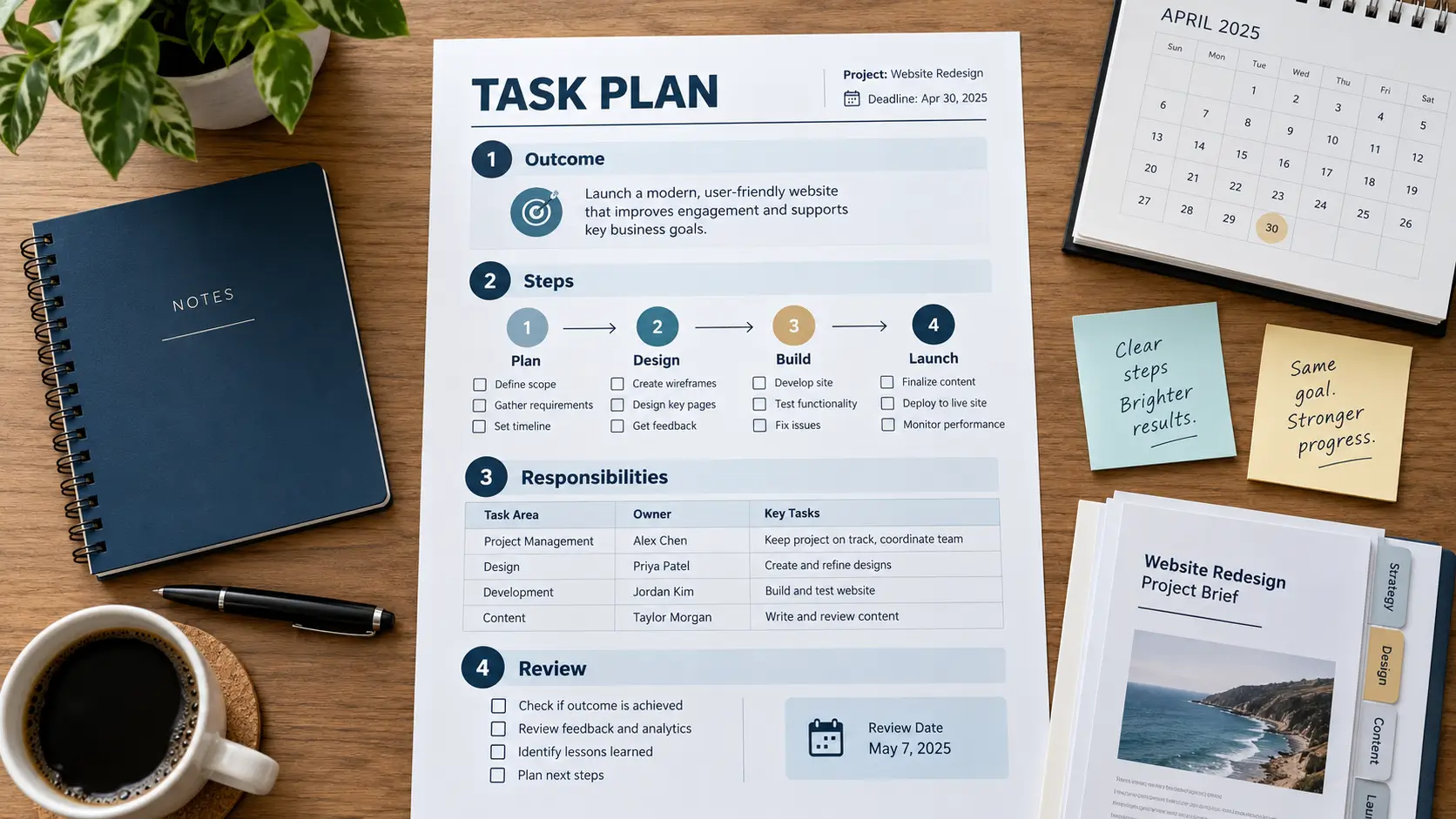
Giving clear instructions for a complex task means explaining more than what someone needs to do. The person receiving the instructions must understand the expected result, where to begin, which steps depend on others, what decisions they can make, and how to recognize when the work is complete.
The challenge is finding the right level of detail. Too little information leaves important decisions unclear. Too much detail can hide the actions that matter or restrict someone who already knows how to complete the work.
A practical approach is to define the outcome, consider the recipient's knowledge, organize the work into manageable stages, clarify responsibilities, and check understanding before problems develop.
Understand What Makes the Task Complex
A task does not need dozens of steps to be complex. Difficulty can arise from unfamiliar terminology, missing information, multiple participants, dependent activities, or decisions that affect later work.
Consider a group assignment involving research, writing, reviewing, and presenting. Each activity may be straightforward, but participants need to know which information must be gathered first, who prepares each part, and when the separate contributions must come together.
Before preparing instructions, distinguish between a prescribed procedure and an assignment that allows independent judgment.
|
Type of task |
Appropriate instruction style |
What needs to be clear |
|---|---|---|
|
Fixed procedure |
Numbered steps in the required order |
Starting conditions, exact actions, exceptions, completion |
|
Flexible assignment |
Outcome, requirements, responsibilities, and milestones |
Expected result, decision authority, deadlines, review |
|
Mixed task |
Required steps alongside flexible work stages |
Which actions are mandatory and where choices are allowed |
This distinction matters because an instruction such as "complete these actions in order" serves a different purpose from "produce this result using an appropriate method."
The BCcampus technical writing guide distinguishes fixed-order, variable-order, and alternative steps. GitLab's delegation guidance addresses a different need: communicating outcomes while allowing appropriate responsibility for decisions.
A complex task may require both approaches.
Define the Expected Result Before Explaining the Steps
One of the most useful questions to answer is: What should exist when the task is finished?
An instruction to "prepare the report" identifies an activity but leaves several questions unanswered. What should the report cover? Is the recipient preparing a draft or a final submission? Who will read it? What must be checked before it is accepted?
A clearer assignment identifies the deliverable and the conditions that matter.
For example, an instruction for a student project might specify that the group should submit a draft report containing its research question, main findings, supporting sources, and areas requiring further investigation. The instructor will review the draft before the group prepares its final version.
This example defines a result without prescribing every writing decision.
Explain what successful completion means
Depending on the task, clarify:
-
The required output, such as a document, presentation, completed form, or reviewed proposal.
-
The essential content or quality requirements.
-
Whether the work is a draft, recommendation, or final submission.
-
Where the result should be delivered.
-
Who reviews or approves it.
These details form a practical definition of completion. They need not become an elaborate assessment system.
The University of Waterloo's guidance on group work recommends explaining both what students must do and what their final product should look like.
Also distinguish essential requirements from preferences. A required submission format may be non-negotiable; a preferred visual style may leave room for choice.
Consider What the Recipient Already Knows
Instructions should start from the recipient's actual knowledge, not the writer's assumptions.
Someone familiar with a task may need only the objective, constraints, and deadline. A person performing it for the first time may need explanations of unfamiliar terms, access requirements, and preliminary actions.
Before communicating the task, consider three questions:
-
What knowledge can reasonably be assumed?
-
What information must be explained?
-
What tools, documents, permissions, or people must be available before work begins?
A person cannot follow a procedure that refers to a document they cannot access. Nor can they complete an assigned review if they do not know which version is current.
Google's technical writing guidance on audience emphasizes matching information to readers' existing knowledge and explaining unfamiliar vocabulary and abbreviations.
This is particularly important when instructions are shared across departments, institutions, or countries. An abbreviation familiar to one group may mean nothing to another. Culturally specific expressions can create additional uncertainty.
The aim is not to simplify every term. It is to remove knowledge gaps that prevent the recipient from acting.
Organize the Work into Clear Stages
Long instructions become easier to use when related actions are grouped around a meaningful purpose.
For a project, those stages might involve gathering information, preparing an initial output, reviewing the work, and submitting the final version. These are illustrative categories, not a mandatory process for every task.
Each stage should have a recognizable result.
Identify dependencies first
A dependency is something that must happen before another action can proceed.
For example, a group cannot accurately summarize research findings until the relevant information has been collected. A reviewer may also need an agreed draft before providing feedback.
Identify dependencies before arranging the instructions. Otherwise, the sequence may send people toward work they cannot yet complete.
For tasks involving several participants, make the handoff explicit. State what one person must provide and what the next person needs to do with it.
Number steps only when order matters
Numbered lists communicate sequence. Use them when the recipient must complete actions in a particular order.
Microsoft's guidance on writing step-by-step instructions recommends separating actions into understandable steps and making the starting location clear when necessary.
A useful numbered instruction follows a consistent pattern:
-
Identify where the action takes place.
-
State the action using a direct verb.
-
Include any condition necessary to perform it correctly.
-
Explain how the recipient knows the action is complete.
Not every action needs a numbered position. If several activities can happen independently, bullets or separate task assignments may communicate that flexibility more accurately.
When there are alternative routes, state the condition that determines which one applies. Otherwise, readers may interpret both alternatives as required.
Keep actions visible
Begin procedural steps with verbs such as "open," "review," "compare," "record," or "submit."
Place supporting explanations after the relevant action rather than burying the action inside a long paragraph.
For example, an instruction that begins "Review the source document for missing references" is easier to act on than a general paragraph about the importance of references that eventually mentions the review.
Include sufficient detail to make the action possible, but remove explanations that do not affect the action or a necessary decision.
Clarify Responsibilities, Authority, and Deadlines
When several people participate, instructions must establish who is responsible for each part of the work.
Naming a group as a whole may be sufficient for a short shared activity. For a task with separate stages or approvals, individual responsibilities may need to be explicit.
Clarify who performs the work, who provides input, and who has authority to accept or change the result.
Distinguish responsibility from permission
A person may be responsible for preparing a document without having permission to approve its publication. Another may be allowed to choose the research method but not change the assignment's scope.
These differences should appear in the instructions wherever they affect decisions.
GitLab's effective delegation guidance addresses objectives, resources, authority, follow-up, and appropriate independence. It is organizational guidance, not proof that a single delegation method works equally well in every setting.
For student teams, communication in student group projects is also relevant to dividing responsibilities and coordinating contributions.
Make deadlines and priorities usable
A deadline should identify what is due, not simply when people must stop working.
Distinguish the date for an initial draft from the date for final submission. If one participant's work is needed by another, specify the earlier handoff.
For teams working across time zones, state the applicable time zone when the deadline might otherwise be ambiguous.
Also explain which requirements take priority if constraints compete. A recipient should know whether to seek clarification, request more time, or submit a partial result when a necessary input is missing.
Finally, identify the person or channel for raising problems that cannot be resolved within the recipient's authority.
Choose the Right Way to Deliver the Instructions
Written, spoken, and visual instructions serve different purposes.
Spoken directions allow immediate discussion and clarification. Written directions provide a reference that recipients can revisit. Demonstrations can be useful when an action is difficult to describe accurately with words alone.
For a complex assignment, a short verbal explanation accompanied by an accessible written brief may be more useful than relying on memory of a conversation.
The British Council's training guidance recommends organizing complex activities into stages, using language suited to participants, and checking understanding.
Give the overview before the detail
Begin by identifying the purpose, expected result, and broad stages.
Then explain the immediate actions. Additional instructions can be introduced when participants reach the relevant stage, provided they already know any conditions that affect earlier decisions.
This balance matters. Giving every procedural detail at once may obscure the first action. Withholding a requirement that affects planning can be equally unhelpful.
The practical distinction is between information needed now and information that can be consulted later.
Make instructions accessible
Clear instructions should not depend solely on a person's ability to interpret a diagram, remember a spoken explanation, or understand unexplained symbols.
Where appropriate, provide text alongside visuals, define unfamiliar labels, and place essential directions close to the action they describe.
The W3C's cognitive accessibility guidance recommends clear steps without omitted actions and instructions positioned near relevant activities. This is supplemental accessibility guidance, not a separate mandatory WCAG conformance requirement.
A visual is useful when it clarifies a relationship, decision, or sequence. It should not merely repeat information already expressed clearly.
Check Understanding Before Work Progresses Too Far
Instructions are not necessarily understood simply because they have been delivered.
A question such as "Does everyone understand?" may invite agreement without revealing how people have interpreted the assignment.
Instead, ask a question connected to an important action or condition.
For example:
-
What will you prepare first?
-
Which information do you need before starting?
-
Who will review the draft?
-
What will you do if the required source is unavailable?
These questions reveal whether the recipient understands the expected result, sequence, or decision boundaries.
The British Council recommends specific questions rather than relying solely on a general request for confirmation.
For a group, ask participants to describe their own responsibilities. When appropriate, invite them to identify unclear instructions or missing resources before they begin.
The purpose is to check the instructions, not to embarrass the recipient or test unrelated knowledge.
Review an early milestone
For longer tasks, understanding should also be checked through the work itself.
An initial outline, draft, or agreed plan can reveal differences between the intended result and the recipient's interpretation.
Choose the checkpoint according to the task's complexity and consequences. Frequent monitoring is not automatically better. Experienced participants may need fewer interventions when the expected outcome and decision authority are already clear.
Keep Instructions Consistent When Requirements Change
Complex tasks often change after work begins. New information may affect the scope, available resources, or deadline.
When that happens, the instructions should change with the task.
If several participants are involved, avoid leaving different people to rely on conflicting messages. Update the shared document or agreed communication record and identify the change that matters.
A useful update explains what changed, which earlier instruction it replaces, and whether the change affects responsibilities or deadlines.
Consequential changes should also be communicated to the people whose work depends on them.
Not every minor adjustment needs a formal approval process. However, decisions that change the required output, allocate additional work, or exceed the recipient's authority may need confirmation from the appropriate person.
The original instructions remain useful only if recipients can identify which requirements currently apply.
When Instructions Are Not Working, Identify the Actual Problem
If someone struggles to follow directions, rewriting the same message is not always the solution.
First determine what is preventing progress.
An unclear outcome requires a clearer description of the deliverable. A missing prerequisite requires access or information. Conflicting deadlines require a decision about priorities.
Other difficulties may involve an unrealistic workload, unavailable expertise, unclear approval authority, or a task that has changed without a corresponding update.
These are different problems, even when they produce similar questions.
Review the first point at which the recipient could not proceed. Ask which information or decision was missing at that point.
If several people interpret the same instruction differently, examine the wording, assumptions, and task structure. If only one person is blocked, check whether that person has the necessary resources or background.
The goal is to correct the source of uncertainty rather than simply add more words.
A Reusable Brief for Giving Complex Instructions
Before sending an important assignment, use the following fields to check whether the instructions contain the information the recipient needs.
This is a practical writing aid, not a universal standard. A short task may require only a few fields.
|
Field |
Question to answer |
|---|---|
|
Outcome |
What must be produced or achieved? |
|
Audience |
What does the recipient already know? |
|
Starting point |
What materials, access, or approvals are needed? |
|
Sequence |
Which steps or milestones matter, and in what order? |
|
Responsibility |
Who does the work and who reviews it? |
|
Decision authority |
What can the recipient decide independently? |
|
Requirements |
What conditions, formats, or exclusions are mandatory? |
|
Timing |
When are checkpoints, handoffs, and completion due? |
|
Changes |
Where should questions, obstacles, or revised requirements go? |
Use the answers to produce a brief the recipient can follow, rather than sending the table as an additional administrative requirement.
A final review should answer four practical questions: Can the recipient identify the expected result? Do they know how to begin? Are important decisions and restrictions clear? Is there a reliable route for clarification and review?
If those answers are available, the instruction is more likely to serve its purpose without unnecessary detail.
Giving Complex Instructions to AI Tools
An AI assistant requires a different kind of task handoff because it does not share a human colleague's reliable understanding of the project context.
For a complex request, specify the task, provide the necessary source material, identify important constraints, and describe the expected output format.
If several activities are involved, divide the work into stages where useful. Review the result before relying on it.
OpenAI's guidance on creating effective prompts recommends clear, specific requests, appropriate context, and iterative refinement for complex work.
Specifying an output format can also help distinguish a summary from a detailed report or a checklist from a narrative explanation. Collegenp's article on specifying an AI response format discusses this aspect in more detail.
Clear prompts can reduce ambiguity, but they do not guarantee that generated information is correct. Important facts, references, and conclusions still require verification.
Final Takeaway
Clear instructions for a complex task are built around a shared understanding of the result, starting conditions, necessary actions, responsibilities, and limits on decision-making.
Use exact steps when the process requires them. Allow flexibility when the recipient is responsible for achieving an outcome rather than following a prescribed procedure.
Match the detail to the person's experience, confirm that important requirements are understood, and keep the instructions current as the task develops. The objective is not to explain everything possible. It is to provide the information needed to act correctly and recognize when the work is complete.







Comments 0
No comments yet. Be the first to start the conversation.