



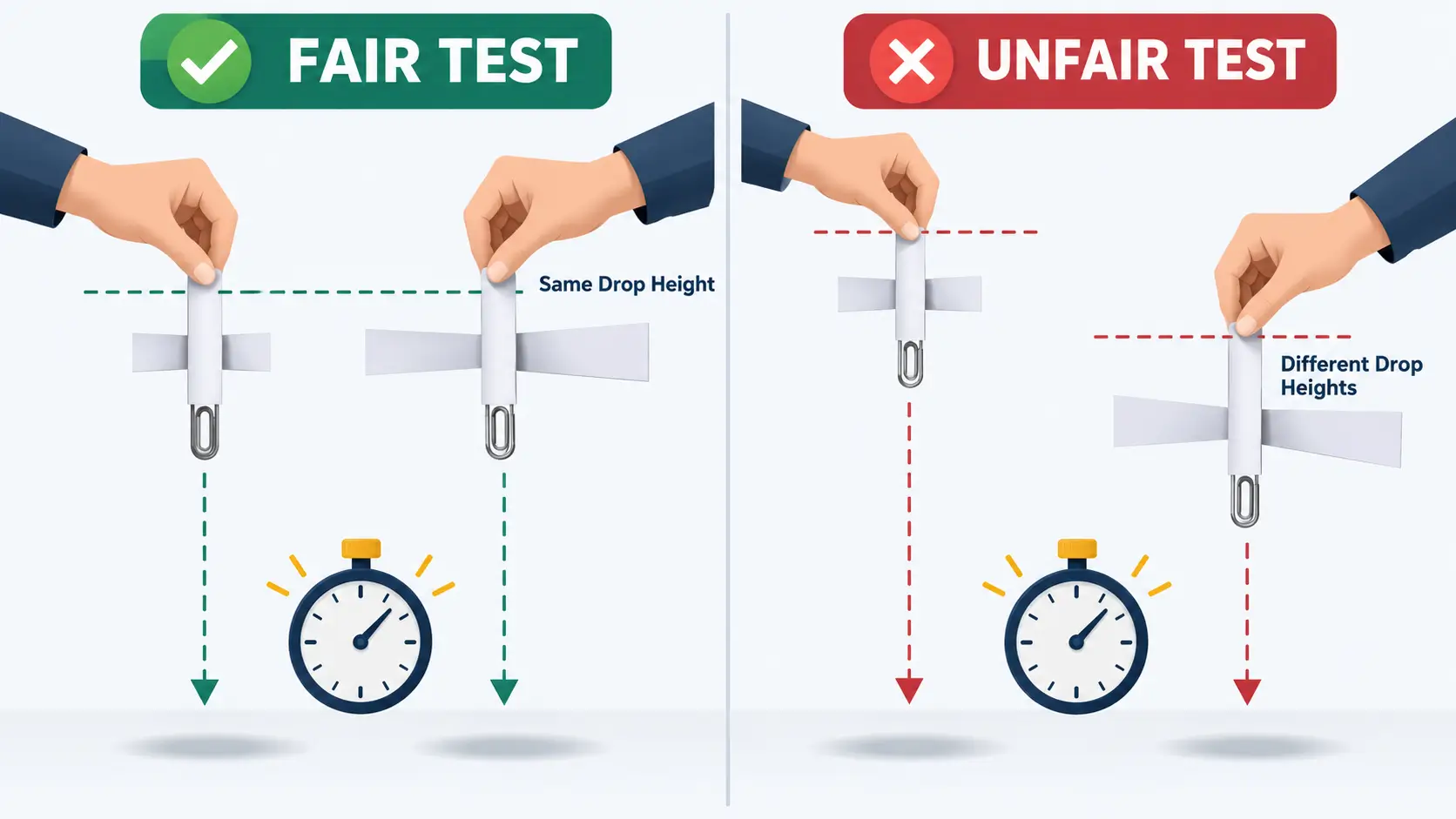
An experiment is a fair test when it compares conditions in a way that allows investigators to examine the effect of the factor being tested without confusing it with other influences.
To tell whether an experiment is fair, identify what was deliberately changed, what was measured, and what other factors may have affected the result.
In a simple fair test, the investigator changes one independent variable while keeping other relevant conditions the same. The outcome is then measured or observed using a consistent method.
However, changing one factor deliberately does not automatically make a test fair. Unintentional differences in starting conditions, procedures, or measurements can also affect the comparison.
A fair test can produce unexpected results, and an experiment that appears properly controlled may still provide weak evidence. Understanding these distinctions helps students evaluate scientific investigations and explain how an unfair test can be improved.
What Makes an Experiment a Fair Test?
A fair test is a controlled scientific investigation in which one factor is deliberately changed, its effect is measured or observed, and other relevant factors are kept constant.
The Australian Academy of Science's Primary Connections guidance identifies three types of variables used in fair testing.
|
Variable |
What it means |
Question to ask |
|---|---|---|
|
Independent variable |
The factor deliberately changed |
What are we changing? |
|
Dependent variable |
The outcome measured or observed |
What are we measuring? |
|
Controlled variables |
Other relevant factors kept the same |
What must stay the same? |
These variables help investigators make meaningful comparisons.
For example, suppose students want to investigate whether changing the length of a paper spinner's wings affects how long it takes to fall.
They change the wing length and measure the falling time while keeping the drop height and other relevant conditions constant.
If both wing length and drop height change, the results become difficult to interpret because either factor may have influenced the falling time.
The purpose of controlling variables is to reduce alternative explanations, not to guarantee that an experiment will produce a particular result.
How to Check Whether an Experiment Is Fair
The most useful way to evaluate a fair test is to examine its question, variables, procedure, and evidence separately.
1. Identify the Question Being Tested
Begin by identifying what the experiment is supposed to investigate.
A clear question should connect a factor that can be changed with an outcome that can be measured or observed.
For example:
"Does the length of a paper spinner's wings affect how long it takes to fall?"
This identifies the intended change and the outcome.
A question such as "Which paper spinner is better?" is less useful because it does not define what "better" means.
The investigation might compare falling time, stability, or another characteristic. Until the intended outcome is clear, it is difficult to judge whether the experiment answers its question.
2. Find the Independent Variable
The independent variable is the factor deliberately changed during the investigation.
In the paper-spinner example, it is wing length.
Testing several wing lengths still means investigating one independent variable. The different lengths are values of that variable, not separate independent variables.
A fairness problem arises when another potentially influential factor changes at the same time.
For example, if students use greater drop heights for every spinner with longer wings, both wing length and drop height vary together.
Any difference in falling time may be related to either factor or their combined effects.
The Open University's TESSA guidance explains that when two relevant factors change together, investigators cannot confidently distinguish their individual contributions to the observed result.
3. Identify the Dependent Variable
The dependent variable is the outcome measured or observed to answer the experimental question.
For the paper-spinner investigation, it is the time taken to fall.
To evaluate the measurement method, check whether:
-
The same outcome is measured in each condition.
-
Measurements use consistent units.
-
The same timing or observation rules are followed.
-
Equipment and recording methods are applied consistently.
Suppose one spinner is timed from the moment it is released, while timing another begins after it starts falling.
Even if the spinners have otherwise comparable conditions, the inconsistent timing procedure makes their recorded times less suitable for comparison.
Measurement procedures matter because an apparent difference in results may reflect how observations were collected rather than the factor under investigation.
4. Check Which Other Variables Were Controlled
Controlled variables are relevant conditions kept constant so they do not interfere with the intended comparison.
Ask:
"What else might affect the result apart from the factor being tested?"
Possible answers may include the starting position, materials, equipment, environmental conditions, or measurement procedure.
A factor that changes unintentionally and offers another explanation for the outcome may introduce confounding.
For example, if two paper spinners have different wing lengths and different numbers of paper clips, the investigation cannot isolate the effect of wing length.
The number of paper clips is relevant because it changes a feature of the spinner that may affect how it falls.
An important qualification is that not every background difference must be eliminated. Investigators should prioritize conditions that can reasonably influence the measured outcome.
5. Decide Whether the Available Information Supports a Fair Comparison
After examining the variables and method, decide what can reasonably be concluded about the test.
|
Judgment |
When it applies |
|---|---|
|
Fairly controlled |
The intended factor changes while other relevant influences are controlled and the procedure is consistent. |
|
Unfair or confounded |
Another relevant factor changes, making the intended effect difficult to isolate. |
|
Not enough information |
Important details about the controls or procedure are missing. |
|
Fair design, uncertain evidence |
The comparison appears properly controlled, but limited or inconsistent observations weaken confidence in the findings. |
These judgments distinguish problems in experimental design from problems in the available evidence.
For example, if an investigation description does not state whether the drop height was kept constant, the information is insufficient to establish fairness.
That omission does not prove the students used different heights.
A careful evaluation should identify what is known, what remains uncertain, and what additional information would resolve the question.
An Example of an Unfair Test and How to Make It Fair
An unfair test can occur when two conditions appear comparable but an important difference in procedure affects the result.
Science Buddies illustrates this using two toy cars moving down a sloping ramp.
The investigation aims to compare which car coasts faster.
In the published teaching example, the first car is released gently while the second receives a push.
The comparison is unfair because both the car and the starting method differ.
The push introduces another possible influence on the result.
Even if both cars travel along the same ramp, the investigation does not provide a fair comparison of their performance under equivalent starting conditions.
How Can the Comparison Be Improved?
The investigator should use the same release method for each car while maintaining comparable ramp conditions.
A revised procedure would:
-
Release each car in the same way without giving either an additional push.
-
Use the same ramp and starting position.
-
Measure performance using the same method.
-
Repeat comparable trials where appropriate.
The improved design reduces the chance that differences in how the cars start will be mistaken for differences between the cars.
It does not establish which car is faster. That conclusion would require actual measurements.
This example demonstrates why using identical equipment or testing objects in the same location is insufficient when the procedures are different.
Which Variables Need to Stay the Same?
The variables that need to remain constant are those that may influence the measured outcome without being the intended focus of the investigation.
The Association for Science Education and Primary Science Teaching Trust use a paper-spinner investigation to illustrate this principle in Primary Science Skills and How to Teach Them, Unit 3.
The teaching resource considers how wing length affects the time a spinner takes to fall.
|
Role |
Factor |
How it is handled |
|---|---|---|
|
Independent variable |
Wing length |
Change between test conditions |
|
Dependent variable |
Falling time |
Measure in seconds |
|
Controlled variables |
Drop height, paper-clip count, wing width, and other relevant dimensions |
Keep constant |
Changing wing length while also changing the number of paper clips makes it difficult to separate their possible effects.
Similarly, comparing spinners dropped from different heights introduces an additional difference relevant to the falling time.
The investigator should identify these influences before collecting measurements.
Does Everything Have to Be Identical?
Perfectly identical conditions are not always achievable or necessary.
The Australian Academy of Science notes that investigators may need to prioritize which variables to control because maintaining every detail is not feasible.
The important distinction is between differences that are reasonably expected to affect the outcome and differences that are unlikely to matter.
An uncontrolled factor deserves attention when it provides a plausible alternative explanation for the result.
If its relevance is uncertain, that uncertainty may itself become a question for further investigation.
Does a Fair Test Need Repeated Trials or a Control Group?
Repeated trials and control groups can strengthen an investigation, but neither is a universal requirement for identifying a simple fair comparison.
Do Repeated Trials Make an Experiment Fair?
Repeating an experiment helps investigators assess whether results remain consistent under comparable conditions.
A trial is one run of an investigation under specified conditions.
Repeating trials may reveal variation, unusual observations, or inconsistencies that were not apparent in a single measurement.
However, repetition cannot correct an unfair comparison by itself.
If one toy car receives a push in every trial while another does not, the same uncontrolled difference remains.
Additional trials might establish that the outcomes are consistent, but they cannot separate the effect of the car from the effect of the starting method.
There is also no universal number of repetitions that guarantees fair or reliable findings. The appropriate number depends on the investigation, expected variation, and the evidence needed.
Science Buddies' experimental-procedure guidance discusses repeated trials and the need to choose procedures appropriate to the investigation.
Are Control Groups and Controlled Variables the Same?
A control group is a comparison condition, often one that does not receive the treatment being investigated.
Controlled variables are the other relevant factors maintained consistently across the comparison.
Consider an experiment examining the effect of fertilizer on plant growth.
Plants receiving fertilizer may be compared with plants receiving none. The group without fertilizer provides a baseline for comparison.
Water, light, and other relevant growing conditions should remain comparable between groups.
However, an experiment comparing several settings of an independent variable does not necessarily require a separate untreated control group.
Science Buddies illustrates this distinction with an experiment comparing the speed of an electric motor at different voltage settings.
The important requirement is an appropriate comparison, whether or not the design includes a specially designated control group.
Can a Fair Test Produce Unreliable or Unexpected Results?
A fair test can produce unexpected or inconsistent results because fairness and the quality of the resulting evidence are related but distinct issues.
The New South Wales Department of Education differentiates accuracy, precision, reliability, and validity when evaluating scientific investigations.
-
Accuracy concerns how closely a measurement agrees with an appropriate reference or true value.
-
Precision concerns how closely repeated measurements agree with one another.
-
Reliability concerns the consistency of findings when investigations are repeated under comparable conditions.
-
Validity concerns whether an investigation addresses the question it was intended to answer.
A test may use appropriate controls but still produce imprecise measurements.
Similarly, repeated measurements may agree closely even when an experiment fails to address its intended question.
The distinction matters because careful measurement alone cannot correct a confounded design, while controlling variables does not guarantee accurate measurements.
Does the Result Have to Support the Hypothesis?
A fair test does not have to support the investigator's original hypothesis.
A hypothesis is a proposed explanation or prediction that can be examined using evidence.
An unexpected finding does not automatically indicate that the investigation was unfair.
Science Buddies' guidance on scientific conclusions advises investigators to report findings accurately, including results that do not support their predictions.
When results differ from expectations, the investigator should examine the method, controls, measurements, and possible limitations.
An unusual observation should not automatically be discarded. Its possible causes can be investigated, and additional comparable trials may be appropriate.
If a design problem is discovered after an experiment, the original observations should remain unchanged. The investigator can report the limitation and plan a new comparison using an improved method.
Is Every Scientific Investigation a Fair Test?
Not every scientific investigation uses the simple fair-test approach.
Fair testing is particularly suitable when investigators can deliberately change a factor and compare its effect while controlling relevant conditions.
Other scientific questions require different methods.
The University of Waikato's Science Learning Hub describes several forms of scientific enquiry, including observation, classification, pattern seeking, modelling, and fair testing.
For example, scientists investigating natural weather patterns cannot necessarily control environmental conditions or deliberately alter the factors being studied.
Such investigations may rely on systematic observations and comparisons rather than a simple experiment involving one deliberately changed variable.
More advanced experimental designs may also investigate several factors together using methods intended to separate their effects.
The school-level rule of changing one variable at a time is therefore a useful introduction to controlled experimentation, rather than a universal rule for every scientific investigation.
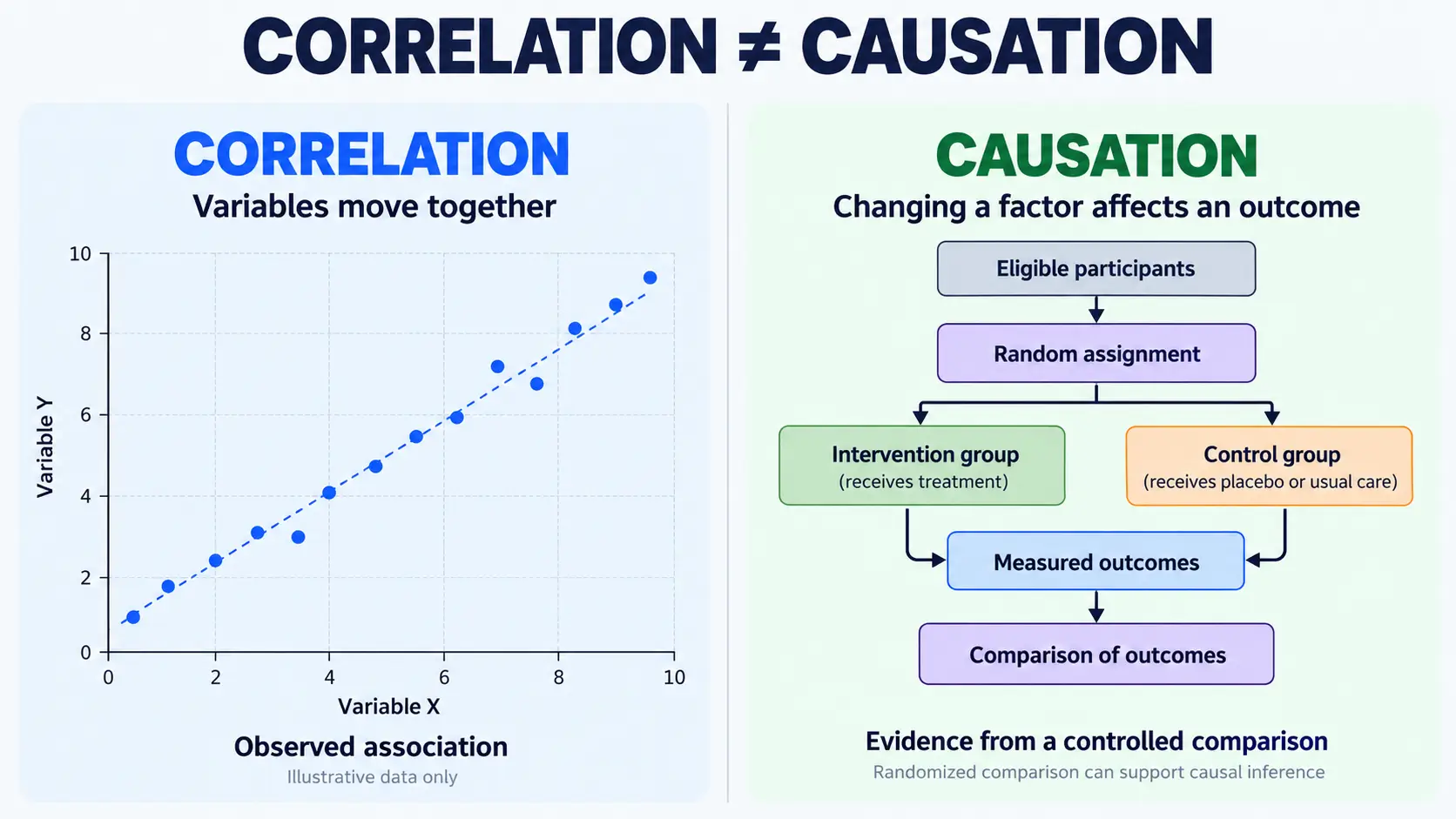
When relevant factors cannot be controlled, investigators should explain those limitations and avoid making causal claims that the evidence cannot support.
Fair-Test Checklist for Students
Use the following questions to evaluate a proposed or completed experiment:
-
Is the scientific question clear and specific?
-
Can the independent variable be identified?
-
Is the dependent variable suitable for answering the question?
-
Were other relevant factors kept constant or appropriately accounted for?
-
Were the same procedures and measurement methods used across comparisons?
-
Could another difference reasonably explain the observed result?
-
Do the observations and limitations support the conclusion being drawn?
The checklist is a practical reasoning aid rather than a formal scoring instrument. Its purpose is to help identify the evidence needed for a justified judgment.
How to Explain Why a Test Is Unfair
A useful explanation identifies the uncontrolled factor and describes how it affects interpretation.
For example:
"The test was unfair because both wing length and drop height changed. Either factor may have affected the falling time, so the investigation cannot isolate the effect of wing length."
A suitable improvement would be:
"Keep the drop height constant and change the wing length while measuring the falling time consistently."
If a description provides insufficient information, a more accurate answer would be:
"The information does not establish whether the test was fair because it does not state whether the drop height was controlled."
The most important part of an explanation is identifying the additional influence rather than merely stating that an experiment is fair or unfair.
This way of questioning experimental evidence is also connected to critical thinking in science, particularly when evaluating whether an alternative explanation has been overlooked.
Conclusion
To tell whether an experiment is a fair test, identify the intended change, determine what is measured, and examine whether other relevant influences were controlled.
A fair comparison reduces alternative explanations through consistent conditions and procedures. An unfair comparison introduces differences that make the intended effect difficult to interpret.
Repeated trials, suitable measurements, and careful reporting help assess the strength of the evidence, but they do not replace a properly controlled comparison.
The guiding principle is to evaluate how the experiment was designed and conducted before deciding what its results show.
References
1. Australian Academy of Science, Primary Connections. Conducting Fair Test Investigations. Educational guidance on independent, dependent, and controlled variables, including practical limits to controlling conditions.
2. The Open University, TESSA. Step 2: Choosing the Variables. Guidance on selecting controlled variables and recognizing the problems created when multiple relevant factors change.
3. Science Buddies. Doing a Fair Test: Variables for Beginners. Explanation of fair comparisons, including the toy-car illustration.
4. Association for Science Education and Primary Science Teaching Trust. Primary Science Skills and How to Teach Them, Unit 3: Planning and Predicting. Teaching resource covering fair and comparative testing, paper-spinner variables, experimental planning, and evidence evaluation.
5. Science Buddies. Experimental Procedure. Guidance on repeated trials, control groups, controlled variables, and consistency of procedures.
6. New South Wales Department of Education. Evaluating Scientific Investigations Abridged. Definitions and distinctions involving accuracy, precision, reliability, and validity.
7. University of Waikato, Science Learning Hub. Ways of Investigating in Science. Educational explanation of fair testing and alternative scientific enquiry methods.
8. Science Buddies. Conclusions. Guidance on evaluating hypotheses, reporting unexpected findings, and identifying experimental limitations.




Comments 0
No comments yet. Be the first to start the conversation.