



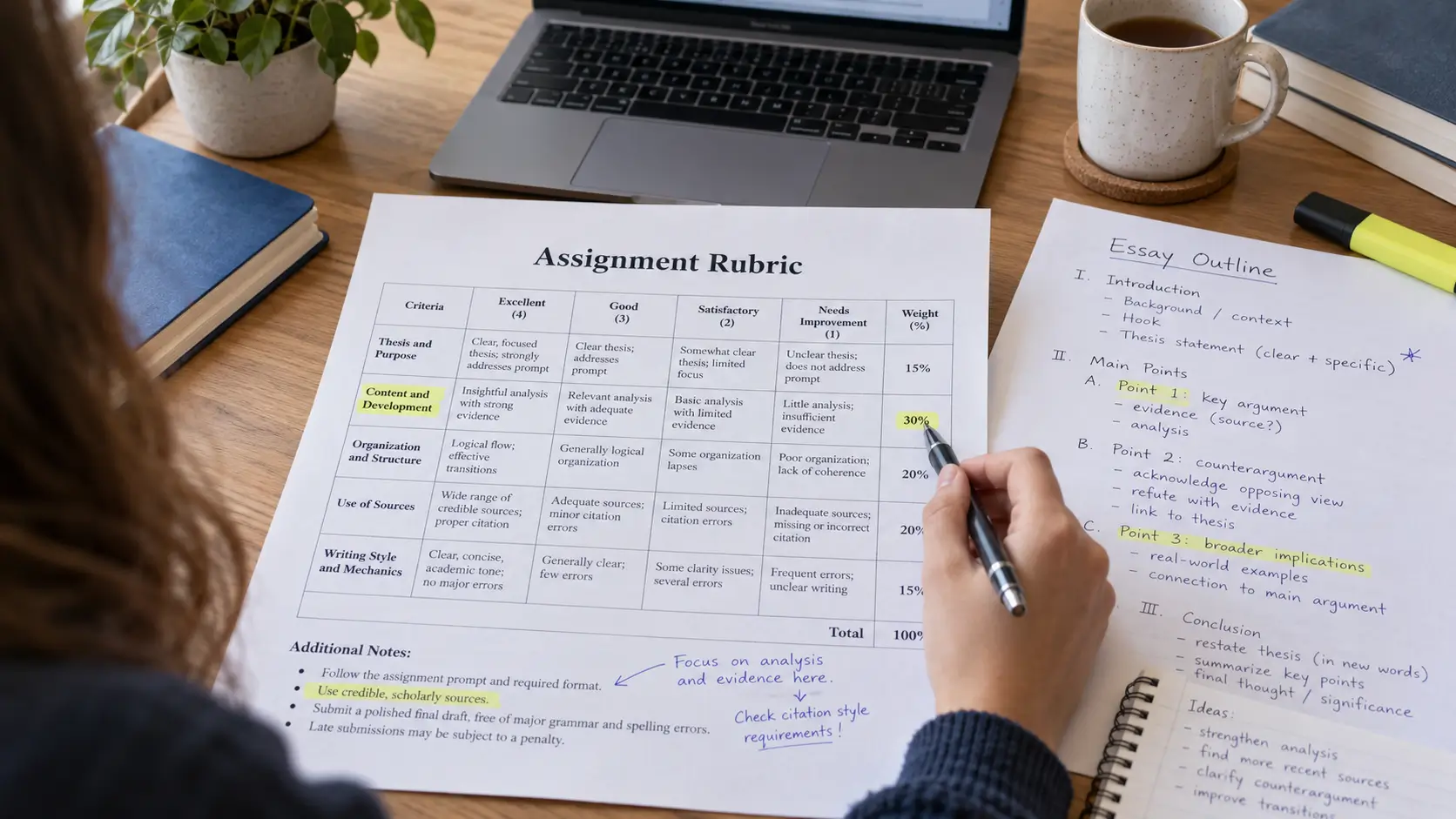
Before writing an essay, research paper, report, or reflective assignment, read the assignment instructions and grading rubric together. Identify what you are expected to produce, how your work will be assessed, and what evidence or reasoning you need to demonstrate.
An assignment rubric is an assessment guide that identifies the criteria used to evaluate student work. Depending on its format, it may also describe different performance levels and assign marks or percentages to individual criteria.
The difficulty is not necessarily understanding the labels. A rubric may mention critical analysis, relevant evidence, or a coherent argument without explaining how to turn those expectations into a workable writing plan.
Students need to interpret what the criteria mean for their particular task, determine which requirements apply, and decide how their writing will demonstrate the expected qualities.
The University of North Carolina at Chapel Hill Writing Center advises students to examine assignment requirements carefully, especially the task verbs, expected evidence, and purpose of the writing. The University of Arizona College of Nursing also recommends comparing the rubric with the instructions and developing an outline before beginning.
Using a rubric before drafting is not about predicting your grade or writing mechanically for a marking sheet. It is about understanding the assignment well enough to plan a relevant, supported, and coherent response.
Answer Summary: To use an assignment rubric before writing, compare it with the assignment instructions, identify the assessment criteria and performance descriptions, and examine any grading weights. Translate each important criterion into a question about what your work must demonstrate. Then plan the argument, evidence, analysis, and structure needed to address those expectations. Clarify ambiguous requirements with your instructor and use the same rubric to review your draft.
Key Takeaways:
-
Read the assignment prompt and rubric as related documents with different purposes.
-
Identify the task, assessment criteria, performance descriptions, and any grading weights.
-
Turn rubric language into specific writing and research decisions.
-
Organize the paper around the assignment question rather than automatically copying rubric headings.
-
Use weighting to understand assessment priorities without ignoring other requirements.
-
Clarify uncertain expectations before committing to a writing plan.
Read the Assignment Instructions and Rubric Together
The assignment instructions explain what work you must complete. The rubric explains how particular qualities of that work will be assessed.
Both documents matter, but they serve different purposes.
Identify the main task
Begin with the assignment prompt rather than the marking percentages.
Find the question or problem you must address and identify the action required.
Common assignment verbs include:
-
Analyze: examine components, relationships, or explanations.
-
Compare: identify relevant similarities and differences.
-
Evaluate: make a reasoned judgment using suitable criteria and evidence.
-
Discuss: examine the subject in the manner required by the assignment.
-
Reflect: consider experience, learning, or practice in relation to the specified reflective task.
The exact expectations associated with these verbs can vary by subject and instructor.
For example, an assignment asking students to evaluate a policy requires more than describing the policy's main features. The writer must also establish a basis for judgment and use relevant evidence to support an assessment.
A descriptive explanation may provide necessary background, but it does not independently satisfy an evaluative task.
After reading the prompt, complete this sentence:
"This assignment asks me to ______ by examining ______ and using ______."
If you cannot state the task accurately, revisit the instructions before planning your argument.
Identify requirements that may not appear in the rubric
An assignment brief may specify conditions that are not repeated in the assessment grid.
These can include the required document type, word limit, referencing style, source restrictions, section headings, or submission requirements.
For instance, a rubric may award marks for evidence and analysis without mentioning that the instructions require a particular source type.
Similarly, presentation may carry a relatively small grading weight, while the assignment still specifies a compulsory structure.
The absence of a requirement from the rubric does not mean it can be ignored.
Keep two sets of notes: one containing the requirements you must satisfy and another describing the qualities used to assess your work.
Understand the Rubric's Criteria, Descriptors, and Weights
A rubric becomes useful for planning when you understand what is being assessed, how quality is described, and whether some criteria carry greater weight.
The University of Hawai‘i at Mānoa identifies four common rubric components: a task description, characteristics being assessed, levels of achievement, and descriptions of performance at those levels.
Not every rubric includes all these elements in the same format.
Assessment criteria: What is being evaluated?
Criteria identify the qualities of student work that assessors will examine.
In academic writing, these may include argument, understanding of the subject, evidence, analysis, organization, or source documentation.
Consider a criterion called "Use of Evidence."
The label alone does not establish whether the assessor is primarily concerned with the relevance of sources, the amount of supporting material, source credibility, interpretation, or documentation.
Read any accompanying description to understand what the criterion requires.
The question to ask is not simply whether your assignment contains evidence, but what makes that evidence appropriate for the particular task.
Performance descriptors: What distinguishes different levels?
Performance descriptors describe differences in the quality of work.
Some rubrics use labels such as developing, proficient, and exemplary. Others use numerical bands or descriptions of expected achievement.
Compare the descriptions across performance levels for the same criterion.
Look for meaningful differences in accuracy, depth, reasoning, organization, or use of evidence.
For example, a descriptor for stronger analysis may emphasize interpreting relationships and evaluating evidence, while another may describe limited explanation.
Rather than copying the descriptor into your outline, ask what a reader would need to see in your writing to recognize that quality.
This distinction matters because mentioning "critical analysis" in a heading does not demonstrate critical analysis. The reasoning must appear in the work itself.
Grading weights: How should you understand priorities?
Some rubrics assign marks or percentages to individual criteria.
These weights indicate their relative emphasis within that assessment.
If argument and evidence carry substantial weight, the writing plan needs to give serious attention to developing and supporting the central response.
However, grading weights should not be treated as a fixed formula for allocating writing time.
Criteria can overlap, and the effort required to meet a standard depends on the task and the student's preparation.
A heavily weighted criterion is important, but other requirements remain relevant.
What if the rubric has no numerical scores?
Rubrics do not all use conventional grids with numerical marks.
The University of Illinois Chicago distinguishes several formats, including analytic rubrics, which assess criteria separately; holistic rubrics, which evaluate overall performance; and single-point rubrics, which describe an expected standard.
Checklists are another assessment tool used to verify specified elements.
If your marking guide does not assign separate weights, focus on the criteria and descriptions it provides.
Do not invent percentages or assume that the first listed criterion is the most important.
Turn the Rubric Into a Writing Plan
The central pre-writing task is to translate assessment criteria into decisions about your argument, research, analysis, and structure.
Reading the rubric gives you information. Planning determines how you will use it.
Identify what each criterion requires you to demonstrate
For every significant criterion, consider three questions:
-
What does this criterion mean in the context of the assignment?
-
What evidence, reasoning, or explanation would demonstrate it?
-
Where should that work appear in the planned response?
Suppose your rubric assesses the quality of an argument.
Before drafting, identify the central question and consider the claim or explanation you expect to develop.
If the rubric assesses evidence, identify what information you need to support the response.
If it assesses critical analysis, consider which interpretations, relationships, assumptions, or limitations need examination.
A criterion becomes useful when it leads to a meaningful writing decision rather than another item on a checklist.
Connect research to the claims you need to support
Avoid treating the research stage as a separate task with no connection to the rubric.
If your assignment requires an evidence-based argument, identify the claims that will need support before gathering extensive material.
For each planned section, consider:
-
What question will this section answer?
-
What information or source material is necessary?
-
Why is that evidence relevant?
-
What explanation or interpretation will connect the evidence to the main response?
This approach also helps identify gaps in your preparation.
For example, if you have enough information to describe competing explanations but insufficient evidence to evaluate them, further research should address that limitation.
A source list is not the same as an evidence plan. Your outline should show what the sources will contribute to the argument.
Build the outline around the assignment question
Once the main task and criteria are clear, arrange the planned sections in a logical order.
Each section should have a distinct function.
A research essay may require sections that develop related arguments. A laboratory report may require specified sections that follow disciplinary conventions. A reflective assignment may need a structure based on experience, interpretation, and learning.
Follow the format required by your assignment.
Do not automatically turn rubric criteria such as argument, evidence, analysis, and clarity into separate headings.
These are often qualities that assessors expect to find throughout the writing.
Stanford University's guidance on writing assessment warns against restrictive formulas that limit how students develop their ideas.
For further guidance on planning an essay thesis, structure, and citations, distinguish the central claim from the supporting arguments and the function of individual paragraphs.
A Worked Example Using a University Essay Rubric
A published university rubric provides a concrete example of how marking criteria can be converted into pre-writing decisions.
The Carnegie Mellon University in Qatar History Department's History Essay Rubric, attributed to Dr. Benjamin Reilly, contains four weighted assessment categories for history essays and term papers.
Argument
30%
Evidence
30%
Clarity
20%
Synthesis and Analysis
20%
The guide describes qualities for which marks are awarded or deducted. It does not provide a conventional sequence of performance-level columns.
The following table translates its published criteria into suggested writing decisions.
|
Rubric criterion |
What the published rubric assesses |
What to plan before writing |
|---|---|---|
|
Argument — 30% |
A clear thesis, relevance to the question, coherent organization, and connections between evidence and argument |
Develop a provisional thesis and identify how the main sections will support it |
|
Evidence — 30% |
Relevant and sufficient evidence, appropriate quotation use, and source documentation |
Identify the material needed to support each claim and record the required source details |
|
Clarity — 20% |
Grammar, paragraph structure, topic sentences, and connections between ideas |
Arrange sections logically and plan how paragraphs will contribute to the overall response |
|
Synthesis and Analysis — 20% |
Connections between historical events or sources, attention to source limitations and biases, and application of historical theories |
Identify meaningful comparisons, interpretations, and source limitations requiring analysis |
The assessment categories come from the published rubric. The final column contains suggested planning applications, not directions issued by the university.
What the weighting reveals
In this example, argument and evidence together account for 60% of the assessment weighting.
A student using this rubric should understand the importance of developing a relevant argument supported by sufficient evidence.
However, the distribution does not mean that clarity and analysis are optional. Nor does it determine exactly how much time a student should spend on each area.
The criteria interact. Clear writing helps readers follow an argument, while analysis explains the significance of evidence.
Why description alone may be insufficient
The history rubric identifies a predominantly descriptive approach as a weakness under synthesis and analysis.
This distinction has practical consequences.
A history essay may accurately describe events in chronological order without explaining their relationships or evaluating relevant sources.
Where the assignment requires analysis, the writer must examine what the evidence indicates, how interpretations relate, and which limitations affect the conclusions.
A useful planning question is:
"Am I preparing to report what the sources say, or can I explain what their evidence means for the question?"
Students who need more guidance can review how to move from description to analysis in assignments.
The Carnegie Mellon example is useful because it shows assessment priorities clearly. It should not be treated as the marking standard for unrelated courses or disciplines.
Handle Unclear or Conflicting Requirements
When rubric language is ambiguous, identify the uncertainty and seek clarification rather than constructing a writing plan around an unsupported interpretation.
When a criterion is difficult to interpret
Terms such as "critical," "appropriate," "original," or "sophisticated" may require additional explanation.
Begin by reading the full descriptor and comparing it with other performance levels.
Check whether the instructor has provided relevant course guidance or permitted examples.
If the requirement remains unclear, ask a focused question about the assignment.
For example, instead of asking what critical analysis means generally, ask whether the task requires evaluating competing explanations, examining source limitations, applying a specified theory, or addressing another defined expectation.
This gives the instructor a specific issue to clarify.
When the instructions and rubric appear inconsistent
If two documents contain conflicting requirements, identify the statements that create the disagreement.
A difference concerning the required number of sources, document structure, or permitted material may substantially change the writing plan.
Use the instructor's stated communication channel to confirm which requirement applies.
Do not assume that the rubric automatically overrides the assignment brief or that the more recent-looking document is authoritative.
Institutional and course procedures differ.
When no rubric has been provided
If the assignment has no rubric, use the instructions, learning objectives, and relevant course guidance to identify expectations.
Look for the required task, evidence, format, and explicit assessment conditions.
If these remain unclear, ask whether additional marking guidance is available.
A rubric found online may help explain academic writing standards, but it does not establish the rules for your assignment.
Use the Rubric During Drafting and Revision
The rubric can remain useful after you begin writing because it provides a reference for checking whether the draft demonstrates the planned qualities.
Before drafting, identify what you intend to show.
During revision, examine whether that work appears in the text.
For example, an outline may identify a section as analytical. The completed section may instead summarize sources without explaining their significance.
Return to the rubric and compare its expectations with the passage.
A sensible review order is to examine the response to the assignment question, the adequacy of evidence, the quality of reasoning, and the organization before concentrating on sentence-level corrections.
After that, check source documentation and presentation requirements. If the assignment specifies a referencing system, verify that your citations and reference list follow it.
For additional guidance, consult citations and references in academic writing.
The rubric supports self-assessment, but it does not allow students to determine their eventual grade with certainty. Evaluation still involves the assessor's judgment and the course's applicable standards.
What Research Says About Using Rubrics
Research indicates that rubrics can support academic performance, although their effects depend on educational context and how they are used.
A 2023 meta-analysis published in Educational Psychology Review by Ernesto Panadero, Anders Jonsson, Leire Pinedo, and Belén Fernández-Castilla examined rubric use in relation to academic performance, self-regulated learning, and self-efficacy.
The academic-performance analysis synthesized 54 effect sizes from 21 studies. After adjustments for possible publication bias, the researchers reported a positive pooled effect on academic performance.
However, the research included different learning settings, interventions, and assessment practices. Findings about self-regulated learning and self-efficacy were less certain, and the authors identified limitations requiring further research.
These findings do not establish that reading a rubric before writing will raise an individual student's mark by a predictable amount.
The practical implication is narrower: rubrics can make expectations visible and provide a basis for planning and self-assessment. Their usefulness depends on the clarity of the criteria and how students apply them.
A rubric cannot replace subject knowledge, relevant evidence, or independent reasoning.
Pre-Writing Rubric Checklist
Before preparing the first draft, use this checklist to identify whether your plan addresses the important requirements.
Conclusion
Using an assignment rubric before writing helps connect the task you have been given with the standards used to assess your response.
Begin by identifying the assignment's purpose and requirements. Then examine the assessment criteria, performance descriptions, and any grading weights.
Convert those expectations into a plan for the argument, evidence, analysis, and structure. Where requirements are uncertain, seek clarification before committing to an interpretation.
The aim is not to reproduce the rubric's wording throughout the paper. It is to demonstrate the knowledge and reasoning the assessment requires while developing a coherent response to the assignment question.
References
1. University of North Carolina at Chapel Hill Writing Center. Understanding Assignments. Guidance on interpreting assignment prompts, identifying task verbs, examining evidence requirements, and requesting clarification.
2. University of Illinois Chicago, Center for the Advancement of Teaching Excellence. Messier, N. (2022). Rubrics. Explanation of assessment criteria, performance levels, rubric formats, and weighting.
3. University of Hawai‘i at Mānoa, Assessment and Curriculum Support Center (updated 2024). Creating and Using Rubrics. Definitions, rubric components, performance descriptions, and assessment principles.
4. University of Arizona College of Nursing. Tips for Following the Rubric / Instructions. Institutional guidance on comparing assignment instructions with rubric expectations, developing an outline, and checking completed work.
5. Stanford University, TeachingWriting. Rubric Design. Guidance on writing assessment, criterion weighting, analytic and holistic rubrics, and the limitations of restrictive writing formulas.
6. Carnegie Mellon University in Qatar, History Department. Reilly, B. History Essay Rubric. Published rubric covering argument, evidence, clarity, and synthesis and analysis, with stated category weights.
7. Panadero, E., Jonsson, A., Pinedo, L., & Fernández-Castilla, B. (2023). Effects of Rubrics on Academic Performance, Self-Regulated Learning, and Self-Efficacy: A Meta-Analytic Review. Educational Psychology Review, 35, Article 113.




Comments 0
No comments yet. Be the first to start the conversation.