



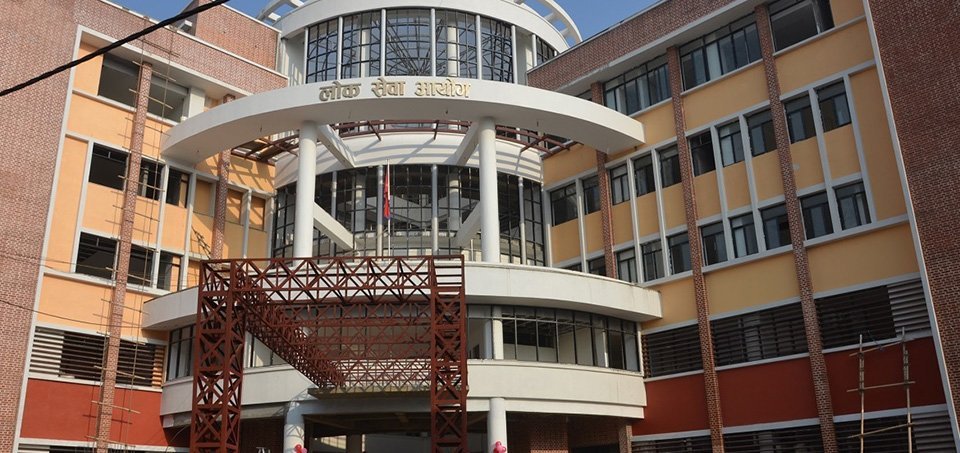
Lok Sewa Aayog: From the End of the ‘Pajani’ System to Merit-Based Governance and Broad Expansion of Jurisdiction
The Public Service Commission, Nepal’s oldest constitutional body, established as the greatest pillar of merit, impartiality, and fairness in the country’s public administration, has completed its glorious Diamond Jubilee, celebrated throughout the year since its establishment.
The institution has crossed 75 years and entered its 76th year on 1st Ashad 2083. The rise of democracy in Nepal and the formation of this institution took place around the same period. For any democratic system to succeed, people’s representatives elected through fair elections and competent employees appointed on the basis of merit are essential conditions.
The qualification of people’s representatives elected by the people is to make democracy successful. However, until legality and merit are established in public institutions, such institutions become weak and ineffective. If the state mechanism lacks these qualities, its direct negative impact falls on the good governance of politicians.
In politics, workers rising from ordinary levels of society may reach leadership, but at the same time, as the “General Impossibility Theorem” suggests, there remains a possibility that the wrong people may also assume the reins of power through elections. In this context, the debate has continued over whether the “spoils system” could enter administration or whether “meritocracy” would be practiced. After the change of 2007 BS, the leaders of that time wisely formed the Public Service Commission and laid a strong foundation for merit-based governance.
In its long journey of the past 74 years, the Public Service Commission, which has made rules, laws, and fairness the main basis of its performance, has succeeded in preserving its distinct ideal and sanctity. In a society like ours, where the influence of “bhan-sun” and “banchawad” (favoritism/nepotism) is present, this institution has kept itself away from such distortions and earned high respect in the public sphere. Getting a job through this institution is seen not merely as a means of economic earning, but also as a test of purity and ideals.
Another strong aspect of the Commission is that its office-bearers get the opportunity to perform their duties free from any kind of unnecessary pressure and influence. On this day, while becoming nostalgic, anyone who has succeeded in the Lok Sewa examination or served while being associated with this institution can proudly say that this institution has guided the psychology of our society through faith in impartiality.
Competence of Employees and International Practice
Recruitment determines the form and strength of any institution. If the recruitment policy is not impartial and is based only on political and social considerations, state institutions cannot become stable and effective. Such institutions eventually become shelters for the “sluggish and incompetent.”
Looking at world political history, whether it was the “Nomenklatura” system of the then Soviet Union or the posts and rewards distributed to political supporters in authoritarian regimes, these practices deprived ordinary people of entry into government service. Even in countries considered democratic, especially in the early stages of development, the “spoils system” used to be practiced, where the party winning the election would recruit its own workers.
When society had not yet developed, selections from government office contracts to peon-level positions were made at the discretion of politicians, and in some cases, party workers themselves were deployed in government work as volunteers.
However, countries including those in Europe began searching for an alternative to this system and started practicing “meritocracy.” The system of China’s Han Dynasty in 165 BC, the merit system introduced by Macaulay in British India in 1853 for selecting employees in the Indian service, and the system adopted in 1853 by the then British Prime Minister Gladstone are excellent historical examples of this. Later, due to British influence, democratic leaders made the merit system the main basis of administration. Singapore’s Lee Kuan Yew regarded this as the backbone of Singapore’s development.
His belief was that, as in trade and business, the practice of meritocracy in administration increases competition and helps achieve excellence. Today, capable employees in the administrative mechanisms of countries such as Singapore, Japan, and Korea are considered to have made an important contribution to their development.
Historical Background and End of the ‘Pajani’ System in Nepal
The “Pajani” system remained in place for a long time in Nepal’s administrative history. Historical study shows that its roots had been established since the Lichchhavi period. Historian Sylvain Lévi, in his book “Nepal: The History of a Hindu Kingdom,” wrote that an inscription containing records related to coronation during the time of Amshuverma mentioned “appointing people to work in one’s palace.”
During the Malla period, the word “dware” was in use, while during the Shah and Rana periods, the term “Pajani” was prevalent. Even in Prithvi Narayan Shah’s “Divyopadesh,” there is mention of a policy of protecting the “chhatra,” meaning “tharghar” (Pande, Pant, Aryal, Khanal, Bohora, and Ranamagar), while recruiting and dismissing people in other posts through Pajani.
According to Sylvain Lévi, because Pajani was carried out every year, holding a job was temporary and risky, where whether the job would remain or be lost depended entirely on the ruler’s discretion.
In the 1850s, after Prime Minister Jung Bahadur Rana took the entire authority of Pajani into his own hands, arbitrariness began to increase. By the time of Bhim Shumsher, as the influence of his consort Maharani Tilkumari (Sita Maharani) and her courtiers grew, the Pajani system became even more infamous. As Rana rule was collapsing in 2007 BS, the then constitution provided for a “Public Service Commission” and gave it the authority to select employees on the basis of merit.
After the revolution of 2007 BS, the Public Service Commission was formally established on Asar 1, 2008 BS. With this, the arbitrary “Pajani” system legally ended in Nepal’s civil administration. During the tenure of then Prime Minister Tanka Prasad Acharya, after the Civil Service Act was issued on Bhadra 22, 2013 BS, the rule of law began in administration.
King Tribhuvan had appointed Govind Narayan, an ICS officer from India, as his private secretary, who was also given responsibility as Cabinet Secretary and as advisor to the Public Service Commission and the Ministry of Home Affairs.
On his advice, the Commission’s procedures were determined, and Khadga Man Singh Malla was appointed as Nepal’s first Secretary of the Public Service Commission. According to Bhuwan Man Singh, the Commission could appoint its own employees, and this office, which began work from two ordinary rooms inside Singha Durbar, moved to Ramshahpath in 2014 BS.
In 2012 BS, when the Commission called for advertisements for eight graduate-level posts for the first time, the examination system was so strict that only four candidates passed. From the same year, the Commission also began conducting examinations for the Nepali Army and Police. However, in 2014 BS, the Council of Ministers made a decision stating “Commission is to Department,” limiting the Commission’s status to that of a department.
Recognition as a Constitutional Body and Political Upheavals
The “Constitution of the Kingdom of Nepal,” issued on Falgun 1, 2015 BS, recognized the Public Service Commission as an independent constitutional body. The Commission presented its first annual report on Asar 15, 2016 BS. After then Chairperson Aniruddha Prasad Singh was appointed Chief Justice on Asar 19, 2016 BS, another member, Bhagwati Prasad Singh, was given responsibility as acting chairperson.
During this period, individuals including Sardar Man Bahadur from government service and Shiv Chandrika Prasad Shah from outside government service were appointed as active members. From 2016 BS, the Commission also began conducting examinations for the Police Service, which was expanding in government service. Later, after the Police Force Rules were issued in 2018 BS, a Commission member also began chairing Police Service promotion processes.
However, after King Mahendra dismissed the elected government on Poush 1, 2017 BS, the Public Service Commission suffered a major setback. With the beginning of the Panchayat system, the “Public Service Commission (Restriction on Proceedings) Rules, 2017” were issued in a manner that again resembled the “Pajani” system in the civil service. From Magh 24, 2017 BS to the end of Jestha 2018 BS, the Commission was fully suspended. During this period, many employees, including 13 secretaries and several personnel from the Army and Police, were arbitrarily dismissed.
The Constitution of 2019 BS curtailed the authority of the Public Service Commission and limited it only to the civil service. Throughout the Panchayat period, the Commission was forced to remain only a witness to the system of handing employees “parcha and pension,” meaning dismissal without explanation.
With the changing political context, the “Constitution of the Kingdom of Nepal, 2047,” issued after the restoration of democracy in 2047 BS, made the Commission powerful again and restored its lost authority. This constitution also directed the Commission’s authority to determine principles for organized institutions. The Interim Constitution of 2063 BS and the “Constitution of Nepal” of 2072 BS expanded the Commission’s jurisdiction to an unimaginable extent and established it as the most trusted body of the state.
Broad Expansion of Jurisdiction and Innovation
The Constitution of Nepal, issued on Ashoj 3, 2072 BS, historically broadened the jurisdiction of the Public Service Commission. The Commission, which was previously limited only to the civil service, has now been given the sole constitutional authority to conduct written examinations for recruitment in the Nepali Army, Nepal Police, Armed Police Force, Nepal, other federal government services, and organized institutions, except the Teachers Service Commission and universities.
This has ensured merit and impartiality in security bodies and public institutions as well. The Commission’s consultation has also been made mandatory in formulating laws related to the service conditions of employees of organized institutions and in preparing general principles related to promotion and departmental action, which came into effect in 2074 BS.
By making maximum use of modern technology, the Commission has reformed itself according to the needs of the time. At present, technologies such as online application, e-payment, and mobile app are being operated successfully. In recognition of this innovation, the Commission also received the prestigious Digital Governance Award in 2019.
To make the examination system more objective and scientific, modern testing methods such as the Assessment Center Methodology (ACM) for recruitment at the Joint Secretary level and the In-basket Exercise for the second class have been implemented.
Giving high priority to the confidentiality and impartiality of examinations, the “Double Dummy” system is used in evaluating written answer sheets, ensuring that the examiner does not know any identity of the examinee. In addition, the “Blind” method has also been started in the interview system, so that no personal background other than the candidate’s merit can influence the result.
Having crossed 75 years and entered its 76th year, the Public Service Commission has preserved its reputation, impartiality, and commitment to merit despite Nepal’s unstable political landscape. The journey of the Public Service Commission, from an administrative system that began with an arbitrary practice such as “Pajani” to today’s modern, clean, competitive, and fully merit-based system, is a glorious chapter in Nepal’s democratic development.







Comments 0
No comments yet. Be the first to start the conversation.