



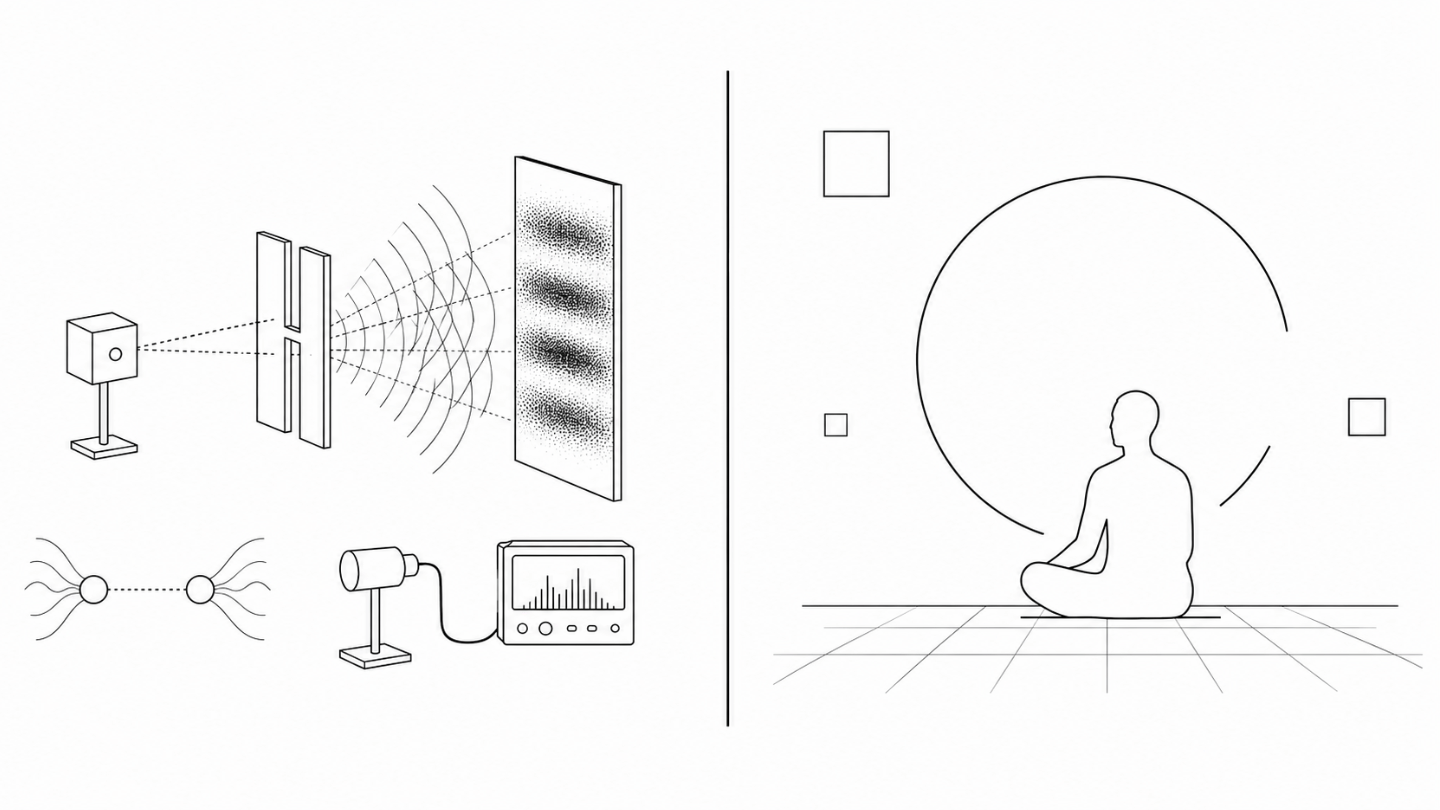
Quantum physics and spirituality are often discussed together because both can prompt questions about reality, knowledge, consciousness, and the limits of ordinary experience. This shared interest does not mean that quantum mechanics scientifically confirms spiritual beliefs.
Quantum mechanics provides a framework for calculating probabilities and predicting the results of experiments involving physical systems. Physicists agree on its successful operational core, although they continue to debate what the mathematical formalism says about the underlying nature of reality. The philosophical issues in quantum theory include questions about measurement, quantum states, entanglement, and the differences among foundational approaches.
Spirituality is a broader category involving meaning, transcendence, sacredness, religious experience, personal practice, or beliefs about existence. Spiritual and mystical traditions differ in their concepts, aims, practices, and historical settings. They should not be treated as one scientific theory.
The distinction matters because words such as “observer,” “energy,” “frequency,” “uncertainty,” and “entanglement” have technical meanings in physics. The same words may be used symbolically in spiritual writing. A symbolic comparison can carry personal or philosophical meaning, but it does not inherit the experimental evidence attached to the scientific concept.
Answer Summary: Quantum physics does not establish spirituality, manifestation, telepathy, healing, universal consciousness, God, a soul, or an afterlife as scientific facts. It provides experimentally tested predictions about physical systems while leaving several interpretive questions open. Quantum concepts can inspire philosophical or spiritual comparisons, but those comparisons remain interpretations or metaphors unless independent evidence supports the specific claim.
Table of Content
- Why Is Quantum Physics Linked With Spirituality?
- What Does Quantum Physics Describe?
- Four Types of Quantum-Spiritual Statements
- Does the Observer Effect Mean Consciousness Creates Reality?
- Does Entanglement Prove Universal Oneness?
- Can Quantum Physics Explain Consciousness?
- Can Quantum Ideas Be Compared With Spiritual Traditions?
- What Is Quantum Mysticism?
- Common Misuses of Quantum Language
- Can Science and Spirituality Coexist Responsibly?
- How to Evaluate a Quantum-Spiritual Claim
- What Does the Evidence Support?
Key Takeaways:
-
Quantum mechanics is a physical theory, not a spiritual doctrine.
-
An observer in quantum physics is not automatically a conscious person.
-
Bell-test results do not establish a spiritual or metaphysical worldview.
-
Entanglement cannot transmit controllable faster-than-light messages.
-
Decoherence suppresses observable interference but does not settle the measurement problem by itself.
-
Quantum-consciousness proposals form a disputed research area, not one accepted theory.
-
Healing, manifestation, and telepathy claims require evidence independent of quantum terminology.
Why Is Quantum Physics Linked With Spirituality?
Quantum physics is linked with spirituality because its findings challenge everyday intuition and raise philosophical questions about physical reality.
Shared Questions Invite Comparison
Quantum mechanics differs from classical descriptions in its treatment of physical states, probability, interference, measurement, and entanglement. These features raise questions about what exists, what can be known, and how measurements relate to physical descriptions. Foundational approaches offer different accounts of what the formalism means, even when they agree on many experimental predictions.
Spiritual and mystical traditions may also address knowledge, identity, transformation, transcendence, or ultimate reality. The overlap exists mainly at the level of themes and questions. It does not show that spiritual traditions and quantum mechanics provide the same explanations or follow the same standards of evidence.
Scientific Terms Are Easy to Overextend
Quantum terminology often sounds broader in everyday language than it is in physics.
“Uncertainty” may be mistaken for unlimited possibility. “Observer” may be interpreted as a conscious mind. “Entanglement” may be treated as proof that all people or events are spiritually linked. “Energy” and “frequency” may be used without identifying a measurable physical quantity.
In physics, these concepts depend on a defined system, mathematical structure, preparation procedure, interaction, measurement, and predicted outcome. Removing those conditions changes the meaning of the claim.
Historical Dialogue Increased Public Interest
The association between quantum theory and spirituality also has a documented cultural history.
The historical relationship between quantum foundations and mysticism includes the Fundamental Fysiks Group, whose members discussed quantum entanglement alongside Eastern mysticism and psychic phenomena in 1970s Berkeley. This history shows that some physicists and counterculture groups investigated such connections. It does not show that their spiritual or paranormal ideas became established physical findings.
Individual physicists have also held different philosophical and religious views. Those views may be historically significant, but a scientist’s private belief is not experimental evidence. Quotations attributed to physicists should therefore be checked against primary texts and their original context.
What Does Quantum Physics Describe?
Quantum physics describes physical states, probabilities, interactions, and measurement outcomes.
Quantum States and Measurement
A quantum state is a mathematical object used to calculate probabilities for possible experimental outcomes.
Quantum theory has a shared operational framework in which preparation procedures, states, measurements, and outcomes are connected mathematically. Foundational approaches differ over how this framework should be interpreted as a description of reality.
A measurement involves a physical arrangement in which a system interacts with an apparatus or another system and a result is registered. Measurement can affect the system being measured, but this does not demonstrate that human intention can select any desired outcome.
Superposition Is a Mathematical Combination
Superposition means that quantum states can be combined linearly. When a system is prepared in such a state, quantum theory predicts possible outcomes, probabilities, and interference effects.
It does not mean that every imagined event is physically possible. The possible outcomes remain constrained by the system, its preparation, its evolution, and the observable being measured.
Uncertainty Is a Technical Relation
Quantum uncertainty concerns limits on the joint precision associated with certain pairs of observables, such as position and momentum.
It does not mean that all knowledge is impossible or that any result can occur without physical constraint. The uncertainty principle also does not provide evidence that belief or intention can override the conditions governing a system.
Entanglement Is a Property of Composite States
Entanglement occurs when the state of a composite quantum system cannot be represented as independent states for its parts. Those parts can then display correlations that cannot be reduced to ordinary mixtures of independently prepared states.
Entanglement concerns identified physical systems and defined measurements. It is not a general scientific statement that every object, person, and thought forms one operationally entangled system.
Bell Tests Restrict Certain Local Explanations
Bell inequalities allow researchers to test whether quantum correlations can be reproduced by local hidden-variable models satisfying Bell’s assumptions.
Experiments have produced violations of Bell inequalities. The careful conclusion is that the observed correlations cannot be explained by the tested class of local hidden-variable accounts under the relevant assumptions. Bell-test violations do not select a spiritual doctrine or settle every metaphysical debate.
Decoherence Suppresses Interference
Decoherence examines how interactions between a system and its environment suppress observable interference.
Macroscopic objects continually interact with complex environments. These interactions help explain why they usually display stable, classical-looking behavior rather than easily observable interference between macroscopically distinct states.
Decoherence does not mean that quantum mechanics stops applying to large systems. It also does not solve the measurement problem by itself; its explanatory role depends partly on the wider foundational approach in which it is used.
Four Types of Quantum-Spiritual Statements
Quantum-spiritual statements become easier to assess when their evidence status is explicit.
| Category | Meaning | Example |
|---|---|---|
| Experimental finding | A result supported by defined measurement and repeatable testing | Entangled systems can violate a Bell inequality |
| Interpretation | An account of what the formalism means | Collapse, hidden-variable, relational, or Everettian approaches |
| Metaphor | A comparison used for reflection or communication | Entanglement as a symbol of human interdependence |
| Unsupported empirical claim | A testable conclusion presented without suitable evidence | Human intention controls distant events through entanglement |
An interpretation is not the same as an unsupported claim. Interpretations are serious attempts to understand quantum theory, although they disagree about measurement, ontology, and the status of the quantum state.
A metaphor is also not automatically pseudoscience. It becomes misleading when it is presented as experimental confirmation or when the authority of quantum mechanics is used to support a claim that has not been tested.
Does the Observer Effect Mean Consciousness Creates Reality?
No. Quantum measurement does not generally require conscious awareness, and the observer effect does not establish that the mind creates external reality.
What “Observer” Means in Quantum Physics
An observer can refer to a physical system, apparatus, or measurement context that registers information.
The measurement problem can be described through interactions among a quantum system, measuring apparatus, environment, and recorded outcomes. Conscious human awareness does not need to be inserted into every physical interaction.
Mainstream foundational approaches do not generally give conscious observers a special physical role, although historical proposals have done so.
Measurement Context Affects Predictions
Quantum predictions depend on how a system is prepared and which observable is measured. A different experimental arrangement can produce a different probability distribution.
This context dependence concerns the physical setup. It does not show that personal desire or attention can produce any selected event.
Why Consciousness Entered the Debate
The everyday word “observer” usually refers to a conscious person, which encourages misunderstanding.
Historical proposals have also assigned consciousness a special role. Eugene Wigner, for example, considered the possibility that conscious awareness was connected with collapse. This was a particular foundational proposal, not a standard experimental requirement of quantum mechanics.
The existence of such proposals shows that consciousness has appeared in foundational debate. It does not show that experiments have confirmed a consciousness-caused collapse mechanism.
Interpretation and Result Must Remain Separate
Quantum theory has a common predictive framework, while interpretations and related theories differ over collapse, hidden variables, branching, relational properties, and the status of the quantum state.
Some approaches modify or supplement standard quantum theory rather than simply describing it in different words. Because these approaches disagree, no single spiritual conclusion follows automatically from the mathematics.
Does Entanglement Prove Universal Oneness?
No. Entanglement establishes a specific physical relation within a composite quantum system, not a universal spiritual connection among all minds and events.
Entanglement Requires a Defined System
Scientists identify the systems involved, prepare or detect an entangled state, select measurements, and compare the resulting data.
The claim has meaning within that experimental and mathematical structure. Saying that people are “entangled” may work as a metaphor for relationship or interdependence, but it is not equivalent to demonstrating an entangled quantum state.
Bell Violations Do Not Establish a Spiritual Worldview
Bell-test results restrict certain local hidden-variable explanations. They do not establish idealism, spiritual oneness, a cosmic mind, or any religious doctrine.
Those conclusions require additional philosophical arguments and cannot be inferred directly from an experimental violation of a Bell inequality.
Entanglement Cannot Send Controllable Faster-Than-Light Messages
The no-signalling limit means entanglement cannot be used by a sender to choose a local outcome and encode a controllable message that reaches a distant receiver faster than light.
Individual outcomes contain an unpredictable element. The correlations become evident when measurement records are compared through ordinary communication. Entanglement therefore does not provide a mechanism for instant thought transmission.
Interconnectedness Can Remain a Metaphor
A reader may find entanglement spiritually suggestive. That response can be acknowledged without claiming scientific proof.
The accurate conclusion is that entanglement can inspire a metaphor of interconnectedness. Physics does not establish the broader spiritual meaning attached to that metaphor.
Can Quantum Physics Explain Consciousness?
Quantum theory has inspired several approaches to consciousness, but no single quantum theory of consciousness is established.
Research on quantum approaches to consciousness can be grouped into three broad families:
-
Consciousness as a manifestation of quantum processes in the brain.
-
Quantum concepts applied to conscious mental activity without claiming literal quantum brain processes.
-
Mind and matter treated as dual aspects of an underlying reality.
These families use quantum ideas in different ways and make different assumptions. They should not be presented as one unified research programme.
Quantum Brain Proposals Remain Speculative
Quantum effects occur in biological matter, including the brain, because biological matter is physical. The unresolved question is whether specifically quantum features play an explanatory role in the brain processes associated with consciousness.
Many quantum-brain approaches remain speculative. A proposal must explain where the relevant quantum states occur, how they persist, how they influence neural processes, and how those processes relate to conscious experience.
Quantum-Like Cognition Is a Different Claim
Some researchers use mathematical structures inspired by quantum theory to model decision-making or cognition. Such models do not necessarily claim that the brain performs a physical quantum process.
A successful quantum-like probability model for human decisions would not, by itself, establish physical entanglement in the brain or a quantum origin of consciousness.
A Quantum Model Would Not Prove a Soul
Even if a quantum process were shown to contribute to consciousness, that finding would not establish a soul, survival after death, universal consciousness, or mind-over-matter effects.
Each conclusion would require separate definitions, predictions, and evidence.
Can Quantum Ideas Be Compared With Spiritual Traditions?
Quantum ideas can be compared with spiritual traditions philosophically, but a parallel is not evidence that a tradition predicted quantum mechanics.
Religious, philosophical, and mystical traditions differ in their histories, concepts, aims, and practices. They should not be combined into a single doctrine of “oneness.”
A responsible comparison should identify:
-
The exact concept from quantum theory.
-
The exact idea from the named tradition.
-
The proposed similarities.
-
The differences in purpose and method.
-
Whether the comparison is historical, philosophical, or metaphorical.
Quantum mechanics uses mathematical models and empirical tests. Spiritual traditions may focus on ethics, experience, liberation, worship, sacredness, identity, or meaning. Similar vocabulary does not make the concepts scientifically equivalent.
Detailed claims about a named tradition require sources appropriate to that tradition. Without those sources, the comparison should remain general and limited.
What Is Quantum Mysticism?
Quantum mysticism is a broad label for attempts to connect quantum theory with mystical, spiritual, or metaphysical ideas.
The label can cover several different activities:
-
Philosophical reflection on quantum theory.
-
Historical dialogue among physicists, psychologists, and spiritual thinkers.
-
Metaphorical comparisons.
-
Speculative hypotheses.
-
Empirical claims that borrow quantum terminology without suitable evidence.
These categories should not be treated as identical.
Philosophical reflection and metaphor do not automatically qualify as pseudoscience. The stronger concern arises when a claim presents itself as scientifically demonstrated, uses quantum terminology as authority, and lacks a defined mechanism or suitable evidence.
Terms such as entanglement, collapse, and superposition do not establish a scientific explanation unless they are developed into precise models with testable consequences.
Common Misuses of Quantum Language
Quantum language is misused when a technical term is separated from its scientific definition and presented as proof of an unrelated conclusion.
Manifestation and Reality-Creation Claims
Quantum measurement does not demonstrate that thoughts alone select desired external outcomes.
A manifestation claim needs evidence addressing its proposed mechanism and result. Referring to the observer effect does not provide that evidence because measurement context is not equivalent to personal desire.
“Energy” and “Frequency” Without Measurement
A physical statement about energy or frequency should identify the system, measurable quantity, unit, method, and predicted result.
When these elements are absent, “energy” or “frequency” may be metaphorical. A metaphor should not be presented as a measured physical mechanism.
Quantum Healing Claims
The word “quantum” does not demonstrate that a treatment is safe or effective.
The U.S. Food and Drug Administration’s information on health fraud scams explains that products promoted for health conditions without evidence of safety and effectiveness can waste money, delay appropriate diagnosis or treatment, and cause harm.
Any treatment claim requires evidence relevant to the proposed intervention and condition. Quantum terminology cannot replace clinical evaluation.
This article provides general science information and does not offer treatment guidance.
Telepathy and Distant Mental Connection
Entanglement does not provide a controllable communication channel between minds.
A telepathy claim requires evidence for telepathy itself rather than an analogy with quantum correlations.
Famous-Physicist Quotations
A quotation should be checked against the original publication, edition, page, and surrounding argument.
Even when authentic, a quotation records a person’s position. It is not experimental confirmation merely because the speaker was an influential physicist.
Moving From Quantum Experiments to Everyday Outcomes
Quantum mechanics applies to physical systems at every scale, but observable interference and entanglement can be difficult to maintain because systems interact with their environments.
A result involving photons, atoms, or isolated experimental systems cannot be transferred directly to health, relationships, thoughts, or social events without a relevant mechanism and evidence.
Decoherence is part of this scale discussion, but it does not imply that macroscopic systems become non-quantum.
Can Science and Spirituality Coexist Responsibly?
Science and spirituality can coexist when their different questions, purposes, and standards are stated clearly.
Philosophy Examines Interpretation
Physics predicts experimental outcomes. Philosophy considers what theories mean, what kinds of entities they describe, and how formal models relate to claims about reality.
Quantum foundations provide a clear example because researchers can agree on successful predictions while differing over interpretation. Readers seeking broader context can review Collegenp’s discussion of philosophy’s role in the modern world. This internal link provides background rather than evidence for the quantum-physics claims in this article.
Personal Meaning Does Not Require Scientific Proof
Learning about nature can inspire awe, humility, connection, or spiritual reflection. These reactions may be meaningful without being experimental findings.
Respecting personal meaning does not require claiming that quantum equations verify it.
Spiritual Experience Can Be Studied Through Other Fields
Psychology, philosophy, anthropology, neuroscience, history, and religious studies can examine spiritual practices, communities, texts, and reported experiences.
Quantum mechanics is not necessary for every serious study of spirituality or consciousness.
Scientific Uncertainty Is Not Confirmation
An unanswered scientific question does not confirm a preferred spiritual answer.
Evidence may remain incomplete, support several interpretations, or leave a question outside the scope of physical experiment. Intellectual caution includes withholding a conclusion when the evidence does not decide it.
How to Evaluate a Quantum-Spiritual Claim
A credible evaluation begins with the exact claim rather than the scientific vocabulary surrounding it.
-
State the claim precisely. Identify the proposed mechanism, event, and outcome.
-
Define the central terms. Check whether “observer,” “energy,” “frequency,” “field,” “nonlocality,” or “entanglement” is being used technically or metaphorically.
-
Identify the evidence category. Separate experiment, interpretation, metaphor, testimony, and commercial assertion.
-
Check the scale. Ask whether a result from controlled quantum systems is being transferred to a brain, body, relationship, or social event.
-
Compare the source with the conclusion. A source may support a narrow physics result while the surrounding claim is much broader.
-
Check the observer explanation. A reliable account should not assume that conscious awareness is required by mainstream quantum mechanics.
-
Check the no-signalling limit. Entanglement should not be presented as a controllable instant-message channel.
-
Look for testable predictions. An empirical claim should indicate what outcome would support or challenge it.
-
Check independent testing. Evidence is stronger when independent researchers can examine the same effect.
-
Review commercial or health interests. Added caution is appropriate when certainty is tied to a treatment, course, device, or paid service.
-
Verify quotations and credentials. Expertise in physics does not automatically establish expertise in medicine, theology, psychology, or religious studies.
Collegenp’s article on critical thinking in science provides additional guidance on evaluating evidence, questioning assumptions, and separating conclusions from unsupported claims.
What Does the Evidence Support?
Quantum physics changes how scientists describe states, probability, interference, measurement, and correlations. It also raises unresolved philosophical questions about how the formalism should be understood.
These findings can motivate philosophical or spiritual reflection. They do not, on their own, establish manifestation, telepathy, healing, universal consciousness, God, a soul, or an afterlife.
A responsible discussion keeps four levels separate:
-
Experimental findings describe measured results.
-
Interpretations address what the mathematical framework means.
-
Metaphors connect scientific ideas with personal or philosophical themes.
-
Unsupported claims extend scientific authority beyond the available evidence.
This boundary allows respectful discussion without overstating science or dismissing personal meaning. Quantum mechanics may influence how people think about reality, but spiritual conclusions require arguments and evidence beyond the existence of quantum phenomena.







Comments 0
No comments yet. Be the first to start the conversation.