



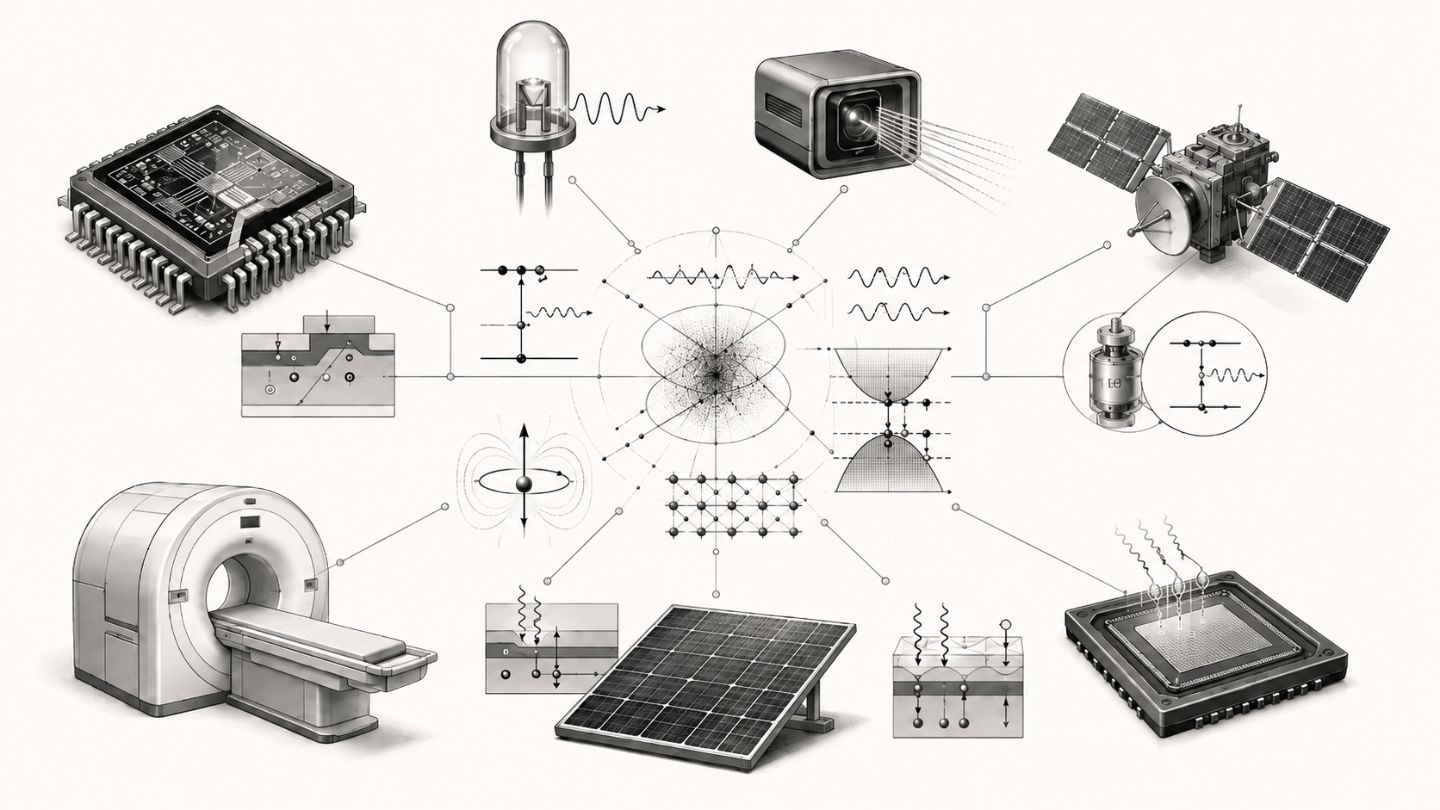
Quantum physics supports technologies used for communication, lighting, navigation, medical imaging, electricity generation, and automatic sensing. Smartphones and computers depend on quantum properties of semiconductors. Light-emitting diodes, lasers, atomic clocks used by the Global Positioning System, magnetic resonance imaging, solar cells, and photodetectors rely on controlled interactions involving electrons, photons, atoms, or atomic nuclei.
These devices are not explained by quantum mechanics alone. A quantum-scale process usually operates inside a larger system that also depends on classical physics, materials science, optics, electronics, software, and mechanical engineering. The National Institute of Standards and Technology identifies smartphones, solar panels, GPS, lasers, LEDs, MRI, and photodetectors among established everyday quantum technologies.
Answer Summary: Quantum physics appears in everyday life when engineers control atomic energy states, semiconductor behavior, photons, atomic resonances, or nuclear spin. These principles allow transistors to regulate current, LEDs to emit light, lasers to produce coherent beams, atomic clocks to keep precise time, MRI scanners to detect tissue-sensitive signals, solar cells to generate electricity, and photodetectors to register light.
Table of Content
- What Quantum Physics Means in Simple Terms
- Why Ordinary Objects Do Not Look Quantum
- Quantum-Enabled Devices and Quantum Computers
- 1. Smartphones and Computers
- 2. LEDs and Electronic Displays
- 3. Lasers
- 4. GPS and Atomic Clocks
- 5. Magnetic Resonance Imaging
- 6. Solar Panels
- 7. Photodetectors and Automatic Sensors
- Common Misconceptions About Everyday Quantum Physics
- Seven Everyday Applications Compared
- How to Assess an Everyday Quantum Claim
- What Quantum Physics Contributes to Daily Life
Key Takeaways:
-
Quantum physics describes matter and light at atomic and subatomic scales.
-
Semiconductor energy states make transistor control possible.
-
LEDs and lasers use transitions between allowed energy states.
-
Atomic clocks provide the precise timing required by GPS.
-
MRI uses magnetic behavior associated with nuclear spin.
-
Solar cells and photodetectors convert absorbed light into electrical effects.
-
A device can rely on quantum physics without being a quantum computer.
What Quantum Physics Means in Simple Terms
Quantum physics describes matter and light at scales where classical explanations are no longer sufficient. Electrons and photons can produce wave-like or particle-like experimental results, and predictions about their measurable properties are often expressed through probabilities.
A photon is a discrete unit of electromagnetic radiation. Electrons bound within atoms can occupy particular energy states rather than every possible energy value. The term quantization refers to this restriction to discrete values.
When an electron moves between allowed energy states, it absorbs or releases a corresponding amount of energy. This relationship helps explain light production in LEDs and lasers and the atomic resonances used in atomic clocks.
“Quantum physics” and “quantum mechanics” are often treated as near-synonyms in introductory explanations. Quantum physics is the broader public-facing term, while quantum mechanics commonly refers to the theory and its mathematical framework. The U.S. Department of Energy provides a plain-language explanation of quantum mechanics, quantization, photons, wave-particle behavior, and modern technological applications.
Why Ordinary Objects Do Not Look Quantum
A chair, book, football, or cup is made from particles governed by quantum mechanics, but these objects normally behave in ways that classical physics describes effectively.
Large objects contain enormous numbers of interacting particles and are continually affected by their surroundings. Their individual quantum states are difficult to isolate, while large-scale properties such as motion, force, temperature, and pressure follow stable patterns.
Quantum physics has not stopped applying. Microscopic effects combine into large-scale behavior for which classical models are usually more practical. A falling smartphone, for example, can be described through gravity and classical motion. The electronic properties of the transistors inside it require quantum mechanics to explain.
This distinction prevents an overly broad interpretation. Everything has a quantum foundation, but not every everyday event is a useful example of quantum technology.
Quantum-Enabled Devices and Quantum Computers
Quantum physics, established quantum-enabled devices, and quantum computers are related but distinct concepts.
Quantum physics is the scientific framework used to describe matter and light at atomic and subatomic scales.
Quantum-enabled conventional technology is a useful label for established devices whose components require quantum mechanics to understand or design. Transistors, LEDs, lasers, atomic clocks, solar cells, and photodetectors belong to this category.
A quantum computer represents and processes information using controlled quantum states called qubits. Conventional processors use transistor circuits to create stable classical states represented as binary values.
A smartphone is quantum-enabled because its semiconductor components rely on quantum material properties. It is not normally a quantum computer. The U.S. Department of Energy distinguishes conventional transistor technology from newer systems that store or transfer information through controlled quantized states.
1. Smartphones and Computers
Smartphones and computers depend on semiconductor devices, especially transistors. Quantum mechanics explains the electronic structure that makes their electrical behavior controllable.
A semiconductor is a material whose conductivity lies between that of a good conductor and an insulator. A band gap is an energy range separating groups of allowed electron states in the material.
Quantum Principle
Electrons in a solid occupy allowed energy bands. The arrangement of these bands influences whether electrical charge can move through the material.
Engineers alter semiconductor behavior by adding selected impurities, combining regions with different electrical properties, and applying electric fields. The intentional addition of impurities is called doping.
Practical Result
A transistor controls electrical current and can operate as a switching or amplifying component. Large arrangements of transistors form the logic, memory, and processing circuits used in phones, computers, vehicles, televisions, and communication equipment.
The Department of Energy notes that smartphone transistors operate through electron behavior described by quantum mechanics. NIST also identifies useful semiconductor properties as a foundation of personal computers and smartphones.
Boundary
Quantum physics explains essential material behavior, not the entire device. A working computer also requires circuit architecture, manufacturing, electrical power, cooling, software, storage, and communication systems.
2. LEDs and Electronic Displays
A light-emitting diode converts electrical energy into light through processes inside a semiconductor.
An LED contains regions with mobile electrons and unoccupied electronic states commonly described as holes. A hole is not an independent particle like an electron. It is a useful way to describe a missing electron in the material’s electronic structure.
Quantum Principle
When an electron and a hole recombine, energy can be released as light through electroluminescence. The emitted photon’s energy is related to the electronic energy difference involved in the transition.
Semiconductor composition and structure influence the range of wavelengths the LED emits.
Practical Result
LEDs are used in indicator lamps, household lighting, traffic signals, electronic displays, optical communication, and instrument panels. NIST and the Department of Energy identify LEDs as established applications of quantum mechanics. (NIST)
Boundary
The final visible output does not depend on one quantum transition alone. Device geometry, semiconductor composition, electrical current, phosphor coatings, optical components, packaging, and temperature can influence color and brightness.
3. Lasers
A laser produces an organized beam of light through stimulated emission and optical amplification.
Stimulated emission occurs when electromagnetic radiation interacts with an excited atom, molecule, or other light-emitting system and induces a transition to a lower-energy state.
Quantum Principle
During stimulated emission, the emitted radiation joins an optical mode that matches the stimulating field in frequency and phase relationship. This allows the radiation to build coherently.
A laser supplies energy to a gain medium and places it within an optical cavity, commonly formed by mirrors. Light passes repeatedly through the medium, stimulating further emission and amplifying selected optical modes.
Practical Result
Laser light can be directional, concentrated, and coherent. These properties support barcode scanners, printers, optical communication, measurement equipment, disc readers, manufacturing tools, and some medical instruments. NIST and the Department of Energy list lasers among technologies made possible by quantum mechanics.
Boundary
A complete laser also needs a gain medium, energy source, optical components, controls, and often temperature management. Stimulated emission provides the quantum mechanism, while the device’s engineering determines how the beam is generated and used.
4. GPS and Atomic Clocks
The Global Positioning System requires highly precise timing. Its main quantum contribution comes from atomic clocks.
An atomic clock uses a characteristic atomic transition frequency as a timing reference. Atoms of the same type have consistent internal energy structures under equivalent conditions, making selected transitions suitable for precision timekeeping.
Quantum Principle
Atoms absorb electromagnetic radiation at particular frequencies associated with transitions between quantum states.
An atomic clock compares an applied electromagnetic frequency with an atomic resonance. A feedback system keeps an oscillator aligned with that reference. NIST explains how these resonant frequencies allow atomic clocks to produce exceptionally stable timing signals.
Practical Result
GPS satellites transmit time and orbital information. A receiver compares the arrival times of signals from multiple satellites to estimate its distance from each one and calculate its position.
NIST identifies atomic clocks as an essential part of GPS navigation.
Boundary
GPS is not explained by quantum mechanics alone. Its operation also depends on satellite orbits, radio transmission, receiver calculations, signal corrections, and relativistic effects.
Clocks moving at different speeds or operating under different gravitational conditions do not run at exactly the same rate. Quantum mechanics supplies the atomic frequency reference, while relativity and classical engineering allow that reference to function accurately in satellite navigation.
5. Magnetic Resonance Imaging
Magnetic resonance imaging uses the response of atomic nuclei, mainly hydrogen nuclei, to magnetic fields and radiofrequency energy.
A hydrogen nucleus contains one proton. Protons have an intrinsic quantum property called spin, which is associated with angular momentum and magnetic behavior.
Spin should not be pictured as a tiny solid sphere rotating around an axis. It is a quantum property without a complete classical equivalent.
Quantum Principle
A strong MRI magnetic field produces a small net alignment among hydrogen nuclei in the body. A radiofrequency field then moves the nuclei away from equilibrium.
After the radiofrequency field is removed, the nuclei return toward equilibrium and produce detectable signals. The timing and strength of these signals vary with their molecular environment, allowing the system to distinguish tissues.
The National Institute of Biomedical Imaging and Bioengineering explains how magnetic resonance imaging uses magnetic fields, radiofrequency excitation, proton realignment, and tissue-sensitive signal detection.
Practical Result
Gradient magnetic fields provide spatial information, receiver coils detect the signals, and computer reconstruction converts the measurements into images.
Boundary
MRI combines nuclear quantum properties with strong magnets, gradient coils, radiofrequency equipment, signal processing, and image-reconstruction methods. Quantum spin explains an essential microscopic feature, not the entire scanner.
MRI does not use ionizing X-rays, although its strong magnetic field creates different safety requirements. This section explains the technology and does not determine whether a scan is appropriate for an individual.
6. Solar Panels
A photovoltaic solar cell converts absorbed light into electrical energy through a semiconductor.
Quantum Principle
Light arrives in discrete units called photons. When a semiconductor absorbs a photon with sufficient energy, that energy can move an electron into a mobile state and leave a corresponding hole.
The band gap helps determine which photon energies the semiconductor can absorb. Different photovoltaic materials therefore respond differently across the solar spectrum.
The U.S. Department of Energy explains how solar photovoltaic cells use semiconductor materials, photon absorption, electron movement, and conductive contacts to produce electrical current.
Practical Result
The structure of a solar cell directs photogenerated charges toward different contacts, creating a voltage. When the cell is connected to an external circuit, the movement of charge produces an electrical current.
Readers seeking the wider system context can review Collegenp’s explanation of renewable energy technology, including solar generation, inverters, grids, and storage.
Boundary
Photovoltaic conversion is the clearest term for this process. “Photoelectric effect” is sometimes used more broadly, but it can also refer specifically to electrons leaving a material after absorbing light.
A complete solar power system also requires electrical contacts, protective layers, wiring, power electronics, mounting equipment, and other system components.
7. Photodetectors and Automatic Sensors
Photodetectors convert incoming light into a measurable output, often an electrical signal.
Quantum Principle
When a detector absorbs a photon, the energy can change the state of electrons or other charge carriers in the detector material. The device converts this microscopic event into a signal that ordinary electronics can measure.
Practical Result
Photodetectors are used in camera sensors, optical communication receivers, safety systems, automatic controls, and scientific instruments.
NIST includes photodetectors in smoke detectors and garage-door systems, along with light-responsive systems that operate doors, lamps, and faucets.
Boundary
Different photodetectors use different materials and mechanisms. Semiconductor photodiodes, superconducting detectors, camera sensors, and thermal detectors should not be treated as identical devices.
A complete automatic system may also require a light source, processor, alarm, motor, communication circuit, or power supply.
Common Misconceptions About Everyday Quantum Physics
Quantum Effects Exist Only in Laboratories
Laboratories are needed when researchers must isolate and control delicate quantum states. Established consumer, medical, and industrial technologies also rely on quantum principles.
Semiconductor electronics, LEDs, lasers, atomic clocks, MRI scanners, solar cells, and photodetectors are documented examples. People usually observe the large-scale result rather than an individual quantum event.
Every Smartphone Is a Quantum Computer
A smartphone contains transistors whose semiconductor properties require quantum mechanics to understand. Its processor normally handles classical information through stable transistor states rather than controlled qubits.
Using quantum physics does not make a device a quantum computer.
GPS Is Explained Only by Quantum Physics or Relativity
Atomic transitions provide the frequency references used by GPS clocks. Relativistic corrections account for differences in clock rates caused by motion and gravity.
Radio signals, orbital information, synchronization, receiver calculations, and other engineering systems are also required.
Proton Spin Means Literal Rotation
Spin is intrinsic quantum angular momentum. Although the word resembles ordinary rotation, a proton should not be pictured as a small rigid ball rotating around a conventional axis.
MRI explanations should connect spin with magnetic behavior and resonance rather than literal mechanical movement.
Consciousness Is Required for Quantum Measurement
The word “observer” can misleadingly suggest that a conscious person causes a quantum result.
In the technologies discussed here, measurement means a physical interaction involving matter, radiation, a detector, or the surrounding environment. Human awareness is not part of the operating mechanism. Quantum mechanics does not establish that thoughts alone cause external events, healing, manifestation, or telepathy.
Everything Made of Atoms Is an Everyday Quantum Example
Everything has a quantum foundation, but not every event is usefully explained as a direct quantum application.
A meaningful example identifies:
-
A specific quantum property or interaction
-
A component that uses it
-
A practical result
-
The additional engineering needed to complete the system
Seven Everyday Applications Compared
| Everyday example | Quantum principle | Practical role and boundary |
|---|---|---|
| Smartphone or computer | Semiconductor electronic states | Enables transistor control and classical processing; not a quantum computer |
| LED or display | Electron-hole recombination | Produces light; output also depends on material and device design |
| Laser | Stimulated emission | Amplifies coherent optical modes; requires a gain medium and optical cavity |
| GPS | Atomic transitions | Supplies precise timing; relativity and system engineering remain essential |
| MRI | Nuclear spin and magnetic resonance | Generates tissue-sensitive signals; spin is not literal rotation |
| Solar cell | Photon absorption and semiconductor states | Generates mobile charge and current through photovoltaic conversion |
| Photodetector | Photon absorption | Produces a measurable signal; detector mechanisms differ |
All seven examples follow the same broad pattern: a quantum-scale process is controlled within a component, and a larger classical system converts the result into a useful service.
How to Assess an Everyday Quantum Claim
A credible explanation should do more than attach the word “quantum” to a product or idea.
1. Does It Identify a Quantum Principle?
The explanation should name a defined mechanism, such as:
-
Semiconductor energy bands
-
Electron-hole recombination
-
Stimulated emission
-
Atomic resonance
-
Nuclear spin
-
Photon absorption
2. Does It Connect the Principle to a Function?
It should explain how the quantum process contributes to switching, light emission, timing, imaging, energy conversion, or detection.
3. Does It State the Boundary?
A responsible explanation acknowledges the roles of materials, electronics, optics, software, classical physics, and system design.
Claims involving consciousness, manifestation, healing, unrestricted communication, or guaranteed security require evidence specific to those claims. Scientific terminology is not evidence by itself.
What Quantum Physics Contributes to Daily Life
Quantum physics affects everyday life through the controlled behavior of electrons, photons, atoms, and nuclei. It provides essential mechanisms inside chips, LEDs, lasers, atomic clocks, MRI scanners, photovoltaic cells, and photodetectors.
Two extremes should be avoided. Quantum effects are not confined to specialist laboratories, but quantum mechanics is also not the complete explanation for every object or event.
The clearest approach is to identify the quantum principle, explain what it enables, and show which parts of the finished technology depend on other branches of science and engineering.







Comments 0
No comments yet. Be the first to start the conversation.