



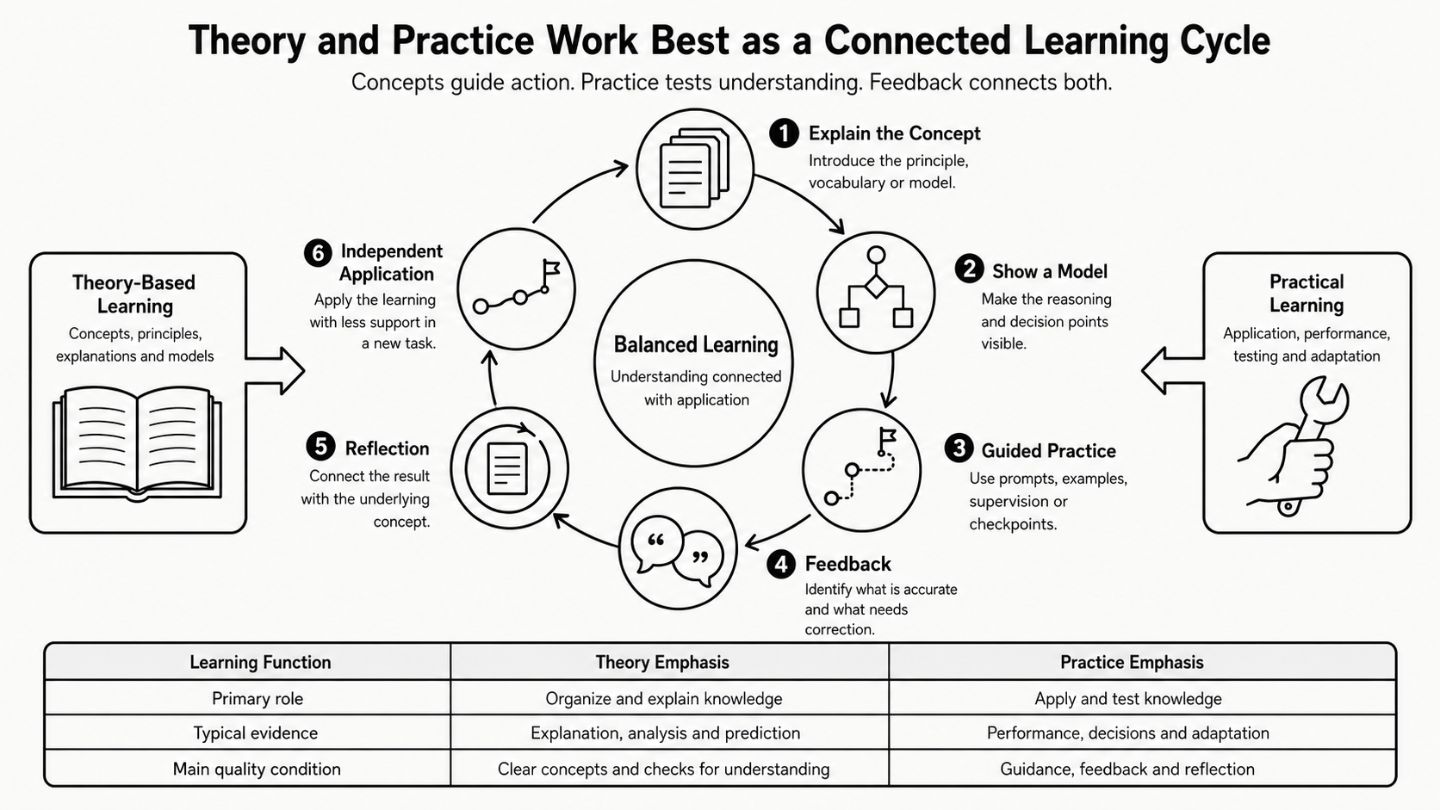
Students, parents, teachers, and adult learners often compare courses by asking whether they are theoretical or practical. The distinction matters, but it becomes misleading when the two approaches are treated as strict opposites.
Theory-based learning emphasizes concepts, principles, explanations, models, and organized knowledge. Practical learning emphasizes using knowledge through projects, laboratories, simulations, fieldwork, supervised practice, and workplace tasks.
These are broad educational categories rather than two standardized teaching methods. A theory-focused lesson can involve discussion, prediction, analysis, and problem-solving. A practical activity can produce little meaningful learning when students follow instructions without understanding, feedback, or reflection.
The more useful question is not whether theory or practice is universally better. It is how the two should be balanced for the learner’s prior knowledge, subject, expected outcome, available resources, and level of risk.
Answer Summary: Neither theory-based nor practical-based learning is universally superior. Theory helps learners organize concepts, explain reasons, and reason beyond one example. Practical learning helps them perform, test, adapt, and correct errors. An effective design often combines explanation, modeling, guided practice, feedback, reflection, and increasingly independent application. The appropriate balance depends on the learner, discipline, assessment, resources, and task.
Table of Content
- What Is Theory-Based Learning?
- What Is Practical Learning?
- How Do Related Learning Approaches Differ?
- Theory-Based vs Practical-Based Learning: Key Differences
- Strengths of Theory-Based Learning
- Limitations of Theory-Based Learning
- Strengths of Practical Learning
- Limitations of Practical Learning
- What Does Research Indicate?
- Which Approach Fits Different Situations?
- Examples Across Subjects
- How Can Theory and Practice Be Combined?
- How Should a Course or Learning Program Be Evaluated?
- Which Approach Is Better?
Key Takeaways:
-
Theory provides concepts, explanations, and organized knowledge.
-
Practice develops performance and exposes application difficulties.
-
Theory-based teaching does not have to be passive.
-
Physical activity does not automatically create active learning.
-
Learners with limited prior knowledge may require more guidance.
-
Feedback and reflection connect experience with understanding.
-
No universal theory-to-practice percentage fits every course.
What Is Theory-Based Learning?
Theory-based learning emphasizes the concepts and explanatory structures used to understand a subject. It helps learners explain relationships, compare possible approaches, and reason beyond a familiar example.
Purpose and Common Methods
The main purpose is conceptual understanding. Learners study definitions, principles, frameworks, models, relationships, assumptions, and reasons.
Common formats include:
-
reading;
-
teacher explanation;
-
lectures;
-
discussions;
-
demonstrations;
-
worked examples;
-
diagrams and models;
-
conceptual questions;
-
case analysis;
-
written reasoning.
These formats can help learners build subject vocabulary, organize information, identify patterns, and explain why a process or result occurs.
A worked example is most useful when it shows the reasoning and decision points, not only the final answer.
What Theory-Based Learning Is Not
Theory-based learning is not the same as memorization. Recalling definitions may support learning, but conceptual understanding also requires learners to connect, interpret, compare, and use ideas.
It is not automatically passive. Learners can engage actively with theoretical material by:
-
explaining a principle in their own words;
-
predicting an outcome;
-
comparing competing explanations;
-
retrieving concepts without notes;
-
identifying assumptions;
-
analyzing cases;
-
deciding when a rule does not apply.
The important distinction is the thinking required by the activity, not whether the learner is sitting, reading, speaking, or handling equipment.
What Is Practical Learning?
Practical learning emphasizes using knowledge in action. Learners perform tasks, make decisions, test ideas, interpret results, and adjust their work.
Purpose and Common Methods
The main purpose is to develop observable application or performance. Practical learning may include:
-
laboratory work;
-
projects;
-
simulations;
-
fieldwork;
-
workshops;
-
role-play;
-
supervised clinical or technical tasks;
-
workplace activities;
-
internships;
-
apprenticeships;
-
product or portfolio creation.
A practical task can expose difficulties that remain hidden during reading or listening. A learner may understand a process in outline but struggle to select relevant information, use a tool, manage constraints, explain a decision, or respond to an unexpected result.
Practice gives learners and instructors an opportunity to observe those difficulties and address them.
What Practical Learning Is Not
Practical learning is not limited to vocational education. It can appear in science, languages, humanities, business, technology, professional education, and general academic study.
It is also not automatically independent or minimally guided. Practical learning may begin with:
-
safety instructions;
-
an explanation;
-
a demonstration;
-
a worked example;
-
guiding questions;
-
supervision;
-
checkpoints;
-
feedback.
A learner may complete a task mechanically without understanding its purpose or recognizing when the same principle applies elsewhere. Effective practical learning therefore requires more than activity alone.
How Do Related Learning Approaches Differ?
Practical, active, experiential, discovery, project-based, problem-based, and vocational learning overlap, but they are not interchangeable.
Active Learning
Active learning is a broad category in which learners meaningfully think, solve, discuss, explain, create, or apply rather than only receive information.
It does not require physical movement. A learner comparing arguments or solving a conceptual question may be engaged in active learning without completing a hands-on task.
Structured question-based learning is one way to encourage learners to retrieve ideas, explain reasoning, and respond to feedback. It remains effective only when questions match the learning goal and learner readiness.
Experiential Learning
Experiential learning organizes learning around experience together with interpretation, reflection, and conceptualization.
Experience alone should not be treated as sufficient evidence of learning. Learners also need to consider what happened, connect the experience with relevant concepts, and determine what may transfer to another setting.
Discovery Learning
Discovery learning asks learners to infer or uncover principles through exploration.
It may be unassisted or supported through:
-
feedback;
-
scaffolding;
-
worked examples;
-
prompts;
-
elicited explanations.
This distinction matters because assisted and unassisted discovery have not produced the same results in research comparisons.
Discovery learning is not identical to practical learning. A practical lesson may use explicit explanation and close supervision, while a discovery task may involve a conceptual puzzle rather than physical activity.
Project-Based and Problem-Based Learning
Project-based learning commonly organizes work around an extended product, response, or investigation. Problem-based learning uses a problem as the central context for inquiry and learning.
Both approaches can combine conceptual study and application. Their value depends on learning goals, learner readiness, task design, teacher guidance, and assessment.
Readers comparing these formats can review Collegenp’s guides to problem-based learning and problem-solving-based learning. These approaches overlap, but the first is the more established academic term.
Vocational Learning
Vocational learning prepares people for occupational roles or areas of work. It often includes substantial practical training, but it may also require technical principles, regulations, safety knowledge, communication, and assessment.
Practical learning is broader because applied tasks also appear in academic and general education.
Direct or Explicit Instruction
Direct or explicit instruction may include clear explanation, modeling, examples, checks for understanding, guided practice, feedback, and movement toward greater independence.
It should not be reduced to uninterrupted lecturing. Learner responses and guided application can form part of explicit teaching.
Theory-Based vs Practical-Based Learning: Key Differences
The central difference is functional: theory organizes and explains knowledge, while practice applies and tests it. Strong learning designs often connect these functions rather than treating them as separate routes.
| Criterion | Theory-based learning | Practical learning |
|---|---|---|
| Main purpose | Build conceptual understanding and explanatory structure | Apply, perform, test, adapt, and receive feedback |
| Common methods | Reading, explanation, discussion, models, worked examples, and conceptual analysis | Laboratories, projects, simulations, fieldwork, role-play, and supervised practice |
| Typical output | Explain, compare, analyze, predict, or justify | Demonstrate, produce, troubleshoot, decide, or adapt |
| Strongest use | Foundations, vocabulary, principles, comparison, prediction, and preparation | Performance, application, contextual judgment, feedback, and adaptation |
| Main risk | Knowledge remains disconnected from use, or passive delivery hides misunderstanding | Activity becomes shallow, unguided, inaccessible, unsafe, or tied to one setting |
| Assessment | Explanation, analysis, comparison, prediction, and reasoning | Demonstration, project work, performance, decision-making, and troubleshooting |
| Resource needs | Vary by subject and may not require specialist practice facilities | May require equipment, placements, supervision, time, or digital tools |
| Quality indicators | Clear explanation, examples, questions, retrieval, and checks for understanding | Relevant tasks, appropriate guidance, feedback, reflection, assessment, and supervision |
The categories overlap. Practical tasks can deepen conceptual understanding when learners interpret results and connect them to principles. Theory can inform performance by helping learners predict, diagnose, and adapt.
Strengths of Theory-Based Learning
Theory-based learning is especially useful when learners need an organized structure before dealing with complex examples or tasks.
It Organizes Concepts and Vocabulary
Concepts help learners connect information rather than treating every fact as separate. Subject vocabulary also allows them to describe relationships and communicate their reasoning more precisely.
A conceptual framework may help a learner identify:
-
which information is relevant;
-
how two cases are related;
-
why a procedure works;
-
which assumptions support a conclusion;
-
when a familiar method may not apply.
It Explains Why Methods Work
Knowing the steps of a procedure differs from understanding its basis. Theory can explain why a method is suitable, what conditions affect it, and why another approach may produce a different result.
This understanding can help when learners face a case that does not exactly match the example they studied.
It Supports Comparison and Prediction
Organized knowledge can help learners compare cases and predict how changing conditions may affect an outcome.
Transfer should not be assumed, however. Learners still need opportunities to recognize relevant principles and apply them in varied situations.
It Can Prepare Learners for Complex Tasks
Explanation, modeling, and rehearsal can prepare learners before they use unfamiliar equipment or enter a setting where mistakes may have consequences.
Preparation does not replace supervised practice. It provides knowledge that can make later practice more informed.
Limitations of Theory-Based Learning
Theory becomes limited when learners can repeat an explanation but cannot recognize when or how to use it.
Knowledge May Remain Disconnected from Action
A learner may reproduce definitions or complete a familiar written question without being able to perform a related task.
Without application, learners have fewer opportunities to discover whether they can:
-
choose an appropriate method;
-
work within constraints;
-
use tools;
-
explain a decision;
-
respond to an unexpected result;
-
adapt knowledge to another context.
Passive Delivery Can Hide Misunderstanding
An explanation may appear clear while the learner is listening. That feeling does not establish whether the learner can later retrieve, explain, or apply the idea independently.
Questions, retrieval, learner explanations, and application tasks can provide better evidence of understanding.
This limitation does not mean that all lectures are ineffective. The relevant comparison is between particular forms of instruction, learner activity, and assessment—not simply between “lecture” and “practical” formats.
Performance Requires Relevant Practice
Conceptual knowledge alone does not demonstrate every aspect of performance. Tasks involving tool use, timing, communication, diagnosis, coordination, or situational judgment require opportunities to practise the relevant skill.
Strengths of Practical Learning
Practical learning is most useful when the intended outcome requires action, performance, or decision-making.
It Connects Knowledge with Performance
A practical task may require learners to:
-
select information;
-
apply a process;
-
use a tool;
-
interpret a result;
-
create a product;
-
solve a problem;
-
justify a choice;
-
adjust after an error.
These requirements expose differences between recognizing an explanation and producing an independent response.
It Creates Opportunities for Feedback
Feedback allows learners to compare their performance with the intended outcome and identify what needs correction.
Its usefulness depends on the information it provides and whether learners have an opportunity to respond. A score alone does not necessarily explain what should change.
It Reveals Hidden Learning Gaps
A learner may follow a worked example successfully but struggle when the next task contains fewer prompts.
Practical application can show whether the learner can identify the problem, select a method, monitor progress, and interpret the result.
It Makes Relevance More Visible
Projects, cases, simulations, and workplace tasks may help learners see how concepts relate to decisions or products.
Relevance, enjoyment, and participation are not proof of learning. The activity still needs to be assessed against its intended outcome.
Limitations of Practical Learning
Practical learning can be ineffective when activity replaces clear instructional design.
Unguided Activity Can Become Trial and Error
Alfieri and colleagues examined unassisted and assisted discovery through a meta-analysis of 164 studies. The review found that unassisted discovery generally produced less favorable outcomes than explicit instruction, while enhanced discovery benefited from support such as feedback, worked examples, scaffolding, and elicited explanations.
This evidence concerns discovery learning rather than every type of practical instruction. Its relevant lesson is narrower: giving learners an activity with little support should not automatically be assumed to produce better learning.
Skills May Remain Tied to One Setting
A learner may perform successfully with familiar tools, instructions, or examples but struggle when conditions change.
Using varied examples and asking learners to explain the underlying principle can help instructors examine whether understanding extends beyond one routine. This is a design recommendation rather than a guarantee of transfer.
Access and Resources Can Differ
Practical activities may require:
-
laboratories;
-
software;
-
equipment;
-
transport;
-
placements;
-
qualified supervision;
-
additional time.
When access differs, course designers need to consider whether learners receive comparable opportunities to practise and demonstrate the intended outcome.
Simulations and cases may support some goals, but they should not be presented as interchangeable with direct supervised experience for every skill.
Some Tasks Require Safety Controls
Laboratory, technical, clinical, field, and workplace activities may involve risks. Appropriate preparation, facilities, supervision, and institutional safety procedures are therefore relevant parts of course quality.
This article provides general educational guidance and does not replace discipline-specific safety requirements.
Assessment May Reward Completion Rather Than Understanding
A completed project does not necessarily show what each learner knows. In group work, individual contributions may also be difficult to identify.
Where both understanding and performance matter, assessment should examine the product or task together with relevant reasoning, explanation, reflection, or individual demonstration.
What Does Research Indicate?
Research supports several principles related to active engagement and guided application. It does not provide a universal experiment comparing every possible theory-based lesson with every form of practical learning.
The evidence used here is strongest in undergraduate science, technology, engineering, and mathematics education and in research on discovery instruction. It should not be generalized automatically to every discipline, age group, or learning outcome.
Active Learning in Undergraduate STEM
Freeman and colleagues conducted a meta-analysis of 225 undergraduate STEM studies comparing active learning with traditional lecturing.
Across the included studies, active-learning conditions produced higher examination or concept-inventory performance on average. Students in traditional lecture conditions were also more likely to fail. The study covered active-learning interventions broadly; it did not test practical learning as one standardized method.
The finding supports meaningful participation in the studied undergraduate STEM settings. It does not establish that every project, laboratory, or hands-on activity is more effective than every explanation or lecture.
Actual Learning and the Feeling of Learning
Deslauriers and colleagues used a randomized crossover study in introductory college physics to compare active instruction with passive lecture.
Students performed better on the study’s learning measure after active instruction but reported a lower feeling of learning than after the fluent lecture condition.
The result shows that perceived instructional fluency and measured performance can differ in this setting. It does not show that student experience is unimportant, that lectures always create false confidence, or that the same result occurs in every course.
Active Engagement and Context-Responsive Teaching
The National Academies’ 2025 consensus report on undergraduate STEM teaching identifies active engagement as one principle of equitable and effective teaching in the United States.
The report also addresses student knowledge and experience, social dimensions of learning, evidence for improvement, flexibility, responsiveness, transparency, and institutional support.
It therefore presents active engagement as part of a wider teaching system rather than as a stand-alone activity added without attention to context or support.
Assisted and Unassisted Discovery
The discovery-based instruction review by Alfieri and colleagues distinguishes unassisted discovery from forms supported by feedback, examples, scaffolding, and explanation.
Discovery learning is not synonymous with practical learning. The evidence is relevant to the narrower question of how much guidance learners receive during exploration.
Practice Design and Knowledge Acquisition
The American Psychological Association’s guidance on practice for knowledge acquisition recommends varying practice activities, distributing practice over time, and providing clear performance expectations and criteria.
This guidance does not establish a universal theory-to-practice ratio. It supports the narrower principle that practice quality, timing, variation, and feedback conditions matter.
What the Studies Do Not Establish
The cited evidence does not establish that:
-
every practical task is active learning;
-
every lecture is passive;
-
all subjects respond in the same way;
-
engagement guarantees achievement;
-
practical learning guarantees employment;
-
one level of guidance fits every learner;
-
one fixed theory-to-practice ratio is optimal.
The supportable conclusion is narrower: meaningful participation, appropriate guidance, feedback, contextual responsiveness, and aligned assessment are important considerations in learning design.
Which Approach Fits Different Situations?
The appropriate emphasis depends on the learner’s prior knowledge, the outcome, the task, available support, and any associated risk.
| Situation | Possible emphasis | Reason |
|---|---|---|
| Learner with limited prior knowledge | Clear explanation, models, worked examples, and guided practice | Unsupported exploration may create avoidable confusion |
| Developing learner | Mixed problem-solving, feedback, conceptual review, and varied practice | Application can expose gaps while support remains available |
| Experienced learner | More independent and varied application with analytical review | Stronger foundations may allow greater autonomy |
| Concept-heavy subject | Organized concepts connected to cases and application | Learners need explanatory structure and opportunities to use it |
| Performance-based skill | Principles, demonstration, supervised practice, and performance checks | Observable performance is part of the outcome |
| Safety-sensitive task | Preparation, modeling, suitable rehearsal, and qualified supervision | Errors may carry consequences |
| Online learning | Cases, simulations, projects, demonstrations, feedback, and reflection | Digital activities can support some forms of application |
| Self-directed study | Short concept blocks, examples, supported tasks, feedback, and later independent work | Structure can reduce passive reading and aimless repetition |
These are conditional guidelines rather than rules that guarantee a particular result.
Start with the Intended Outcome
A course expecting learners to explain and analyze needs assessment of conceptual understanding. A course expecting learners to perform also needs evidence of performance.
When both outcomes matter, both should appear in teaching and assessment. The distinction between learning objectives and learning outcomes can help course designers connect teaching activities with what learners are expected to demonstrate.
Adjust Guidance Gradually
Support can change as learners develop. Early tasks may include demonstrations, examples, prompts, or supervision. Later tasks can require greater independence and adaptation.
The timing of that change should depend on learner performance and task demands rather than a fixed schedule.
Examples Across Subjects
Theory and practice can be linked in many fields.
-
Science: Concepts and models followed by a demonstration, supervised laboratory work, data interpretation, and investigation.
-
Engineering or technology: Principles and worked examples followed by design, simulation or prototyping, testing, and analysis.
-
Languages: Vocabulary and grammar followed by modeled examples, guided speaking or writing, feedback, and communication in varied settings.
-
Business: Decision frameworks and case analysis followed by simulation, a client-style brief, explanation of choices, and review.
-
Humanities: Historical or theoretical context followed by source analysis, debate, archival work, fieldwork, or an applied project.
-
Teacher education: Learning principles followed by planning, observation, supervised teaching, feedback, and reflection.
-
Vocational education: Technical and safety principles followed by demonstration, supervised practice, assessment, and greater independence.
-
Online study: Explanation and demonstration followed by interactive cases, simulations, projects, peer review, or instructor feedback.
These are simplified illustrations rather than evidence that one sequence fits every discipline.
How Can Theory and Practice Be Combined?
A useful learning sequence can move from explanation toward supported application and greater independence. The following model is an editorial synthesis rather than a universally tested formula.
1. Define the Learning Outcome
State what the learner should understand and what the learner should be able to do.
A precise outcome may ask the learner to explain a principle, compare alternatives, perform a procedure, diagnose a problem, interpret evidence, or justify a decision.
2. Explain the Necessary Concept
Introduce the concepts, vocabulary, relationships, or rules required for the task.
The explanation should connect with what the learner will apply rather than functioning as disconnected background.
3. Show a Model or Worked Example
Demonstrate the process while making the reasoning visible.
A useful model can show:
-
how the task is interpreted;
-
why a method is selected;
-
where an error may occur;
-
how the result is checked.
4. Use Guided Practice
Give the learner a related task with appropriate support.
Support may include prompts, partial steps, questions, checklists, supervision, or feedback. The task should be difficult enough to require thought but structured enough to prevent avoidable confusion.
5. Provide Feedback
Feedback should identify what is accurate, what needs correction, and what the learner should reconsider.
Where possible, the learner should have an opportunity to use the feedback in a later attempt.
6. Ask for Explanation and Reflection
The learner can be asked to explain:
-
what happened;
-
which principle applied;
-
why a result occurred;
-
what caused an error;
-
what may change in another setting.
This step helps reveal whether the learner can connect performance with relevant concepts.
7. Increase Independence and Vary the Task
Reduce support when performance indicates that the learner is ready.
Use a different example, tool, setting, or problem format so the learner must decide how to proceed.
8. Assess the Intended Outcomes
Assessment should reflect what the course claims learners will know or do.
Where both theory and practice matter, assessment may ask learners to:
-
explain a principle;
-
justify a method;
-
complete a task;
-
interpret the result;
-
diagnose an error;
-
adapt an approach.
A Self-Study Version
A self-directed learner can apply the same logic:
-
Study one manageable concept.
-
Explain it without copying the source.
-
Review a worked example.
-
Complete a supported task.
-
Check the response against reliable feedback.
-
Record the error and its likely cause.
-
Try a related task with less support.
-
Return to the concept when application exposes a gap.
Collegenp’s guide to evidence-aware study habits provides related ideas for retrieval, practice, planning, and review.
This is a study framework, not a guarantee of improved grades or retention.
How Should a Course or Learning Program Be Evaluated?
A course should be judged by the alignment and quality of its learning design rather than by a fixed percentage of theoretical and practical hours.
Check whether the course:
-
states clear learning outcomes;
-
develops concepts needed for later tasks;
-
includes practice aligned with those outcomes;
-
explains or demonstrates complex tasks;
-
provides guidance suited to learner readiness;
-
offers feedback that learners can use;
-
asks learners to explain or interpret their work;
-
assesses understanding and performance where both matter;
-
provides suitable supervision and safety controls;
-
addresses access to equipment, software, placements, or alternatives;
-
increases independence when learners are ready;
-
uses more than one context when adaptation matters;
-
explains the role and limits of simulations;
-
distinguishes participation from demonstrated learning.
A program with many practical hours may still provide weak learning if tasks are repetitive, poorly supervised, or disconnected from assessment.
A theory-heavy program may still involve substantial cognitive activity through analysis, retrieval, explanation, cases, and problem-solving.
Questions to Ask Before Choosing a Course
-
What should learners understand and perform by the end?
-
How are concepts connected to projects, laboratories, cases, or workplace tasks?
-
What guidance is provided before difficult practical work?
-
Who provides feedback, and can learners act on it?
-
How is individual understanding assessed during group work?
-
Do tasks become more independent as learners progress?
-
Are facilities and practical opportunities reasonably accessible?
-
What alternatives exist when direct practical access is limited?
-
Are assessments aligned with the skills advertised by the course?
-
Does the program explain task quality rather than relying only on a practical-hours figure?
Which Approach Is Better?
Neither approach is universally better. Theory-based and practical learning address different parts of the learning process.
Theory is useful for building concepts, explanations, vocabulary, models, and principles. Practical learning is useful for applying knowledge, demonstrating performance, interpreting results, and responding to feedback.
Theory without application may remain disconnected from use. Practice without concepts, guidance, or reflection may remain narrow or difficult to adapt.
A well-aligned learning design connects both. It starts with clear outcomes, provides the necessary explanation and modeling, introduces appropriately guided application, offers feedback, asks learners to explain their reasoning, and increases independence when they are ready.
The balance should be determined by the learner, discipline, assessment, resources, and risk—not by an unsupported universal ratio.







Comments 0
No comments yet. Be the first to start the conversation.