



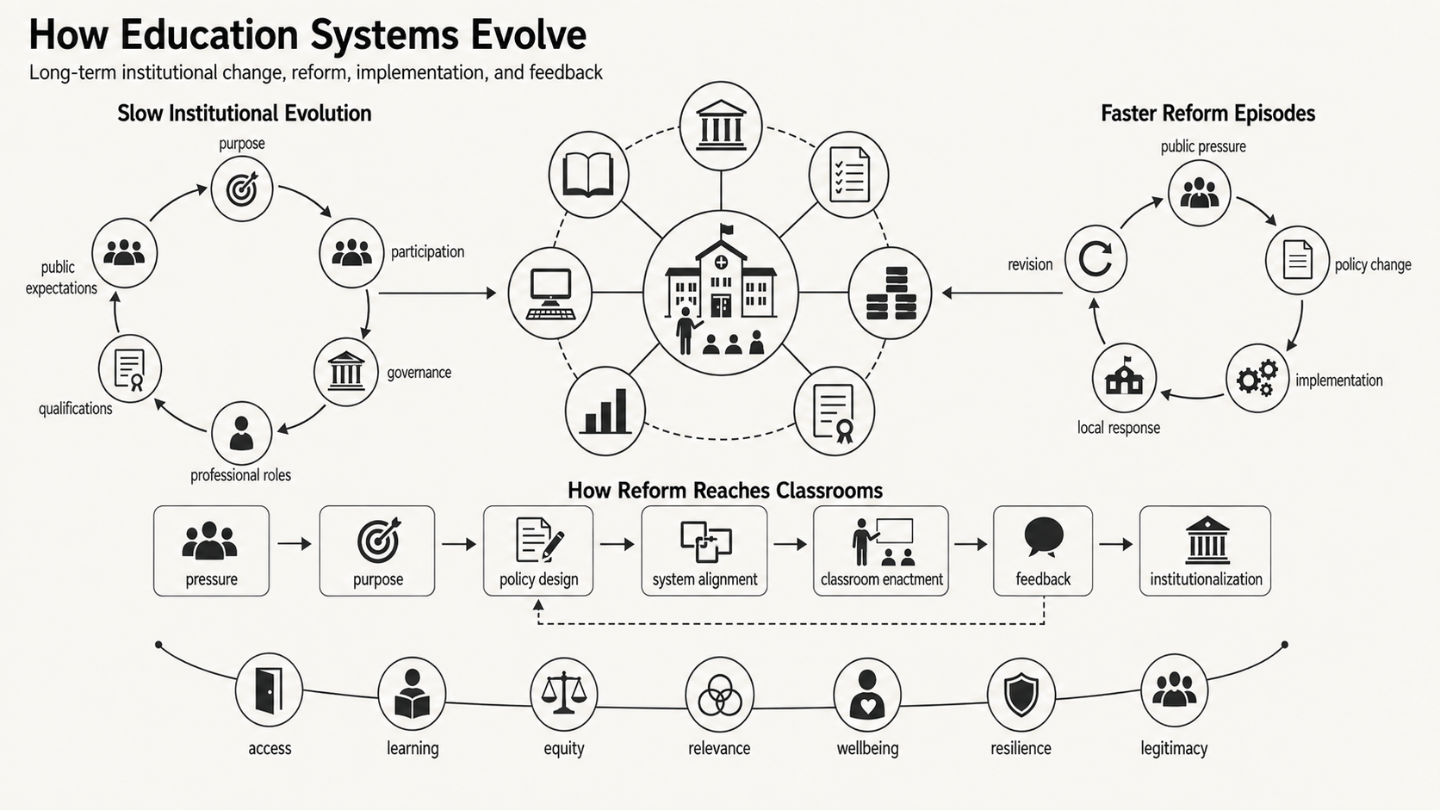
Education systems evolve when societies revise what they expect education to achieve and when governments, institutions, educators, families, and learners translate those expectations into policy, resources, professional practice, and feedback.
Lasting change generally requires coordination among curriculum, assessment, teacher support, finance, governance, infrastructure, information systems, and accountability. A new policy, curriculum, platform, or funding program may alter one part of education, but its introduction alone does not establish that the wider system has changed.
Education-system evolution also occurs at different speeds. Long-term institutional development reshapes participation, qualifications, governance, professional roles, and public expectations. Shorter reform episodes respond to political decisions, evidence, demographic pressure, economic change, technology, environmental disruption, or crises.
Answer Summary: Education systems evolve through changing social purposes, political choices, institutional development, resource decisions, and local adaptation. Durable reform requires more than adopting a policy. Curriculum, assessment, teacher preparation, finance, governance, infrastructure, information, and accountability need to support compatible goals. Results also depend on context, institutional capacity, public trust, and how educators and institutions interpret change. This is why similar reforms can produce different outcomes across countries and communities.
Table of Content
- What Is an Education System?
- How Education Systems Evolved Over Time
- What Drives Education Systems to Change?
- How Does Education Reform Reach Classrooms?
- Why Do Education Systems Change Slowly or Unevenly?
- Reform, Innovation, and Transformation
- Why Does the Same Reform Produce Different Results?
- What Pressures Are Reshaping Education Systems?
- How Can We Judge Whether Change Is Improvement?
- How Can Readers Assess Claims About Education Reform?
- What Education-System Evolution Ultimately Depends On
Key Takeaways:
-
Education systems include institutions, people, rules, resources, qualifications, and learning practices.
-
Their histories do not follow one universal sequence.
-
Social values, demographics, politics, economics, evidence, technology, environmental conditions, and crises influence change.
-
Adopting a policy and putting it into practice are different stages.
-
System coherence means that policies, resources, relationships, and incentives support compatible goals.
-
Reform outcomes differ because institutional and social conditions differ.
-
Change should be judged through access, learning, equity, relevance, wellbeing, resilience, and legitimacy.
What Is an Education System?
An education system includes more than schools or government ministries. It connects institutions with the rules, resources, relationships, and pathways that influence who learns, what they study, how learning is assessed, and which opportunities follow.
UNESCO defines an education system as the framework through which formal and non-formal education and learning opportunities are provided within a country or society. Its definition includes provision or financing by state and non-state actors.
Important system components may include:
-
educational purposes and public expectations;
-
curriculum and learning standards;
-
assessment and examinations;
-
teachers and other education professionals;
-
governance and institutional authority;
-
finance and resource allocation;
-
infrastructure and learning materials;
-
information and data systems;
-
qualifications and progression routes;
-
accountability arrangements;
-
links among education levels, sectors, and programs.
These components affect one another. A revised curriculum may have limited influence when examinations continue to reward different knowledge or methods. Expanded participation may place pressure on teaching conditions when staffing, facilities, and finance do not grow accordingly. A digital platform may remain peripheral when access is unequal, educators lack support, or its use does not correspond with curriculum and assessment.
The World Bank’s Systems Approach for Better Education Results emphasizes that system improvement requires more than adding resources. Its framework examines alignment among governance, accountability, information, financing rules, and school management. It is an institutional framework, not a guaranteed formula for successful reform.
This interconnected perspective also helps explain the components of a modern education system.
Evolution, Reform, Innovation, and Transformation
Evolution refers to cumulative change over time. It can include deliberate policy reform and adaptations that were not centrally planned.
Reform is a deliberate attempt to change one or more parts of an existing system, such as curriculum, assessment, teacher policy, finance, access, or governance.
Innovation is a new practice, tool, program, or institutional arrangement. It may remain limited to one institution, locality, or project unless wider rules, resources, and organizations support continued use.
Transformation is used in this article for deeper changes in educational purposes, institutional relationships, incentives, or operating arrangements. The term does not have one universally standardized definition.
Innovation can contribute to reform, and reform can contribute to transformation. However, not every innovation spreads, and not every reform changes the system’s underlying relationships.
How Education Systems Evolved Over Time
Education systems have not followed one global historical path. Different societies developed learning institutions through religious traditions, communities, states, local knowledge systems, political movements, economic demands, and colonial and post-colonial histories.
Across long periods, many societies moved from education available to limited groups toward broader participation. Systems also became more differentiated, with arrangements for early childhood, primary, secondary, technical and vocational, higher, adult, and non-formal education.
Expanded participation did not automatically produce equal opportunity or effective learning. Institutions often grew at different rates, and access could expand faster than teacher supply, infrastructure, finance, or academic support.
Historical development has also changed the purposes assigned to education. Systems may be expected to support literacy, knowledge, cultural continuity, citizenship, social participation, employment, equality, public administration, and personal development. These purposes can reinforce one another, but they can also create tension.
A useful analytical model is to view education-system change through two interacting clocks.
Diagram 1: The Two Clocks of Education-System Change
Slow institutional evolution
Purpose → participation → governance → professional roles → qualifications → public expectations
Faster reform episodes
Public or political pressure → policy change → implementation → local response → revision
The slower clock represents institutions and expectations built over long periods. The faster clock represents reform programs, political decisions, crises, and external pressures. A rapid reform enters an existing institutional environment, so old and new arrangements often operate together.
The two-clocks model is an editorial framework for explaining change. It is not a universal historical sequence or a predictive model.
What Drives Education Systems to Change?
Education systems change when pressures alter who requires education, what education is expected to achieve, or how institutions can provide it. One pressure may affect several system components at the same time.
| Driver | Main system effects | Central question |
|---|---|---|
| Social values and rights | Access, inclusion, curriculum, accountability | Who should education serve, and for what purposes? |
| Demography and migration | Institution location, staffing, language support, finance | Where are learners, and what provision do they need? |
| Economy and work | Curriculum, qualifications, pathways, transitions | Which capabilities and routes require support? |
| Politics and governance | Authority, priorities, finance, accountability | Who decides, coordinates, funds, and carries responsibility? |
| Evidence and assessment | Targets, teaching priorities, reporting, resource decisions | What is measured, and how is the evidence used? |
| Technology, climate, and crises | Infrastructure, continuity, access, teacher roles | How can the system adapt without increasing inequality? |
Social Values, Rights, and Public Expectations
Social values influence who receives education and what institutions are expected to teach. Public debate may concern inclusion, gender equality, language, culture, citizenship, wellbeing, employment, academic learning, or education as a public good.
UNESCO’s Reimagining Our Futures Together presents education as a shared public responsibility connected to human rights, social justice, dignity, cultural diversity, care, reciprocity, and solidarity. UNESCO describes the report as an invitation to discussion rather than an implementation manual.
Conflicting purposes can produce conflicting system signals. A curriculum may promote inquiry while high-stakes examinations reward recall. A government may expand participation without providing corresponding staff, facilities, or support. A policy focused on immediate employment needs may give less attention to citizenship, culture, or broader knowledge.
Education reform therefore involves decisions about public purpose as well as administrative design.
Demography, Migration, and Geography
Population growth, declining birth rates, migration, urbanization, displacement, and changing learner needs affect where and how education is provided.
A growing urban area may require additional institutions and teachers. Remote or sparsely populated communities face different questions involving transport, staffing, infrastructure, and access to specialized provision.
Migration and displacement may also require language support, recognition of previous learning, flexible placement, alternative schedules, or additional learner services.
The effect of demographic change varies by setting. A policy suitable for a densely populated city may not work in a remote region with small institutions, long travel distances, and limited connectivity.
Economy, Work, and Qualifications
Economic and occupational change influences the knowledge, capabilities, qualifications, and transitions that societies expect education to support. Policy responses may involve curriculum revision, technical and vocational pathways, work-based learning, adult education, or career guidance.
Employment preparation is not education’s only purpose. Education may also support citizenship, cultural continuity, further learning, social participation, and personal development.
Qualification systems influence movement between education levels and employment, but recognition and transfer rules differ by country and institution. Any specific claim about the recognition or value of a credential should therefore be checked against the relevant education authority, qualifications framework, or institution.
Politics, Governance, and Policy Learning
Education change is political because it can redistribute authority, resources, workload, opportunity, and status.
Governance determines which bodies set standards, employ teachers, approve qualifications, manage finance, collect information, and answer to the public. Coordination becomes difficult when responsibilities are distributed across ministries, local authorities, examination bodies, institutions, regulators, and private providers.
Education systems also learn from one another. Policy learning can help governments identify alternatives, but visible practices from one system may depend on less visible conditions such as teacher preparation, stable finance, institutional authority, language arrangements, or public trust.
Policies therefore need adaptation rather than direct copying. Readers seeking a country-specific example can review the relationship between structure and reform in Nepal’s education system.
Evidence, Assessment, and Accountability
Evidence can reveal unequal participation, learning gaps, resource shortages, or weak transitions. It can also narrow attention when one indicator becomes the dominant definition of success.
Assessment influences what learners and institutions treat as important. Accountability arrangements shape behavior through reporting, inspection, targets, incentives, and consequences.
Information alone does not produce improvement. Institutions also need authority, capacity, resources, and professional knowledge to respond.
Measurement can also create unintended effects. When one examination, ranking, or indicator carries excessive weight, institutions may focus on improving that measure rather than addressing the wider educational purpose behind it.
Technology, Climate, and Crises
Technology, environmental hazards, conflict, displacement, and other emergencies can accelerate adaptation or expose weaknesses in existing systems.
Digital tools can support communication, administration, assessment, access, and teaching. Their effects depend on infrastructure, accessibility, curriculum fit, instructional design, governance, and professional support.
Technology should therefore be treated as part of a wider education system rather than as a substitute for policy, teaching, or institutional capacity. Classroom-level considerations are discussed further in effective ways to use technology in the classroom.
Schools and institutions also need to distinguish between the availability of a tool and its educational usefulness. A related overview of technologies for teaching and learning explains how different tools serve different instructional and administrative purposes.
Crises can affect facilities, attendance, safety, staff deployment, public finance, and continuity of learning. Responses may include flexible calendars, alternative learning sites, remote provision, revised infrastructure, or additional support for displaced learners.
Such adaptations should be judged through access, learning quality, safety, and equity rather than novelty alone.
How Does Education Reform Reach Classrooms?
Education reform reaches classrooms through a chain of decisions, resources, interpretations, and adjustments. Policy adoption begins the process; it does not prove that institutional practice or learner outcomes have changed.
The OECD describes education-policy implementation as a purposeful and multidirectional process through which policy is put into practice across several levels of an education system. Its framework highlights policy design, stakeholder engagement, context, and a coherent implementation strategy.
Diagram 2: How an Education System Changes
Pressure → purpose → policy design → system alignment → classroom enactment → feedback → institutionalization
This pathway is an explanatory model. Real reforms may move backward, repeat stages, or develop differently across institutions and locations.
1. Pressure and Agenda-Setting
An issue first needs enough public, institutional, or political attention to enter the policy agenda. Pressure may come from learners, families, educators, employers, research, political movements, demographic change, elections, financial constraints, or emergencies.
How a problem is defined influences the proposed response. Weak learning outcomes, for example, can be framed as a curriculum issue, an assessment issue, a teacher-support issue, an inequality issue, or a governance issue.
A reform aimed at the wrong cause may generate activity without resolving the underlying problem.
2. Purpose, Policy Design, and Support
Policy design translates a concern into goals, responsibilities, rules, resources, and implementation arrangements.
Stakeholder engagement matters because educators, learners, families, institutions, and local authorities hold knowledge and responsibilities that affect feasibility.
A reform tied to one office, political term, or temporary project may weaken when leadership or funding changes. A design may also fail when responsibilities are assigned without matching authority, time, or resources.
3. System Alignment
System coherence is the degree to which relationships and system components support compatible goals.
A competency-based curriculum may have limited effect when examinations, textbooks, teacher preparation, timetables, and accountability continue to reward a different model. A policy assigning new responsibilities to institutions may stall when authority and finance remain unchanged.
RISE research on system coherence for learning shows how a systems framework can be used to examine relationships among goals, accountability, finance, management, and frontline practice. Its findings should guide diagnosis rather than be treated as a universal prediction.
Useful alignment questions include:
-
Does finance match the new responsibility?
-
Does assessment reflect the intended learning?
-
Do educators have suitable preparation, time, and materials?
-
Do institutions have enough authority to adapt?
-
Do accountability arrangements support compatible practices?
-
Can information show whether different learner groups are being reached?
4. Classroom and Institutional Enactment
Educators and institutions interpret policy rather than reproduce it mechanically. They connect new requirements with learner needs, existing routines, professional judgment, staffing, infrastructure, and local expectations.
Local adaptation may improve relevance. It may also create uneven implementation when institutions differ in resources, staffing, leadership, geography, or access to support.
Teacher responses should not be reduced to willingness or resistance. Workload, professional judgment, trust, incentives, class conditions, training quality, and policy clarity can all affect enactment.
5. Feedback, Adaptation, Scale, and Institutionalization
Feedback helps determine whether a reform is reaching intended groups and whether implementation reflects its goals. Useful feedback combines system information with local knowledge from educators, learners, institutions, and communities.
Adaptation may involve revising materials, guidance, professional development, assessment, funding, sequencing, or institutional responsibilities.
Scaling means extending a change to more settings. A model used in one location may require adjustment elsewhere because institutional capacity and learner needs differ.
Institutionalization occurs when a change becomes part of routine rules, budgets, professional practice, organizational knowledge, and public expectations. It can still be revised or reversed, but it no longer depends only on temporary project support.
Why Do Education Systems Change Slowly or Unevenly?
Education systems change slowly because they contain inherited institutions, competing purposes, professional roles, political interests, financial rules, and public expectations.
New policies can also be layered over existing arrangements without resolving contradictions. A system may adopt a new curriculum while keeping older examinations, introduce technology without sufficient support, or give institutions new responsibilities without matching finance or authority.
Common sources of friction include:
-
Competing purposes: Inclusion, selection, employment, academic learning, citizenship, culture, and wellbeing can create different priorities.
-
Path dependence: Existing institutions, qualifications, contracts, and expectations make some options easier to adopt than others.
-
Capacity limits: Staffing, finance, leadership, training, information, and infrastructure may not match the reform.
-
Conflicting incentives: Institutions may be rewarded for behavior that does not support the stated policy goal.
-
Weak trust: A reform can lose legitimacy when its process appears unclear, unfair, or detached from professional and local knowledge.
-
Short political and funding cycles: Education change can take longer than electoral terms or project grants.
-
Unequal starting conditions: Communities and institutions differ in resources, geography, language, connectivity, and learner needs.
Slow implementation does not automatically indicate failure. Consultation, testing, sequencing, and adaptation can reduce risk. Rapid implementation does not establish quality either.
The appropriate pace depends on the nature of the problem, available evidence, institutional capacity, urgency, and the consequences of error.
Reform, Innovation, and Transformation
Innovation, reform, and transformation describe different depths of change. Innovation usually begins with a new practice or arrangement. Reform deliberately changes defined parts of an existing system. Transformation, as used here, alters deeper purposes, relationships, incentives, or operating arrangements.
The comparison below is an editorial framework rather than a universally accepted classification.
| Dimension | Reform | Transformation |
|---|---|---|
| Scope | One or several defined components | Relationships among several major components |
| Purpose | Improve or reorganize the existing system | Change deeper purposes or operating arrangements |
| Pace | Often introduced through a defined policy cycle | Usually develops through linked changes over time |
| Coordination | Requires alignment around affected components | Requires wider coordination across institutions and levels |
| Evidence needs | Evidence that the intervention addresses the stated problem | Evidence about interactions, adaptation, distribution, and longer-term effects |
| Main risk | Other components continue to send conflicting signals | Ambition exceeds capacity, support, evidence, or resources |
Transformation should not be treated as automatically preferable. A focused reform may be the appropriate response to a defined problem. Deeper change carries wider uncertainty and greater coordination demands.
A local innovation may become part of reform when institutions adopt it more widely. It may contribute to transformation when finance, governance, assessment, teacher roles, and public expectations also change.
Why Does the Same Reform Produce Different Results?
Similar reforms produce different results because they enter different institutional, political, economic, and social settings.
Five factors help explain this variation:
-
Problem fit: The reform addresses the main cause of the problem in one context but not another.
-
System coherence: Curriculum, assessment, finance, teacher support, governance, and accountability support the reform to different degrees.
-
Implementation capacity: Institutions differ in staffing, leadership, infrastructure, information, and administrative ability.
-
Political economy: Interests, incentives, authority, and public trust affect adoption and implementation.
-
Distributional effects: A reform may improve conditions for one group while creating barriers for another.
This is why rankings or visible policy features do not provide ready-made models for transfer. The relevant questions are which problem a policy addressed, which conditions supported it, and whether those conditions exist elsewhere.
What Pressures Are Reshaping Education Systems?
Current education debates commonly focus on teacher support, inclusion, flexible learning, technology, resilience, and wider participation in decision-making. These themes do not mean that all systems share the same priorities or are changing at the same rate.
Teacher Roles and Professional Support
New curriculum goals, technologies, assessment approaches, and learner needs can increase demands on teachers and institutional leaders.
Professional learning, working conditions, time, materials, support, and participation in policy design influence whether new expectations are realistic.
Inclusion and Participation
Inclusion involves more than admission. Depending on the setting, it may require accessible infrastructure, learning materials, language support, professional preparation, financial assistance, appropriate assessment, and reliable information.
A policy may expand formal access while leaving practical barriers unchanged. Evaluation therefore needs to examine participation, progression, learning conditions, and outcomes across different learner groups.
Lifelong Learning and Flexible Pathways
Adult education, non-formal learning, recognition of prior learning, and movement among education routes are receiving greater attention.
Related nontraditional learning models should be assessed through access, quality, recognition, progression, and learner support rather than novelty.
Digital and Artificial Intelligence Tools
Education systems are examining digital and artificial intelligence tools for teaching, professional learning, assessment, administration, and communication.
Relevant questions include:
-
What educational problem is the tool intended to address?
-
Who can access it?
-
How does it affect professional judgment?
-
What information does it collect?
-
Does it correspond with curriculum and assessment?
-
Which learners may face new barriers?
-
What professional and institutional support is required?
Technology expands the range of possible actions, but it does not determine educational outcomes independently of institutions and people.
Resilience and Continuity
Environmental disruption, emergencies, conflict, and displacement can interrupt learning and place pressure on facilities, finance, staffing, transport, and student support.
A resilient system needs planning, information, infrastructure, coordination, and support for affected learners and educators. Resilience should not mean transferring unsupported responsibilities to families, learners, or teachers.
How Can We Judge Whether Change Is Improvement?
Education change should be described as improvement only when evidence shows better results on relevant dimensions without unacceptable harm elsewhere.
Change is not automatically improvement.
A new curriculum, digital platform, financing program, governance structure, or qualification shows that an intervention occurred. It does not by itself show that access, learning, equity, or public trust improved.
The following seven-part test is an editorial evaluation framework:
-
Access: Can intended learners enter and remain in education?
-
Learning: Are learners developing the knowledge and capabilities the system claims to support?
-
Equity: Are differences among learner groups narrowing, remaining stable, or widening?
-
Relevance: Does learning connect to further education, work, citizenship, culture, and personal development?
-
Wellbeing: What effects appear in safety, belonging, workload, and the learning environment?
-
Resilience: Can the system continue and adapt during disruption?
-
Legitimacy: Do learners, educators, families, and the public regard the system and reform process as fair and credible?
These outcomes may move in different directions. Expanding access without enough staffing may place pressure on learning conditions. Stronger accountability may improve visibility while increasing administrative workload. Flexible pathways may widen choice while creating uncertainty about recognition. Technology may extend access for some learners while creating barriers for others.
Evaluation should distinguish inputs, activities, implementation, and outcomes:
-
Inputs: finance, staff, facilities, devices, and materials;
-
Activities: training, policy publication, curriculum revision, and program delivery;
-
Implementation: whether institutions and educators enact or adapt the reform;
-
Outcomes: changes in access, learning, equity, relevance, wellbeing, resilience, or legitimacy.
Evidence that an activity occurred is not the same as evidence that an outcome improved.
How Can Readers Assess Claims About Education Reform?
Readers can assess reform claims by examining the problem, the proposed mechanism, implementation conditions, evidence, and trade-offs.
1. Identify the Claimed Problem
Check whether the reform clearly defines the problem it is intended to address. Broad promises such as “modernizing education” provide little basis for evaluation.
2. Examine the Proposed Mechanism
Look for an explanation of how the policy is expected to affect teaching, learning, access, institutional behavior, or learner transitions.
A claim is weaker when it lists resources or activities without explaining how they relate to outcomes.
3. Check System Alignment
Ask whether curriculum, assessment, teacher support, finance, governance, infrastructure, information, and accountability support the proposed change.
One new component may have limited influence when other components reward different behavior.
4. Distinguish Announcement From Implementation
A published policy, public commitment, or purchased platform does not establish that the reform reached institutions or learners.
Look for evidence about finance, participation, local adaptation, professional support, and continued implementation.
5. Check Who Benefits and Who Faces Barriers
Average results may hide unequal effects. Examine whether the reform reaches learners and institutions facing disadvantages linked to income, disability, geography, displacement, language, or limited institutional capacity.
6. Examine the Evidence and Timeframe
Check whether the evidence measures short-term activity or longer-term outcomes. Also consider whether the source’s population, jurisdiction, definitions, and institutional conditions match the claim.
7. Look for Trade-Offs and Revision Mechanisms
Responsible reform analysis explains risks, workload, uncertainty, distributional effects, and possible unintended consequences. It should also show how feedback may lead to revision.
What Education-System Evolution Ultimately Depends On
Education systems evolve through the interaction of long-term institutional development and shorter reform episodes. Social values, demographics, politics, economics, evidence, technology, environmental conditions, and crises shape pressure for change.
Policy reaches learners through system relationships and local practice. Curriculum, assessment, teacher support, finance, governance, infrastructure, information, and accountability need enough alignment to avoid working at cross-purposes.
Because contexts differ, similar reforms can produce different results. A reform should therefore be judged through evidence about access, learning, equity, relevance, wellbeing, resilience, and legitimacy—not merely by the existence of a policy, technology, or public commitment.







Comments 0
No comments yet. Be the first to start the conversation.