



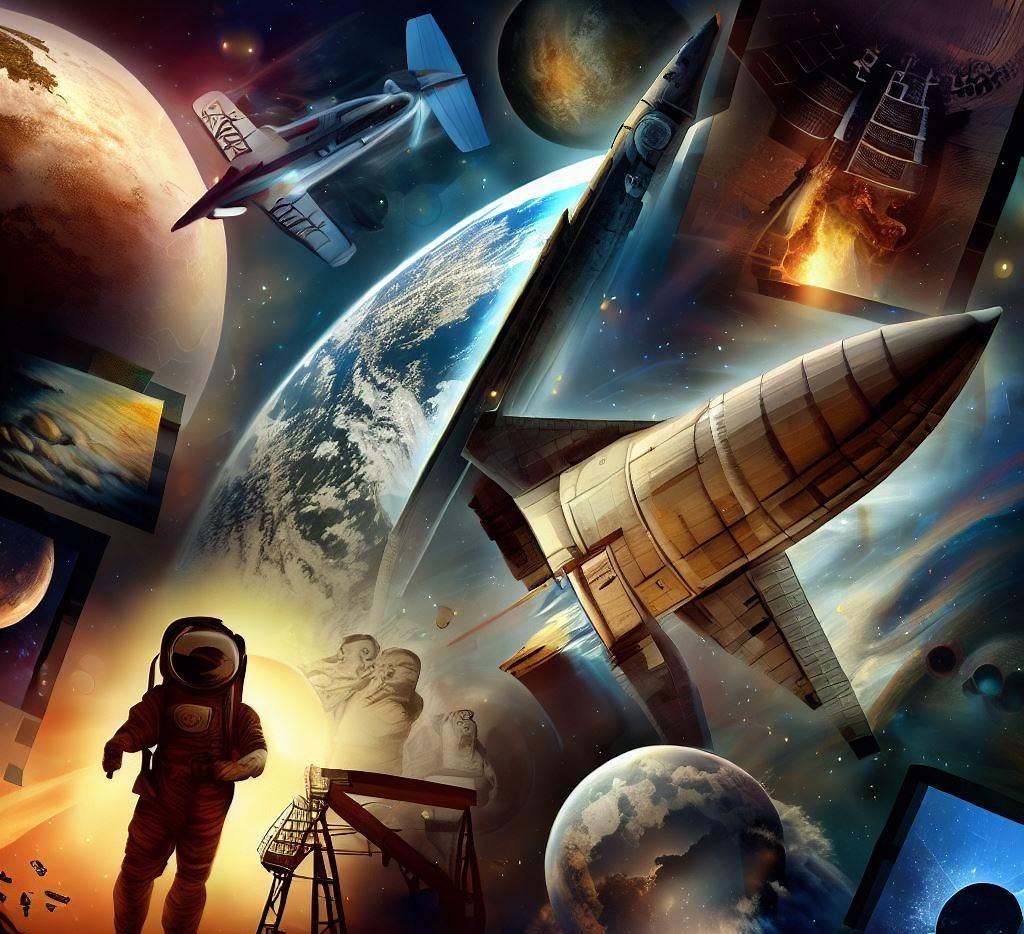
Space exploration is the study and investigation of outer space through astronomy, satellites, robotic spacecraft, crewed missions, space stations, and planetary probes. It has changed how humans understand Earth, the Moon, the planets, and the wider universe.
The history of space exploration is not only a story of rockets and astronauts. It is also a story of scientific curiosity, political rivalry, engineering risk, international cooperation, and technological change. From the first artificial satellite to Mars rovers and renewed lunar missions, each milestone has expanded what humans can observe, measure, and attempt beyond Earth.
Table of Content
- Early Foundations of Space Exploration
- Sputnik and the Beginning of the Space Age
- The Soviet Union’s Role in Space Exploration
- NASA and the Apollo Program
- Key Milestones in Lunar Exploration
- Technology Developed Through Space Exploration
- The International Space Station and Global Cooperation
- Mars Rovers and Interplanetary Missions
- Private Spaceflight and a New Era of Access
- Why Space Exploration Matters
- Conclusion
Early Foundations of Space Exploration
Long before the first rocket reached orbit, people studied the night sky to understand time, seasons, navigation, and the movement of celestial bodies. Early astronomy helped build the knowledge base that later made spaceflight possible.
Modern space exploration became realistic only after advances in physics, mathematics, rocketry, materials science, communications, and computing. By the mid-20th century, the Cold War rivalry between the United States and the Soviet Union turned spaceflight into both a scientific goal and a geopolitical contest.
Sputnik and the Beginning of the Space Age
The Space Age began on October 4, 1957, when the Soviet Union launched Sputnik 1, the world’s first artificial satellite. Its radio signal from orbit demonstrated that human-made objects could circle Earth and showed the world that the Soviet Union had made a major advance in rocket technology. NASA describes the Sputnik launch as the beginning of the Space Age and notes that it helped lead to the creation of NASA in 1958.
Sputnik intensified the competition between the Soviet Union and the United States. The achievement had scientific importance, but its political impact was just as strong. It pushed both superpowers to invest heavily in rockets, satellites, space science, and human spaceflight.
The Soviet Union’s Role in Space Exploration
The Soviet Union achieved several early milestones in space exploration. In 1959, Luna 2 became the first spacecraft to make contact with another celestial body when it impacted the Moon. In 1961, Yuri Gagarin became the first human in space when Vostok 1 completed a 108-minute flight around Earth.
The Soviet program also sent Valentina Tereshkova into space in 1963, making her the first woman to travel beyond Earth’s atmosphere. The European Space Agency notes that Tereshkova flew aboard Vostok 6 and used the radio call sign “Chaika,” meaning “seagull.”
These achievements gave the Soviet Union an early lead in the Space Race and helped shape the pace of American space policy. They also showed that space exploration would involve not only machines, but human endurance, national ambition, and public imagination.
NASA and the Apollo Program
The United States created NASA in 1958, shortly after Sputnik, to organize and expand the country’s civilian space program. NASA’s early work included Project Mercury, Project Gemini, and the Apollo program, each building the knowledge needed for longer and more complex human spaceflight.
Apollo 11 became the defining mission of the program. Launched on July 16, 1969, it carried Neil Armstrong, Buzz Aldrin, and Michael Collins toward the Moon. Armstrong and Aldrin landed on the lunar surface on July 20, 1969, while Collins remained in lunar orbit. NASA records Apollo 11 as the mission that brought the first human steps on the Moon.
The Apollo program continued after Apollo 11. NASA completed six successful crewed lunar landings between 1969 and 1972. Apollo 17, launched in December 1972, was the final Apollo lunar landing mission and the first to include an astronaut-scientist, Harrison Schmitt.
Key Milestones in Lunar Exploration
Lunar exploration did not begin with Apollo. Robotic missions came first, especially from the Soviet Luna program, which showed that spacecraft could reach and study the Moon. These missions helped open the path for later crewed exploration.
Apollo changed lunar exploration by allowing astronauts to collect samples, deploy scientific instruments, and conduct field observations directly on the Moon. The missions gave scientists new evidence about the Moon’s geology, age, surface conditions, and relationship to Earth.
Today, lunar exploration is again a major focus. NASA’s Artemis program is designed to return humans to the Moon, support scientific discovery, and prepare for future missions to Mars. NASA describes Artemis as a campaign connecting lunar exploration with longer-term human exploration beyond the Moon.
Technology Developed Through Space Exploration
Space exploration has produced practical benefits beyond science. Satellites have improved communications, navigation, weather forecasting, Earth observation, disaster monitoring, and climate research. A NASA-supported report notes that early space activity contributed to the development of satellite telecommunications, global positioning, and advances in weather forecasting.
NASA technology programs have also supported innovations with use on Earth. NASA says technology developed for exploration can generate benefits for daily life and the wider economy. One example is the infrared ear thermometer, which NASA Spinoff describes as using infrared astronomy technology developed with the Jet Propulsion Laboratory.
These benefits do not mean every modern technology came directly from space programs. A more accurate view is that space exploration has accelerated research, encouraged new engineering solutions, and helped adapt specialized technologies for broader use.
The International Space Station and Global Cooperation
After decades of Cold War competition, space exploration gradually moved toward greater international cooperation. The International Space Station is one of the clearest examples of that shift.
The ISS is operated through a partnership involving NASA, Roscosmos, the European Space Agency, the Japan Aerospace Exploration Agency, and the Canadian Space Agency. NASA describes it as an international partnership of five space agencies from 15 countries, and the station has been continuously occupied since November 2000. ESA also identifies the ISS as a partnership involving Europe, the United States, Japan, Canada, and Russia.
The station functions as a laboratory in low Earth orbit. Astronauts use it to study biology, physics, materials, human health, Earth observation, and the effects of long-duration spaceflight. Its long-term importance lies not only in the research conducted there, but also in the cooperation needed to build and operate it.
Mars Rovers and Interplanetary Missions
Robotic missions have made Mars one of the most studied worlds beyond Earth. NASA’s Spirit and Opportunity rovers landed on Mars in January 2004 and were designed to look for signs of past water. NASA states that the twin rovers helped change scientific understanding of Mars’ early history.
Curiosity landed in Gale Crater in 2012 and has studied Martian geology and environmental conditions. NASA’s Jet Propulsion Laboratory describes Curiosity as part of the Mars Science Laboratory mission and notes that it landed using a complex “sky crane” system.
Perseverance landed in Jezero Crater in 2021. NASA chose the site because scientists believe it once contained water and an ancient river delta, making it valuable for studying Mars’ past habitability.
Mars missions matter because they help scientists understand whether the planet once had conditions suitable for life, how its climate changed, and what future human missions would need to survive there.
Private Spaceflight and a New Era of Access
Space exploration is no longer driven only by national space agencies. Private companies now play a major role in launch services, cargo delivery, crew transportation, satellite deployment, and lunar mission support.
SpaceX is one of the most visible companies in this shift. Its Falcon 9 rocket is designed for partial reusability, with the first stage capable of landing and flying again. SpaceX describes Falcon 9 as an orbital-class reusable rocket designed to reduce the cost of access to space by reusing major rocket components.
Private spaceflight does not replace public space agencies. Instead, it has changed how some missions are developed and delivered. NASA’s Commercial Crew Program, for example, uses commercial spacecraft to transport astronauts to and from the International Space Station. NASA documents that SpaceX began regular crew rotation missions after the Demo-2 flight test and certification process.
Why Space Exploration Matters
Space exploration matters for several reasons. Scientifically, it helps answer questions about the origin of the solar system, the history of planets, the possibility of life beyond Earth, and the physical laws that shape the universe.
Technologically, it pushes engineering into difficult conditions where systems must be reliable, lightweight, efficient, and precise. Those demands can lead to new tools, materials, sensors, software, and communication systems.
Socially, space exploration gives humanity a wider perspective on Earth. Images of Earth from space have influenced environmental awareness, global cooperation, and public understanding of the planet as a shared home.
Conclusion
The history of space exploration is a record of ambition, risk, discovery, and adaptation. Sputnik opened the Space Age. Soviet missions proved that satellites, lunar probes, and human spaceflight were possible. NASA’s Apollo program brought humans to the Moon. The International Space Station showed that long-term cooperation in orbit could work. Mars rovers and interplanetary missions continue to extend scientific knowledge across the solar system.
The next stage of exploration will likely combine government missions, private companies, robotic spacecraft, international partnerships, and renewed human missions to the Moon and beyond. Space remains difficult, expensive, and risky, but it continues to draw human attention because it asks some of the oldest and largest questions: where we come from, how the universe works, and how far human curiosity can reach.







Comments 0
No comments yet. Be the first to start the conversation.