



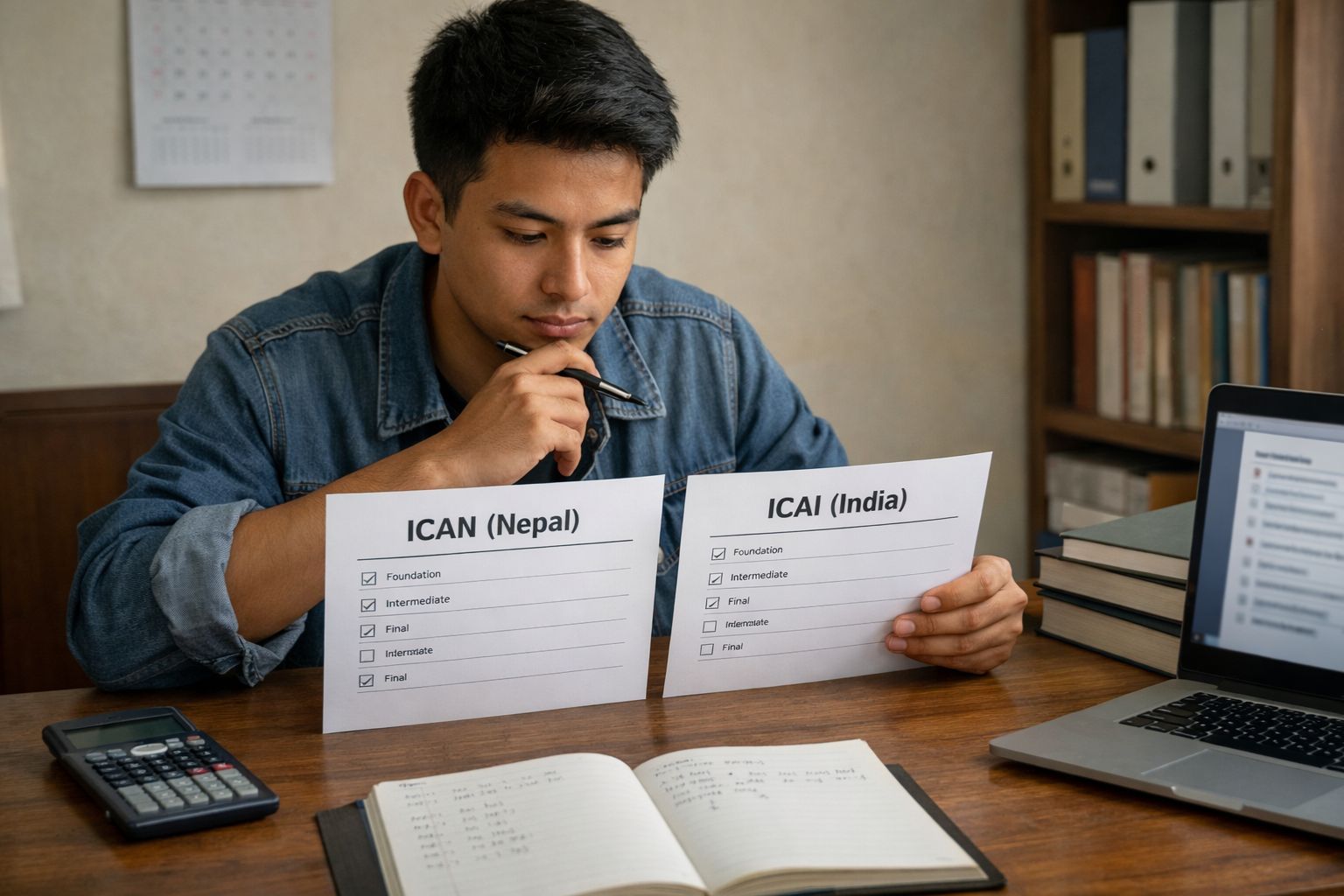
In-Depth CA Education Analysis: Nepal (ICAN) vs India (ICAI)
In Nepal, after passing Class 12 (especially Management or Science), thousands of students face one common question: “Should I study CA? If yes, should I study under ICAN (The Institute of Chartered Accountants of Nepal) in Nepal, or go to India and study under ICAI (The Institute of Chartered Accountants of India)?”
This question is not only about choosing a country. It directly affects a student’s 50-year career future, legal recognition, right to practice, and social standing.
With 20 years of experience, I have seen thousands of students who go to India based on assumptions, then return to Nepal and get trapped in the “conversion” process. Similarly, some students who study in Nepal still live with the insecurity of “Did I miss the Indian CA ‘exposure’?”
The purpose of this article is to bridge this “information gap.” Here, we will compare both institutions, their curriculum, exam systems, costs, and most importantly, legal validity, using a detailed, practical approach.
Table of Content
- In-Depth CA Education Analysis: Nepal (ICAN) vs India (ICAI)
- Institutional Introduction and Legal Framework
- Curriculum Structure and Comparison
- Financial Analysis of Course Cost
- Articleship (Practical Training Reality)
- Recognition and the Process After Returning to Nepal
- Pass Rate and Difficulty Level
- Who Should Choose Which? (Expert Verdict)
- Frequently Asked Questions (FAQs)
- Conclusion
Institutional Introduction and Legal Framework
Before enrolling in any course, it is essential to understand the legal status of the institution conducting it.
1. ICAN (Institute of Chartered Accountants of Nepal)
Established Under: Nepal Chartered Accountants Act, 2053 (1997)
Status: The only regulatory body in Nepal that regulates the accounting profession. It is a member of the International Federation of Accountants (IFAC).
Jurisdiction: Within Nepal, the final authority to sign audit reports belongs only to ICAN members.
2. ICAI (Institute of Chartered Accountants of India)
Established Under: Chartered Accountants Act, 1949. It is the world’s second-largest accounting body established by the Parliament of India.
Affiliations: Founding member of IFAC, SAFA, and CAPA.
Jurisdiction: It holds full monopoly within India.
Expert Opinion
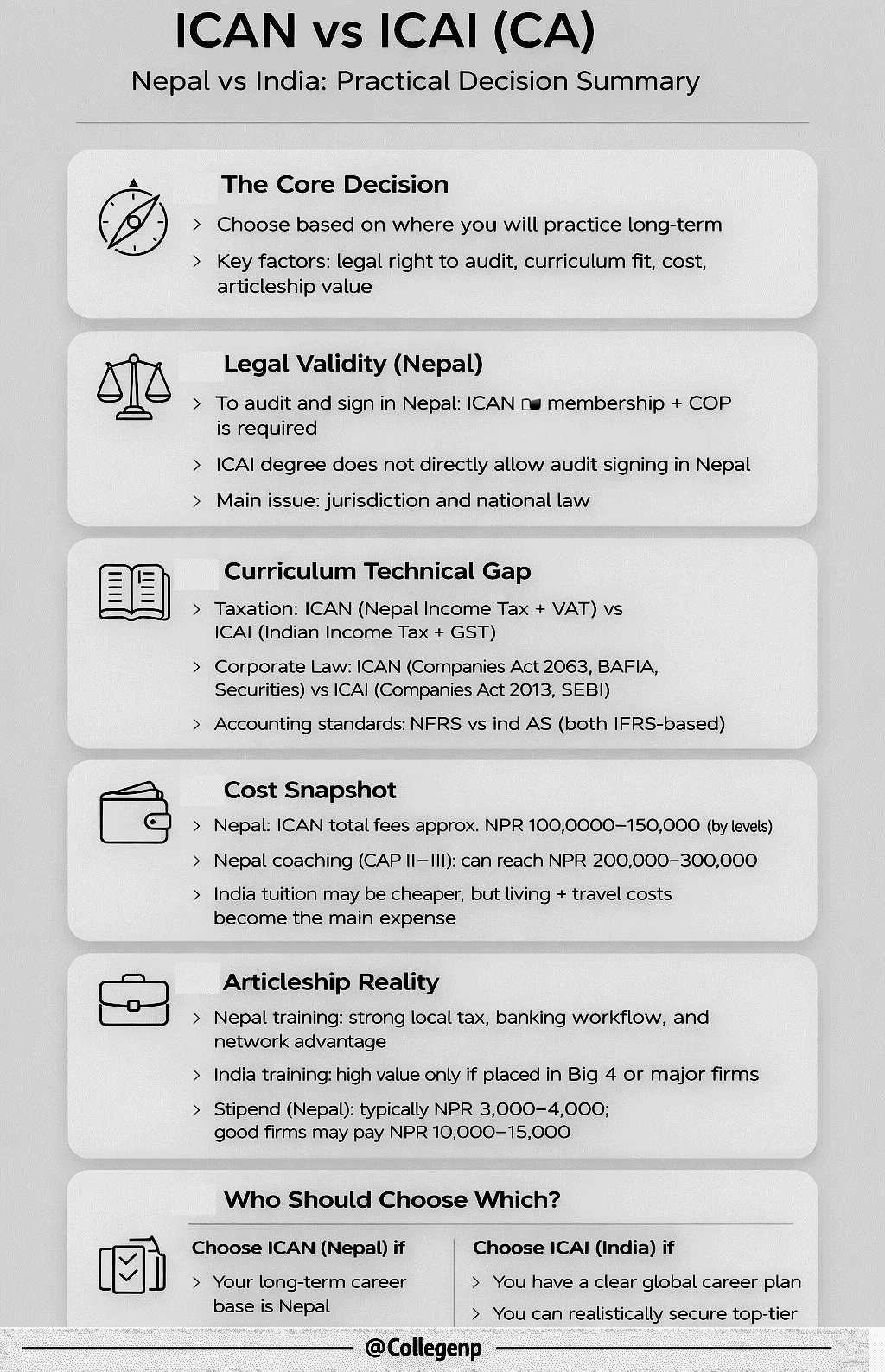
The core point to understand here is “jurisdiction and law.” If your long-term plan is to live in Nepal and practice audit, you will ultimately need ICAN membership and a COP (Certificate of Practice). An ICAI degree does not directly allow you to conduct audits in Nepal.
Curriculum Structure and Comparison
Students often assume the curriculum is the same. In reality, there are major differences that affect pass rates and future work performance.
Level Comparison (ICAN vs ICAI)
Entry Level:
ICAN: CAP I (6 months)
ICAI: Foundation Course
Analysis: Both are similar.
Second Level:
ICAN: CAP II (9 months)
ICAI: Intermediate Course
Analysis: Differences in subject depth begin here.
Final Level:
ICAN: CAP III (3 years with articleship)
ICAI: Final Course
Analysis: The biggest differences appear in law and taxation.
The Technical Gap in Subjects
This is the most important area where many students make mistakes.
1. Taxation
ICAN requires detailed study of Nepal’s Income Tax Act, 2058 and VAT Act, 2052. This is fully essential for working in Nepal in practice.
ICAI focuses on the Indian Income Tax Act, 1961 and GST (Goods and Services Tax).
The issue is that tax knowledge gained in India does not directly apply in Nepal. GST and Nepal’s VAT are very different. India’s tax rules are far more complex and structurally different from Nepal’s. After returning to Nepal, you must study Nepal’s tax system again from the beginning.
2. Corporate Laws
ICAN includes Companies Act, 2063, Bank and Financial Institutions Act (BAFIA), and Securities Act.
ICAI includes Indian Companies Act, 2013 and SEBI Guidelines.
For working in Nepal, knowledge of BAFIA is extremely important because most major audits involve banks. Students trained in India typically do not study BAFIA.
3. Accounting Standards
ICAN follows NFRS (Nepal Financial Reporting Standards), which are based on IFRS.
ICAI follows Ind AS (Indian Accounting Standards), also based on IFRS but with certain “carve-outs” adapted to the Indian context.
Conclusion: This area is not a major issue because both are fundamentally based on IFRS. Accounting principles remain largely universal across countries.
Financial Analysis of Course Cost
CA is often described as a “low cost course,” but that is not fully true. Let us examine the hidden costs.
Scenario A: Studying in Nepal (ICAN)
Registration Fee: ICAN registration may appear slightly higher compared to India. Across levels, it can reach approximately NPR 100,000 to NPR 150,000.
Tuition/Coaching: Kathmandu-centered institutes have become increasingly expensive. For CAP II and CAP III, it may cost up to NPR 200,000–300,000.
Living Cost: If you study while staying at home, this cost is avoided. If you move to Kathmandu from outside districts, monthly living expenses may reach NPR 15,000–20,000.
Scenario B: Studying in India (ICAI) (Delhi/Laxmi Nagar/Jaipur)
Registration Fee: Paying in INR often makes the registration fee cheaper.
Tuition/Coaching: India offers affordable and high-quality subject-wise online classes or pendrive classes. Because competition is high, coaching fees are generally lower.
Living Cost: This becomes the biggest expense. Food and rent over 5 years can be significant. On average, monthly costs may reach NPR 20,000–25,000.
Travel: Round-trip travel costs also add up.
Financial Conclusion
If you must leave home (outside Kathmandu), the cost of living in Kathmandu and smaller Indian cities may feel similar. However, if you already have a home in Kathmandu, studying in Nepal can be around 70% cheaper financially.
Articleship (Practical Training Reality)
The backbone of CA is the 3-year articleship. More than textbook learning, this experience determines your market value.
ICAN (Articleship in Nepal)
Positive Side: You learn Nepal’s taxation, Nepal’s banking software (Pumori/Finacle), and Nepal’s work culture. After passing, getting a job or opening your own firm becomes easier because you already have a local network.
Negative Side: Nepal does not have a direct presence of the “Big 4” (Deloitte, PwC, EY, KPMG), only correspondent firms. Because the corporate sector is smaller, international exposure may be limited.
Stipend: ICAN’s prescribed stipend is low (NPR 3,000–4,000 monthly), although good firms may pay up to NPR 10,000–15,000.
ICAI (Articleship in India)
Positive Side: If you secure articleship in a Big 4 or a major Indian firm, the experience is highly valuable. You may gain exposure to multinational audits, transfer pricing, and large merger work.
Negative Side: Many Nepali students in India do not get placement in top firms and instead work in smaller firms. If you end up in a small Indian firm, that experience can be far less valuable than training in a Class A firm in Nepal. Also, working in India usually gives zero exposure to Nepali tax and laws.
Recognition and the Process After Returning to Nepal
This is the core area where most students get misled.
Fact 1: What is required to audit in Nepal?
Under Nepali law, to become an auditor of a public limited company or similar entities, you must have ICAN membership and COP.
Fact 2: What must be done after passing from India?
You may become a “CA” in India, but to work in Nepal you must register with ICAN. ICAN applies certain requirements (rules may change over time, but current practice is as follows):
Membership Examination: Those who pass from ICAI must pass a special ICAN exam to obtain full membership in Nepal.
Subjects: Primarily Corporate Laws and Taxation.
Training: A provision for one additional year of articleship training in Nepal is sometimes discussed, although it may apply to practice requirements. Under current practice, membership is obtained after passing tax and law papers, but additional requirements must be fulfilled to receive COP.
The Real Problem
Many students spend 5–6 years in India, work hard, become CA, and return to Nepal. Then they must spend another 6 months to 1 year studying Nepal’s tax and law. Until they pass those papers, they cannot write “CA” before their name and legally sign in Nepal. This becomes a major cause of time loss and frustration.
In contrast, students who pass from ICAN can apply for membership immediately after passing.
Pass Rate and Difficulty Level
CA is difficult everywhere. The question is whether India is harder or easier than Nepal.
Question Paper Standard
Both institutions maintain similar standards. ICAI has a longer history, so it has a larger question bank and often focuses more on case-study-based questions. ICAN has also improved its exam standards significantly in recent years.
Pass Rate
ICAI (India): Generally around 3% to 12–15% depending on level. With millions of candidates, competition is intense.
ICAN (Nepal): Results are strict as well. Because the number of students is smaller, pass percentages may appear higher sometimes, but evaluation remains tough. Many Nepali students struggle more with subjective answers.
Clarifying a Common Misbelief
The idea of “going to India because it is harder to pass in Nepal” is incorrect. CA requires the same level of discipline wherever you study. If you do not study seriously, you will not pass even in Delhi.
Who Should Choose Which? (Expert Verdict)
Based on 20 years of experience and current market demand, I suggest students decide using the following criteria.
Choose ICAN (Nepal) if:
Your long-term plan is Nepal: You want to build your life in Nepal, work in banks/corporates, or open your own firm here.
You want to avoid legal complications: You want to start working immediately after passing, without “conversion” or extra exam issues.
You want to become a tax expert in Nepal: Studying Nepal’s tax laws from the beginning is more practical.
You want government jobs: For Public Service Commission or government institutions, ICAN is directly recognized.
Choose ICAI (India) if:
You have global aspirations: If you plan to work outside Nepal (such as Dubai, Australia, or multinational companies), ICAI may offer relatively broader recognition (although ICAN is also expanding through MRAs).
You can secure Big 4 exposure: Go only if you can realistically ensure articleship in a Big 4 or major Indian firm. That corporate exposure can be a strong opportunity.
You want wider resource access: India may provide more advanced resources in finance, stock market, and valuation-related areas.
Frequently Asked Questions (FAQs)
Q1: Can an ICAN CA go to Australia or Canada?
Yes. ICAN is moving forward through technical cooperation or the process of a Mutual Recognition Agreement (MRA) with CPA Australia and CA ANZ. Also, after becoming an ICAN member, you can receive multiple exemptions in ACCA (UK). ICAN does not stop you from going abroad.
Q2: People say studying in India is cheaper. Is it true?
If you only look at tuition, it may seem cheaper. But when you add 5 years of living costs, food, and travel expenses, India often becomes more expensive. You should also consider the value of family support.
Q3: Do Indian CAs get higher salary in Nepal?
This is completely wrong. Employers look at your skills, not the institution. In fact, Nepali employers often prefer ICAN graduates because they already understand Nepali tax and laws. Employers generally do not want to hire an Indian CA and then invest time teaching Nepali legal frameworks from scratch.
Conclusion
CA study is a demanding journey. This qualification can provide strong social respect and financial security.
However, do not make decisions based on emotion. Based on my two decades of experience, the reality is this: if you plan to build your professional life in Nepal, choosing ICAN in Nepal is often the most practical and informed decision.
Why spend 5 years memorizing another country’s laws when that knowledge cannot be applied after returning home? In terms of knowledge and resources, ICAN has become much stronger today. With online resources, there is no longer a boundary in education quality. You can stay in Nepal and still pursue globally competitive learning.
Finally, whichever path you choose, discipline, consistency, and patience remain the keys to success. Do not follow cheap popularity or peer pressure. Write down your family’s financial situation and your future goals clearly, and only then decide.
(Note: This article is prepared purely for educational and informational purposes. For final and updated admission-related information, please stay in contact with the official websites of ICAN or ICAI.)







Comments 0
No comments yet. Be the first to start the conversation.