



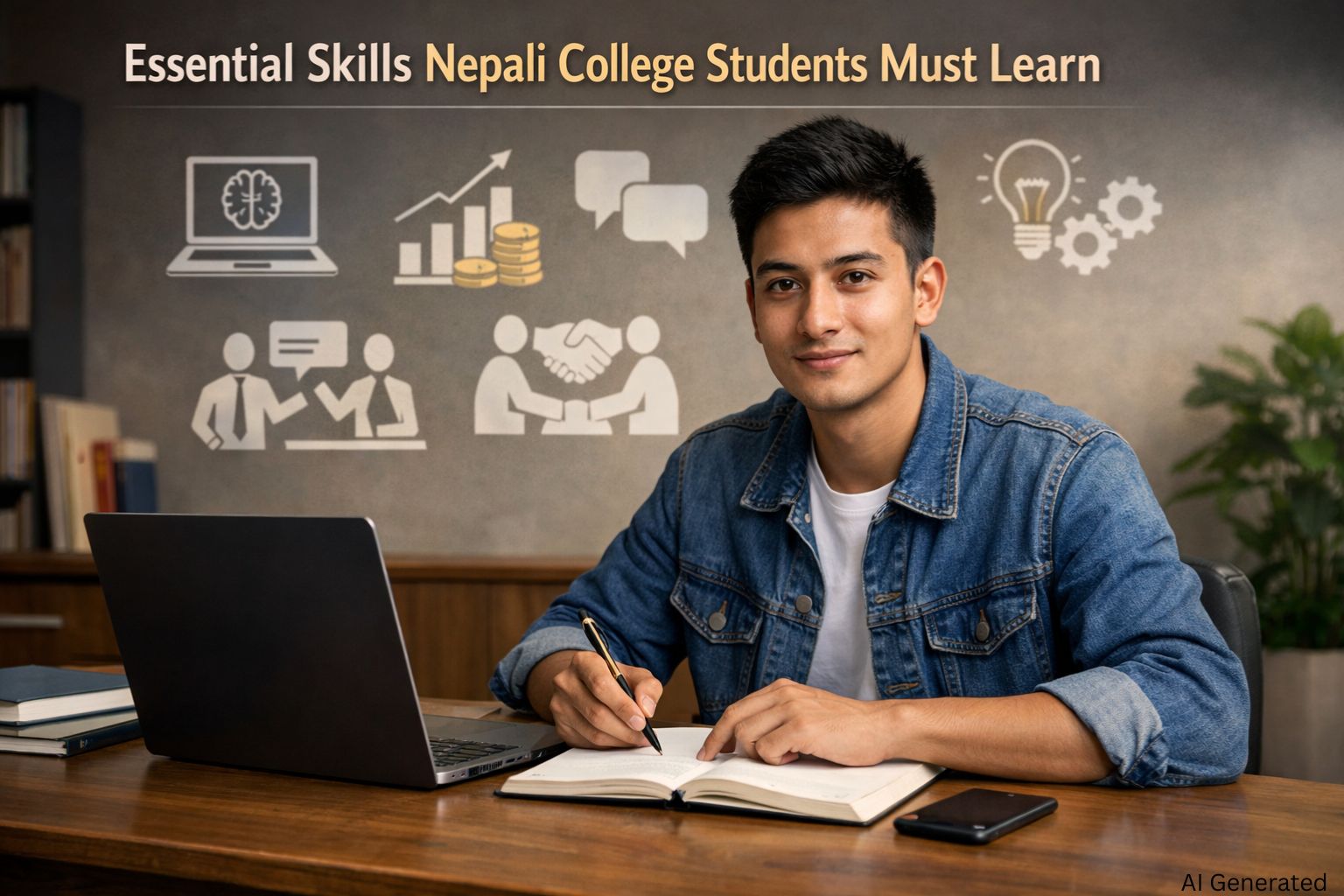
The Gap Between Academic Certificates and Skills
If we look at Nepal’s current education situation, thousands of graduates enter the market every year. However, according to the Nepal Labour Force Survey and reports from various employer organizations, a large number of these students appear not only “unemployed” but also “unemployable.”
The main reason behind this is the wide gap between academic degrees and practical work capability.
In the 21st century, a career cannot be built on textbook knowledge alone. The world has already entered the Fourth Industrial Revolution (Industry 4.0), where a triangular combination of technology, human emotion, and managerial competence is necessary.
For students in a developing country like Nepal, this challenge is even greater. On one side, we must solve local problems, and on the other, we must perform strongly in global competition.
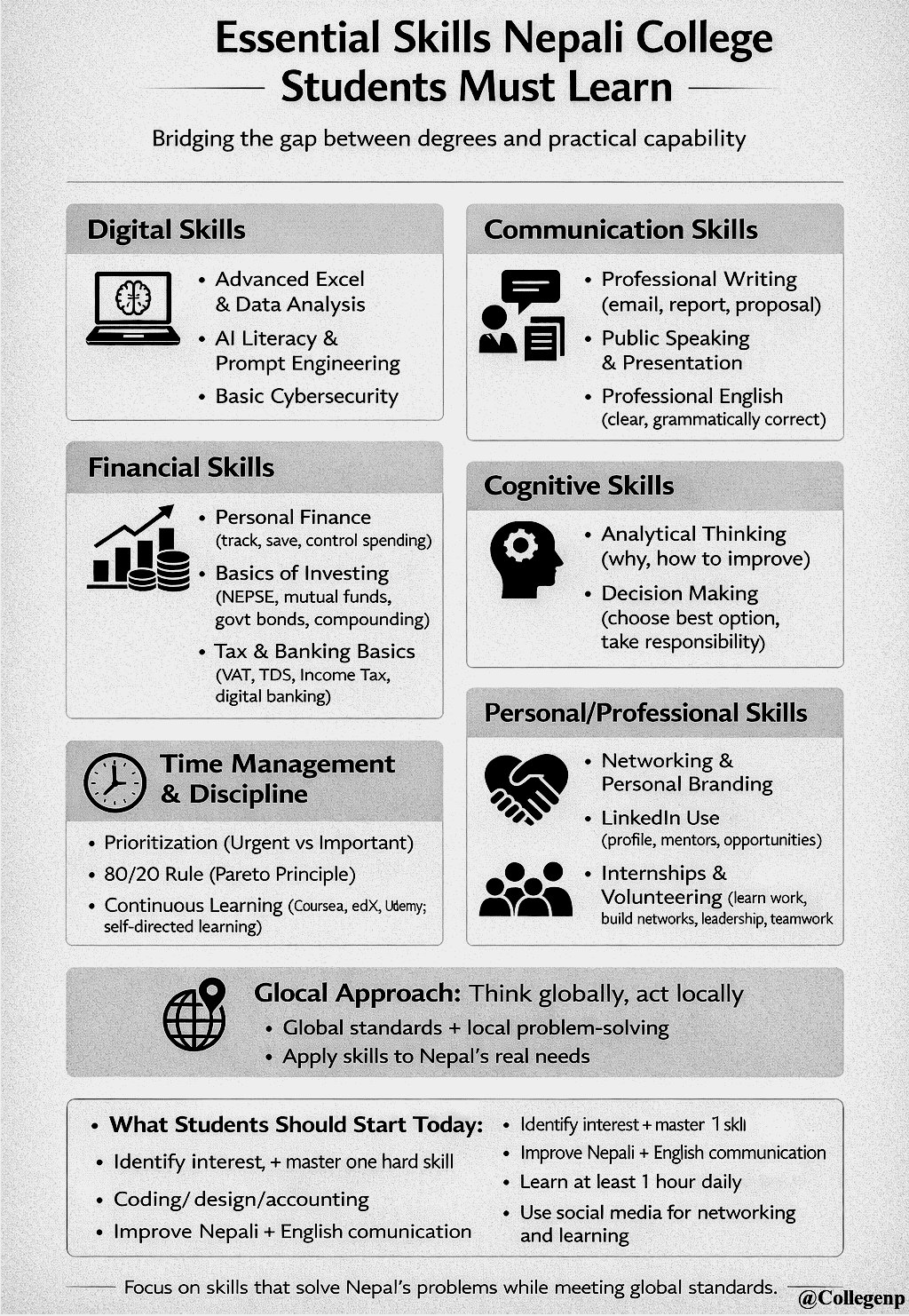
In this blog, we will discuss these essential skills based on five key pillars (Digital, Personal, Financial, Professional, and Cognitive skills).
Table of Content
- The Gap Between Academic Certificates and Skills
- Digital Literacy and Tech Proficiency
- Communication Skills and Language Proficiency
- Financial Literacy: Managing Money
- Problem Solving and Critical Thinking
- Networking and Personal Branding
- Time Management and Discipline
- Emotional Intelligence (EQ)
- Special Context in Nepal: The “Glocal” Approach
- Conclusion
Digital Literacy and Tech Proficiency
In today’s era, the definition of “literacy” has changed. Literacy is no longer only about reading and writing. Only those who can use digital tools correctly and effectively can survive in the modern market.
A) Advanced Excel and Data Analysis
No matter which faculty you study in (Humanities, Management, or Science), it is essential to know how to work with data.
In Nepal’s banks, NGOs/INGOs, and corporate houses, there is strong demand for people with advanced knowledge of Microsoft Excel. Learning how to visualize data and make decisions from it has become a top priority.
B) AI Literacy and Prompt Engineering
Artificial intelligence does not “take jobs.” Instead, people who know how to use AI will take the jobs of those who do not.
Nepali students must learn how to use tools like ChatGPT, Gemini, or other AI platforms to increase productivity. These tools should not be treated as a “copy-paste” shortcut, but as a “research assistant.”
C) Basic Cybersecurity Knowledge
While working in the digital world, it is essential to understand how to protect your data, privacy, and accounts.
Knowing how to avoid phishing, malware, and online scams is important from both personal and professional perspectives.
Communication Skills and Language Proficiency
In Nepal, many students have knowledge, but they do not have the skill to express it.
A) Professional Writing
How do you write a formal email? How do you prepare a report? How do you draft a proposal?
These skills are rarely taught in college courses. Being able to write clearly, briefly, and effectively in both Nepali and English is a major strength.
B) Public Speaking and Presentation
You must be able to confidently present your ideas in front of 10 people.
A presentation is not just showing PowerPoint (PPT) slides. The real skill is capturing the audience’s attention and helping them understand your message.
C) Professional English Skills
English is essential to connect with the global market.
However, this does not mean you must have a foreign accent. Students who can speak and write grammatically correct and understandable English will find opportunities opening worldwide.
Financial Literacy: Managing Money
In Nepali society, “talking about money” is still treated as uncomfortable in some situations. But a lack of financial discipline during college years can create major problems later in life.
A) Personal Finance Management
You should be able to track your income (or pocket money) and expenses, save money, and control unnecessary spending.
B) Basics of Investing
Students should start learning early about Nepal’s share market (NEPSE), mutual funds, and government bonds.
A student who understands the power of compounding can achieve financial stability by the time they reach 30.
C) Tax and Banking System
Basic knowledge of Nepal’s tax system (VAT, TDS, Income Tax) and banking processes (L/C, Guarantee, Digital Banking) is necessary.
This knowledge can be highly useful later, whether you become an entrepreneur or do a job.
Problem Solving and Critical Thinking
No matter how much work machines do, problem-solving ability remains human.
Nepal’s education system often focuses on memorizing and passing exams, but that approach does not work in real workplaces.
A) Analytical Skills
You must develop the ability to look at a problem from different angles and analyze it objectively.
Questions like “Why did this happen?” and “How can this be improved?” should always be in your mind.
B) Decision-Making Skills
During college life, you must learn to choose the best option among available choices and have the courage to take responsibility for the result.
Networking and Personal Branding
“It is not only about what you know, but also about who knows you. This also determines your career.”
A) Using LinkedIn
Many students in Nepal spend time on Facebook and TikTok, but ignore professional platforms like LinkedIn.
Creating and updating a LinkedIn profile is necessary to connect with experts, find mentors, and learn about new opportunities.
B) Internships and Volunteering
Do not do internships only for certificates. Do them to learn work and build networks.
Volunteering improves leadership and teamwork skills.
Time Management and Discipline
In college life, the thing wasted the most is “time.”
A) Prioritization
You must understand the difference between “urgent” and “important” work.
By following the 80/20 rule (Pareto Principle), you can learn to produce better results with less effort.
B) Continuous Learning
Learning does not end after completing a degree.
You should develop the habit of learning new skills through platforms like Coursera, edX, or Udemy. This is called self-directed learning.
Emotional Intelligence (EQ)
In the workplace, IQ may help you get a job, but EQ helps you succeed.
A) Empathy
The ability to understand others’ feelings and work together with them.
B) Stress Management
The skill of managing exam pressure, worries about the future, and failure.
C) Adaptability
The ability to change yourself according to the situation.
In a changing environment like Nepal, this skill is extremely important.
Special Context in Nepal: The “Glocal” Approach
In today’s globalized world, no student is limited only by geography.
The meaning of the “Glocal” approach is: “Think globally, but act locally.”
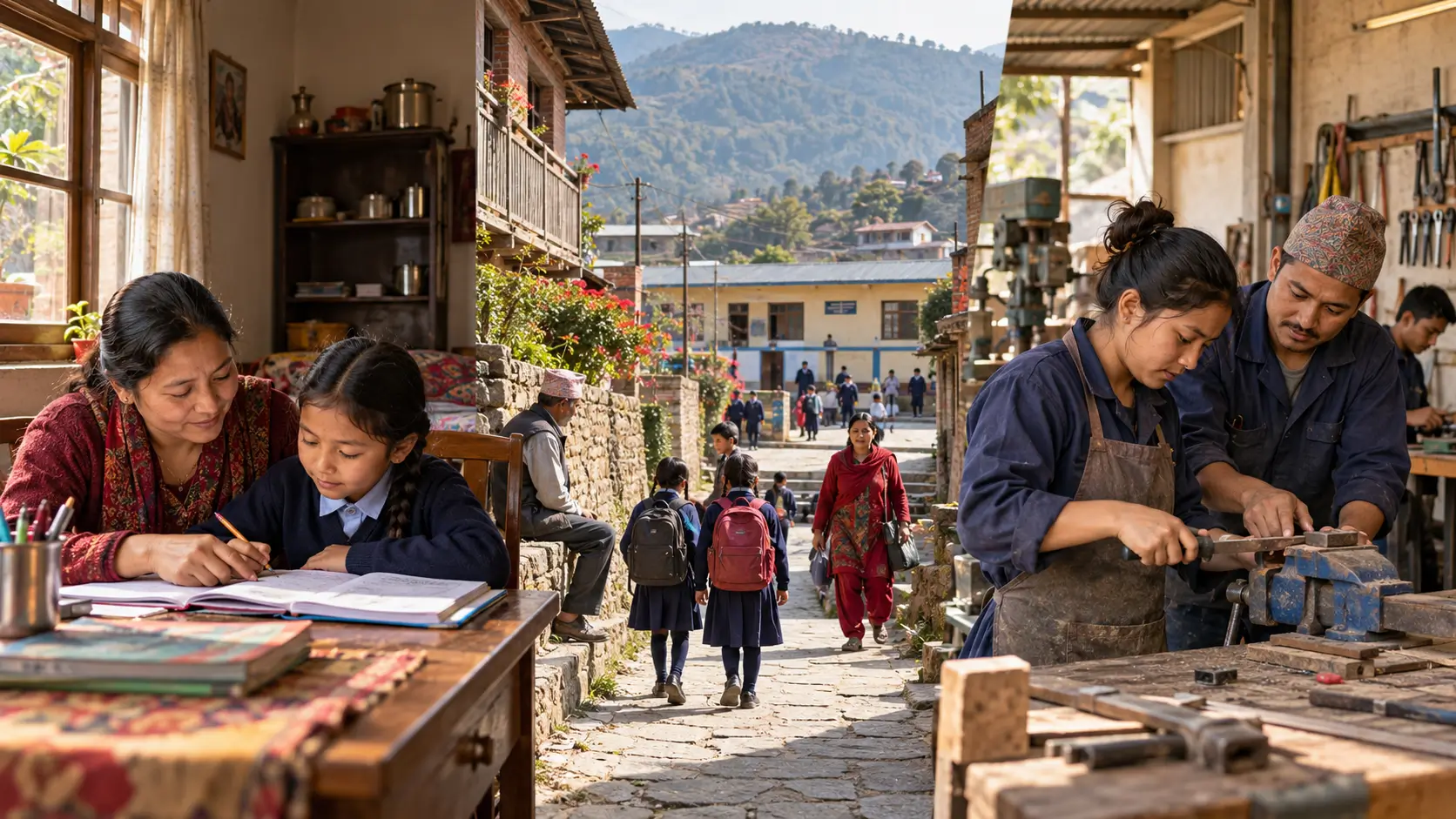
For Nepali students, this concept is even more relevant because of our country’s unique geography, economic potential, and social challenges.
A) Global Standards and Local Grounding
Students studying in Nepal should not limit themselves only to the exam systems of Tribhuvan University or Kathmandu University.
The quality of coding, management, or engineering you learn should be able to compete with professionals in Silicon Valley or London. However, the application of those skills should focus on solving problems in Nepal’s villages and communities.
For example, if you learn Data Science, and you use it to analyze soil productivity in Nepal’s agriculture sector or to forecast floods, you become a “Glocal” professional.
Unless global skills are connected to local realities, they do not benefit society, and they do not build a sustainable career.
B) Modernizing Agriculture Through Technology
More than 60% of Nepal’s workforce depends on agriculture, but its contribution to GDP is declining. The main reason is traditional methods.
College students must now understand concepts like Smart Farming and Precision Agriculture.
Problem-solving: To solve the issue of farmers not getting fair prices due to middlemen, solutions can be created through blockchain or mobile apps that connect farmers directly to markets.
Skills: Learning technologies like using drones to spray pesticides or using sensors for irrigation has become necessary.
Connecting global technology to local farmland is real “Glocal” practice.
C) Sustainable Tourism and Digital Storytelling
Nepal’s tourism sector is not only limited to mountain climbing and trekking. The next generation must focus on Experience Tourism.
Global skills:
-
Digital marketing
-
SEO
-
International-level hospitality management
Local application
Promoting Nepal’s hidden villages, local culture, and traditional food to the world through vlogging or digital storytelling.
Students must learn how to build a bridge between the authenticity tourists seek and the culture Nepal already has.
D) Energy and Infrastructure: From Hydropower to Renewables
Nepal is rich in water resources, but we are still behind in efficient energy management.
Engineering and management students should study global success models of Smart Grid systems and Micro-hydro management.
Research should focus on how remote areas of Nepal can achieve energy sovereignty through a combination of solar and wind energy.
E) Self-Employment and the Entrepreneurial Mindset
For years, Nepal’s education system produced only “job seekers.” But today, the demand is for “job creators.”
A “Glocal” student does not complain when they see a problem. Instead, they see it as a business opportunity.
Startup culture
Develop the mindset to solve Nepal’s issues like waste management, traffic jams, or gaps in online education through technology.
Financial risk management
It is essential to learn how models like venture capital or angel investment can be applied within Nepal’s legal framework.
F) Social Responsibility and Ethical Leadership
Another side of being “Glocal” is following global ethical standards.
Breaking old habits like corruption, delays, and poor-quality work, you must adopt corporate ethics and transparency as part of your working style.
Nepali students must understand that honesty and transparency are among the most valuable skills in the global market.
Nepali students should stop thinking, “Which country can I go to after studying this subject?” and start thinking, “Which problem of Nepal can my global-level skill solve?”
When your skills create change in local lives, money and recognition will naturally follow you.
Nepal should no longer remain only a country that exports raw labor. It must become a center of skilled manpower with “Glocal” minds. This is the only practical path to building a prosperous Nepal.
Conclusion
For college students in Nepal, this is like an alarm.
The market has piles of certificates, but there is a shortage of skills. If you spend four years of college only to pass exams, your future may become challenging.
Things students should start doing from today:
-
Identify your interest and gain expertise in at least one hard skill (for example: coding, design, accounting).
-
Improve your communication skills in both English and Nepali.
-
Set aside at least 1 hour every day to learn a new skill.
-
Use social media not only for entertainment, but also as a tool for networking and learning.
In the end, the real purpose of education is not only to earn a degree, but to become a capable, skilled, and aware citizen.
Your skills are your future protection. Therefore, along with your college degree, start learning these essential skills from today.
This blog post has been prepared after deep study of various labor market surveys, reports from educational psychologists, and global employment trends. Its purpose is to show students the right direction and prepare them for the future market.




Comments 0
No comments yet. Be the first to start the conversation.