



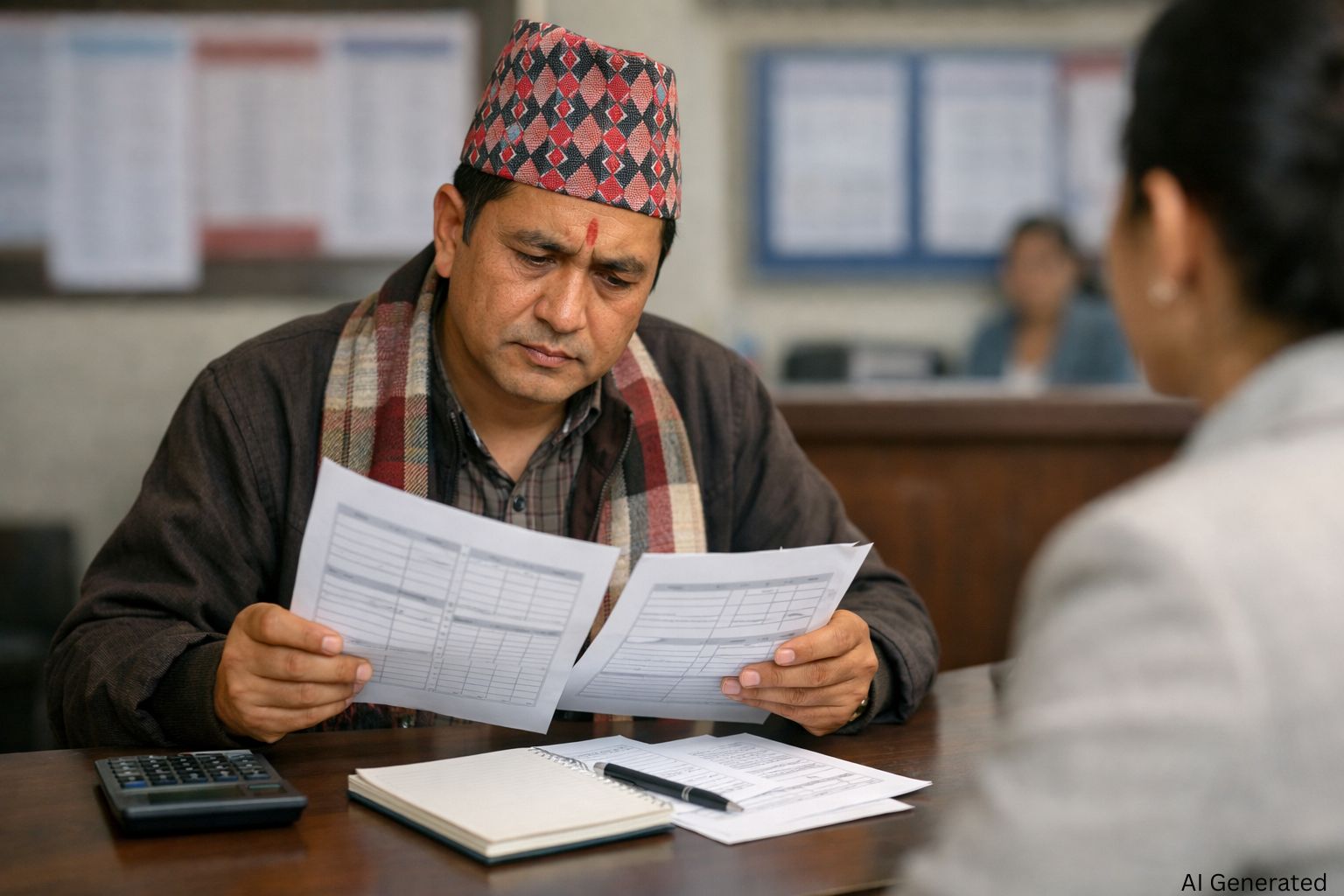
Commercialization of Education or a Service?
Nepal’s Constitution recognizes education as a fundamental right. However, in real life, accessing quality education has started to feel like a major financial battle for middle- and low-income families.
Nepal has thousands of privately funded schools and colleges. There is no doubt that these institutions have played a major role in improving the country’s educational standard. But one serious problem troubles parents every academic session: an “unclear fee structure.”
When a parent visits a school or college for admission, there is often a huge difference between what is shown in the brochure and what must ultimately be paid in the final bill. Why does this happen? Is it only poor management, or a planned strategy?
In this article, we examine the deeper realities behind it.
Table of Content
- Commercialization of Education or a Service?
- Marketing Strategy and the Deep Game of “Entry Barriers”
- Weak Monitoring by Regulatory Bodies and Legal Gaps
- Hidden Costs and the Syndicate
- Staff Exploitation and Double Accounting
- Social Prestige (Status Symbol) and Parental Compulsion
- Practical Steps to Solve the Problem (The Way Forward)
- Practical Solutions
- Expert Opinion
- Conclusion
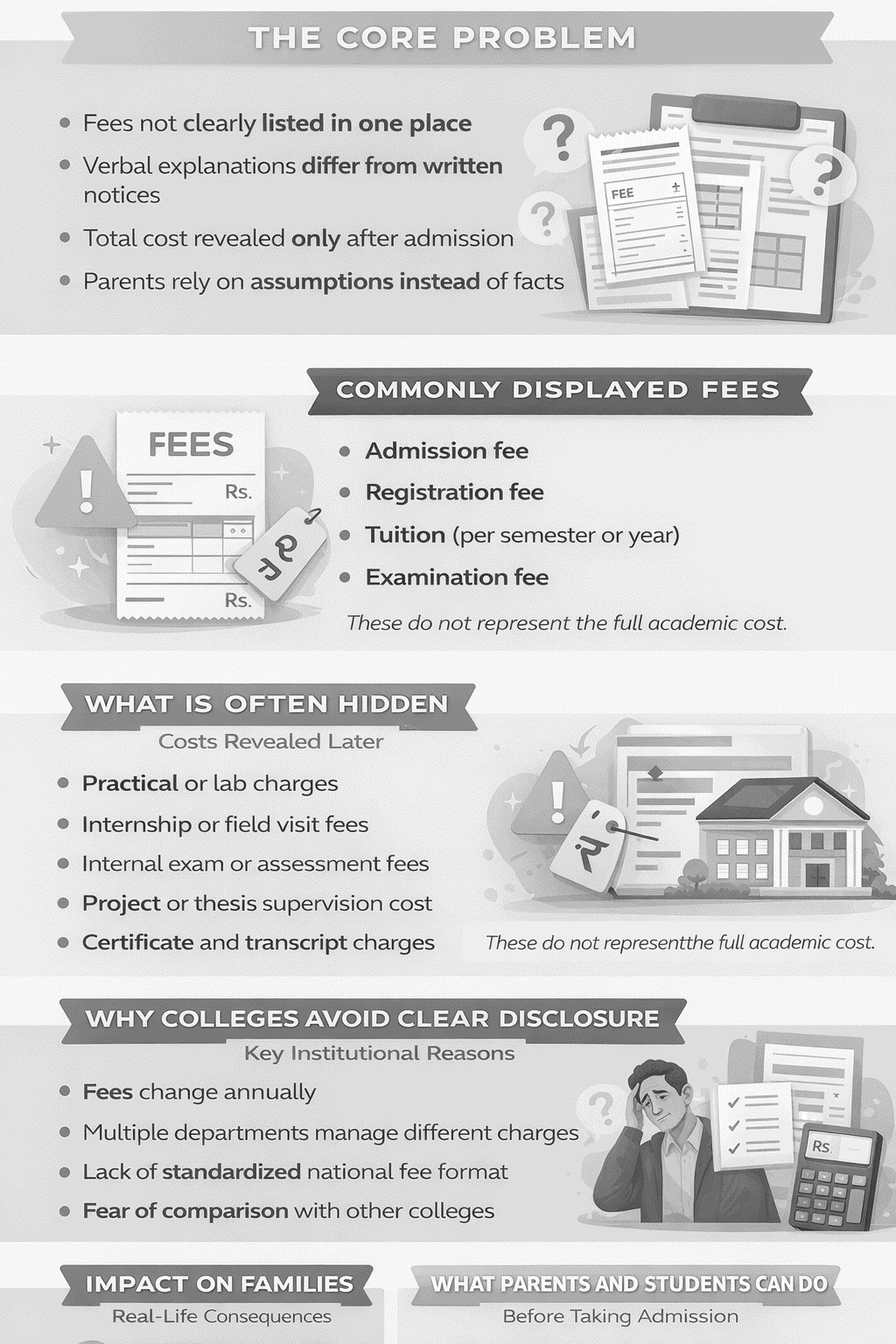
Marketing Strategy and the Deep Game of “Entry Barriers”
Private educational institutions in Nepal have increasingly become players in a “competitive market,” rather than purely service-oriented institutions. In this environment, a psychological wall called an “entry barrier” is created—one that ordinary parents often cannot clearly understand.
The Trap of Low-Ball Pricing
In marketing terms, this is called a “low-ball” strategy. When colleges advertise, they focus only on the “monthly tuition fee.”
For example, reputed colleges in Kathmandu advertise a monthly fee of NPR 6,000. But when a student goes for admission, they may have to pay NPR 50,000 to NPR 100,000 as an “admission fee.” This admission fee is not truly the institution’s operational cost; it is an “entry barrier.”
Once a large amount is paid for admission, parents cannot easily withdraw midway. In economics, this is known as a “sunk cost.”
Untitled and Unclear Fee Categorization
Educational institutions never mention the total cost in the brochure. Instead, they use vague headings such as “miscellaneous” or “other charges.”
Research shows that in many colleges, the real tuition fee is only about 40 percent of the total bill. The remaining 60 percent is distributed across headings such as lab, library, sports, IT support, and annual development fees.
The main purpose of breaking fees into parts is to create the illusion that it is “affordable.”
Weak Monitoring by Regulatory Bodies and Legal Gaps
In Nepal’s federal structure, education authority has been given to the local level. However, compliance with the “Institutional School Fee Determination and Operation Guidelines” remains limited to paperwork.
Local Capacity and Conflict of Interest
Many elected local representatives are themselves operators or investors in private schools. When the regulator and the businessperson are the same, a “conflict of interest” arises.
Because of this, even when schools violate government standards and charge fees under arbitrary headings, they often face no action.
The Mask of “Non-Profit”
Legally, many schools are registered under a “trust” (Guthi) or company structure. Trust-based schools are not supposed to earn profits, but they collect large amounts under headings like “building construction fee” or “land rent,” and transfer it into the pockets of operators.
The biggest weakness is that the government has failed to create a mechanism to audit such headings.
Hidden Costs and the Syndicate
Schools and colleges do not only collect fees. They build a business network (eco-system) where parents are fully exploited.
Monopoly in Books and Uniforms
Most colleges provide students with a card for a specific shop. During research, it has been found that book sellers and uniform suppliers provide “cash commission” of around 20 to 35 percent to school administrations.
If one set of books costs NPR 5,000, the school’s commission alone could be NPR 1,500. This does not appear on the fee bill, but it comes directly from the parent’s pocket.
“Price Fixing” in Transportation and Canteen
When setting transportation fees, schools do not rely only on fuel prices. They treat it as a “profit center.”
In the canteen, there is no competition in the quality and pricing of food items. As a result, parents are forced to pay up to double the market price.
Staff Exploitation and Double Accounting
There is a belief that colleges charging high fees also pay high salaries to teachers, but the reality is different.
Low Pay and “Cost Cutting”
More than 70 percent of private schools in Nepal do not provide even the minimum salary scale set by the government.
To avoid enrolling teachers in the Social Security Fund (SSF), they hide the teachers’ real salaries. Parents are charged money under headings like “teacher welfare fee” or “higher-level teaching,” but that money does not reach teachers.
Tax Evasion and Two Different Ledgers
Another major reason behind the lack of financial transparency is tax evasion. The “audit report” submitted to the Inland Revenue Office and the real “ledger” of money collected from parents are not the same.
If all fees were disclosed transparently, institutions would have to pay crores of rupees annually in taxes. Therefore, many transactions are encouraged in cash, and billing is shown under “miscellaneous” headings.
Social Prestige (Status Symbol) and Parental Compulsion
In Nepali society, the wrong mindset of linking “expensive education” with “quality education” has also strengthened the power of schools to act arbitrarily.
Fear of Missing Out (FOMO)
When a college considered “prestigious” keeps its fees high, parents feel that only studying there will secure their child’s future.
Colleges take advantage of this “psychological weakness.” They showcase physical infrastructure (AC rooms, swimming pools) and spread an illusion of educational quality.
Information Asymmetry
Parents lack a scientific basis for comparison when choosing a college. What is the “return on investment” (ROI) of a college? How many extra fees does it charge?
There is no common data available. Because of this lack of information, parents feel “trapped” only after admission, but by then they have already paid non-refundable fees.
Practical Steps to Solve the Problem (The Way Forward)
Standardized Billing System
The government should require a mandatory software system for all private educational institutions, directly connected to the local level server. Every billing record should immediately reach the government.
“All-in-One” Fee Declaration
Before admission, the “total cost of ownership” for the entire academic session should be made public. This should include an average cost covering books, clothes, and picnic expenses as well.
Third-Party Audit
Financial audits should not be limited to chartered accountants only. A team including parent representatives and education experts should conduct a yearly “social audit”.
Open Market Book Policy
Schools should not be allowed to force a specific shop. Students must have the freedom to use quality books from any publication available in the market.
This lack of transparency in Nepal’s education sector is not only the fault of schools. It is the outcome of weak regulation and a mindset that treats “education as a business.”
Until parents begin questioning bills with unclear headings, and the government enforces strong financial monitoring, this “invisible exploitation” will continue. Real fees are not only about financial accounting—it is also about being honest with students and parents.
Practical Solutions
Ending this disorder in the education sector cannot be achieved only by blaming the government. Multi-stakeholder reforms are necessary.
One Window Fee Policy
The government should require an integrated fee framework for every school and college. The total yearly cost (including everything from admission to certificates) should be legally mandatory to disclose at the time of admission.
If any additional fee is demanded afterward, the institution should face strict penalties.
Digital Portal and Transparency
Each local level should publish the fee details of all schools in its area on a public website. Parents should be able to compare the total cost of schools before admission.
Active Role of Parent Associations
In Nepal, parent associations often function like sister organizations of political parties. They should be restructured to represent real parents.
They should also have access to the school’s audit reports.
Strict Tax Audit
Even if private educational institutions are called “non-profit,” in practice they operate like profit-making companies. Therefore, the Inland Revenue Department should strictly monitor their financial transactions.
Expert Opinion
Education in Nepal has now transformed fully from a “service” into a “commodity”. When education becomes a commodity, the desire for profit becomes natural.
But in a sensitive sector like education, “unethical profit” should not exist.
The main reasons schools and colleges do not disclose real fees are their “fear of competition” and an “opaque profit motive.” If an institution is truly high-quality, it has no reason to hide its fees.
Conclusion
If schools and colleges in Nepal did not hide real fees, parents would be able to choose education based on their budget. This is not only a financial issue—it is also a moral question.
It is ironic that institutions meant to teach students “honesty” are themselves dishonest in their fee structures.
The government is already late in strictly implementing a balanced and transparent “fee guideline,” respecting parents’ hard-earned money and also protecting private investors’ investments.
The new generation must learn to question, and educational institutions must learn to become accountable.
(Note: This article is fully based on facts, research, and sectoral experience. The arguments used here are presented for improving the overall system, without targeting any specific institution.)





Comments 0
No comments yet. Be the first to start the conversation.