



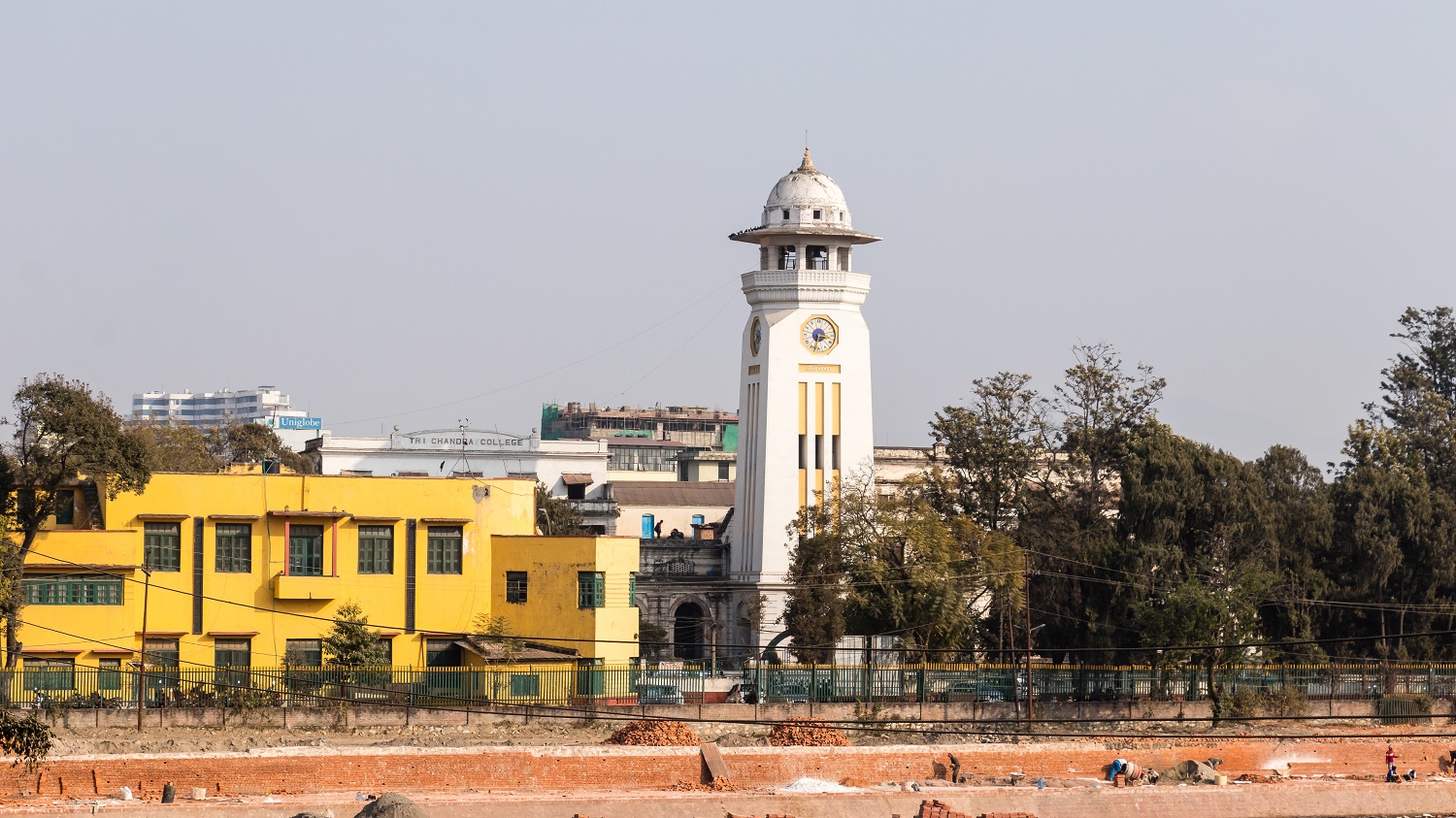
Nepal’s First Center of Higher Education, Tri-Chandra College: Historical Background, Contributions and Current Challenges
Tri Chandra College, the first academic institution to lay the foundation of higher education in Nepal, was established on 1975 Bhadra 12 BS. The institution began teaching and learning activities from the Majlis Ghar of Durbar School and has continued to observe the same date as its establishment day.
Established as a government college, the institution was initially named “Tribhuvan Chandra College,” combining the names of the then King Tribhuvan and Prime Minister Chandra Shumsher.
After becoming a constituent campus of Tribhuvan University in 2030 BS, it came to be known as “Tri-Chandra Multiple Campus.” The campus currently operates a total of 21 departments under Science and Technology and Humanities and Social Sciences. Around 7,500 students are studying at the campus, which has 251 full-time faculty members and 78 employees.
Background to the Establishment and Inauguration
Then Rana Prime Minister Chandra Shumsher established the college after recognizing the need for a higher education institution in Nepal. Contemporary political, social and international circumstances, including fears that Nepali students could be influenced by Mahatma Gandhi’s “Quit India” movement in India, Chandra Shumsher’s visit to Britain, British King George V’s visit to Nepal, and Britain’s release of Gurkha soldiers from service following the First World War, played important roles in the establishment of the college.
Batuk Krishna Maitra, then headmaster of Durbar School, was appointed the first principal of the college.
The grand college building, constructed over approximately 14 months at a cost of Rs. 70,000, was inaugurated by King Tribhuvan on October 13, 1919, by opening it with a silver key. An excerpt from a poem recited during the inauguration read:
“The bell of convenience rang,
The turmoil of attachment disappeared,
The rod of ignorance broke,
The flag of delusion fell!!”
Interestingly, historical accounts record that then Prime Minister Chandra Shumsher, while inaugurating the college, remarked, “I have struck an axe on my own foot.”
Academic and Political Contributions
Initially affiliated with Patna University in India and later with the University of Calcutta, the college provided an opportunity for higher education in Nepal. It has made significant contributions to Nepal’s nation-building, science, literature, administration and politics.
Martyrs Gangalal Shrestha and Dasharath Chand, Mahakavi Laxmi Prasad Devkota, Balkrishna Sama, Pushkar Shumsher, Gopal Prasad Rimal, Satya Mohan Joshi and Swar Samrat Narayan Gopal were among those who studied here.
Similarly, former prime ministers Kirti Nidhi Bista and Girija Prasad Koirala, along with Yadunath Khanal, Dilli Raman Regmi, Gagan Thapa and other prominent personalities, are alumni of the college.
Tri-Chandra College has not only been an academic institution but has also remained a center of Nepal’s democratic movements. Its students and faculty members played leading roles in the Revolution of 2007 BS, the People’s Movement of 2046 BS and the political change of 2062/63 BS.
Foundation of Science and Humanities Education
Modern science education in Nepal began at Tri-Chandra College. Intermediate Science was introduced in 1919, followed by the Bachelor of Science (BSc) program in 1947.
A historical record from December 11, 1934, states that a medical officer in Birgunj sent a tissue sample from the abdomen of a pregnant woman to the Tri-Chandra College laboratory for chemical testing. This indicates that the college laboratory also carried out pathology-related work at the time.
The campus laboratory contains archaeological materials dating back 109 years, which have the potential to be developed into a museum.
Alongside science, the college has strengthened Nepal’s intellectual foundation through the teaching of subjects including Nepali, English, history, philosophy, economics, political science and sociology.
Prof. Dr. Neelam Shrestha has served as the first woman campus chief in the institution’s history.
Current Challenges and Future Direction
Despite its long and distinguished history, Tri-Chandra College is currently facing serious physical and administrative challenges. The old buildings in the Ghantaghar and Bir Library premises, constructed in neoclassical architectural style, were damaged by the 2015 earthquake. Only around 30 percent of the strengthening and reconstruction work on these buildings has been completed so far.
The college now needs modern laboratories, digital classrooms, an e-library and an information technology-friendly environment.
According to Campus Chief Prof. Dr. Neelam Shrestha, the campus aims to develop Tri-Chandra into a research hub in the near future and establish research centers in emerging fields including artificial intelligence (AI) and climate change.
Prof. Dr. Kedar Bhakta Mathema, an alumnus of the college and former Vice-Chancellor of Tribhuvan University, emphasizes that Tri-Chandra should be granted autonomy and developed into an institution capable of designing its own curricula and awarding degrees.
Given its status as Nepal’s oldest and historic college, there is a growing need for the government to introduce a special financial package without delay for the preservation of Tri-Chandra’s physical infrastructure and the advancement of its academic standards.






Comments 0
No comments yet. Be the first to start the conversation.