



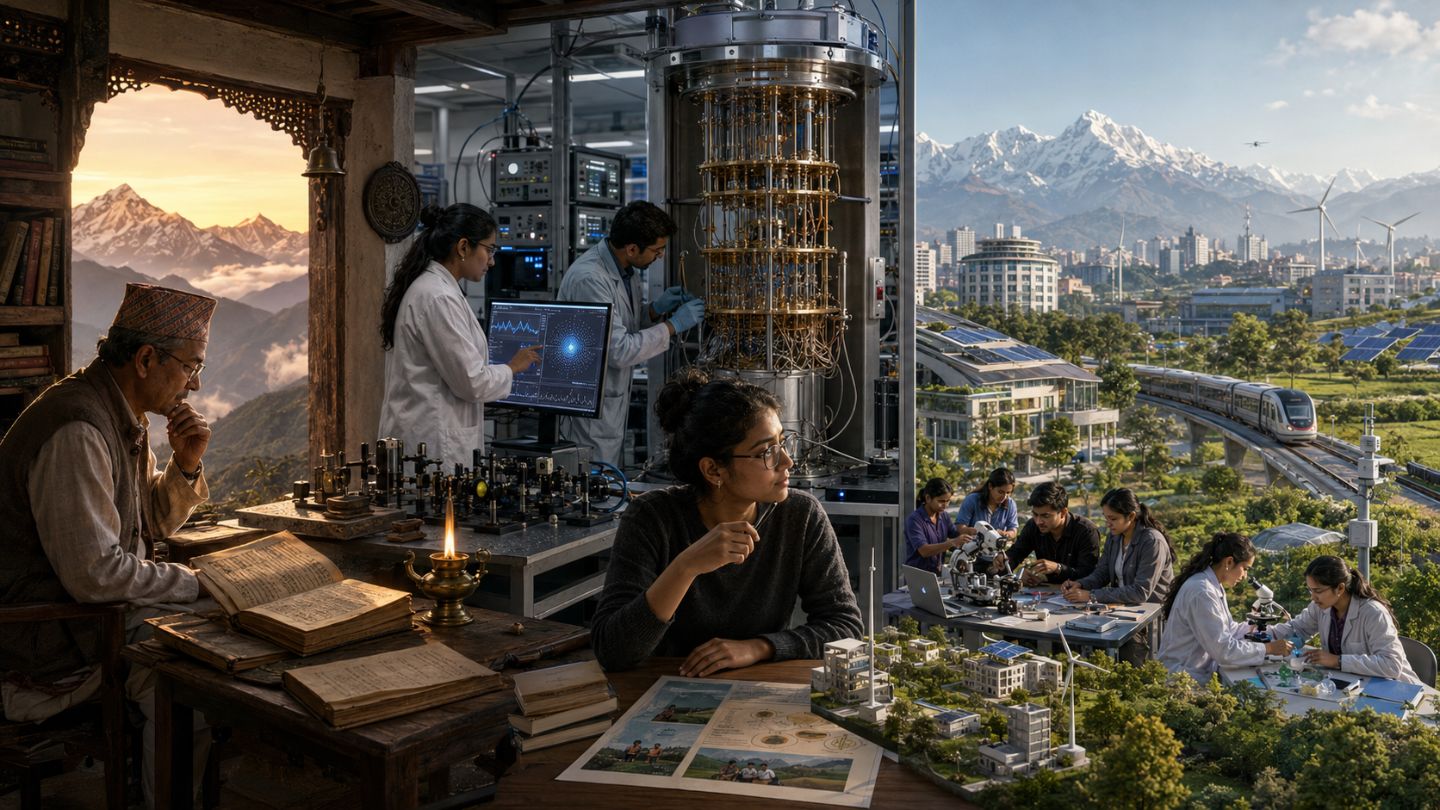
A review of human history reveals one enduring truth: people have always searched for the truth. At times, they sought answers in the stars, in the flow of rivers, in the silence of sages meditating in Himalayan caves, and in the complex instruments of laboratories. Although eras and languages have changed, questions such as “What is this universe?”, “What is life?”, “What is consciousness?”, and “Ultimately, who am I?” have remained the same. Thousands of years ago, the Vedic sages attempted to answer these questions through the Upanishads.
Today, modern science, particularly quantum physics, has emerged as another chapter in the same search. The only difference is that the sages sought truth through meditation, spiritual discipline, and personal realization, while scientists seek it through mathematics, experimentation, and research. At times, science and spirituality appear to be two parallel rivers whose sources may seem different but which ultimately flow into the same ocean.
The Upanishads contain the statement, “Sarvam Khalvidam Brahma,” meaning that this entire existence is an expression of one supreme consciousness. The Earth, sky, water, air, humans, animals, and plants are all different forms of the same universal consciousness. This idea, expressed thousands of years ago, appears strikingly similar to certain concepts in modern quantum science.
Table of Content
- From Classical Physics to Quantum Mystery
- Quantum Computers and the Technological Revolution
- Cybersecurity and Ethical Challenges
- Nepal’s Education System and the Way Forward
- Conclusion
From Classical Physics to Quantum Mystery
Classical physics describes the universe as a completely mechanical, deterministic, and predictable system in which every event is governed by strict laws of cause and effect. However, when we reach the microscopic level—the world of atoms and subatomic particles—classical physics falls silent. This is where quantum physics begins, speaking the language of probability instead of certainty, change instead of stability, and interconnectedness instead of separation.
Quantum science views the universe as a shared field of energy in which all particles are invisibly connected. What classical physics regards as separate objects, quantum science presents as a unified existence within a network of relationships. In the early twentieth century, scientists discovered that the microscopic world was not static but filled with probability, vibration, energy, and mystery.
Quantum physics states that a particle can exist in several possible states at the same time, a phenomenon known as “superposition.” More remarkably, two particles may remain connected even when they are millions of kilometres apart, a phenomenon known as “quantum entanglement.”
The sages of the Upanishads expressed a similar idea in a different language. They said, “Aham Brahmasmi,” meaning, “I myself am a part of cosmic consciousness.” This is not merely a religious statement; it is a declaration of the profound interconnectedness within the universe.
Quantum Computers and the Technological Revolution
The world now stands at the threshold of a major revolution based on quantum science: the age of quantum computing.
Traditional computers use a “bit,” which can hold only one of two states: 0 or 1. A quantum computer, however, uses a “qubit,” which can represent both 0 and 1 simultaneously. This characteristic gives quantum computers extraordinary computational power.
Developed countries such as the United States, China, Japan, Germany, the United Kingdom, and Canada are investing billions of dollars in developing quantum technology. It is still difficult to fully imagine the changes quantum computers may bring to human life.
Their potential areas of application include:
-
Healthcare: Accelerating the search for treatments for cancer, Alzheimer’s disease, Parkinson’s disease, and rare diseases.
-
Energy and climate: Developing new types of batteries, materials, and clean-energy solutions and becoming a powerful tool in the fight against climate change.
-
Agriculture: Providing precise information about weather, soil, water, and production, which could help reduce food shortages.
Cybersecurity and Ethical Challenges
One of the greatest potential effects of quantum computers will be on cybersecurity. Today, banking transactions, government documents, and national security information are protected through complex encryption systems. However, sufficiently powerful quantum computers may be capable of breaking these security systems in the future.
To address this risk, researchers around the world are developing “post-quantum cryptography,” or quantum-resistant security systems.
On the other hand, combining quantum computers with artificial intelligence (AI) could also make a positive contribution to human safety. It could improve natural disaster forecasting, pandemic control, crime analysis, traffic management, and emergency rescue operations.
However, ethical awareness must develop alongside this immense technological power. The Upanishads repeatedly emphasize the importance of discernment, righteousness, truth, and self-restraint. Knowledge without ethics can become a cause of destruction.
Technology does not make decisions; consciousness does. Therefore, the greatest challenge of the future will not be technological but ethical.
Nepal’s Education System and the Way Forward
As the world stands at the threshold of the quantum age, this is also a time for serious reflection in Nepal. Our current education system remains focused on memorization and rote learning. Students are taught to memorize answers rather than ask questions.
Success in the quantum age will require creativity, research, logical thinking, and innovation. Changes to the school curriculum are therefore essential. Teaching students only history and geography will no longer be sufficient. They must also be educated about artificial intelligence, data science, robotics, quantum computing, cybersecurity, and digital ethics.
In the classroom, teachers should not merely deliver lessons; they should create an environment that stimulates curiosity. With proper education, research opportunities, and support, Nepali youths can also become world-class quantum scientists, artificial intelligence specialists, and innovators.
Conclusion
The quantum age conveys a profound message: the universe is not merely a structure of matter but an extraordinary expanse of possibility, relationships, and consciousness. What the Upanishads expressed thousands of years ago in spiritual language, science is now describing in mathematical language.
Perhaps human civilization will one day reach a point where laboratory science and the experience of meditation are regarded not as opposites but as complementary paths. The well-known Upanishadic mantra expresses this aspiration:
“असतो मा सद्गमय। तमसो मा ज्योतिर्गमय। मृत्योर्मा अमृतं गमय।”
“Lead us from falsehood to truth, from darkness to light, and from limitation to immortality.”






Comments 0
No comments yet. Be the first to start the conversation.