




Health License Examinations in Nepal: NMC vs NNC Guide
In Nepal’s health system, regulatory bodies play a central role in ensuring service quality. Completing medical or nursing education alone does not legally make a person eligible to examine patients or provide care.
To practice lawfully, it is mandatory to obtain a license from the relevant council.
The Nepal Medical Council (NMC) and the Nepal Nursing Council (NNC) are two key institutions that determine the standard of Nepal’s health workforce. In recent years, there has been growing discussion around licensure exam results and perceived difficulty levels.
This guide provides a clear roadmap for students preparing for these exams, as well as those planning a long-term career in Nepal’s health sector.
Table of Content
- Health License Examinations in Nepal: NMC vs NNC Guide
- Nepal Medical Council (NMC) and the Licensing Exam (NLE)
- Nepal Nursing Council (NNC) and the National Licensure Examination (NLNE)
- Comparative Analysis: NMC vs NNC
- Deep Review: Why Students Fail
- Practical Solutions: How to Succeed
- Process for Verification of Foreign Academic Qualifications
- Responsibilities and Professional Code After Receiving a License
- Reader Questions and Clarifications (FAQ)
- Conclusion
- Author’s Note
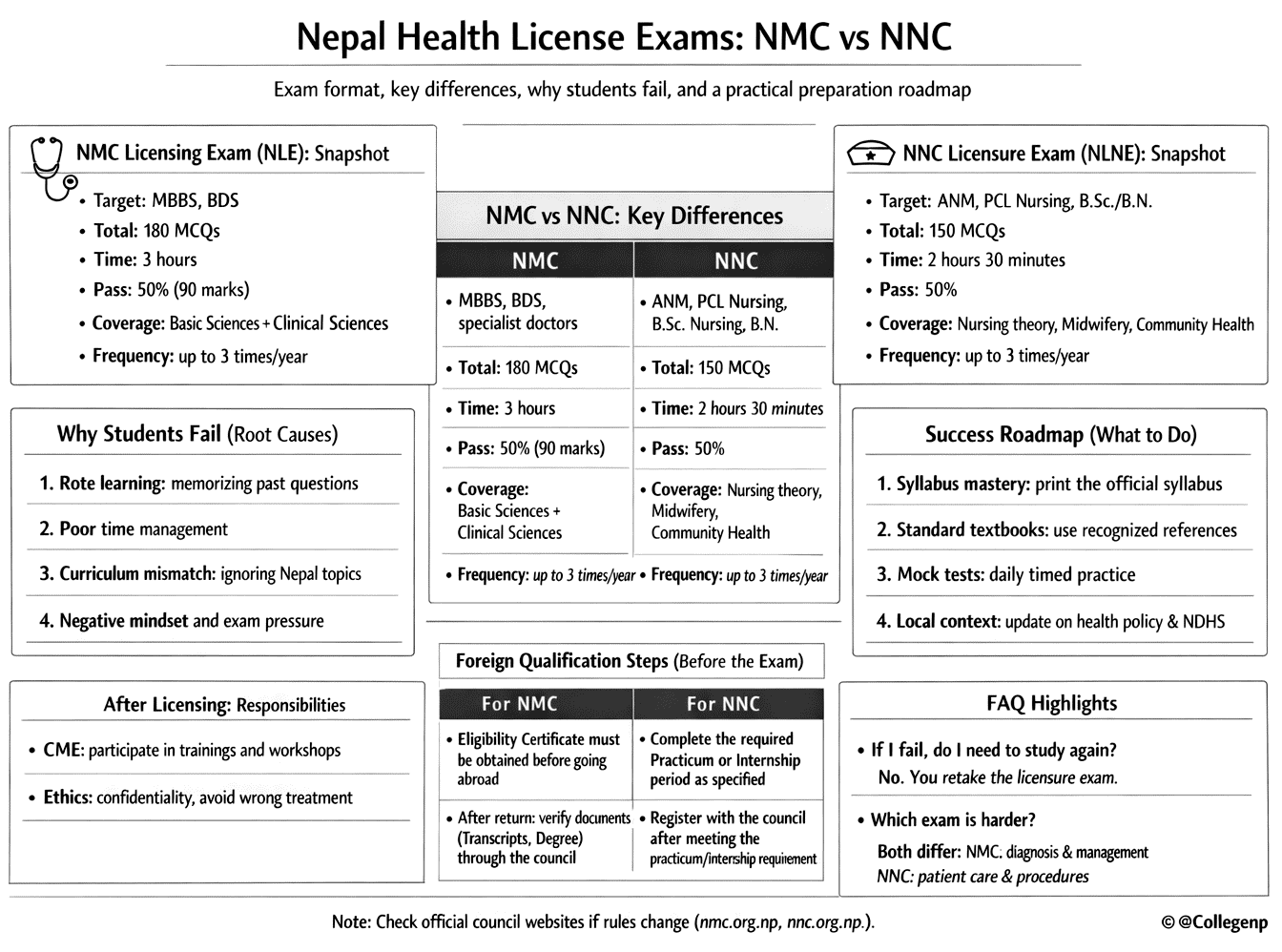
Nepal Medical Council (NMC) and the Licensing Exam (NLE)
Background and Core Purpose
Established under the Nepal Medical Council Act, 2020 (BS), the council is responsible for:
-
Registering medical practitioners in Nepal
-
Setting standards for medical education
-
Monitoring professional conduct and ethics
Its primary focus is to protect patient safety and maintain the dignity and standards of the medical profession.
NMC Licensing Exam (Medical Registration Certificate Examination)
This exam is mandatory for students who have passed MBBS and BDS.
Previously conducted only twice a year, it is now held up to three times a year based on need.
Exam structure:
-
Total marks: 180 (Multiple Choice Questions—MCQs)
-
Duration: 3 hours
-
Pass mark: 50% (90 marks)
-
Content areas: Basic Sciences and Clinical Sciences
Key Challenges in the NMC Exam
Based on our research, students returning after studying at foreign universities (especially in China, Bangladesh, and the Philippines) often face challenges due to limited knowledge of:
-
Disease patterns specific to Nepal
-
Local health policies and systems
This gap has been identified as one of the major reasons for exam failure.
Nepal Nursing Council (NNC) and the National Licensure Examination (NLNE)
Role of the Nursing Council
Established under the Nepal Nursing Council Act, 2052 (BS), the council was formed to make the nursing profession organized and professionally dignified in Nepal.
Separate examination systems are arranged for:
-
ANM
-
PCL Nursing
-
Bachelor-level Nursing (B.Sc./B.N.)
Exam Format (National Licensure Examination for Nurses)
-
Total questions: 150 MCQs
-
Duration: 2 hours 30 minutes
-
Pass mark: 50%
-
Focus areas: Nursing theory, Midwifery, Community Health, and practical skill-based questions
Common Problems Observed in Nursing Licensure
In recent years, an “Academic Gap” has become a major challenge in nursing education.
The difference between theoretical teaching in colleges and real clinical practice in hospitals often causes confusion for students during the licensure exam.
Comparative Analysis: NMC vs NNC
Target Group:
NMC—MBBS, BDS, specialist doctors
NNC—PCL Nursing, B.Sc. Nursing, B.N., ANM
Exam Difficulty Level:
NMC—High (more logical and clinical decision-based questions)
NNC—Moderate (more factual and procedure-oriented questions)
Eligibility/Certification Requirement:
NMC—Mandatory (Eligibility Certificate)
NNC—Mandatory (pre-approval and certification/validation)
Exam Frequency:
NMC—Up to 3 times a year
NNC—Up to 3 times a year
Experience Requirement for Full License:
NMC—Full license only after internship
NNC—Exam can be taken immediately after completing academic qualification
Deep Review: Why Students Fail
Based on 20 years of experience and analysis of thousands of student results, the following causes are seen as the most common:
-
Rote learning tendency
Many students rely only on memorizing past questions. However, councils have increasingly moved toward conceptual and case-based questions. -
Weak time management
Solving 180 questions in 180 minutes leaves about one minute per question. Long clinical case questions often consume too much time. -
Differences between foreign and Nepali curricula
Students returning from abroad often lose marks by neglecting Nepal’s epidemiology and National Health Programs. -
Negative mindset and exam pressure
Fear-driven beliefs such as “the licensing exam is extremely difficult” often lead students to panic in the exam hall.
Practical Solutions: How to Succeed
Syllabus mastery
The first step is to print the official syllabus prescribed by the council and build strong command over every topic.
Depending only on guidebooks can be harmful.
Use of standard textbooks
For NMC, internationally recognized references such as:
-
Harrison’s Principles of Internal Medicine
-
Bailey & Love’s Surgery
For NNC, globally accepted nursing references such as:
-
Potter & Perry
should be used as core reference materials.
Mock tests
From one month before the exam, practice solving model sets daily with a fixed time limit.
This improves both speed and accuracy.
Nepal-specific health context
Stay updated on Nepal’s:
-
Health policy
-
Nepal Demographic and Health Survey (NDHS)
-
National immunization program and related national initiatives
Process for Verification of Foreign Academic Qualifications
If you have completed medical or nursing education abroad, you must complete certain legal and procedural steps before taking the licensing exam in Nepal.
For NMC:
-
You must have obtained an Eligibility Certificate before going abroad.
-
After returning, your documents (Transcripts, Degree) must be verified through the council.
For NNC:
-
Nurses who studied abroad must complete the required Practicum or Internship period as specified, before registration with the council.
Responsibilities and Professional Code After Receiving a License
Receiving a license is not only about obtaining a certificate. It is also a legal commitment to remain accountable to society.
Continuing Medical Education (CME):
Doctors and nurses should participate in periodic trainings and workshops to keep their knowledge updated.
Ethics:
Maintaining patient confidentiality, avoiding incorrect treatment, and staying within professional standards are essential duties of every licensed health professional.
Reader Questions and Clarifications (FAQ)
If I fail the licensing exam, do I need to go back to study again?
No. You have already completed your academic qualification. You only need to retake the licensing exam. There is no fixed limit, but repeated failures may delay your career progress.
Which council exam is more difficult?
Both have their own level. NMC places stronger focus on diagnosis and management, while NNC focuses more on patient care and procedures. However, based on recent figures, the NMC pass rate appears to be more challenging.
Conclusion
The exams of the Nepal Medical Council and Nepal Nursing Council function as gatekeepers of the health system.
These exams are not meant to block students, but to ensure that patients are treated by competent and safe hands.
With the right strategy, deep study, and patience, passing these exams is achievable.
We believe this guide will help reduce confusion and provide a clear direction. Best wishes in advance for choosing a responsible and meaningful profession like health service.
Author’s Note
This article is based on government gazettes published at different times, official council reports, and interviews with education experts.
If any rules change, readers are requested to check the official council websites (nmc.org.np or nnc.org.np).







Comments 0
No comments yet. Be the first to start the conversation.