




Many NEB +2 students study for hours but still feel unsure before exams. The problem is not always laziness or lack of effort. Often, the real problem is the study method. Reading the same chapter again, copying notes, highlighting important lines, and watching videos can feel productive, but these habits do not always prove that you can remember and write the answer without help.
NEB Class 11 and Class 12 preparation needs more than reading. You need to understand the topic, remember it later, write clear answers, solve questions, and manage exam time. A practical study system should help with all of these.
Table of Content
- Why Studying More Is Not Always Enough
- Start With the Syllabus Before Notes
- Use Active Recall Instead of Passive Reading
- Revise With Spacing, Not Last-Minute Pressure
- Practice Board-Style Answer Writing
- Build a Weekly Study Plan You Can Actually Follow
- Study Weak Subjects Earlier
- Use Past Questions and Model Questions Correctly
- Avoid These Common Study Mistakes
- When to Ask for Help
- Conclusion
Why Studying More Is Not Always Enough
Many students judge preparation by time: “I studied five hours today.” But the better question is: “Can I write or solve this without looking?”
If the answer is no, the study session may not be complete. You may have understood the topic while reading, but the memory may still be weak. This is why some students feel confident at home but become blank during tests.
Good preparation should create output. That means you should be able to explain, recall, write, solve, and correct mistakes.
Start With the Syllabus Before Notes
Before collecting guides, videos, or “important questions,” check your syllabus and subject content. Make a chapter list for each subject and divide the chapters into three groups:
-
Strong: You can explain and write answers without help.
-
Medium: You understand the topic but forget some points.
-
Weak: You avoid the topic or cannot write the answer clearly.
This simple check shows where your real work is. Many students revise strong chapters repeatedly because it feels comfortable. Weak chapters remain weak until the final month.
For exam routine, syllabus updates, model questions, grading rules, registration deadlines, and official instructions, always check the latest notice from NEB, your school, or the relevant official source from neb.gov.np. Verification is needed for any rule, date, routine, or policy detail that may change from one academic year to the next.
Use Active Recall Instead of Passive Reading
Passive reading means looking at the same material again and again. Active recall means closing the book and bringing the answer from memory.
After studying a topic, ask yourself:
-
What is the main idea?
-
What definitions, formulas, or points should I remember?
-
Can I explain this in simple words?
-
Can I write the answer without looking?
-
Where did I make mistakes?
Then write the answer or solve the question without using notes. After that, compare your answer with the textbook, class notes, or teacher’s explanation. This method quickly shows what you really know and what only looked familiar while reading.

Revise With Spacing, Not Last-Minute Pressure
Last-minute revision creates stress because too many chapters come together at once. A better method is spaced revision. This means revising the same topic several times with gaps between sessions.
A simple cycle can work like this:
-
First study: Understand the topic and make short notes.
-
After 2–3 days: Recall the topic without looking.
-
After one week: Solve questions from that chapter.
-
Before the exam: Revise mistakes, formulas, definitions, and answer structure.
Each revision does not need to be long. The purpose is to return to the topic before you forget it completely.
Practice Board-Style Answer Writing
Understanding a lesson and writing an exam answer are different skills. Many +2 students know the topic but lose marks because their answers are unclear, too long, incomplete, or poorly structured.
For theory answers, use a simple structure:
-
Start with the direct answer, definition, or main point.
-
Explain the idea clearly.
-
Add points, examples, diagrams, formulas, or tables where relevant.
-
Avoid long introductions that do not answer the question.
For numerical subjects, do not only read solved examples. Write every step yourself. Show the formula, substitution, calculation, and final answer with units where required.
At least once a week, write answers under a time limit. This helps you notice slow writing, weak memory, poor presentation, and careless mistakes.
Build a Weekly Study Plan You Can Actually Follow
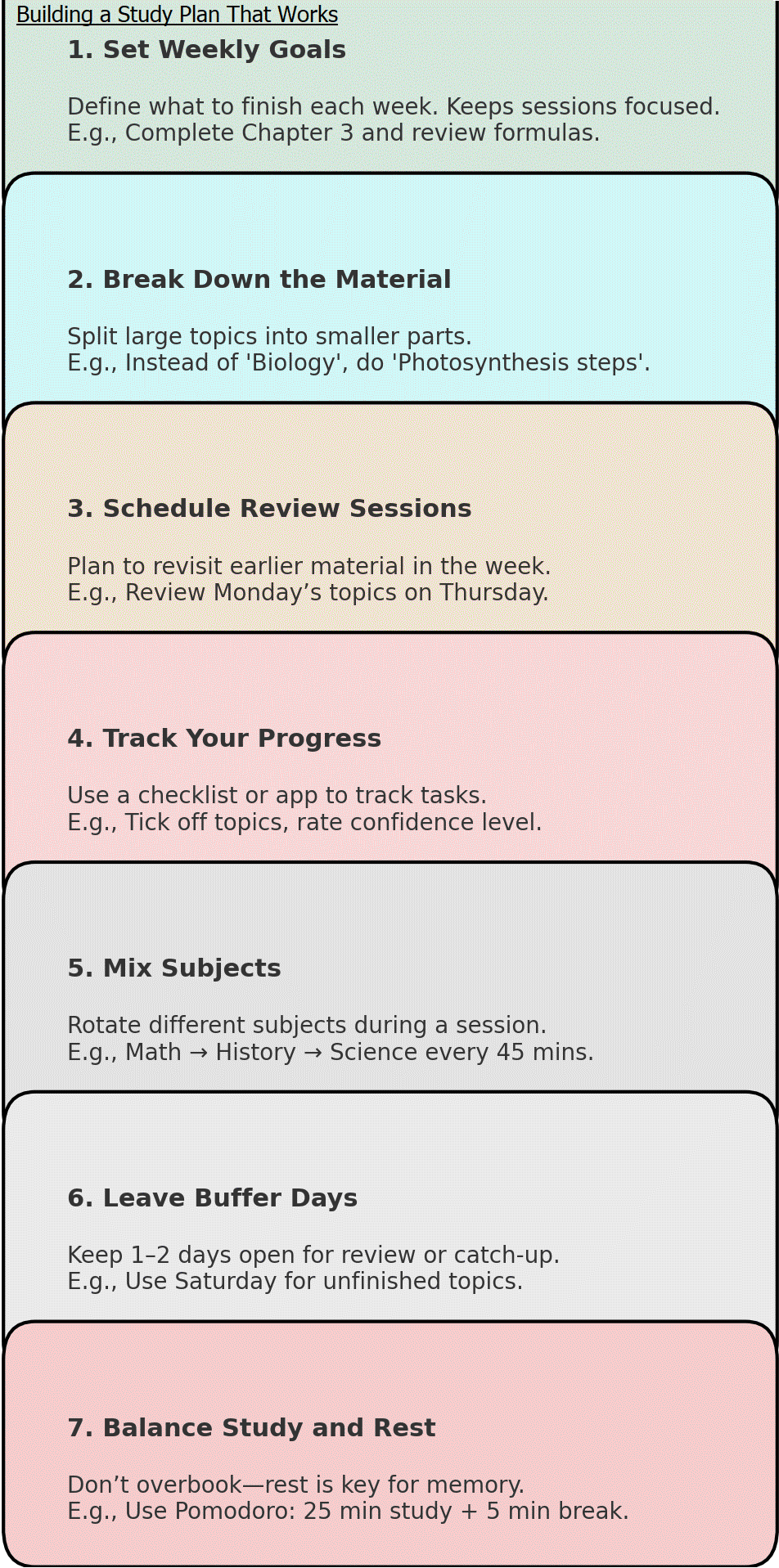
A study routine should match real life. Most +2 students have college hours, homework, practical work, travel time, family responsibilities, and tiredness. A perfect-looking routine that ignores these things usually fails.
Use a weekly plan instead of trying to control every minute. Choose two main subjects per day and one small revision task. For example, you may study one difficult topic, complete one practice set, and revise one old chapter.
Keep one weekly review session. Check what you completed, what is still weak, and what needs teacher support. This makes the plan flexible but still serious.
Study Weak Subjects Earlier
Students often start with subjects they like. This feels easier, but it does not solve the main problem. Weak subjects need more time, so they should not be left until the end.
Start difficult chapters in small parts. Study one concept, solve a few questions, check your mistakes, and return to it after a few days. Slow, regular work is better than avoiding the subject until the final month.
Use Past Questions and Model Questions Correctly
Past questions and model questions are useful, but they should not replace the syllabus. They help you understand question style, answer length, marks distribution, and common patterns. They do not guarantee the next exam question.
Use them after studying a chapter. If you cannot answer, return to the textbook, class notes, or teacher’s explanation. Do not depend only on guess papers or “sure-shot” lists. They may help with revision, but they can also create false confidence.
Avoid These Common Study Mistakes
Do not count only study hours. Check whether you can write or solve the answer without looking.
Do not make notes so long that you never revise them. Short, clear notes are more useful for final revision.
Do not keep your phone open while studying unless it is needed for a specific task. Small distractions break focus.
Do not wait for the exam routine before serious preparation. The routine should help with final organization, not become the starting point.
Do not ignore mistakes. A wrong answer is useful only if you correct it and revise it again.
When to Ask for Help
Ask for help if you cannot understand a chapter after repeated attempts, keep making the same mistake, or cannot write answers even after reading the topic. Ask your subject teacher, a serious classmate, or a tutor if needed.
Also ask for help when official instructions are unclear. For exam routine, registration, syllabus, practical exam, model question, or grading-related information, verify from your school or the latest official notice.
Conclusion
The best study technique for NEB +2 students is not a shortcut. It is a clear system: check the syllabus, identify weak chapters, use active recall, revise with spacing, practice board-style answers, solve questions, and verify official exam information from reliable sources.
Start with one weak chapter today. Study it, test yourself without looking, correct your mistakes, and schedule the next revision. That is how preparation becomes more focused, realistic, and useful. You can check the Class 11 and 12 study material here.







Comments 0
No comments yet. Be the first to start the conversation.