Aathabis Education Campus is a community-owned campus located at Aathabis Municipality-08, Tilepata, Dailekh, Karnali Province, Nepal. Also known as Aathabis Shiksha Campus, it was established in 2012 AD and is affiliated with Tribhuvan University. The campus is recognized by the University Grants Commission of Nepal.
The campus offers the Bachelor of Education program under the Faculty of Education. Its academic role is closely connected with the local need for bachelor-level education in Aathabis Municipality and nearby areas of Dailekh, Kalikot, and Achham. As a community campus, it was developed through local effort, public participation, and institutional support to make university education accessible within the region.
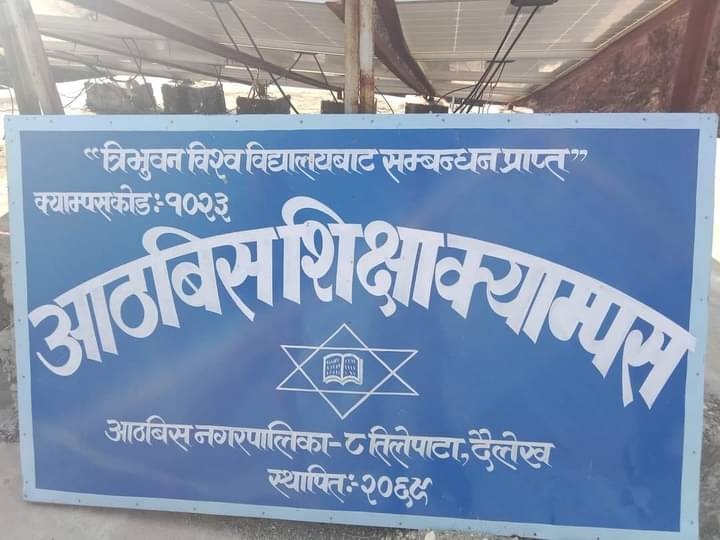
Community-owned campus in Aathabis Municipality-08, Tilepata, Dailekh
Also known as Aathabis Shiksha Campus
Established in 2012 AD
Affiliated with Tribhuvan University
Recognized by the University Grants Commission of Nepal
Offers the four-year Bachelor of Education program
Operates under the Faculty of Education
Located in Karnali Province
Owns 16 ropani of land
Has campus buildings, classrooms, furniture, library, playground, Wi-Fi, CCTV, projector, computers, laptops, printers, bookshelves, and a smart board
Provides scholarship and freeship support for students from economically backward families
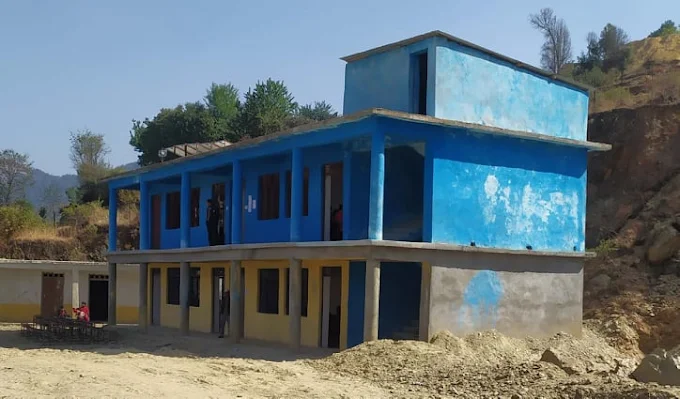
Aathabis Education Campus (आठबिस शिक्षा क्याम्पस) was established as a community institution in 2012 AD. The campus is situated in Tilepata, Ward No. 8 of Aathabis Municipality, Dailekh. It was founded through the efforts of local people, education supporters, Kalika Secondary School, and the then Tilepata Village Development Committee.
The campus received affiliation from Tribhuvan University in 2012 AD and began its academic work with the Bachelor of Education program. Its founding context is linked with the demand for bachelor-level education in a rural part of Dailekh, where many students had to move outside the area for further study.
The campus serves students from Aathabis Municipality and nearby settlements, including areas around Lakandra, Tolijaisi, Singasain, Pipalkot, Rakam Karnali, Singaudi, and Sattala. It is located near the Karnali Highway and is about 8.5 km east of Bakhrekot Bazaar in Rakam Karnali. The wider service area also connects with parts of Kalikot and Achham.
Aathabis Education Campus is operated as a community campus. Its financial base includes grants, donations, student fees, and institutional support. It has received regular and physical grants from the University Grants Commission, support from local levels, donations from donors, and student fees. The campus has also received a grant under the digitalization work performance grant program for the fiscal year 2080/81 BS.
The campus is located in Aathabis Municipality, a local area with surrounding secondary schools and communities from different social and economic backgrounds. The student base includes learners from farming families and economically disadvantaged communities. The campus’s role is connected with widening access to bachelor-level education within the municipality and nearby regions.
Aathabis Education Campus offers the Bachelor of Education program under Tribhuvan University’s Faculty of Education.
The campus offers the Bachelor of Education at bachelor level. The program is affiliated with Tribhuvan University and follows the four-year annual system under the Faculty of Education.
Duration: 4 years
Affiliation: Tribhuvan University
Faculty: Education
The four-year B.Ed. program is a professional and academic program under TU’s Faculty of Education. It prepares students to study education as a field of academic and professional preparation. Under the TU Faculty of Education structure, students study communication skills, professional core courses, specialization major courses, specialization minor courses, and teaching internship or practicum.
The B.Ed. annual-system structure includes 22 courses with a total of 2200 full marks. The course groups include:
Communication Skills
Professional Core Areas
Specialization Major Courses
Specialization Minor Courses
Teaching Internship or Practicum
The communication skills group includes General Nepali and General English. Professional core areas include subjects such as Philosophical and Sociological Foundations of Education, Educational Psychology, Curriculum and Evaluation, and one elective related to instructional technology or ICT in Education.
Specialization areas under the TU B.Ed. structure include Nepali Language Education, English Language Education, Mathematics Education, Science Education, Health and Physical Education, Population Education, Geography Education, Economics Education, History Education, and Political Science Education. Students select specialization areas as major and minor according to the applicable TU Faculty of Education rules.
Admission to the four-year B.Ed. program is open to students who have completed Grade 12, Higher Secondary Education, Proficiency Certificate Level, or an equivalent qualification.
For specialization areas, eligibility depends on the subject selected. TU Faculty of Education rules include separate entry requirements for major subjects such as Nepali Education, English Education, Mathematics Education, Science Education, Health and Physical Education, Population Education, Geography Education, Economics Education, Political Science Education, and History Education.
Students selecting English Education, Health and Physical Education, or other subject-specific areas may need to meet additional requirements set by the concerned department or campus according to TU rules.
Admission to bachelor-level programs under Tribhuvan University generally follows the regulations of the concerned faculty, Dean’s Office, and campus. For Aathabis Education Campus, admission is connected with TU rules and the B.Ed. program under the Faculty of Education.
Admission notice is published by the campus or concerned authority.
Eligible applicants submit the prescribed application form.
Applicants submit required academic documents.
The admission process may include entrance examination, merit-based selection, or both, depending on program or campus policy.
Selected candidates complete admission by submitting the required documents.
Students pay the prescribed admission fee.
Academic registration, examinations, and results follow TU rules, guidelines, and the applicable academic calendar.
Academic Transcript or Grade Sheet of Class 12, +2, or equivalent
Character Certificate from the previous institution
Migration Certificate, if the previous board or university is different
Transfer Certificate from the previous school or college
Citizenship Certificate or Birth Certificate copy
Passport-size photographs
Entrance Examination Scorecard, if required by the program or campus
Completed Admission or Application Form of the campus
Admission Fee Payment Receipt
Equivalence Certificate, only if the qualification is from a foreign board or university
Aathabis Education Campus runs the B.Ed. program with teaching staff and administrative support. In the academic year 2081/082 BS, the campus had one full-time campus chief and teaching staff that included full-time and part-time assistant professors. Administrative and support staff included assistant accountant, assistant administrative staff, assistant library staff, and peon.
The campus has used regular classroom-based teaching for the B.Ed. program. The source context also notes the campus’s move toward digital academic management and the use of ICT-related facilities. Wi-Fi, computers, laptops, a projector, and a smart board are available on campus. These facilities support classroom delivery, administrative work, and student access to learning resources.
The campus has also worked on a higher education management information system through a digitalization grant. This work is connected with maintaining physical, financial, educational, administrative, and statistical records through a digital system.
Aathabis Education Campus has physical and learning facilities that support its bachelor-level program. The campus owns 16 ropani of land and has buildings, classrooms, and basic academic assets.
Campus-owned land
Concrete buildings and smaller buildings
Classrooms
Desks and benches
Plastic chairs
Cupboards
Office tables and chairs
Armchairs
Computers
Laptops
Printers
Projector
Bookshelves
Library
Office space
Wi-Fi
CCTV cameras
Smart board
Playground
Furniture
Campus premises with physical space for academic use
The campus has six buildings. Some building support has come through the University Grants Commission, Social Development Office Dailekh, and District Development Committee Dailekh. The presence of campus-owned land gives the institution space for classrooms, playground use, and physical development connected with its academic work.
Student life at Aathabis Education Campus is shaped by its community setting in Tilepata, Dailekh. The campus serves students from Aathabis Municipality and nearby areas where access to bachelor-level education is an important local need. Many students come from rural and farming families, and the campus provides a local option for those who want to study education at bachelor level without moving far from the region.
The campus is placed within a broad catchment area. Nearby communities and secondary schools create a local education network from which students can continue to higher education. The surrounding area includes settlements across Aathabis Municipality and neighboring regions, with links to the Karnali Highway and nearby local centers.
The campus environment is also connected with local participation. Its establishment involved community members, education supporters, and local institutions. The campus assembly includes community membership, and the campus aims to increase the number of donors and supporters through local involvement.
Aathabis Education Campus provides scholarship and freeship support for students from economically backward families.
Scholarship support for eligible students
Freeship support for students from economically backward family backgrounds
Community and grant-supported campus operation
Financial support structure linked with grants, donations, student fees, and fixed-deposit interest
The campus’s financial sources include individual and institutional donations, grants, student fees, and interest on fixed deposits. As a community campus, its financial model is tied to local support, public contribution, and institutional grants.
Aathabis Education Campus has received support from the University Grants Commission and local bodies. The campus operates with regular and physical grants, local-level support, donations, and student fees. These sources support the continuation of bachelor-level education in the area.
The campus has also received support for digitalization under the fiscal year 2080/81 BS program. This has been used for establishing a higher education management information system. The digitalization work is connected with record-keeping and institutional management.
The campus’s community role is also connected with its location. It serves an area where several secondary schools operate up to Class 12. Local communities include Brahman, Chhetri, Raji, Majhi, Magar, Kami, Damai, Sarki, and other groups. The campus supports access to bachelor-level education for students from different social and economic backgrounds in the municipality and nearby settlements.
Aathabis Education Campus runs the B.Ed. program from the first year to the fourth year. In the academic year 2081/082 BS, the campus had students enrolled across all four years of the B.Ed. program.
The enrollment data for the academic year 2081/082 BS shows:
First Year: 136 students
Second Year: 156 students
Third Year: 329 students
Fourth Year: 255 students
Total: 875 students
The third year had two sessions in the stated academic year. The enrollment figure shows the campus’s active role in delivering the B.Ed. program at bachelor level in Aathabis Municipality.
Aathabis Education Campus is located at Aathabis Municipality-08, Tilepata, Dailekh, Karnali Province, Nepal. The campus is placed in a hill setting in the Sitalchaur area of Tilepata. It is about half an hour’s drive, around 8.5 km, east of Bakhrekot Bazaar in Rakam Karnali along the Karnali Highway.
The location connects the campus with settlements in Dailekh and with neighboring areas toward Kalikot and Achham. The source context also notes the wider area’s relation with Karnali Highway and Mid-Hill Highway routes. This location supports the campus’s role as a local higher education center for students from surrounding settlements.
Aathabis Education Campus has worked to prepare and publish institutional records through a higher education management information system supported by the digitalization work performance grant program of fiscal year 2080/81 BS. The campus has expressed confidence that the digital system will support teaching, administration, and academic record management.
The campus chief, Mr. Basudev Upadhyaya, has emphasized the use of available opportunities by students and the role of teachers and assistant professors in conducting teaching activities through physical presence and online means.
Aathabis Education Campus is a community-owned higher education institution serving Aathabis Municipality and nearby areas of Dailekh. Its identity is shaped by local effort, affiliation with Tribhuvan University, recognition from the University Grants Commission, and its focus on the Bachelor of Education program.
The campus provides a local pathway to bachelor-level education for students in a rural municipality of Karnali Province. With campus-owned land, academic buildings, classroom resources, library support, ICT-related facilities, scholarship and freeship support, and community participation, Aathabis Education Campus continues to function as an important education institution in its service area.
College Name: Aathabis Education Campus
Alternative Name: Aathabis Shiksha Campus
Location: Aathabis Municipality-08, Tilepata, Dailekh, Karnali Province, Nepal
Affiliation: Tribhuvan University
Recognition: University Grants Commission of Nepal
Program: Bachelor of Education
Campus Chief: Mr. Basudev Upadhyaya
Aathabis Education Campus is a community-owned campus located at Aathabis Municipality-08, Tilepata, Dailekh, Karnali Province, Nepal. It is affiliated with Tribhuvan University and recognized by the University Grants Commission of Nepal.
Aathabis Education Campus was established in 2012 AD. It was founded as a community campus to provide bachelor-level education in the Aathabis area of Dailekh.
Aathabis Education Campus offers the Bachelor of Education program under the Faculty of Education. The program is affiliated with Tribhuvan University.
The Bachelor of Education program follows the four-year annual system of Tribhuvan University’s Faculty of Education.
Students who have completed Grade 12, Higher Secondary Education, Proficiency Certificate Level, or equivalent can apply for the B.Ed. program. Subject-specific requirements apply for some specialization areas under TU Faculty of Education rules.
Yes. The campus provides scholarship and freeship support for students from economically backward families.
The campus has classrooms, furniture, library, playground, Wi-Fi, CCTV, computers, laptops, printers, projector, bookshelves, office space, and a smart board.
The campus is located at Aathabis Municipality-08, Tilepata, Dailekh, Karnali Province, Nepal. It is around 8.5 km east of Bakhrekot Bazaar in Rakam Karnali along the Karnali Highway.