Amar Shahid Multiple Campus (ASMC) is a non-profit community campus in Rajapur, Bardiya. Established in 2065 BS (2008 AD), it was founded to expand access to higher education in a river-surrounded area of western Bardiya where local demand for bachelor-level study had grown steadily.
The campus is affiliated with Tribhuvan University and runs bachelor-level programs in Education, Management, and Humanities. Its institutional background, community foundation, and program mix show a campus shaped by local initiative and sustained by public participation, with academic facilities, student support, and extracurricular activities developed to serve students in Rajapur and nearby areas.
Quick Highlights
-
Established: 2065 BS (2008 AD)
-
Type: Non-profit community campus
-
Location: Rajapur-4, Rajapur Municipality, Bardiya, Lumbini Province, Nepal
-
Affiliation: Tribhuvan University
-
Faculties: Education, Management, and Humanities & Social Science
-
Active Programs: Bachelor of Education (B.Ed.), Bachelor of Business Studies (BBS), and Bachelor of Arts (BA)
-
Campus Chief: Anil Dutt Chaudhary
-
Academic Team: 22 teachers and 4 staff members
-
Library Resources: Nearly 5,000 books
-
Key Facilities: ICT lab, computer lab, playground, multimedia support, conference hall, hall room, library rooms, CCTV
-
Student Support: Scholarships for needy students from internal sources
-
Institutional Distinction: First multiple campus in Rajapur Municipality
Institutional Background
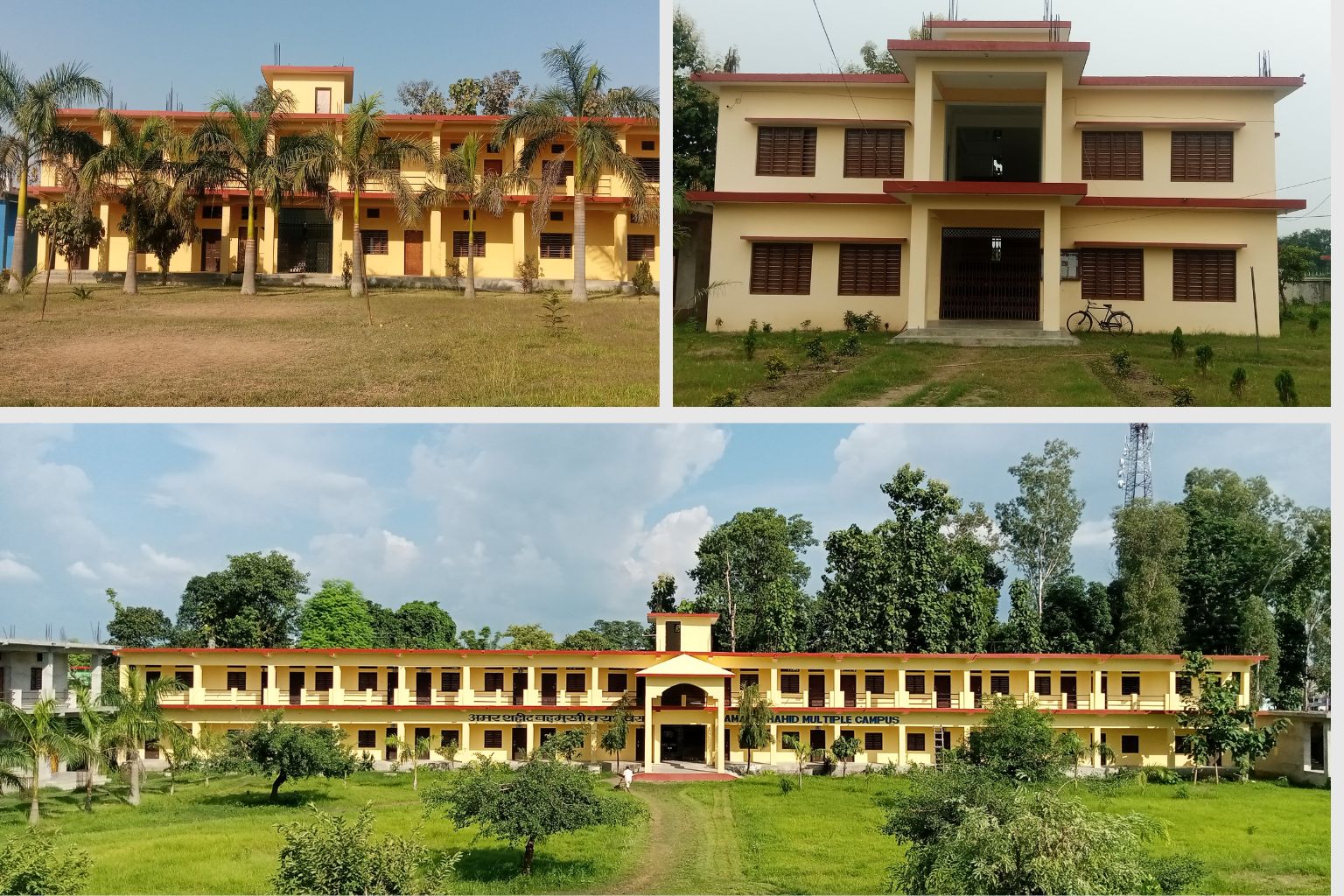
Amar Shahid Multiple Campus (अमर शहिद बहुमुखी क्याम्पस, राजापुर बर्दिया) was established after local stakeholders identified the need for higher education opportunities for students from Rajapur and surrounding areas. The campus grew out of joint efforts by the public, parents, government bodies, non-government institutions, and community stakeholders. It was founded in memory of martyrs who sacrificed their lives in Nepal’s political movements, which gives the institution both an educational and civic identity.
The campus is located in Rajapur-4, Bardiya, in a river-surrounded area connected to nearby regions through the Hulaki Highway. This setting matters to the institution’s identity. Its development is tied to the educational needs of students from rural, economically constrained, and socially marginalized communities, including Tharu and other indigenous and disadvantaged groups in the area.
ASMC functions as a community campus under Tribhuvan University. It identifies itself as an autonomous educational institution operated on a non-profit basis. In governance terms, the available institutional details identify Anil Dutt Chaudhary as Campus Chief. The campus also reflects sustained public involvement, including long-term support from local families and community members.
Its institutional objectives center on widening access to higher education, operating academic and research programs after receiving university affiliation, using modern educational technology in instruction, and supporting students from rural and disadvantaged backgrounds. These objectives make the campus more specific than a general bachelor-level institution: it was formed to respond to a local access gap and continues to work within that community-based role.
Academic Programs Offered
Amar Shahid Multiple Campus runs bachelor-level programs across three faculties.
The campus began with the Education faculty in 2065 BS. Management followed after TU affiliation, and Humanities was added afterward. Institutional records also identify first-year through fourth-year student groups in all three programs, indicating a four-year bachelor-level academic structure at the campus.
Within the B.Ed. program, the listed teaching areas include English Education, Nepali Education, and Health and Physical Education. First-year course listings also show the combination of compulsory communication subjects, educational foundations, and major or minor specialization options.
Within BBS, the campus identifies Finance and Marketing as teaching areas. The TU BBS framework is designed to build foundations in business, economics, communication, accounting, management, and applied study in later years.
Within BA, the campus lists English, Sociology, and Rural Development among the subjects taught. This gives the program a humanities and social science orientation suited to students seeking broad undergraduate study in social fields.
Admission Process
-
Admission to bachelor-level programs generally follows the rules of the concerned faculty, campus, and Tribhuvan University.
-
After the publication of an admission notice, eligible applicants submit the prescribed application form with the required academic documents.
-
Depending on the program or campus policy, admission may include an entrance examination, merit-based selection, or both.
-
Selected applicants complete admission by submitting the required documents and paying the prescribed fees.
-
Academic registration, examinations, and results follow TU rules, guidelines, and the applicable academic calendar.
For B.Ed., the available institutional material states that students who have completed intermediate education, +2, or equivalent are eligible for admission. The broader TU bachelor admission framework also applies across the campus.
Required Documents
-
Academic Transcript (Grade Sheet) of Class 12 / +2 or equivalent
-
Character Certificate from the previous institution
-
Migration Certificate, if the previous board or university is different
-
Transfer Certificate (TC) from the previous school or college
-
Citizenship Certificate or Birth Certificate (copy)
-
Passport-size photographs
-
Entrance Examination Scorecard, if required by the program
-
Completed admission or application form
-
Admission fee payment receipt
-
Equivalence Certificate, if the qualification is from a foreign board or university
Teaching Faculty and Learning Methodology
The campus has 22 teachers and 4 staff members. Its academic statements and institutional objectives point to a teaching approach that combines classroom instruction with modern educational technology, library use, ICT support, and research-oriented academic practice.
The teaching methodology described in the institutional material is not limited to lecture delivery. The campus refers to inclusive, participatory, and research-oriented teaching methods. Its objectives also mention counseling, presentation, group discussion, and training-oriented academic support. In this sense, the campus presents teaching as a mix of subject study, guided instruction, and student participation inside and outside the classroom.
This academic approach is reinforced by available facilities such as multimedia support, ICT resources, and library space. For a community campus in a rural municipality, the combination of academic delivery, institutional objectives, and learning infrastructure is one of the more concrete parts of its institutional profile.
Infrastructure and Learning Facilities
-
The campus occupies 1-18-03 bighas of land.
-
It has five buildings: Administrative Building, Academic Building, BA Building, BBS Building, and Degree Building.
-
Four educational buildings together contain 30 rooms.
-
A hall room has a seating capacity of 150 people.
-
A two-story administrative building includes two library rooms.
-
The library holds nearly 5,000 books.
-
The campus has a separate ICT lab room.
-
Other learning and campus facilities include a computer lab, multimedia support, conference hall, classrooms, and a playground.
-
Physical facilities include bicycle stands, boys’ and girls’ separate toilets, a drinking water room, an FSU building, and a Saraswati Temple.
-
The campus has 16 desktops, 2 laptops, 1 printer, 2 multi-projectors, and 1 Wi-Fi router.
-
CCTV has been installed within the premises.
-
A four-room multi-purpose building is under construction.
Student Life and Campus Experience
Student life at Amar Shahid Multiple Campus is closely tied to its community setting. The institution was built through local effort and continues to function within a strong public relationship. More than 350 parents are recorded as having made financial contributions and being recognized as life members of the campus assembly. That level of community participation shapes the campus environment in a practical way.
The student base reflects the social composition of the surrounding region. The campus serves students from Rajapur and nearby areas, including communities that have faced economic and educational disadvantage. Institutional notes also state that the number of female students is high, which gives the campus a distinct place in local access to higher education.
Access is another part of campus life. The Hulaki Highway connection and links toward Kailali improve movement for students coming from surrounding areas. This makes the campus relevant not only within Rajapur Municipality but also for nearby localities where bachelor-level options are limited.
Extracurricular Activities (ECA)
-
Sports
-
Dance and music activities
-
Educational tours
-
Quiz competitions
-
Debates and oratory activities
-
Physical exercise activities
-
ECA programs listed as part of campus features
-
Counseling-related student support
-
Journal-related academic activities
Scholarships and Financial Support
-
The campus provides scholarships to needy students from internal sources.
-
Scholarships are listed among the campus’s student support features.
-
Institutional objectives also include scholarships and awards for poor and meritorious students.
-
The campus links financial support with access for socially and economically disadvantaged students.
Achievements and Institutional Milestones
-
Established in 2065 BS (2008 AD) as a non-profit community campus
-
First multiple campus in Rajapur Municipality
-
Founded through the joint effort of public stakeholders and the local community
-
Established in memory of martyrs of Nepal’s political movements
-
Expanded from Education to Management and Humanities faculties under TU affiliation
-
Built a bachelor-level presence in a rural municipality where demand for higher education had been strongly felt
Message from the Campus Chief
In the message attributed to Campus Chief Anil Dutt Chaudhary, the campus is presented as a non-profit community institution under Tribhuvan University, located on the bank of the Karnali River in Rajapur. The message emphasizes the campus’s focus on Education, Humanities, and Management, along with extracurricular participation and a campus community that values inclusion and academic commitment.
The message also places the institution within a broader social purpose: extending educational opportunities within the community and supporting students as they continue their higher education journey in Rajapur.
Conclusion
Amar Shahid Multiple Campus is defined less by size than by purpose. It was created to open bachelor-level study in Rajapur for students who otherwise had limited local access to higher education. Its profile combines community origin, TU affiliation, three active bachelor programs, identifiable academic facilities, and student support features such as scholarships, counseling, and extracurricular activities.
For students seeking BA, B.Ed., or BBS study in Rajapur, the campus offers an institution with a clear local role, established program structure, and a setting shaped by public participation and regional educational need.
Contact Details
College Name: Amar Shahid Multiple Campus
Location: Rajapur-4, Rajapur Municipality, Bardiya, Lumbini Province, Nepal
Affiliation: Tribhuvan University
Phone No.: +977-84-460103, +977-9848080912, +977-9848147328
Email: info@asmc.edu.np
Website: https://asmc.edu.np
Contact Amar Shahid Multiple Campus's administrative office for detailed information on the course, admissions, location, fees, scholarships, facilities, counseling, or eligibility.