Chure Campus (चुरे क्याम्पस, बगनाहा, बर्दिया) is a community-based, non-profit higher education institution in Bagnaha, Bardiya. Established in 2063 BS (2006 AD), the campus serves students from Thakurbaba Municipality and nearby districts through bachelor’s and master’s programs in Education, Humanities, and Management.
It is affiliated with Tribhuvan University and approved by the University Grants Commission of Nepal. The campus operates from Thakurbaba Municipality-3, Bagnaha, and presents itself as a community institution created to widen access to higher education for students who faced barriers in continuing study after +2.
Established in 2063 BS (2006 AD)
Located at Thakurbaba Municipality-3, Bagnaha, Bardiya, Lumbini Province, Nepal
Community-based and non-profit campus
Affiliated with Tribhuvan University
Approved by the University Grants Commission of Nepal
Faculties in operation: Education, Humanities and Social Science, and Management
Active programs: BA, B.Ed., BBS, M.Ed., and MBS
Student enrollment reported at 703 across bachelor’s and master’s levels
Serves three local levels directly and around five districts indirectly
Campus facilities include three concrete buildings, two temporary sheds, a Megha Hall, library, Wi-Fi, CCTV, computers, and transportation by bus
Scholarship support includes tuition-fee discounts and named memorial or institutional scholarships
The campus is engaged in the QAA process
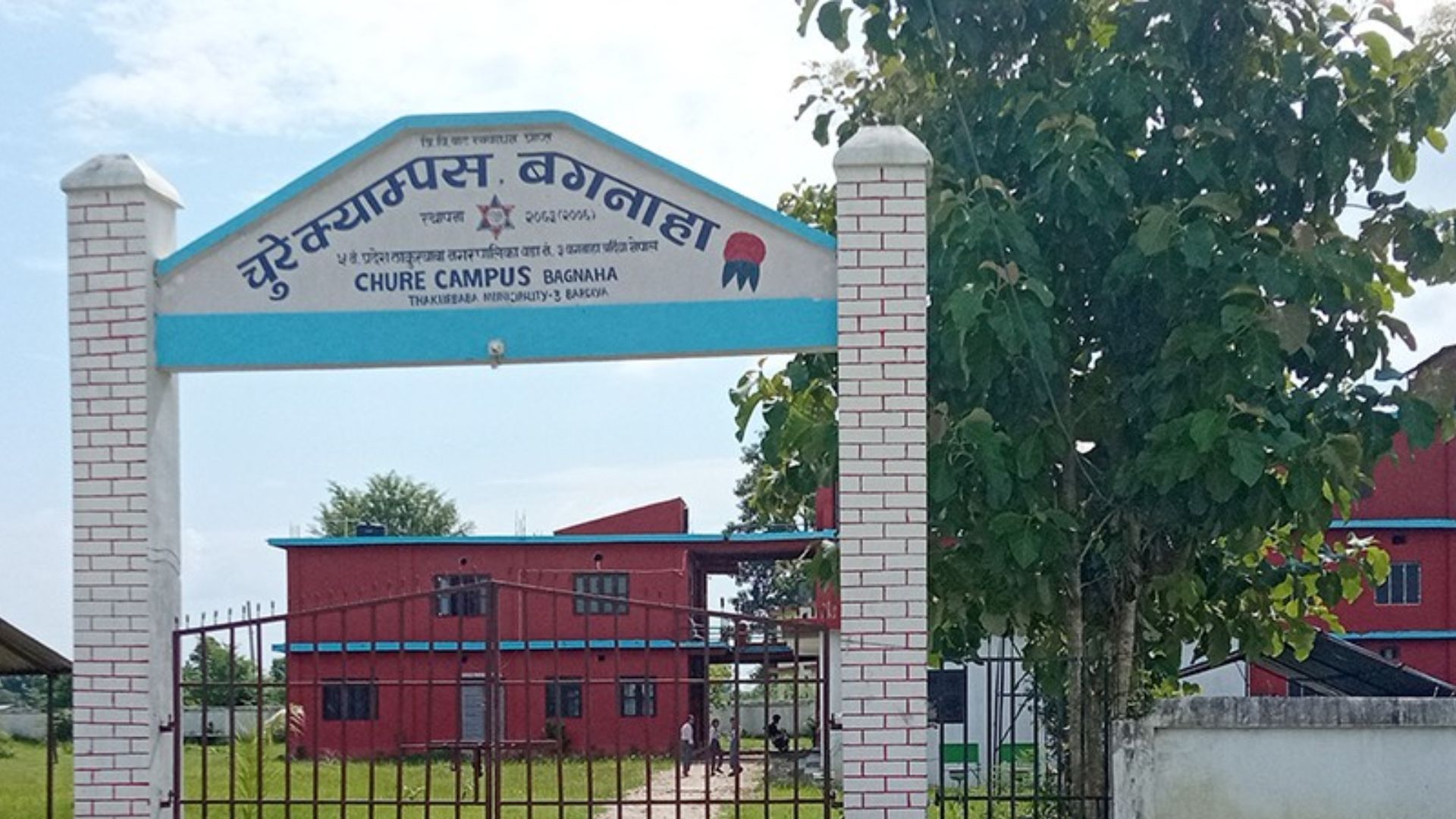
Chure Campus was established as a community-owned campus in 2063 BS. The source history connects its emergence with the earlier establishment of Chure Higher Secondary School on 16 Sharwan 2056 BS and with local efforts to create a practical path to higher education for students who were unable to continue after completing +2 because of economic and access barriers.
The campus is located in the village area of Bardiya district at Ward No. 3 of Thakurbaba Municipality, in Lumbini Province. Its institutional identity is tied to community participation, local educational leadership, and service to students from socially and economically disadvantaged backgrounds, including women and historically marginalized communities.
In governance and academic terms, Chure Campus runs as a TU-affiliated campus and reports approval from the University Grants Commission of Nepal. It also records membership in the Nepal Public Campus Association from 2067/03/28 BS. The institution identifies itself as being in the QAA process and has also received support under a digitalization work performance grant program for the establishment of a higher education management information system.
Its academic reach extends beyond Bardiya. The source material notes direct service to three local levels and indirect reach to about five districts. Student representation is also shown from Achham, Arghakhanchi, Banke, Bardiya, Dailekh, Dang, Humla, Jajarkot, Jumla, Kailali, Kalikot, Kanchanpur, Mugu, Pyuthan, and Rukum (East).
Chure Campus offers programs at both bachelor’s and master’s level under Tribhuvan University. The operating faculties are Education, Humanities and Social Science, and Management.
Bachelor of Education (B.Ed.)
TU-affiliated program under the Faculty of Education. The TU support material used in this profile matches a four-year annual structure for B.Ed. The campus-level optional subjects reported for B.Ed. are Mathematics, Nepali, Population Studies, Health and Physical Education, and Economics.
Bachelor of Arts (BA)
TU-affiliated program under Humanities and Social Science. The BA support material used here matches a four-year bachelor’s structure. The campus-level optional subjects reported for BA are Economics and Sociology.
Bachelor of Business Studies (BBS)
TU-affiliated management program. The TU support material used here matches the four-year annual structure of BBS. At Chure Campus, the optional or concentration-related subjects reported for BBS are Account, Finance, and Marketing.
Master of Education (M.Ed.)
The campus source identifies this as M.Ed. in Health Education. The TU M.Ed. support pack matches a two-year, four-semester structure carrying 69 credit hours, with semester-end examinations conducted by the Dean’s Office and internal as well as external evaluation.
Master of Business Studies (MBS)
TU-affiliated master’s level management program. The campus reports MBS as active and lists Account, Finance, Marketing, and Management among the subjects taught at this level.
B.Ed.: 2063/06/27 BS
BBS: 2066/04/25 BS
BA: 2070/11/11 BS
MBS: 2070/10/13 BS
M.Ed. (Health): 2075/10/11 BS
Admission to bachelor-level programs generally begins after the campus publishes its admission notice.
Eligible applicants submit the prescribed admission or application form with the required academic documents.
For TU bachelor’s programs, selection may include an entrance examination, merit-based selection, or both, depending on the program or campus policy.
Selected applicants complete admission through document submission and payment of the prescribed fees.
Academic registration, examinations, and results follow TU rules, faculty guidelines, and the applicable academic calendar.
For master’s programs, the concerned campus or authority publishes the admission notice and eligible applicants submit the required form and documents.
Master’s admission may also include an entrance examination depending on the program.
Final enrollment in master’s programs is completed according to TU rules and the schedule of the concerned faculty or campus.
Academic Transcript or Grade Sheet of Class 12 / +2 or equivalent for bachelor’s admission
Character Certificate from the previous institution
Migration Certificate, if the previous board or university is different
Transfer Certificate (TC)
Citizenship Certificate or Birth Certificate copy
Passport-size photographs
Entrance Examination Scorecard, if required by the program or campus
Completed Admission or Application Form
Admission Fee Payment Receipt
Equivalence Certificate, if the qualification is from a foreign board or university
Bachelor’s Degree Transcript or Marksheet for master’s admission
Bachelor’s Degree Certificate or Provisional Certificate for master’s admission
Character Certificate from the bachelor-level institution for master’s admission
The source material presents Chure Campus as a campus supported by a mix of teaching and administrative staff across bachelor’s and master’s programs. It also notes a digitalization initiative connected with the campus information system and refers to both physical presence and online teaching activity.
Across the TU programs reflected in the source pack, learning is not limited to lecture classes alone. The academic structure includes assignments, project work, seminars, case studies, field studies, final project components, teaching practice, and thesis work where the program requires them. At the campus level, this aligns with the stated use of classroom teaching, administrative data systems, and digital support tools already installed on campus.
The message from Campus Chief Rudra Bahadur Khadka places emphasis on widening higher education access in the Bardiya area, maintaining regular teaching activity, and making use of the digital and physical systems available to students.
Campus land reported at 1 bigha 10 kattha
Three concrete buildings for classrooms and administration
Two temporary sheds
One Megha Hall with capacity for 250 students
Large campus ground
Library
Office rooms
Wi-Fi installed in rooms and campus premises
CCTV cameras installed in rooms and campus premises
Bus service for student transportation
385 sets of furniture
12 computers
18 laptops
3 all-in-one printers
1 projector
3 bookshelves
Student life at Chure Campus is shaped by its community base, mixed academic levels, and wide catchment area. The source material records enrollment of 703 students across bachelor’s and master’s streams and shows participation from multiple social groups, including Brahman, Chhetri, Madhesi, Dalit, Muslim, Tharu, and Janajati communities.
The campus experience also reflects its geographic role. Students come not only from Bardiya but also from surrounding and distant districts, which gives the institution a broader regional character than a single-locality college. Transport support through the campus bus, scholarship schemes, library access, and on-campus facilities contribute to how students use the institution day to day.
The campus history and current academic structure both point to a local institution built around educational continuity. For many students, Chure Campus functions as a nearby route into TU higher education without leaving the region for study.
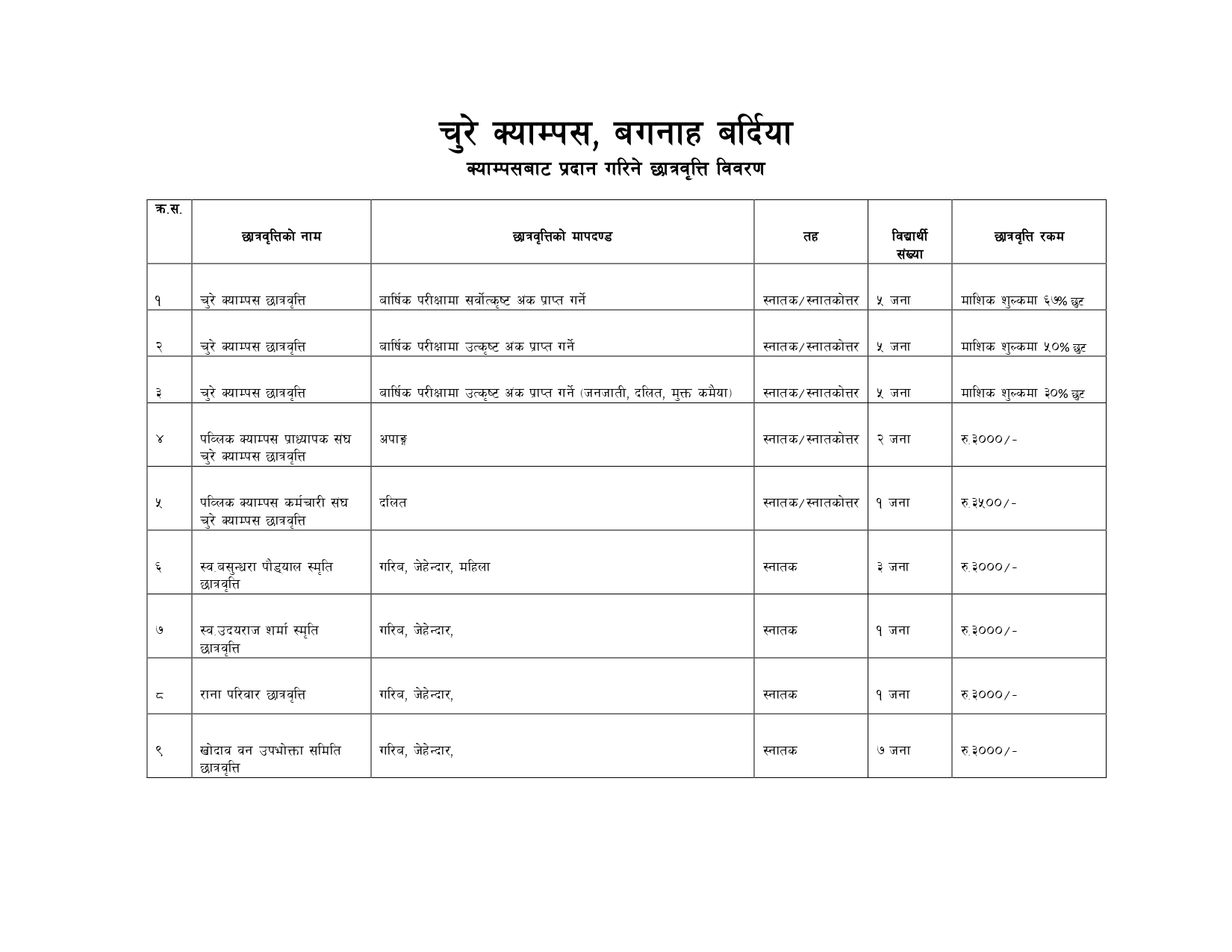
Chure Campus Scholarship for students securing the highest marks in the annual examination: 65% discount on monthly tuition fee for 5 bachelor’s or master’s students
Chure Campus Scholarship for students securing excellent marks in the annual examination: 50% discount on monthly tuition fee for 5 bachelor’s or master’s students
Chure Campus Scholarship for students securing excellent marks in the annual examination from Janajati, Dalit, and Mukta Kamaiya backgrounds: 30% discount on monthly tuition fee for 5 bachelor’s or master’s students
Public Campus Teachers’ Association Chure Campus Scholarship: Rs. 3,000 for 2 bachelor’s or master’s students
Public Campus Employees’ Association Chure Campus Scholarship: Rs. 2,500 for 1 Dalit bachelor’s or master’s student
Late Basundhara Poudyal Memorial Scholarship: Rs. 3,000 for 3 poor, meritorious women students at bachelor’s level
Late Udayaraj Sharma Memorial Scholarship: Rs. 3,000 for 1 poor, meritorious bachelor’s student
Rana Family Scholarship: Rs. 3,000 for 1 poor, meritorious bachelor’s student
Khodawa Forest Users’ Committee Scholarship: Rs. 3,000 for 3 poor, meritorious bachelor’s students
Establishment of Chure Campus in 2063 BS
B.Ed. affiliation received in 2063/06/27 BS
BBS affiliation received in 2066/04/25 BS
Membership in the Nepal Public Campus Association received in 2067/03/28 BS
MBS affiliation received in 2070/10/13 BS
BA affiliation received in 2070/11/11 BS
M.Ed. (Health) affiliation received in 2075/10/11 BS
Participation in the QAA process
Grant support received for a higher education management information system under the digitalization work performance grant program
Campus Chief Rudra Bahadur Khadka presents Chure Campus as a community-based institution created to extend higher education opportunities to students of Bardiya and nearby areas. His message connects the campus mission with access, regional educational need, and the role of higher education in producing capable human resources.
The same message also points to ongoing digitalization work, including the development of a higher education management information system, and links this effort with regular academic activity through both physical presence and online means.
Chure Campus occupies a clear place in the higher education landscape of Bardiya as a TU-affiliated community campus with active programs in Education, Humanities, and Management. Its profile is defined less by scale than by function: it provides a local route into bachelor’s and master’s study, maintains facilities for regular academic use, and supports students through scholarships and regional access.
College Name: Chure Campus
Location: Thakurbaba Municipality-3, Bagnaha, Bardiya, Lumbini Province, Nepal
Phone No.: +977-84-590422, +977-9858024700
Email: info@churecampus.eu.np
Website: https://www.churecampus.edu.np
Affiliation: Tribhuvan University
Approval: University Grants Commission of Nepal
Chure Campus is located at Thakurbaba Municipality-3, Bagnaha, Bardiya, in Lumbini Province, Nepal.
Chure Campus is affiliated with Tribhuvan University and approved by the University Grants Commission of Nepal.
The campus offers BA, B.Ed., BBS, M.Ed., and MBS.
Yes. The campus offers M.Ed. in Health Education and MBS at the postgraduate level.
The campus reports three concrete buildings, two temporary sheds, a Megha Hall with 250-seat capacity, library, Wi-Fi, CCTV, computers, laptops, printers, bookshelves, a large ground, and bus transportation.
Students generally need a Class 12 or +2 transcript, character certificate, migration certificate if applicable, transfer certificate, citizenship or birth certificate copy, passport-size photographs, completed application form, and fee payment receipt. Some programs may also require an entrance scorecard.
Yes. The campus reports scholarship schemes based on annual examination performance, inclusion categories, and named memorial or institutional support, including tuition-fee discounts and fixed-amount scholarships.
Yes. The campus identifies itself as being in the QAA process.