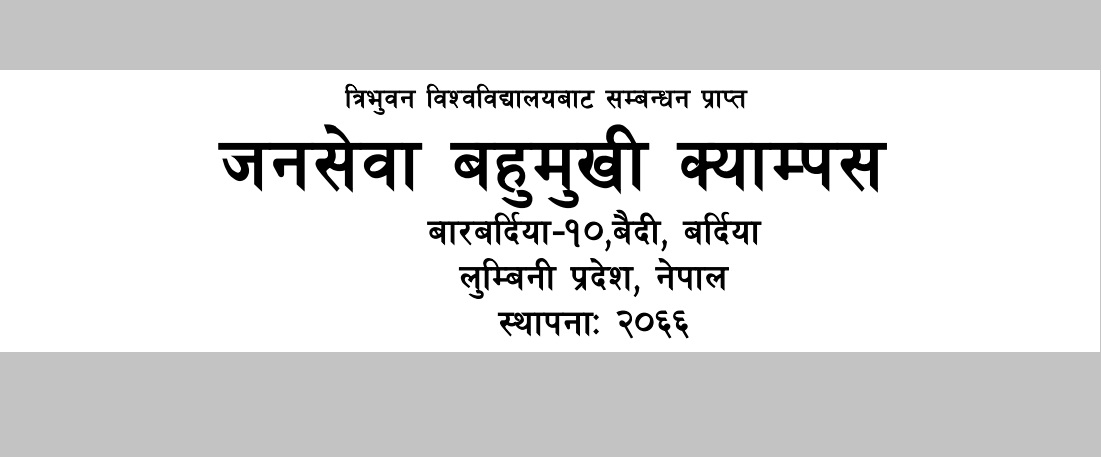
Janasewa Multiple Campus is a community-owned bachelor-level campus in Barbardiya Municipality-10, Baidi, Bardiya. Established in 2010 AD, it was set up to expand access to higher education in an area where local students had limited options beyond school education.
The campus is affiliated with Tribhuvan University and approved by the University Grants Commission. It runs bachelor’s programs in humanities and management, follows the annual examination system, and combines classroom teaching with fieldwork, project-based learning, local internships, and exam support classes.
Community-owned campus established in 2010 AD
Located at Barbardiya-10, Baidi, Bardiya
Affiliated with Tribhuvan University
Approved by the University Grants Commission of Nepal
Offers bachelor-level programs in BA and BBS
Faculties in operation: Humanities and Management
Programs are presented as four-year courses under the annual examination system
BA subjects include English, Nepali, Sociology, and Rural Development
BBS is available under the Faculty of Management
Own campus buildings with 12 rooms and 12 classrooms
Library room with 400 reference books
Internet, desktop computers, laptops, projector, smart board, and CCTV support
Scholarship arrangements for talented and excellent students
Free extra classes before examinations
Access to a sports ground through Janasewa Secondary School
Students have used the annual examination center at Bardiya Multiple Campus since 2073 B.S.
Janasewa Multiple Campus grew from local discussion and community decision-making connected to Janasewa Secondary School. A formal process to begin bachelor-level study moved forward after a management committee decision on 2063/09/21, followed by a broader meeting on 2064 Chaitra 15 under the chairmanship of Ram Bahadur Pande. The campus emerged to address the lack of nearby higher education opportunities in the former Dhanaura area of Bardiya, now within Barbardiya Municipality.
The institution operates as a community campus and has received support from local citizens of Barbardiya Baidi, the Ministry of Social Development of Lumbini Province, and UGC Nepal. Its physical development also includes support from the Parliamentary Development Fund, the provincial government, the municipality, the ward office, and community-backed efforts such as Mahayagya support for selected items and structures.
Academically, the campus is linked with Tribhuvan University through two faculties. The Bachelor of Arts program runs under the Faculty of Humanities and Social Sciences, while the Bachelor of Business Studies program runs under the Faculty of Management. The BA approval process included English, Rural Development, and Sociology from the academic year 2068/069, and Optional Nepali was later added. The BBS program received approval from the academic session 2067/068.
Janasewa Multiple Campus currently offers two bachelor-level programs.
Bachelor of Arts (BA)
Faculty: Humanities and Social Sciences
Duration: 4 years
Examination system: Annual
Subjects in operation at the campus: English, Nepali, Sociology, Rural Development
Bachelor of Business Studies (BBS)
Faculty: Management
Duration: 4 years
Examination system: Annual
Campus-listed study areas include Accounting and Marketing within the management stream
The campus presents both programs as full-time bachelor-level study under TU’s annual structure. BA and BBS are the two academic pillars around which its current teaching, classrooms, library use, and student support systems are organized.
Admission opens after the campus publishes its notice for bachelor-level intake.
Applicants submit the prescribed admission or application form.
Academic documents are checked according to the relevant TU faculty and campus requirements.
Admission may include merit-based selection, an entrance process, or both, depending on the program or campus policy.
Selected applicants complete admission through document submission and fee payment.
Academic registration, examinations, and result procedures follow TU rules, guidelines, and the applicable academic calendar.
BA and BBS are run under the annual examination system.
Final annual examinations are conducted by Tribhuvan University through the Office of the Controller of Examinations.
Class 12 / +2 or equivalent academic transcript
Character certificate from the previous institution
Migration certificate, if the previous board or university is different
Transfer certificate from the previous school or college
Citizenship certificate or birth certificate copy
Passport-size photographs
Entrance examination scorecard, if required
Completed admission or application form
Admission fee payment receipt
Equivalence certificate, if the qualification is from a foreign board or university
The campus uses a mix of conventional classroom teaching and selected practical approaches. In the humanities stream, report-writing activities and fieldwork are included toward the end of the academic session. Projectors and computers are used in teaching according to subject needs, and students are involved in discussion-based learning around language and current issues.
In management, students are engaged in local internships in financial institutions alongside regular teaching. The source material also notes free extra classes before examinations, which adds a direct layer of academic support for enrolled students.
The campus material presents this teaching pattern in a balanced way. Practical and technology-supported activities are in use, but much of the overall teaching and learning process still follows traditional methods.
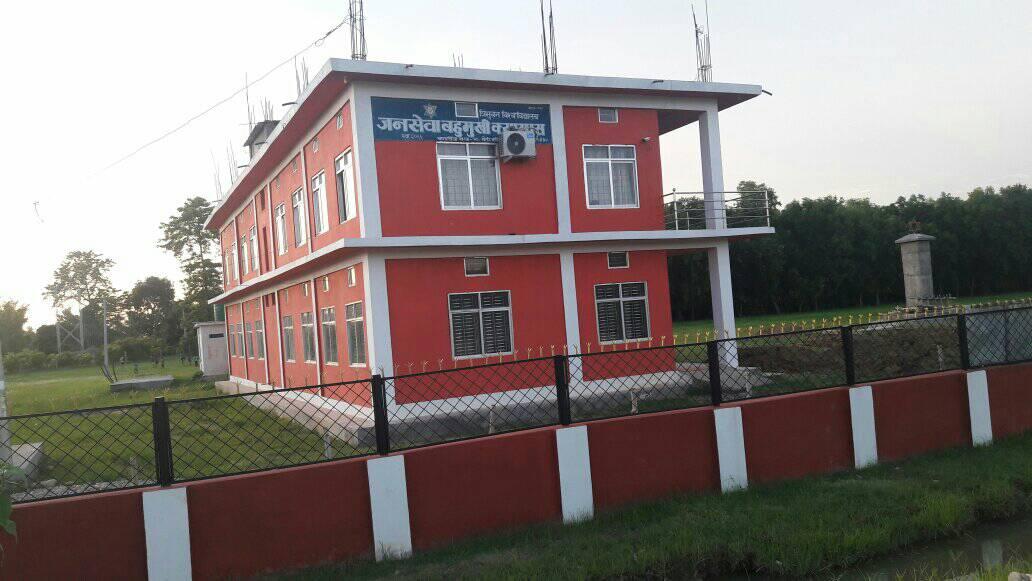
Two-storey concrete building with 8 rooms
Single-storey building with 4 rooms
Total of 12 rooms and 12 classrooms
Administrative room, accounts room, computer room, and staff room
Library room with around 400 reference books
Book-purchase support from UGC, local government, and municipality
60 desk-bench pairs
27 plastic chairs
7 desktop computers
2 laptops
1 projector
1 smart board
Projector screen
WiFi connection
5 CCTV cameras
Printers
Whiteboards
Sound system
Drinking water building
1,000-liter water tank connected to 8 taps
Tube-well pump for drinking water
Concrete toilet building with separate rooms for female students, male students, and teachers
Playground use through Janasewa Secondary School, around 9,500 square meters
Compound wall construction completed in part, with additional work still pending
The campus runs teaching and learning in its own buildings. At the same time, the material identifies space constraints, including the need for an additional four-room building for library use and optional-subject study.
Student life at Janasewa Multiple Campus is shaped by its local community setting and its role as a nearby bachelor-level option for students of the surrounding area. The campus was established to improve access to higher education for local students, including those from economically weaker and socially marginalized backgrounds.
Academic life extends beyond routine classes. Humanities students take part in report writing, discussions, and field-based work. Management students get exposure to local financial institutions through internships. Before examinations, the campus provides extra classes. Since 2073 B.S., students have also benefited from access to the annual examination center at Bardiya Multiple Campus in Laxmanpur, Bansgadhi Municipality.
The campus environment is also supported by a playground arrangement through Janasewa Secondary School, which connects sports and outdoor use with the daily academic setting.
Sports and games supported through use of a playground of about 9,500 square meters
Volleyball court within the campus-related physical area
Fieldwork-based learning activities in the humanities stream
Discussion-based and presentation-linked classroom engagement
Internship exposure for management students in local financial institutions
Scholarship arrangements for talented and excellent students
The campus follows a minimum fee structure
The institution was established with local access in mind, including students from poor, Dalit, Janajati, and other underserved backgrounds
Library book support has also come through UGC, local government, and municipality channels
Established in 2010 AD as a community-owned campus in Baidi, Bardiya
BA program approval process completed under TU with implementation from academic year 2068/069
Optional Nepali added to BA through later TU approval
BBS program approved from academic session 2067/068
Two-storey eight-room campus building developed through Parliamentary Development Fund support
Additional four-room building supported by UGC
Permanent compound wall construction of 220 meters completed in fiscal year 2075/076 with provincial support and campus resources
Land donation and land ownership certificate secured for a campus parcel in Ward No. 10, Baidi
Annual examination access through Bardiya Multiple Campus available to students since 2073 B.S.
Janasewa Multiple Campus serves as a local bachelor-level institution with a clear community foundation. Its academic profile is centered on BA and BBS, and its campus structure reflects steady growth through local initiative, public support, and university affiliation.
College Name: Janasewa Multiple Campus
Location: Barbardiya-10, Baidi, Bardiya
Phone No.: 9848011244, 9858060105, 9814504996
Affiliation: Tribhuvan University
Approval: University Grants Commission of Nepal
Janasewa Multiple Campus is located at Barbardiya-10, Baidi, Bardiya.
Yes. The campus is affiliated with Tribhuvan University and approved by the University Grants Commission of Nepal.
The campus offers Bachelor of Arts (BA) and Bachelor of Business Studies (BBS).
The campus presents BA and BBS as four-year bachelor-level programs under the annual examination system.
The BA program includes English, Nepali, Sociology, and Rural Development.
Students have access to classrooms, a library room with reference books, desktop computers, laptops, projector support, smart board, WiFi, CCTV, drinking water facilities, toilets, and a playground arrangement.
Yes. The campus has scholarship arrangements for talented and excellent students and follows a minimum fee structure.
Admission generally requires the Class 12 or equivalent transcript, character certificate, migration certificate if applicable, transfer certificate, citizenship or birth certificate copy, passport-size photographs, completed application form, fee receipt, and other conditional documents such as an entrance scorecard or equivalence certificate where applicable.