Chaturbhujeshwar Janata Multiple Campus (चतुर्भूजेश्वर जनता बहुमुखी क्याम्पस, सुखेपोखरी, हरिवन, सर्लाही) is a community campus established in 1991 AD (2048 BS) at Sukhepokhari, Harion, Sarlahi, in Madhesh Province, Nepal. The campus is affiliated with Tribhuvan University for higher education programs and with the National Examination Board for Ten Plus Two studies. It began with the Intermediate Certificate Level in Humanities and Social Sciences and later expanded to bachelor’s and master’s levels. CJMC is QAA-accredited by UGC Nepal.
The CJMC grew through local community initiative and continues to serve students from Sarlahi and nearby districts such as Rautahat, Sindhuli, and Makwanpur. Its academic profile combines NEB streams at the school level with TU-affiliated annual and semester programs at higher levels, supported by scholarships, student counselling, library services, ECA activities, and a recognized quality-assurance process.
Established: 1991 AD (2048 BS)
Institution Type: Community campus
Location: Hariwan Municipality, Sukhepokhari, Sarlahi, Madhesh Province, Nepal
Affiliation: Tribhuvan University and National Examination Board (NEB)
NEB Programs: Ten Plus Two in Education, Humanities, and Management
TU Bachelor Programs: BA, B.Ed., and BBS
Master’s-Level Presence: Education approval in Health and EPM; campus course list names M.Ed. in Health Education
Student Support: Scholarships for Dalit, Janajati, Madheshi, and other marginalized groups; counselling and scholarship committee support
Key Facilities: Library, science lab, computer lab, multimedia support, conference hall, sports, journal, dance, music, tour, and ECA activities
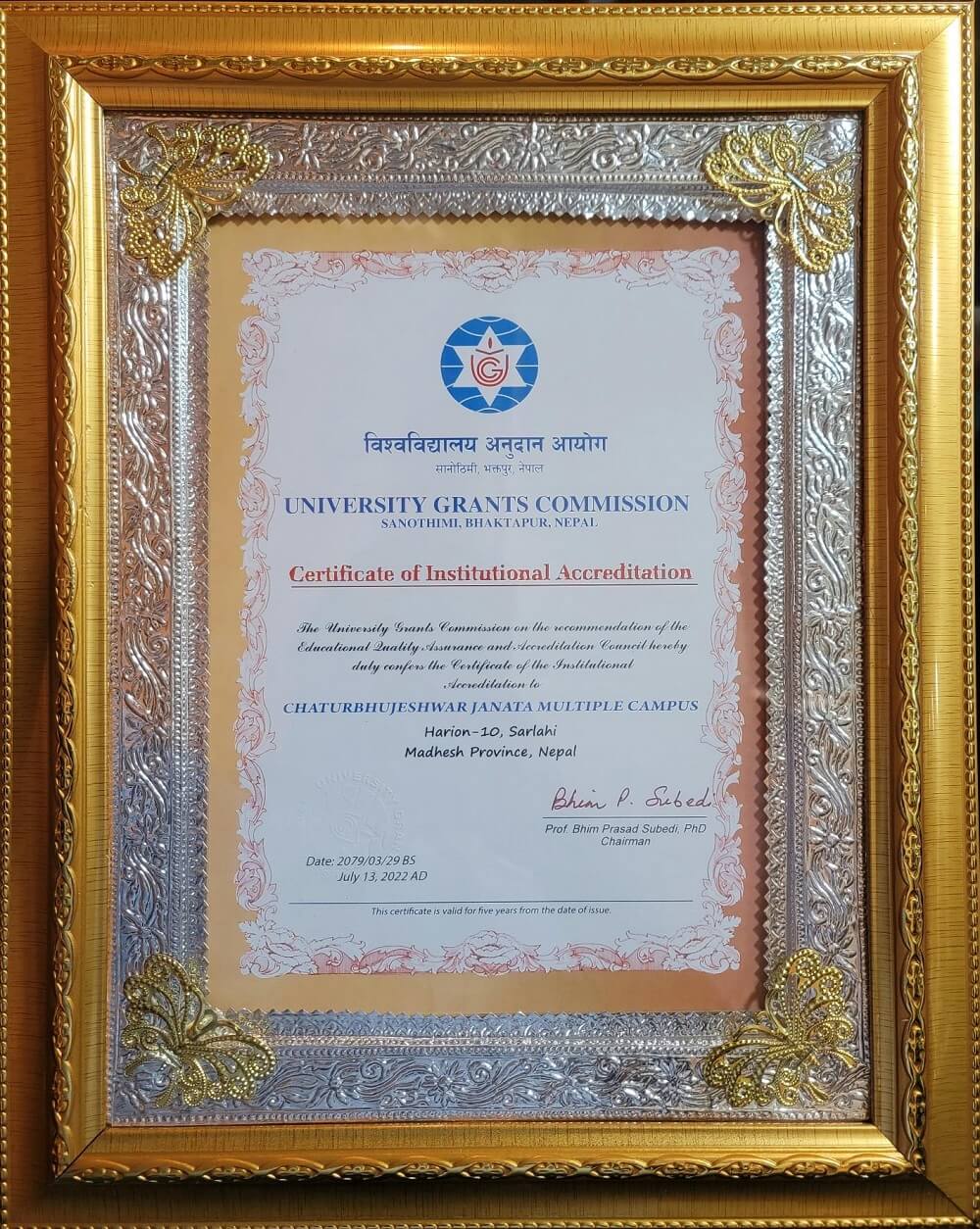
Quality Status: UGC Quality Assurance and Accreditation (QAA) certificate received on 2079 Ashar 29
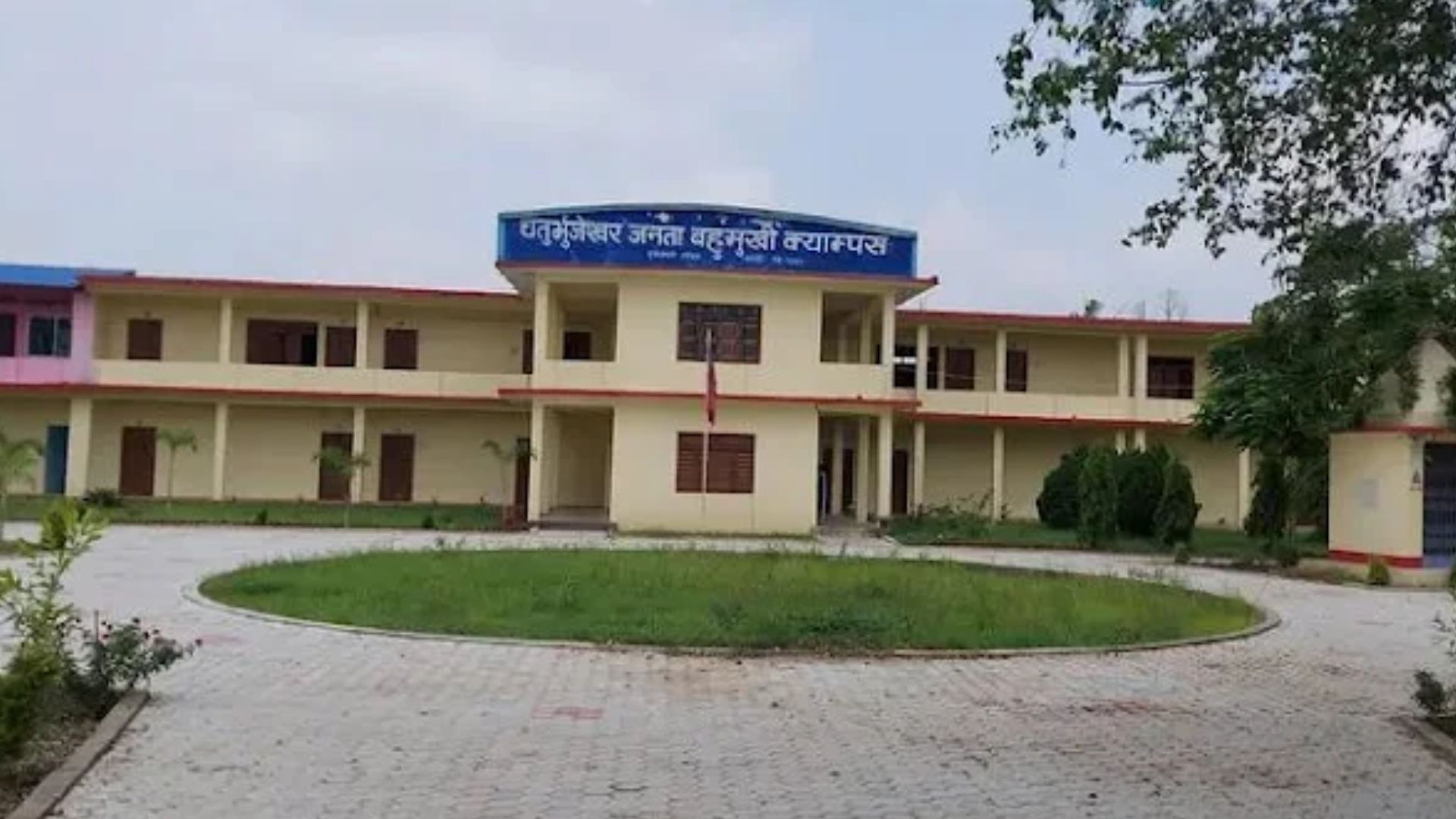
The campus was established through the initiative of local people who wanted to make higher education available within the area. It was named after Shree Chaturbhujeshwar Mahadev Temple at Sukhepokhari in Sarlahi District. The campus location, about 300 meters south of Sukhepokhari Chowk on the East-West Highway, places it within a mixed social and economic setting that includes Brahmin, Chhetri, Tamang, Magar, Madhesi, and Muslim communities. This local base shaped its role as a community-run educational institution rather than a privately driven one.
The institution started higher education teaching in 2048 BS with the Proficiency Certificate Level in Humanities. Over time, it added bachelor’s and master’s programs. The file also records a gradual physical expansion from borrowed classrooms at Chaturbhujeshwar Janata Secondary School to its own buildings, including a separate library building and canteen. This growth shows a steady transition from a small local campus into a broader academic center serving multiple levels of study.
The campus also maintains structured academic administration. Its governance includes the campus assembly, monitoring and management committees, IQAC, research committee, internal examination and evaluation committee, placement and student counselling committee, library committee, ECA committee, and EMIS committee. This administrative structure supports regular academic planning, internal review, student feedback, and record management.
Chaturbhujeshwar Janata Multiple Campus offers programs across NEB and TU frameworks. At the Ten Plus Two level, the campus runs Education, Humanities, and Management streams under NEB. At the university level, it runs BA, B.Ed., and BBS as four-year annual-system bachelor’s programs, while its stated master’s offering includes M.Ed. in Health Education under the semester system. The academic progress section also records master’s-level Education approval in Health and EPM.
The NEB section of the campus includes Ten Plus Two in Education, Humanities, and Management. These programs follow the standard NEB two-year structure for Class 11 and Class 12. Class 11 admission, enrollment, and subject registration are handled through the institution under the NEB framework, while Class 12 serves as the final national board examination stage managed by NEB.
The BA program is a TU-affiliated four-year bachelor’s program under the Faculty of Humanities and Social Sciences. The TU course file identifies BA as a 2,000-mark program spread across four years, with 500 marks each year. Students study compulsory English, Nepali, and Nepal Studies and choose two major subjects and two elective subjects. The evaluation pattern combines 70 marks in written examination and 30 marks for internal assessment that may include mini-projects, classroom presentation, and teamwork. General eligibility includes Grade 12 or equivalent, with subject-related conditions for selected majors.
The campus’s approved Humanities subject areas include English, Nepali, Economics, Mathematics, Political Science, History, Rural Development, and Sociology/Anthropology. This gives the BA stream a wider subject base within the campus than the short course list alone suggests.
The B.Ed. program at the campus is a four-year annual-system program under the Faculty of Education, Tribhuvan University. TU describes the program as both academic and professional, designed to prepare competent teachers who can teach two subjects at the secondary level. The curriculum carries 22 courses and 2,200 marks across communication skills, professional core areas, major specialization, minor specialization, and teaching internship or practicum.
For campus-level academic scope, the Education faculty approvals include English, Nepali, Economics, Population Education, and Health and Physical Education. TU entry requirements vary by specialization area and may depend on prior Grade 12 or PCL subject background, including subject-specific entrance conditions in some cases.
The BBS program is a four-year annual-system TU program under the Faculty of Management. At the campus, approved Management subject areas include Accountancy, Finance, and Marketing. The TU curriculum builds through foundation and core management courses and moves toward concentration and project work in the fourth year. Final project work is a required academic component, and the annual system is administered through TU’s Office of the Controller of Examinations. Students must also meet a minimum 70 percent attendance requirement to qualify for annual examinations.
The campus course list names M.Ed. in Health Education, and the academic progress section records master’s-level Education approval in Health and EPM. The TU M.Ed. semester curriculum is a two-year, four-semester program carrying 69 credit hours. It includes seven core courses, seventeen specialization courses, teaching practice, and thesis writing. Semester evaluation combines internal performance and semester-end examinations conducted by the Office of the Dean, Faculty of Education. Admission to M.Ed. generally requires a B.Ed. or equivalent qualification recognized by TU, and selection is based on marks obtained in the entrance examination for the specialization area.
Admission at the campus follows the affiliation and level of the program. For NEB Class 11, admission usually begins after SEE results. Students submit the application form and required academic documents, and the process may include an entrance examination, interview, or merit-based selection depending on the stream or campus procedure. After fee payment and enrollment, subject registration is completed under the NEB framework. For Class 12, NEB manages the final board examination process, including examination application procedures, centers, schedules, and results.
Common documents for BA, BBS, and B.Ed admission:
Class 12 or equivalent transcript
Character certificate
Migration certificate (if applicable)
Transfer certificate
Citizenship or birth certificate copy
Passport-size photographs
Entrance scorecard (if required)
Completed application form
Admission fee receipt
Equivalence certificate for foreign qualifications
Common documents for NEB Class 11 admission:
SEE marksheet
Character certificate or school leaving certificate
Transfer certificate
Migration certificate (if applicable)
Citizenship or birth certificate copy
Photographs
Class 11 registration or subject registration form
TU master’s admission process:
Admission notice is published by the campus or concerned authority
Eligible applicants submit the prescribed application form
Selection may include an entrance examination
Documents for M.Ed admission:
Bachelor-level transcript
Certificate or provisional certificate
Character certificate
Migration certificate (if applicable)
Transfer certificate
Citizenship or birth certificate copy
Photographs
Completed application form
Admission fee receipt
Equivalence certificate (where needed)
M.Ed. admission note:
The specialization-area entrance process is included in the TU semester curriculum
The campus reports that its teachers come from different parts of Nepal and that full-time teachers outnumber part-time teachers. Students from neighboring districts also study here, which reflects the campus’s broader regional role.
Its teaching approach includes problem-solving, project work, discussion, participatory learning, experimental work, question-answer, educational visits, and survey methods. The use of ICT has also been introduced in teaching, training, and evaluation. This mix suggests a classroom environment that does not rely only on lecture delivery and includes academic participation, practical work, and field-oriented learning. In the case of BBS and M.Ed., the TU frameworks also support project work, assignments, seminar participation, case studies, field study, teaching practice, and thesis writing where applicable.
The campus’s physical growth took place in phases. It began without its own building and initially used school premises. Later, it added a seven-room building, a second floor, further room extensions, a two-storey building, a separate library building completed in 2074, a canteen completed in 2076, another two-storey block under development, and a cycle stand with capacity for about 100 cycles.
Academic and student-use facilities include library services, science lab, computer lab, multimedia support, classrooms, conference hall, journal access, counselling, and scholarship support. Educational materials noted in the campus file include a study room with newspapers, magazines, and books, an e-library facility, computer laboratory access, and projector support. The campus also has its own playground covering 3 bighas and 12 katthas, with planning support from Harivan Municipality for development into a stadium.
Student life at the campus is shaped by both formal academic processes and community engagement. The campus prepares an annual academic calendar, prospectus, work plan, and budget, and it carries out annual audits. It also maintains electronic archiving of campus data, regular internal examinations, student progress evaluation, teacher and campus evaluation by students, student orientation, and EMIS-based academic support. Wi-Fi connection, website development, and online classes during COVID-19 closures are part of this administrative and academic environment.
The institutional structure also includes a placement and student counselling committee, scholarship committee, library committee, and ECA committee. This suggests that student support is linked with both classroom learning and broader campus services. Primary health service is also mentioned among campus activities.
The campus identifies sports, dance, music, tours, and ECA as part of its salient features, and it reports regular ECA programs for students. These activities extend student experience beyond the classroom and connect campus life with participation, culture, and physical activity.
Its social engagement section adds more detail. Students and faculty have participated in awareness programs on violence against women, blood donation and cleanliness campaigns, distribution of stationery to children in care homes, and volunteer work in places affected by floods, landslides, fire, storms, and windstorms. These activities show that ECA and campus participation also include community-oriented work.
Scholarship support is one of the campus’s stated student services. The campus specifically mentions scholarship facilities for Dalit, Janajati, Madheshi, and other students from marginalized groups. Its organizational structure also includes a scholarship committee, which indicates that scholarship administration is treated as a formal institutional function.
The social contribution section also notes regular scholarship grants from Harivan Municipality with the purpose of reducing financial barriers to higher education. In the same section, the campus records annual construction and procurement grants from Harivan Municipality and other community-based support, which strengthens the financial base around student services and infrastructure.
One of the institution’s major milestones is its UGC Quality Assurance and Accreditation recognition, recorded on 2079 Ashar 29. The campus also notes that it has signed and operated five-year Equity Grants and Extended Performance Based Grants programs under the University Grants Commission since 2079. These milestones point to formal academic quality review as well as project-based institutional support.
Other milestones can be seen in its gradual academic expansion and administrative development. The campus moved from certificate-level beginnings to bachelor’s and master’s levels, added new academic subject approvals over time, built its own infrastructure, continued annual progress reporting, introduced ICT use in teaching and evaluation, and maintained research publication, internal review, and student feedback systems.
Chaturbhujeshwar Janata Multiple Campus stands out most clearly as a community-based campus with a long local history, a mix of NEB and TU programs, and a structure that links academic study with student support. For students in Sarlahi and surrounding districts, the campus offers access to secondary, bachelor’s, and master’s study within one institution.
Its academic appeal comes from a few concrete points: recognized affiliation under NEB and TU, annual-system bachelor programs and semester-system master’s study, a library and lab-based learning environment, scholarship support for marginalized groups, counselling and ECA structures, and a UGC-backed quality-assurance record. For students looking for a community-rooted institution with established academic administration and expanding facilities, the campus offers a stable setting for study.
Chaturbhujeshwar Janata Multiple Campus has developed from a locally initiated community campus into a multi-level institution offering NEB and TU programs in Sarlahi. Its growth includes academic expansion, infrastructure development, formal governance committees, scholarship support, and UGC quality-assurance recognition. The campus serves both its immediate locality and students from nearby districts, combining access, community participation, and structured academic administration in one institution.
Contact Chaturbhujeshwar Janata Multiple Campus's administrative office for detailed information on the course, admissions, location, fees, scholarships, facilities, counseling, or eligibility.
Chaturbhujeshwar Janata Multiple Campus
Location: Hariban, Sukhepokhari, Sarlahi, Madhesh Province, Nepal
Email Address: info@cjmcsarlahi.edu.np
Phone Number: +977-46-530413, +977-9855045677
Website: http://www.cjmcsarlahi.edu.np
The campus is affiliated with Tribhuvan University for higher education programs and with the National Examination Board for Ten Plus Two studies.
The campus offers Ten Plus Two in Education, Humanities, and Management; bachelor’s programs in BA, B.Ed., and BBS; and its course list names M.Ed. in Health Education. The academic progress section also records master’s-level Education approval in Health and EPM.
The campus is located at Hariban, Sukhepokhari, Sarlahi, Madhesh Province, Nepal. The background section also places it about 300 meters south of Sukhepokhari Chowk on the East-West Highway.
Yes. The campus mentions scholarship facilities for Dalit, Janajati, Madheshi, and other marginalized groups. It also records regular scholarship grants from Harivan Municipality.
The campus lists a library, sports, science lab, computer lab, multimedia support, classrooms, conference hall, counselling, journal access, dance, music, tour, and ECA activities. It also records an e-library, projector facility, study room, playground, canteen, and cycle stand.
Yes. The campus received the UGC Quality Assurance and Accreditation certificate on 2079 Ashar 29.
For TU annual-system bachelor programs, final examinations are conducted through TU’s Office of the Controller of Examinations. For semester-system master’s study, semester-end examinations are conducted by the respective Dean’s Office. For NEB, the Class 12 final board examination is managed by NEB.