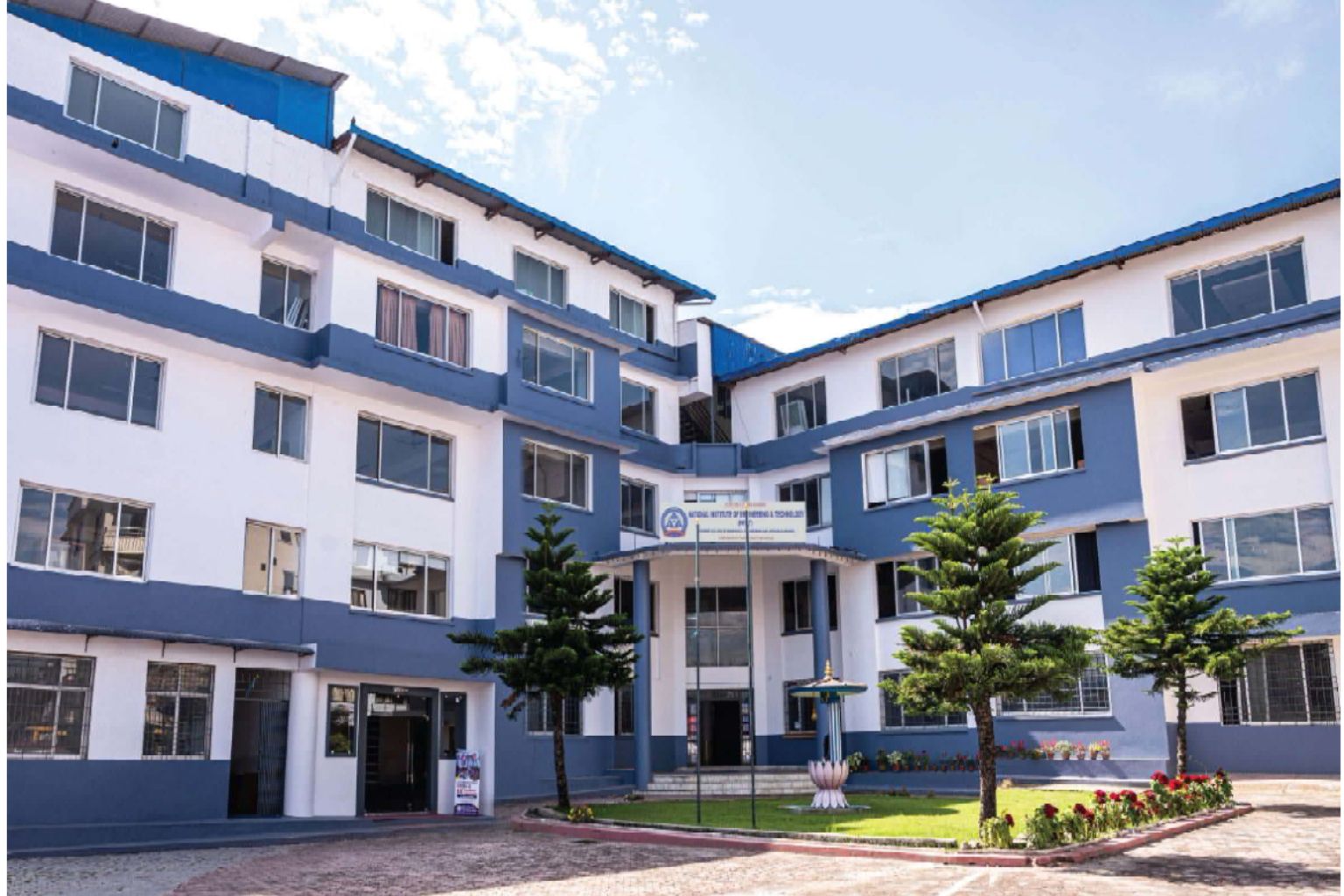
National Institute of Engineering and Technology (NIET) is an engineering institute located in Kupondole, Lalitpur. Established in 2005 under the name College of Biomedical Engineering and Applied Sciences (CBEAS), the institute began with a particular academic focus on Biomedical Engineering before expanding its bachelor-level portfolio into Computer Engineering and Artificial Intelligence.
NIET is affiliated with Purbanchal University, registered with the Nepal Engineering Council, and certified under the University Grants Commission’s Quality Assurance and Accreditation system. Some existing course pages continue to use the former CBEAS name, while the institution now operates under the NIET identity.
| Field | Details |
|---|---|
| Institution | National Institute of Engineering and Technology |
| Abbreviation | NIET |
| Former name | College of Biomedical Engineering and Applied Sciences |
| Established | 2005 |
| Location | Kupondole, Lalitpur |
| Affiliation | Purbanchal University |
| Academic level | Bachelor’s degree |
| Academic areas | Biomedical Engineering, Computer Engineering and Artificial Intelligence |
| Quality status | UGC-QAA certified |
| Professional registration | Nepal Engineering Council |
| Medium of instruction | English |
NIET appears in Purbanchal University’s institutional records in Kupondole, Lalitpur, with approved programs in Computer Engineering and Artificial Intelligence.
NIET conducts its bachelor’s programs under Purbanchal University. The university is responsible for the academic regulations, course structures, examination systems and degree requirements followed by the institute.
The Biomedical Engineering and Computer Engineering programs fall under the university’s Faculty of Engineering. The BTech in Artificial Intelligence is administered under the Faculty of Science and Technology.
NIET’s UGC-QAA certification indicates that the institution has completed the quality assurance and accreditation process administered by the University Grants Commission. Its registration with the Nepal Engineering Council connects its engineering education with Nepal’s professional engineering framework.
NIET offers three bachelor-level programs, with a combined intake of 240 seats.
| Program | Seats | Main academic focus |
|---|---|---|
| BE in Biomedical Engineering | 144 | Engineering, biological sciences and medical technology |
| Bachelor of Computer Engineering | 48 | Programming, computing systems, electronics and software |
| BTech in Artificial Intelligence | 48 | Programming, intelligent systems, mathematics and project work |
Each program follows a semester-based curriculum combining theory, tutorials, practical sessions, laboratory work and academic projects.
The BE in Biomedical Engineering is the largest program at NIET, with an intake of 144 students. It combines engineering subjects with biological and medical sciences, giving students an academic foundation for understanding the design, operation and technical aspects of healthcare-related systems and equipment.
The early semesters cover Mathematics, Physics, Computer Programming, Basic Electrical Engineering, Basic Electronics Engineering and Engineering Drawing. Students also study Chemistry, Basic Mechanical Engineering, Electro Engineering Materials, Introduction to Computational System and Digital Electronics.
The curriculum gradually moves into subjects specific to biomedical engineering, including:
Bio-Engineering Materials and Components
Human Anatomy and Physiology
Cell Biology and Immunology
Biomechanics
Biomedical Embedded System Design
Implantable Devices
Microprocessor
Electronic Devices and Circuits
Fluid Mechanics and Thermodynamics
Probability and Statistics
Numerical Methods
This combination requires students to work across several disciplines rather than treating biomedical engineering as a purely medical or purely electronic subject. The course structure assigns marks to internal assessment, university examinations and practical components according to the nature of each subject.
The Bachelor of Computer Engineering program has an intake of 48 students. Its curriculum combines software development, computing theory, electronics, mathematics and engineering fundamentals.
Students begin with Mathematics, Physics, English for Technical Communication, Computer Programming, Fundamental of Computing Technology, Engineering Drawing and Workshop Technology. The following semesters introduce Object-Oriented Programming with C++, Digital Logic, Basic Electrical Engineering and Applied Mechanics.
As students progress, the program includes subjects such as:
Data Structure and Algorithm
Object-Oriented Analysis and Design
Computer Graphics
Database Management System
Python Programming
Discrete Structure
Microprocessor
Communication System
Computer Architecture and Design
Algorithm Analysis and Design
Probability and Statistics
Project work
The curriculum uses internal and final examinations, with separate practical evaluation where laboratory work forms part of the subject. Project courses give students a structured setting for applying programming, system design and technical problem-solving skills.
The BTech in Artificial Intelligence is a four-year program divided into eight semesters. It is offered under Purbanchal University’s Faculty of Science and Technology and has an intake of 48 students.
The curriculum starts with Introduction to Programming, Digital Logic, Calculus, Introduction to Artificial Intelligence, Technical Report Writing and Presentation, and Society and Professional Ethics.
The second semester moves into Object-Oriented Programming, Artificial Intelligence and Intelligent Systems, Microprocessor and Assembly Language, Probability and Statistics, Linear Algebra and Project I.
Project work begins in the second semester and continues through the remaining semesters. Students may work in groups of up to three under an academic adviser. The project system covers planning, research, teamwork, implementation, assessment, report writing and presentation.
Assessment includes class participation, assignments, laboratory work, tests, quizzes and end-semester examinations. The regulations require at least 80% attendance in lectures, tests and tutorial classes for a student to qualify for the final examination in a subject.
For combined theory and practical courses, the assessment distribution is 20% internal marks, 20% practical marks and 60% final examination marks. Pure theory courses carry 20% internal and 80% final examination marks, while laboratory courses are assessed through continuous internal evaluation and a final university viva.
NIET’s academic structure gives practical work a defined place within each program. Laboratories support subjects involving programming, electronics, digital systems, microprocessors and biomedical applications. Practical marks are included separately in many courses, making laboratory participation part of formal academic evaluation rather than an optional activity.
Project work develops gradually through the programs. Students are expected to identify a technical problem, plan the work, apply relevant theory, prepare reports and present their results. This process helps connect classroom concepts with design, experimentation, programming and system development.
NIET also reports student participation in research projects and publications. Its institutional development has included expanded laboratory and research facilities and additional space for academic activity.
Applicants seeking admission to NIET must have completed 10+2 or an equivalent qualification with Physics, Chemistry and Mathematics. A minimum aggregate of 50% is required under the institute’s stated admission criteria.
Applicants to the BTech in Artificial Intelligence must also meet Purbanchal University’s program regulations. These regulations require twelve years of schooling in the science stream and successful completion of the university entrance examination.
The university regulation for BTech in AI accepts either:
A minimum D+ grade in every subject with a CGPA of 2.0 or above; or
At least second division, equivalent to 45%, in 10+2, PCL or an equivalent science qualification.
NIET’s stated 50% aggregate requirement represents the college-level admission benchmark for applicants.
Students awaiting Grade 12 results may apply for the BTech AI entrance examination but must submit the required academic documents at admission. Applicants holding foreign academic certificates must submit an equivalence certificate and documents showing subject grades, CGPA or total percentage.
Admission procedures may differ across the three programs because the BE courses and BTech program operate under separate Purbanchal University faculties.
NIET offers merit-based and need-based scholarships. Merit scholarships are intended for applicants or enrolled students with strong academic performance, while need-based support considers a student’s financial circumstances.
Scholarship amounts, continuation conditions and the number of awards can depend on the applicable intake and institutional criteria. Students seeking financial assistance are assessed under the scholarship category for which they qualify.
NIET includes internship exposure within its approach to technical education. The institute links academic preparation with practical assignments, project work, laboratory participation and contact with professional settings.
Internships allow students to observe how engineering concepts are used in workplaces and to understand expectations related to technical communication, teamwork, documentation and professional conduct. The nature and placement of an internship may depend on the program, academic schedule and available partner organisation.
The curricula themselves also support workplace preparation through technical report writing, presentations, practical assessment, group projects and professional ethics.
NIET reports a zero-unemployment record among its graduates. This is an institution-reported outcome rather than a placement guarantee for every future student.
The institute also states that more than 40% of its graduates have pursued postgraduate education outside Nepal since its first batch graduated in 2009. Reported destinations include the United States, United Kingdom, Canada, Germany, Australia and Japan.
Some graduates have received international scholarships, including Erasmus Mundus and SINGA awards. Others have remained in Nepal for employment or business activities. These outcomes show that graduates have followed different routes involving further study, technical work and entrepreneurship.
International students from SAARC member states and other countries may apply to NIET. Applicants with foreign qualifications are required to complete the academic equivalence process and provide a clear record of grades, CGPA or percentage.
NIET states that it assists international students with visa-related documentation, accommodation arrangements and cultural adjustment. Applicants must still meet the academic and entrance requirements applicable to their chosen program.
English is used as the medium of teaching and examination, which also applies to the BTech in Artificial Intelligence under Purbanchal University regulations.
Regular attendance is an academic requirement, particularly in programs that combine lectures, tutorials, laboratory sessions and project work.
For the BTech in Artificial Intelligence, students must maintain at least 80% attendance in lectures, tests and tutorial classes before sitting for the final examination of a subject. Missed academic work arising from an unavoidable absence must be completed.
Students are assessed throughout the semester rather than through a final examination alone. Assignments, laboratory performance, quizzes, class tests, project reports, presentations and viva examinations may all contribute to the final result.
NIET has a concentrated academic portfolio rather than a broad collection of unrelated degrees. Its three programs are connected through engineering, computing, electronics, mathematics and applied technical work.
Biomedical Engineering brings engineering and life sciences into the same curriculum. Computer Engineering combines hardware, software and computing systems. Artificial Intelligence places programming and intelligent systems within a project-based four-year degree.
This combination may suit students who want a technical bachelor’s program with regular laboratory work, semester assessment and structured projects. The institute’s UGC-QAA status, Purbanchal University affiliation and Nepal Engineering Council registration also provide a defined academic and institutional setting.
Applicants must have completed 10+2 or an equivalent qualification with Physics, Chemistry and Mathematics. NIET requires a minimum aggregate of 50%. Program-specific entrance and documentation rules also apply.
NIET reports a zero-unemployment record among its graduates. It also states that more than 40% of graduates have continued to postgraduate study outside Nepal. These are institution-reported outcomes and do not constitute an individual employment guarantee.
Yes. NIET offers merit-based and need-based scholarships for eligible students. Scholarship decisions depend on the relevant academic and financial criteria.
Its academic portfolio is centred on Biomedical Engineering, Computer Engineering and Artificial Intelligence. These programs use laboratory work, projects, practical assessment and internship exposure as part of technical preparation.
Yes. Students from SAARC countries and other international locations may apply. NIET provides support related to visa documentation, accommodation and cultural adjustment, while applicants must meet the applicable academic and entrance requirements.