Doti Multiple Campus (डोटी बहुमुखी क्याम्पस) is a constituent campus of Tribhuvan University located in Dipayal Silgadhi, Doti, Sudurpashchim Province. Established on Jestha 3, 2017 B.S. (1960 AD), it is among the oldest higher education institutions in Nepal’s far-western region.
The campus was founded only a year after the establishment of Tribhuvan University. At that time, access to higher education remained limited for people living outside Nepal’s major urban centres. Students from socially, economically, and educationally disadvantaged communities faced particular difficulty continuing their studies.
Doti Multiple Campus was established to bring higher education closer to those communities. It began with three teachers and nine students and gradually developed into a multidisciplinary institution offering bachelor’s and master’s programs in humanities and social sciences, education, management, and computer application.
The campus has 36 teaching faculty members serving in different academic positions and 23 non-teaching staff members supporting administrative, technical, and institutional work. Its development reflects both its historical role in Doti and its continuing responsibility to widen access to higher education in Sudurpashchim Province.
Official Name: Doti Multiple Campus
Nepali Name: डोटी बहुमुखी क्याम्पस
Established: Jestha 3, 2017 B.S. (1960 AD)
Institution Type: Constituent campus
Affiliation: Tribhuvan University
Location: Dipayal Silgadhi, Doti, Sudurpashchim Province, Nepal
Academic Levels: Bachelor’s and master’s
Programs: BA, B.Ed., BBS, BCA, MA in Nepali, and MA in Sociology
Academic Systems: Annual and semester
Research Unit: DMC Research Center
Academic Publication: DMC Research Journal
Learning Resources: Library, electronic library, computer laboratory, internet access, and multimedia equipment
Student Accommodation: Boys’ and girls’ hostels
Scholarship Support: Endowment-based scholarships and local-government support for BCA students
Doti Multiple Campus began without a permanent academic complex. Its earliest classes were conducted at Padma Public Higher Secondary School and in a nearby dharamshala. These temporary arrangements allowed teaching to begin even though the institution did not yet have sufficient buildings of its own.
The campus later moved into a nine-room building, creating a more stable base for classes and administration. A store building was subsequently added with assistance connected to the Seti Zone administration.
Another important development took place in 2037 B.S., when Mahendra Library was transferred to the campus. The transfer provided a foundation for institutional library services and strengthened the academic resources available to students and teachers.
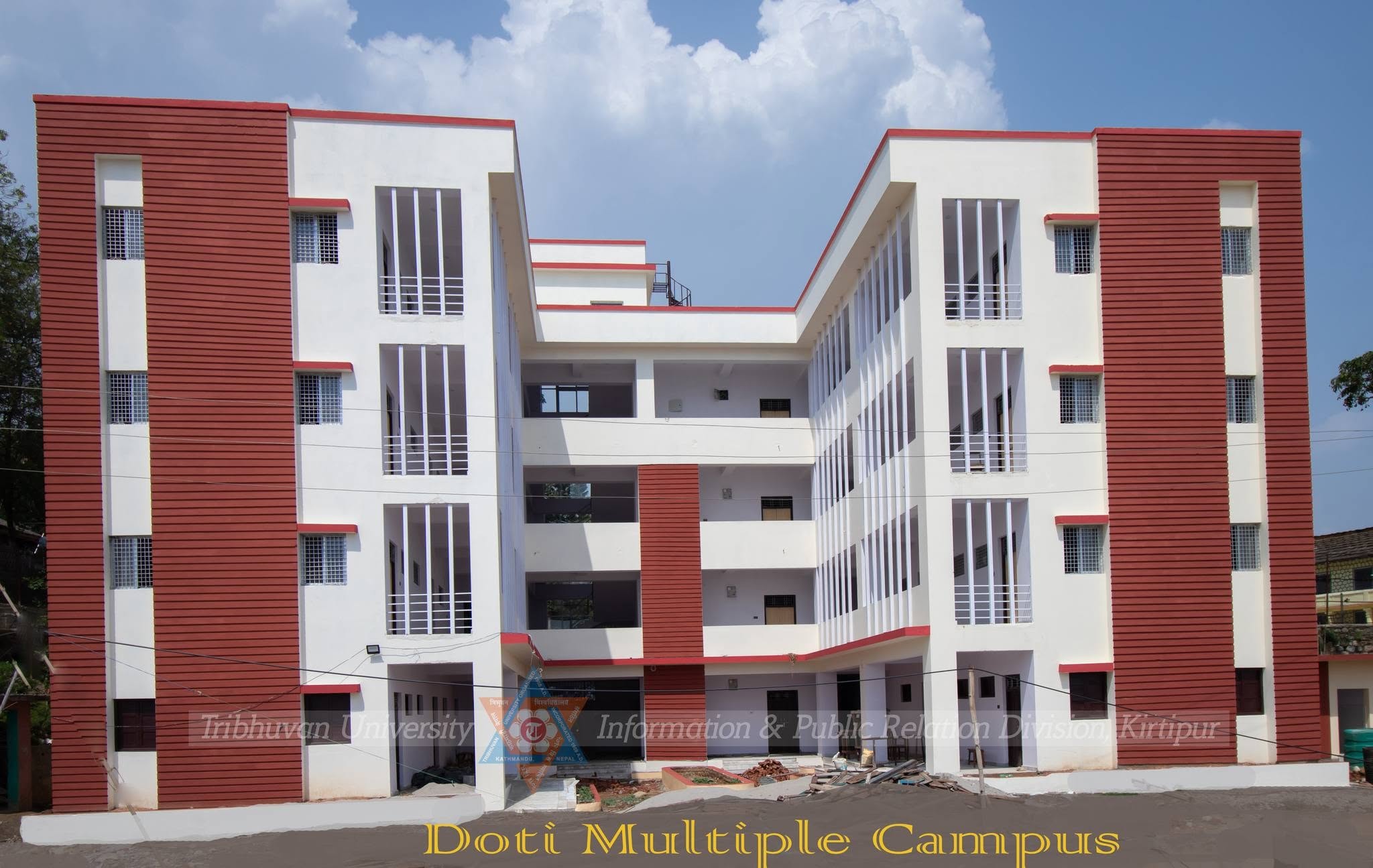
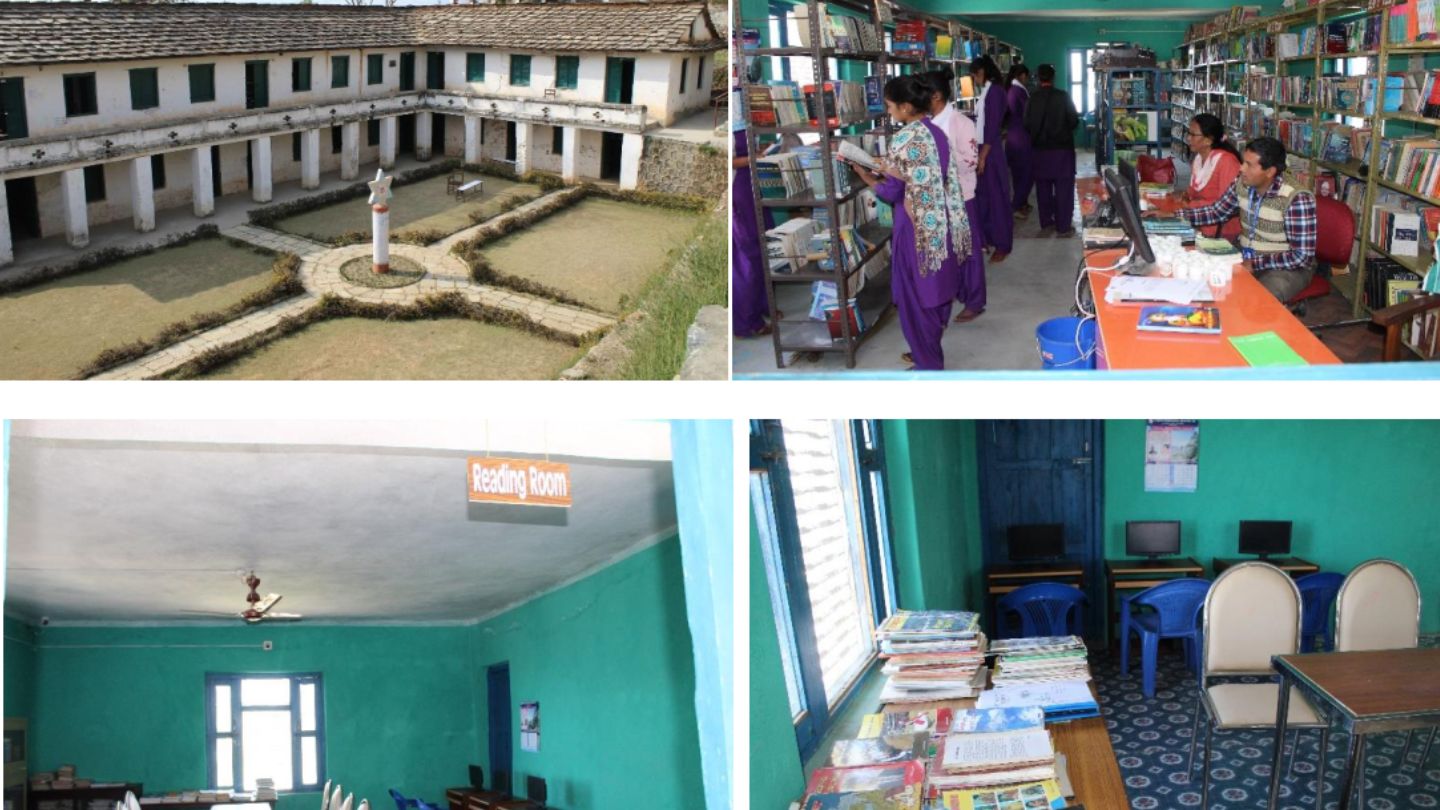
The campus’s physical position expanded significantly in 2054 B.S. Through a decision of the Government of Nepal, the land and buildings of P. Chandra Hospital were transferred to Doti Multiple Campus. These structures were later used for administration, library services, laboratory activities, meetings, and other institutional functions.
The transfer gave the campus more room to organize its academic and administrative work. It also marked an important stage in the development of an institution that had started in borrowed and temporary spaces.
The first academic offering at Doti Multiple Campus was the Intermediate in Arts program. Bachelor of Arts classes were introduced in 2030 B.S., establishing the foundation of its bachelor’s-level education.
The campus also conducted several programs for limited periods as educational policies and regional needs changed. These included pre-service training, certificate-level law education, and a ten-month primary-level teacher training program introduced in 2060 B.S.
The Bachelor of Education program began in 2057 B.S. This expansion created a route for students interested in professional and academic preparation for teaching.
The Bachelor of Business Studies was introduced in 2067 B.S., extending the campus into management education. Master’s-level teaching began with MA in Nepali in 2069 B.S., followed by MA in Sociology in the academic year 2070/071 B.S.
The BCA program was introduced in 2074/075 B.S. Its establishment brought a computer-oriented academic option to a campus whose earlier development had centred mainly on humanities, education, and management.
This progression shows how Doti Multiple Campus has gradually broadened its academic role. Humanities formed its original base, teacher education responded to regional educational needs, management added business and administrative study, postgraduate programs allowed advanced learning within Doti, and BCA introduced a technology-focused pathway.
Doti Multiple Campus works to expand access to higher education for students from different social, economic, and educational backgrounds. Its institutional direction places particular importance on students from disadvantaged and marginalized communities.
Affordability is closely connected with this purpose. For many students from Doti and surrounding areas, studying close to home can reduce the financial and practical burden associated with relocating to another district or city.
The campus’s academic priorities extend beyond classroom instruction. It emphasizes cognitive and experiential learning, research, leadership, and service. Its development plans also address teaching quality, faculty development, financial sustainability, infrastructure, technology, institutional cooperation, and the introduction of relevant academic programs.
Its principal development areas include:
supporting student success and graduate capability;
improving curricular and pedagogical practices;
creating continuous development opportunities for faculty and staff;
strengthening and diversifying financial resources;
improving physical and technological infrastructure;
expanding cooperation with university units, communities, and governments;
developing institutional capacity; and
introducing applied programs in response to changing educational needs.
These priorities reflect the campus’s effort to connect its long history with present academic demands. The task is not only to continue existing programs, but also to improve teaching, research, student services, technology, and institutional management.
Doti Multiple Campus offers four bachelor’s programs and two master’s programs under Tribhuvan University.
| Program | Academic Area | Duration and System |
|---|---|---|
| Bachelor of Arts | Humanities and Social Sciences | 4 years, annual |
| Bachelor of Education | Education | 4 years, annual |
| Bachelor of Business Studies | Management | 4 years, annual |
| Bachelor of Computer Application | Humanities and Social Sciences | 4 years, semester |
| MA in Nepali | Humanities and Social Sciences | 2 years, semester |
| MA in Sociology | Humanities and Social Sciences | 2 years, semester |
The Bachelor of Arts is closely connected with the original academic identity of Doti Multiple Campus. The available subject areas include compulsory English and Nepali, together with English, Nepali, Economics, Mathematics, Geography, Political Science, History, Population Studies, Sociology, and Rural Development.
Tribhuvan University’s four-year BA program follows an interdisciplinary structure. It carries 2,000 marks across four academic years, with 500 marks assigned to each year. The structure includes compulsory, major, and elective components.
Students select subjects from the academic areas available through the campus while following the university’s curricular requirements. The program brings together language, society, history, geography, economics, politics, population, and rural development.
Assessment under the university structure combines written examinations with internal academic work. Internal evaluation may include classroom presentations, teamwork, and mini-projects.
The breadth of available subjects allows students to develop an academic combination connected with their interests and future study plans. It also supports progression into postgraduate study in eligible disciplines.
The Bachelor of Education is a four-year annual-system program under Tribhuvan University’s Faculty of Education. It is both an academic and professional program designed to prepare students for teaching two subjects at the secondary level.
The university curriculum is organized around a specialization major and a specialization minor. Students complete 22 courses grouped into communication skills, professional core studies, specialization major courses, specialization minor courses, and teaching internship or practicum.
General Nepali and General English form the communication component. Professional core study includes philosophical and sociological foundations of education, educational psychology, curriculum and evaluation, and an elective related to instructional technology or information and communication technology.
Specialization areas may include:
Nepali language education;
English language education;
mathematics education;
science education;
health and physical education;
population education;
geography education;
economics education;
history education; and
political science education.
The specialization minor must be different from the major, subject to the university’s curriculum and entry requirements.
Teaching practice is an important part of the program. It connects educational theory, subject knowledge, classroom planning, teaching methods, and professional experience.
For students from Doti and nearby communities, the program provides access to teacher education within the region. It also reflects the campus’s long involvement in educational and teacher-development activities.
The Bachelor of Business Studies is a four-year annual program under Tribhuvan University’s Faculty of Management. Its curriculum combines foundation courses, core management subjects, concentration study, and research-related work.
The first stage of the program builds a foundation in business English, statistics, economics, accounting, and management. Later courses develop understanding of communication, finance, organizational behaviour, human resource management, business law, taxation, marketing, entrepreneurship, strategy, and research methods.
Major areas within the curriculum include:
business communication;
business statistics;
microeconomics and macroeconomics;
financial accounting;
cost and management accounting;
principles of management;
marketing;
financial management;
business law;
organizational behaviour;
human resource management;
taxation;
entrepreneurship;
business environment and strategy; and
business research methods.
At Doti Multiple Campus, the available concentration areas include marketing and finance.
The program is intended to provide a broad understanding of organizations and their functional areas. It does not restrict management education to a single subject. Instead, it connects accounting, economics, finance, communication, marketing, law, strategy, and research.
The introduction of BBS in 2067 B.S. widened the academic options available to students seeking management education within Doti.
The Bachelor of Computer Application is the principal technology-oriented program offered by Doti Multiple Campus. It began in the academic year 2074/075 B.S. and follows a semester system extending across four academic years.
The Tribhuvan University curriculum is organized into eight semesters. It combines computer application subjects with mathematics, statistics, language, social science, management, elective study, project work, and internship experience.
The program includes theoretical study as well as practical and project-based learning. Its academic structure requires regular participation, internal evaluation, final examinations, practical work, and semester registration.
Student performance is assessed through internal and external components. Internal assessment is conducted during the semester, while final examinations are held at the end of each semester. Practical subjects include practical evaluation in addition to theoretical assessment.
The program also follows attendance requirements. Students are expected to attend lectures, tutorials, and practical classes and must meet the required attendance level to qualify for final examinations.
BCA was introduced partly in response to the need for computer-oriented education within the district. Before its establishment, students interested in such study frequently had to leave Doti.
The program operates through internal campus resources, making local cooperation and financial assistance important. K.I. Singh Rural Municipality and Bogtan Fudsil Rural Municipality have supported scholarships for BCA students.
MA in Nepali is a two-year semester-based postgraduate program under Tribhuvan University’s Faculty of Humanities and Social Sciences.
The curriculum provides advanced study of Nepali language, literature, folk literature, literary criticism, literary history, linguistics, research, editing, drama, poetry, fiction, and related areas of Nepali intellectual and creative work.
Students study both theoretical and applied aspects of the discipline. The program includes opportunities to develop analytical, critical, editorial, research, and academic writing abilities.
The curriculum covers areas such as:
historical and social linguistics;
Sanskrit poetics;
Western criticism;
Nepali literary criticism;
modern Nepali essays;
folk literature;
general linguistics;
literary movements and critical methods;
pre-modern and modern Nepali literature;
drama and film theory;
poetry, fiction, and literary history;
research and creative methods; and
research or creative writing.
The program provides a postgraduate pathway for eligible students interested in advanced Nepali studies. It also contributes to the campus’s wider academic environment through literary discussion, research, editing, and publication-related work.
MA in Sociology is a two-year program divided into four semesters. It consists of 18 papers and a compulsory thesis in the fourth semester.
Fourteen papers are compulsory. Students may select three optional courses in the third semester and one optional course in the fourth semester.
The program develops understanding of sociological theories, methods, fieldwork, secondary data analysis, social institutions, social structures, cultural systems, human behaviour, social conflict, human rights, and social justice.
Its academic objectives include developing professional knowledge in sociological theory and research and preparing students to examine social and developmental issues through systematic study.
Evaluation is divided between internal and external assessment. Internal evaluation includes class attendance, participation, discussion, presentations, précis work, term papers, and class tests. The external component is conducted through the Dean’s Office on the basis of the final examination.
Students are required to maintain 80 percent attendance.
The program connects postgraduate sociology with the social and developmental concerns present in Doti and the wider far-western region. It also supports research activity through fieldwork, academic writing, data analysis, and thesis preparation.
Teaching at Doti Multiple Campus is not limited to conventional lectures. Faculty members use different methods according to the nature of the subject and academic program.
Teaching and learning activities include:
classroom lectures;
discussion;
question-and-answer sessions;
project work;
role-play;
report writing;
field visits;
investigative activities;
presentations; and
sessions with resource persons.
Multimedia projectors, internet resources, and other digital tools are used where required. These methods are particularly relevant to semester programs, which place regular emphasis on participation, assignments, practical work, presentations, and internal assessment.
Annual-system programs require sustained course coverage across the academic year. Semester programs involve more frequent evaluation and continuous engagement. The campus therefore works with both long-cycle and continuous-assessment teaching arrangements.
Subject teaching committees support academic coordination. Their responsibilities include distributing courses among teachers, assisting with class routines, organizing seminars and training, and contributing to academic publication.
Where there are not enough teachers to form a separate committee for a subject, related subjects may be combined for coordination.
Academic work is also supported by committees responsible for examinations, internal assessment, library and laboratory management, student welfare, hostels, research, information systems, quality assurance, counselling, feedback, and institutional self-assessment.
Doti Multiple Campus has established the DMC Research Center to encourage research among teachers and students.
The centre supports activities such as:
research and investigative writing;
mini-research projects;
workshops and seminars;
academic publication;
research-oriented discussion; and
cooperation with universities, governments, research bodies, and other organizations.
The centre operates under a separate regulatory framework and publishes the DMC Research Journal annually. Its work is connected with the Research Management Cell and the campus’s wider quality-assurance structure.
Academic publication has a longer history at the campus. Himshikhar was initiated by the Free Students’ Union in 2054 B.S. and continued for five volumes.
Shaildhara began in 2069 B.S. through the Doti campus unit of the Tribhuvan University Teachers’ Association. The DMC Research Journal was introduced during the campus’s 54th anniversary.
These publications provide opportunities for faculty members and students to participate in academic writing, research, analysis, and discussion. They are especially relevant to postgraduate study, where students complete term papers, research work, field studies, and thesis preparation.
The campus library supports programs in humanities and social sciences, education, management, and computer application. Its holdings include books, magazines, academic journals, theses, reports, and other reference resources.
A study room and photocopy service are available. Master’s-level theses, academic journals, and materials related to report writing are maintained for student and faculty use.
The electronic library is equipped with computers and connected with Tribhuvan University Central Library and other library networks. This arrangement allows students and faculty members to access and download academic resources.
Print and digital access are useful for programs that require project work, assignments, presentations, term papers, field reports, internal assessment, and thesis writing.
The campus has 41 computers, four laptops, six multimedia projectors, printers, photocopy equipment, networking devices, and internet services. Ten computers are specifically identified as being connected to the internet.
These resources support administration, classroom presentations, BCA practical work, research, digital study, and campus information management.
Doti Multiple Campus occupies a recorded land area of 49 ropanis and four aanas. Five buildings are used for educational and administrative purposes, while approximately six ropanis and four aanas are occupied by buildings.
Its physical facilities include:
16 classrooms;
nine restrooms for women and men;
two conference halls;
one training hall;
a canteen;
a Saraswati temple;
a six-room boys’ hostel;
a 16-room girls’ hostel; and
a sports ground.
The campus also has an administrative building, library and electronic library rooms, an examination hall, a computer laboratory, conference space, residential blocks for faculty and staff, and hostel buildings.
Some structures require repair, completion, or modernization. The former P. Chandra Hospital building continues to serve academic and administrative purposes, while several older residential structures also need improvement.
Two modern classroom buildings have been identified for completion. The campus has also recognized the need to repair the sports ground and develop it for broader use.
Its physical position therefore combines established resources with continuing infrastructure needs. The campus has land, classrooms, hostels, digital equipment, meeting halls, and library facilities, but some assets require further development.
Scholarship support at Doti Multiple Campus includes several endowment funds established by individuals and families. These funds are intended to recognize academic performance and assist students from economically disadvantaged backgrounds.
The scholarship endowments carry the names of:
Bam Bahadur Kathayat;
Tek Bahadur and Naralaxmi Amatya;
Tek Bahadur and Menuka;
Janaki Devi;
Gopal Prasad Joshi; and
Indra Devi–Khadak Bahadur.
BCA students have also received scholarship assistance from K.I. Singh Rural Municipality and Bogtan Fudsil Rural Municipality.
Student support extends beyond financial assistance. The campus maintains boys’ and girls’ hostel facilities and has institutional committees responsible for student welfare, hostel management, counselling, feedback, and placement-related coordination.
Other areas of student support include drinking water, sanitation, library access, administrative services, classroom improvement, and extracurricular activities.
These services are particularly important for students coming from remote communities. Accommodation, study facilities, academic resources, and accessible administration can influence whether students are able to attend classes regularly and continue a multi-year program.
As a constituent campus, Doti Multiple Campus operates within the academic and administrative structure of Tribhuvan University.
The Campus Management Committee supports institutional planning, resource management, policy implementation, and the conduct of academic activities. Its structure includes representation connected with education, society, business, and the local community. The chairperson of the Free Students’ Union is also represented.
Support received through Tribhuvan University’s higher education project structures contributed to several areas of campus development. These included:
construction of a conference hall;
toilet construction and maintenance;
drinking-water management;
campus software;
updated certificates and identity cards;
computers and printers;
multimedia projectors; and
furniture.
Internal responsibilities are distributed among different committees and units, including:
Internal Quality Assurance Committee;
Research Management Cell;
Public Information Cell;
Counselling, Feedback and Placement Cell;
Campus Student Welfare Committee;
Library and Laboratory Management Committee;
Self-Assessment Team;
Hostel Management Committee;
Procurement Committee;
Subject Teaching Committees;
Examination and Internal Assessment Committee; and
EMIS Committee.
This structure distributes academic, administrative, research, information, and student-support duties across dedicated bodies rather than concentrating them within one office.
Doti Multiple Campus has developed through the participation of teachers, students, guardians, donors, social workers, local governments, political representatives, and members of the wider community.
Faculty members participate in social research and may serve as subject experts for local governments. The campus also maintains contact with government and non-government bodies and encourages former students to contribute to institutional development.
Guardians provide suggestions during anniversary programs, creating another channel between the campus and the community.
The volleyball ground has been made available for district- and provincial-level competitions. Teachers, staff members, and students have also participated in public activities, including election education and immunization-related campaigns.
These activities show how the institution’s academic resources, staff, students, halls, grounds, and research capacity are connected with wider civic and educational life in Doti.
Doti Multiple Campus has considered several areas for future academic expansion. These include tourism and journalism within humanities, social studies within education, and management or social science programs such as BBM, BBA, and BSW.
B.Sc. Agriculture has also been discussed as a possible technical program, and the campus organized a religious ceremony connected with that initiative.
These programs are not part of the current academic offering. Their introduction would require academic approval, qualified faculty, suitable infrastructure, finance, and sustained institutional support.
More immediate development priorities include:
completing classroom buildings;
repairing and improving the sports ground;
strengthening internally financed programs;
expanding extracurricular and outreach activities;
upgrading technology;
improving academic and residential facilities; and
strengthening research and student support.
The campus’s next stage of development depends on how effectively it connects academic plans with available staffing, infrastructure, administration, and financial resources.
Applicants seeking admission to bachelor’s-level programs are expected to prepare the following documents:
passport-size photograph;
SLC or SEE marksheet;
SLC or SEE character certificate;
SLC or SEE provisional certificate;
Grade 12 or +2 marksheet or transcript;
Grade 12 or +2 character certificate;
Grade 12 or +2 provisional certificate; and
original migration certificate.
Additional admission requirements depend on the selected program. BCA follows an entrance-based process under the concerned Dean’s Office. Postgraduate programs such as MA in Sociology also follow separate eligibility and entrance provisions.
Doti Multiple Campus has grown from an institution with three teachers, nine students, and temporary classrooms into a multidisciplinary constituent campus offering bachelor’s, master’s, and computer-oriented education.
Its present academic identity brings together humanities, education, management, sociology, Nepali studies, research, and computer application. Library services, digital resources, hostels, scholarships, research activities, and community engagement support its academic work.
The campus also faces continuing responsibilities. Several buildings require improvement, infrastructure projects remain incomplete, and internally financed programs need sustained support. Future academic expansion must be matched by qualified faculty, appropriate facilities, effective administration, and stable financial resources.
For students in Doti and nearby areas, Doti Multiple Campus provides access to Tribhuvan University programs through both annual and semester systems. Its future development will depend on careful academic planning, stronger research, reliable student support, improved infrastructure, and continued cooperation among the university, government bodies, local communities, faculty, staff, students, and former students.
Institution: Doti Multiple Campus
Affiliation: Tribhuvan University
Institution Type: Constituent campus
Location: Dipayal Silgadhi, Doti, Sudurpashchim Province, Nepal
Phone: +977-94-411110, +977-94-411159, +977-9848432470
Email: info@domc.tu.edu.np
Website: https://domc.tu.edu.np
Doti Multiple Campus was established on Jestha 3, 2017 B.S. (1960 AD), one year after the establishment of Tribhuvan University.
The campus is located in Dipayal Silgadhi, Doti, Sudurpashchim Province, Nepal.
Doti Multiple Campus is a constituent campus of Tribhuvan University.
The campus offers Bachelor of Arts, Bachelor of Education, Bachelor of Business Studies, Bachelor of Computer Application, MA in Nepali, and MA in Sociology.
Yes. BA, B.Ed., and BBS follow the annual system, while BCA, MA in Nepali, and MA in Sociology follow the semester system.
The campus offers the four-year Bachelor of Computer Application program under the semester system.
Yes. It offers MA in Nepali and MA in Sociology, both structured as two-year semester-based programs.
The campus has a six-room boys’ hostel and a 16-room girls’ hostel.
The campus has several scholarship endowment funds intended to support academically capable and economically disadvantaged students. BCA students have also received scholarship assistance from K.I. Singh Rural Municipality and Bogtan Fudsil Rural Municipality.
The campus has a library, electronic library, study room, computer resources, internet services, projectors, printers, and a computer laboratory.
The DMC Research Center supports research, workshops, seminars, investigative writing, and academic publication. The campus also publishes the DMC Research Journal.
Applicants are expected to prepare academic marksheets or transcripts, character and provisional certificates, a passport-size photograph, and an original migration certificate. Program-specific requirements may also apply.