



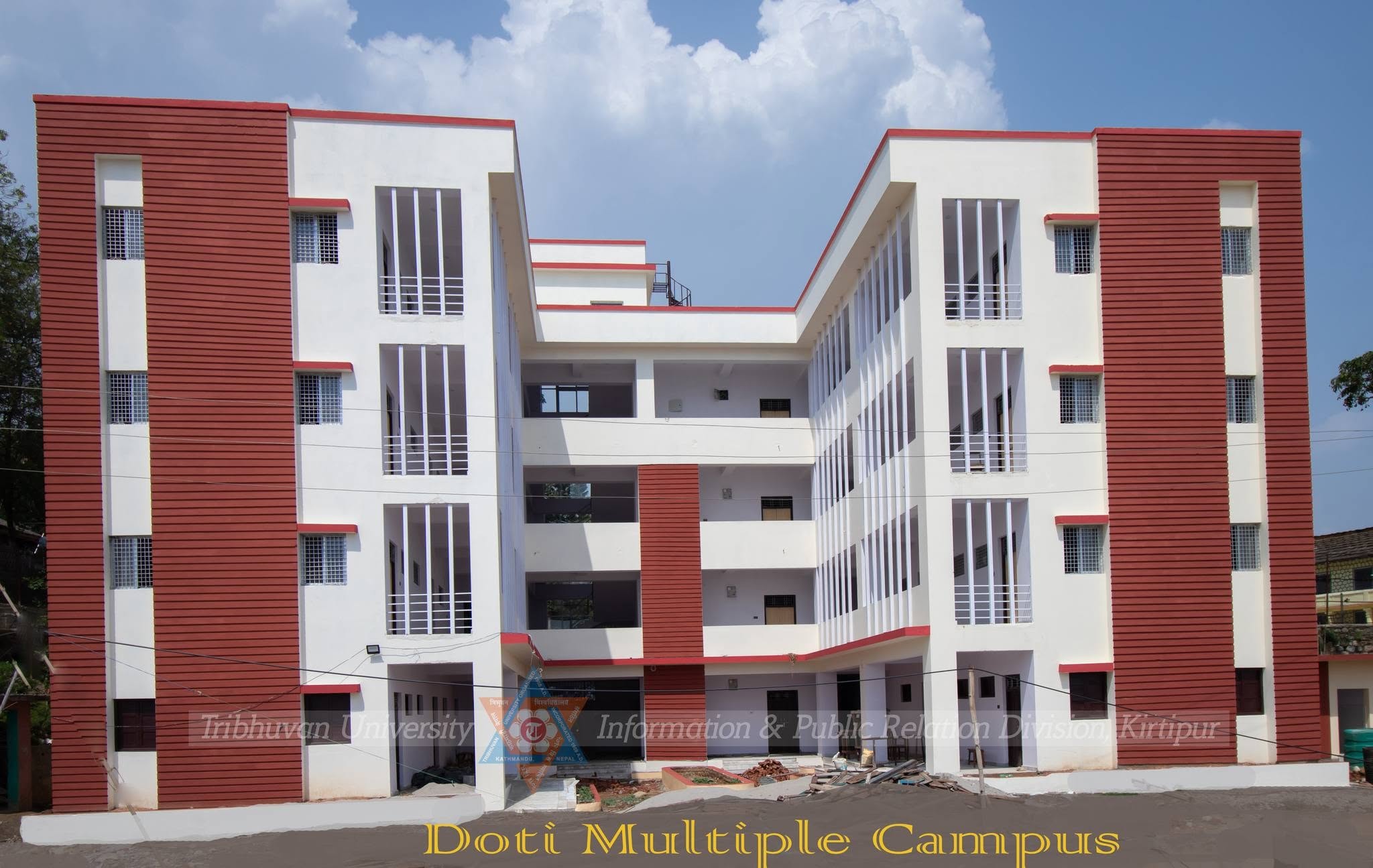
The Master of Arts in Sociology at Doti Multiple Campus is a two-year postgraduate program under the Faculty of Humanities and Social Sciences, Tribhuvan University. It follows the semester system and combines sociological theory, qualitative and quantitative research, statistics, social change, development, inequality, gender, migration, institutions, and applied social analysis.
Doti Multiple Campus began master’s-level Sociology classes in the academic year 2070/071 B.S. The program now runs through four semesters and includes 18 taught papers and a compulsory thesis. Its academic structure gives students a grounding in major sociological perspectives while requiring sustained work in research methods, field-based inquiry, data analysis, academic writing, and independent research.
| Field | Details |
|---|---|
| Course Name | Master of Arts in Sociology |
| Common Name | MA in Sociology |
| College | Doti Multiple Campus |
| Affiliation | Tribhuvan University |
| Faculty | Faculty of Humanities and Social Sciences |
| Level | Master’s degree |
| Duration | 2 academic years |
| Academic System | Semester |
| Number of Semesters | 4 |
| Academic Components | 18 taught papers and a compulsory thesis |
| Assessment | 40% internal and 60% external |
| Attendance Requirement | 80% |
| Admission Basis | Entrance examination, merit list, and enrolment capacity |
| Location | Dipayal Silgadhi, Doti, Sudurpashchim Province |
Sociology examines social relationships, institutions, behaviour, structures, inequalities, conflicts, and cultural patterns. At the postgraduate level, students move beyond introductory descriptions of society and learn to examine social questions through established theoretical perspectives and systematic research methods.
The MA Sociology curriculum includes structural-functional, Marxist, world-system, micro-level, and macro-level approaches. These perspectives give students different ways to analyse social institutions, power, class, identity, change, and interaction.
Research is present throughout the program. Students study qualitative research, quantitative research, statistics, survey research, computer-based data analysis, research design, and academic writing. The fourth-semester thesis brings these areas together through an independent investigation.
Applied subject areas include caste and class, health, household and family, gender, identity, migration, ageing, disability, urban life, disaster, education, tourism, livelihoods, markets, governmentality, and development. The breadth of these areas allows students to connect sociological ideas with social conditions in Nepal and other societies.
The program is structured to develop current knowledge of sociological theories and research methods. It also provides training in fieldwork and secondary data analysis.
Its academic objectives include:
developing knowledge of major sociological theories and methods;
building research abilities through fieldwork and data analysis;
preparing human resources relevant to Nepal’s development needs;
encouraging attention to human rights and social justice; and
developing professional abilities in sociological theory and research.
The course treats sociology as both an academic discipline and a practical approach to understanding social problems, institutions, communities, and development processes.
MA Sociology may suit graduates interested in social research, human behaviour, institutions, inequality, development, public policy, communities, culture, or social change.
The program requires regular reading of sociological theories, participation in classroom discussion, term-paper writing, presentations, statistical study, research design, and independent academic work. Students should be prepared to work with both written social analysis and research data.
The course may be relevant to students interested in:
social and development research;
qualitative fieldwork;
surveys and statistical analysis;
social policy and institutions;
gender and inequality;
migration and urban change;
health, education, family, and community studies;
disaster and development studies; or
further academic research in sociology.
Because the curriculum includes statistics and computer data analysis, students should also be willing to engage with quantitative research rather than viewing sociology only as a theory-based subject.
Applicants holding a bachelor’s degree recognized by Tribhuvan University may be eligible when their previous study falls within one of the following groups.
Sociology
Anthropology
Social Work
Nepalese History, Culture and Archaeology
Psychology
History
Home Science
Geography
Economics
Political Science
Graduates from any discipline under the faculties of Education, Management, or Law may also apply.
Graduates from any discipline under the institutes of Medicine, Engineering, Forestry, Agriculture, or Animal Science are also included within the eligibility provisions.
Applicants must sit for a one-hour entrance examination conducted by the Office of the Dean, Faculty of Humanities and Social Sciences, Tribhuvan University.
A candidate who does not appear in the entrance examination or does not achieve the minimum qualifying score is not admitted. Selection is based on the merit list and the enrolment capacity of the concerned campus or department.
The program contains four semesters. Each taught course carries three credit hours, while the compulsory thesis carries six credit hours.
All five first-semester courses are required.
| Code | Course Title | Credit Hours |
|---|---|---|
| So561 | Introduction to Sociology | 3 |
| So562 | Qualitative Research Methods in Sociology | 3 |
| So563 | Structural-functional Approach | 3 |
| So564 | Caste and Class | 3 |
| So565 | Theories of Social Change and Development | 3 |
The first semester establishes the theoretical and methodological foundation of the program. Introduction to Sociology situates the discipline at an advanced academic level, while the Structural-functional Approach provides one of the major perspectives used to examine social systems and institutions.
Qualitative Research Methods introduces forms of inquiry based on social meaning, experience, observation, interviews, interpretation, and field-based evidence. Caste and Class focuses on social hierarchy and inequality, while Theories of Social Change and Development examines how societies transform and how development is understood sociologically.
The second semester contains two required courses and an optional group from which students select three courses.
| Code | Course Title | Credit Hours |
|---|---|---|
| So571 | Marxist Perspective | 3 |
| So572 | Quantitative Research Methods in Sociology | 3 |
| Code | Course Title | Credit Hours |
|---|---|---|
| So573 | Practice of Social Change and Development in Asia | 3 |
| So574 | Politics and Society: Interface between Nation, State and Globe | 3 |
| So575 | Sociology of Health | 3 |
| So576 | Household and Family in Transition | 3 |
The Marxist Perspective examines society through questions of class, material conditions, power, production, and historical change. Quantitative Research Methods introduces structured data collection, measurement, and numerical analysis in sociological study.
The optional courses allow students to focus on development in Asia, political and social relations across national and global contexts, health as a social institution, or changes taking place in households and families.
The third semester includes two required courses and seven optional courses. Students select three courses from the optional group.
| Code | Course Title | Credit Hours |
|---|---|---|
| So581 | World-System Perspective | 3 |
| So582 | Basic Statistics in Sociological Research | 3 |
| Code | Course Title | Credit Hours |
|---|---|---|
| So583 | Sociology of Gender | 3 |
| So584 | Identity, Inequality and Intersectionality | 3 |
| So585 | Migration, Social Network, Remittance and Development | 3 |
| So586 | Sociology of Ageing and Disability | 3 |
| So587 | Power Leadership, Governmentality, and Development | 3 |
| So588 | Urban Sociology | 3 |
| So589 | Sociology of Disaster | 3 |
The World-System Perspective examines connections among societies within wider historical and economic systems. Basic Statistics in Sociological Research prepares students to organize, interpret, and use numerical evidence in research.
The optional group addresses several contemporary areas of sociological study. Students may focus on gender, overlapping forms of identity and inequality, migration and remittance, ageing and disability, power and governmentality, urban life, or disaster.
The final semester includes two required taught courses, a compulsory thesis, and one optional course.
| Code | Course Title | Credit Hours |
|---|---|---|
| So591 | Agency/Micro versus Structure/Macro Perspectives | 3 |
| So592 | Survey Research and Computer Data Analysis (Practical) | 3 |
| So593 | Thesis | 6 |
| Code | Course Title | Credit Hours |
|---|---|---|
| So594 | Gender, Power and Sexuality | 3 |
| So595 | Changing Livelihoods | 3 |
| So596 | Market and Society | 3 |
| So597 | Sociology of Education | 3 |
| So598 | Sociology of Tourism | 3 |
| So599 | Research Design and Writing | 3 |
Agency/Micro versus Structure/Macro Perspectives examines the relationship between individual action and larger social structures. It brings together questions that appear throughout sociological theory: how far people shape society and how far institutions, norms, and social conditions shape people.
Survey Research and Computer Data Analysis is a practical course. It connects survey methods with the organization and analysis of research data using computers.
The optional group allows focused study in gender and power, changing livelihoods, markets, education, tourism, or research writing.
The thesis is a required fourth-semester component carrying six credit hours. It gives students an opportunity to conduct independent sociological research using the theories and methods studied throughout the program.
Thesis work brings together topic selection, research design, literature review, data collection, analysis, academic writing, and the presentation of findings. Depending on the research question, students may work with qualitative evidence, quantitative evidence, or a suitable combination of methods.
The thesis distinguishes the program from a postgraduate course based only on classroom papers. It requires students to formulate and complete a sustained investigation rather than relying entirely on semester examinations.
Student evaluation is divided into internal and external components.
| Assessment Component | Weight |
|---|---|
| Internal Evaluation | 40% |
| External Evaluation | 60% |
The 40-mark internal evaluation consists of:
| Internal Activity | Marks |
|---|---|
| Class Attendance | 10 |
| Participation, Discussion and Presentation with Précis | 10 |
| Term Paper Writing | 10 |
| Written Class Test | 10 |
| Total | 40 |
The Dean’s Office conducts the 60-percent external evaluation through the final written examination. For practical courses, the external component is conducted practically in the computer laboratory.
This assessment pattern gives regular academic work a defined place in each semester. Attendance, participation, presentation, term-paper writing, and class tests contribute directly to the final evaluation rather than serving only as informal classroom activities.
A university examination is held at the end of each semester, approximately every six months.
Students must maintain 80 percent class attendance. The attendance requirement is part of the program’s academic rules and is also reflected in the internal evaluation, where attendance carries ten marks.
The course operates within a campus environment that supports postgraduate reading, writing, presentations, and research. Teaching methods used at Doti Multiple Campus include lectures, discussions, projects, question-and-answer sessions, report writing, field visits, resource-person sessions, role-play, and investigative activities.
Multimedia projectors and internet-based resources are used according to the needs of the course and classroom activity.
The campus library holds textbooks, reference books, academic journals, master’s-level theses, and report-writing resources. Its electronic library is equipped with computers and connected with Tribhuvan University Central Library and other library networks, allowing students and teachers to study and download academic materials.
The DMC Research Center, Research Management Cell, journals, and faculty involvement in social research also provide an institutional setting relevant to Sociology students. Faculty members participate in social research activities and may serve as subject experts for local governments.
Through theory courses, research methods, statistics, term papers, presentations, practical data analysis, and thesis work, students may develop abilities in:
sociological analysis;
qualitative research;
quantitative research;
survey design;
fieldwork and data collection;
basic statistical analysis;
computer-based data analysis;
academic and research writing;
literature review;
term-paper preparation;
classroom presentation and discussion;
examination of institutions and social structures;
analysis of inequality, identity, gender, and class; and
interpretation of development and social change.
The depth of these abilities depends on regular academic participation, reading, field engagement, research practice, and the quality of the student’s thesis.
Graduates may explore work connected with social research, social services, education, public policy, development activities, community programs, and organizations that examine social behaviour or institutional issues.
The curriculum is also relevant to research roles that require fieldwork, statistics, survey methods, report writing, and applied social analysis. Further academic study may focus on Sociology or related areas of social research.
Career outcomes depend on research competence, writing ability, experience, additional qualifications, the requirements of individual organizations, and available opportunities.
The program runs for two academic years and is divided into four semesters.
MA Sociology at Doti Multiple Campus operates under the Faculty of Humanities and Social Sciences, Tribhuvan University.
Students complete 18 taught papers and a compulsory thesis across four semesters.
Eligible applicants include graduates of specified humanities and social science subjects, graduates from the faculties of Education, Management, and Law, and graduates from disciplines under several professional and technical institutes recognized by Tribhuvan University.
Yes. Applicants must sit for a one-hour entrance examination conducted by the Office of the Dean, Faculty of Humanities and Social Sciences.
Admission is based on the entrance merit list and the enrolment capacity of the campus or department.
Internal evaluation carries 40 percent, while the external semester examination carries 60 percent.
Internal evaluation includes attendance, classroom participation and presentation, term-paper writing, and a written class test.
Yes. Students must maintain 80 percent class attendance.
Yes. The curriculum includes Basic Statistics in Sociological Research and Survey Research and Computer Data Analysis as a practical course.
Yes. Students complete a six-credit thesis in the fourth semester.
College: Doti Multiple Campus
Affiliation: Tribhuvan University
Location: Dipayal Silgadhi, Doti, Sudurpashchim Province, Nepal
Phone: +977-94-411110, +977-94-411159
Email: info@domc.tu.edu.np
Website: https://domc.tu.edu.np






