The Bachelor of Education (B.Ed.) at Doti Multiple Campus is a four-year undergraduate program under the Faculty of Education, Tribhuvan University. It follows the annual academic system and combines communication courses, professional education studies, subject specialization, and teaching practice.
Doti Multiple Campus began its bachelor’s-level education program in 2057 B.S. The current four-year structure prepares students to study one specialization as a major and another as a minor, giving them academic preparation in two teaching areas. The program carries 2,200 marks and requires students to complete 22 courses, including a final-year teaching practicum.
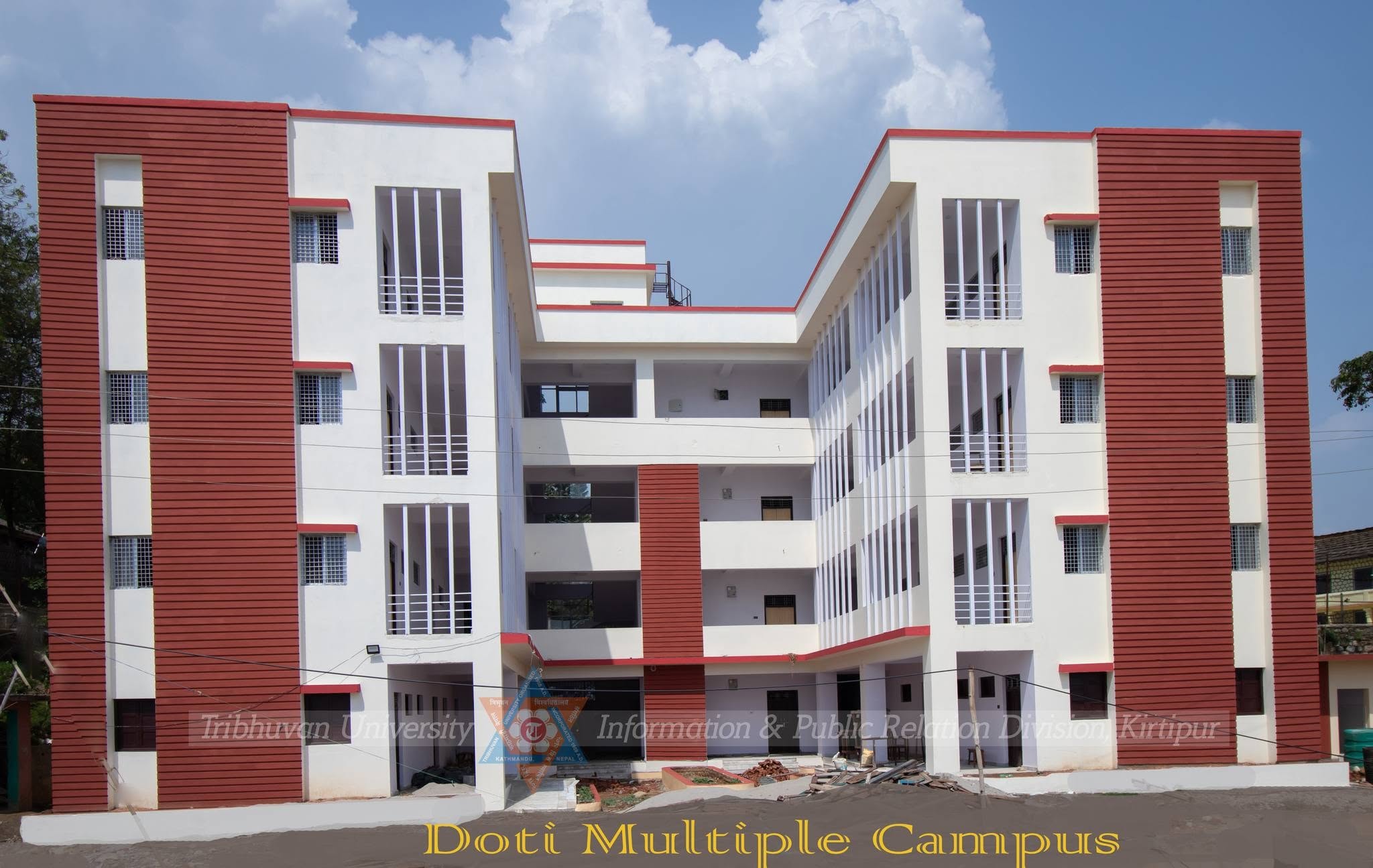
| Field | Details |
|---|---|
| Course Name | Bachelor of Education |
| Abbreviation | B.Ed. |
| College | Doti Multiple Campus |
| Affiliation | Tribhuvan University |
| Faculty | Faculty of Education |
| Level | Bachelor’s degree |
| Duration | 4 academic years |
| Academic System | Annual |
| Total Courses | 22 |
| Total Marks | 2,200 |
| Specialization Structure | One major and one minor |
| Practical Component | Teaching Practice/Practicum |
| Location | Dipayal Silgadhi, Doti, Sudurpashchim Province |
The four-year B.Ed. is both an academic and professional education program. It is designed to prepare students to teach two subjects at the secondary level by combining a specialization major with a different specialization minor.
The program does not focus only on subject knowledge. Students also study educational philosophy, sociology, psychology, curriculum, evaluation, instructional technology, and information and communication technology. These areas help learners understand how teaching is planned, how students learn, how curricula are organized, and how classroom performance can be assessed.
Teaching practice in the fourth year connects the academic component with classroom work. The overall structure therefore combines language and communication, professional education, subject specialization, technology-related learning, and practicum experience.
The program may suit students interested in teaching, education, subject-based instruction, classroom communication, curriculum, and the study of learning processes.
It involves reading, writing, presentations, subject study, lesson-related preparation, classroom participation, project work, and practical teaching. Students selecting the program should consider both their interest in education and the academic requirements of their intended specialization.
A major subject receives greater curricular weight, while the minor provides preparation in a second area. Choosing the two subjects carefully is important because the combination shapes much of the student’s study across all four years.
Applicants who have passed the Higher Secondary Education Examination, Grade 12, Tribhuvan University’s Proficiency Certificate Level, or an equivalent qualification may apply for admission.
Eligibility for a specialization major depends on the subject studied at the higher secondary or PCL level.
Nepali Education: Grade 12, HSE, or PCL with Nepali as a major subject carrying at least 200 marks.
English Education: Grade 12, HSE, or PCL with English or Linguistics as a major, or at least 50 percent in General English. Applicants may also qualify by securing 50 percent in an entrance examination conducted by the concerned campus department.
Mathematics Education: Grade 12, HSE, or PCL with Mathematics as a major subject carrying at least 200 marks.
Population Education: Prior study may include Population Studies, Geography, Economics, Health and Physical Education, Community Health, Science, Mathematics, Home Science, Civics, Social Service, Nursing, or Commerce.
Economics Education, Political Science Education, and History Education: Grade 12, HSE, PCL, or an equivalent qualification from any faculty.
Most minor subject areas are open regardless of the student’s Grade 11, Grade 12, or PCL study area. The minor must be different from the major.
The education subject base at Doti Multiple Campus includes:
English;
Nepali;
Economics;
Mathematics;
Political Science;
History;
Population; and
Health Education.
The program also includes compulsory English, Nepali, and professional education courses. Major and minor selection follows the Tribhuvan University curriculum and the subject combinations operating through the campus.
The curriculum is organized into five academic groups.
| Course Group | Number of Courses | Full Marks |
|---|---|---|
| Communication Skills | 2 | 200 |
| Professional Core Areas | 4 | 400 |
| Specialization Major | 10 | 1,000 |
| Specialization Minor | 5 | 500 |
| Teaching Practice/Practicum | 1 | 100 |
| Total | 22 | 2,200 |
Communication Skills includes General Nepali and General English. The professional core component covers Philosophical and Sociological Foundations of Education, Educational Psychology, Curriculum and Evaluation, and one technology-related elective.
The elective may be selected from Instructional Technology, ICT in Education, or ICT in a Specialized Subject.
The first year carries 600 marks. Students study:
General Nepali;
General English;
Philosophical and Sociological Foundations of Education;
two major specialization courses; and
one minor specialization course.
The year establishes communication skills, educational foundations, and introductory knowledge in both selected teaching subjects.
The second year also carries 600 marks. It includes:
Educational Psychology;
three major specialization courses; and
two minor specialization courses.
Educational Psychology examines learning and learner development, while the specialization courses extend subject knowledge in the major and minor areas.
The third year carries 500 marks. Students complete:
Curriculum and Evaluation;
three major specialization courses; and
one minor specialization course.
Several specialization areas introduce subject-teaching methods during this stage. Examples include English Language Teaching Methods, Teaching Mathematics, Teaching Science, and subject-specific educational approaches.
The final year carries 500 marks and includes:
Teaching Practice;
one professional elective;
two major specialization courses; and
one minor specialization course.
The professional elective focuses on instructional technology or ICT. The specialization courses continue advanced subject study, while Teaching Practice forms the principal practical component of the degree.
The major specialization contains ten courses carrying 1,000 marks. It forms the largest component of the degree and develops both subject knowledge and subject-teaching preparation.
Under the Tribhuvan University structure, major specialization areas include:
Nepali Language Education;
English Language Education;
Mathematics Education;
Science Education;
Health and Physical Education;
Population Education;
Geography Education;
Economics Education;
History Education; and
Political Science Education.
The minor specialization contains five courses carrying 500 marks. Students must select a minor different from their major. The broader university framework includes language, mathematics, science, health, physical education, population, geography, economics, history, and political science education among its minor areas.
The professional core courses provide a common educational foundation regardless of specialization.
This course connects education with philosophical ideas and social institutions. It helps students examine the purposes of education and the relationship between schooling and society.
Educational Psychology focuses on learners, learning processes, development, motivation, and classroom-related psychological concepts.
This course introduces curriculum organization and the assessment of learning. It supports students in understanding how educational content is planned and how learner progress is evaluated.
In the fourth year, students select Instructional Technology, ICT in Education, or ICT in a Specialized Subject. This component connects teaching with instructional resources and technology-supported learning.
Teaching Practice is a compulsory fourth-year course carrying 100 marks. It places practical teaching within the academic structure rather than treating it as a separate optional activity.
The practicum allows students to connect educational theory, subject knowledge, teaching methods, planning, classroom communication, and evaluation. It also gives the major and minor specialization structure a practical purpose, since the degree is designed to prepare students for teaching two subjects at the secondary level.
The campus uses several teaching methods across its academic programs. These include:
lectures;
classroom discussion;
project work;
role-play;
question-and-answer sessions;
report writing;
field visits;
resource-person sessions; and
investigative activities.
Multimedia projectors, internet resources, and other digital tools are used according to instructional needs. These approaches are relevant to B.Ed. because education students study both academic content and the methods used to communicate that content in a classroom.
Students have access to the campus library and electronic library. The library contains books, journals, reference materials, theses, and report-writing resources.
The electronic library is equipped with computers and connected with Tribhuvan University Central Library and other library networks. Campus resources also include computers, laptops, multimedia projectors, printers, internet services, classrooms, conference halls, and a training hall.
Boys’ and girls’ hostel facilities are available for students requiring accommodation.
The abilities developed through the program depend on the selected specializations, participation, teaching practice, and academic performance. Students may strengthen:
subject-based teaching knowledge;
classroom communication;
educational planning;
understanding of learner psychology;
curriculum interpretation;
assessment and evaluation;
lesson-related preparation;
academic reading and writing;
presentation and discussion;
report and project preparation;
use of instructional technology; and
reflective understanding of teaching practice.
The B.Ed. curriculum is designed to prepare students to teach two subjects at the secondary level. Graduates may consider teaching-related work, educational services, training activities, or further academic study connected with education and their specialization areas.
Career direction depends on subject selection, academic performance, practical teaching ability, communication skills, recruitment requirements, further qualifications, and available opportunities.
Students choosing between major and minor subjects should consider their Grade 12 background, subject interest, teaching goals, and plans for further study.
Applicants seeking bachelor’s-level admission at Doti Multiple Campus are expected to prepare:
passport-size photograph;
SLC or SEE marksheet;
SLC or SEE character certificate;
SLC or SEE provisional certificate;
Grade 12 or +2 marksheet or transcript;
Grade 12 or +2 character certificate;
Grade 12 or +2 provisional certificate; and
original migration certificate.
The program runs for four academic years and follows the annual system.
The B.Ed. at Doti Multiple Campus operates under the Faculty of Education, Tribhuvan University.
Students must complete 22 courses carrying a total of 2,200 marks.
Yes. Students select one specialization as a major and a different specialization as a minor.
The campus’s education subject base includes English, Nepali, Economics, Mathematics, Political Science, History, Population, and Health Education.
Yes. Teaching Practice is a compulsory fourth-year course carrying 100 marks.
The professional core includes Philosophical and Sociological Foundations of Education, Educational Psychology, Curriculum and Evaluation, and a technology-related elective.
Grade 12, HSE, PCL, or equivalent graduates may apply. Major specialization eligibility depends on the applicant’s previous subject background.
College: Doti Multiple Campus
Affiliation: Tribhuvan University
Location: Dipayal Silgadhi, Doti, Sudurpashchim Province, Nepal
Phone: +977-94-411110, +977-94-411159
Email: info@domc.tu.edu.np
Website: https://domc.tu.edu.np